


The multivitamin market is full of contradictions. On one side, there are "all-in-one" products with 30, 40, or even 50 ingredients promising to solve everything at once in a single capsule. On the other side, there are spartan products with barely measurable amounts that are cheap but hardly make a difference. In between: a lot of confusion and uncertainty.
Hardly anyone asks the real question: What should a good multivitamin complex actually accomplish? And what should it perhaps deliberately not do?
This guide gives an honest answer. It explains which nutrients belong in an everyday foundational supply, which have no business being there, and why the decision not to include something is just as important as the decision about what goes in.
Why a multivitamin at all?
If you eat a balanced diet (whole grains, legumes, plenty of vegetables, nuts, fish, and dairy every day), you cover most of your micronutrient needs through food. The problem: the dietary reality of most people looks different.
Lack of time, convenience food, changing work schedules, frequent travel, stress, or simply the habit of always buying the same foods. The result is that certain micronutrients become chronically scarce. Not dramatically scarce, not pathologically, but below the level at which the body works optimally over the long term.
According to Germany's National Nutrition Survey II, the nutrients most commonly undersupplied in the adult population are vitamin D, folic acid, iodine, calcium, iron (especially in women), and the vitamins B1, B2, and B12 in vegan or very one-sided diets. What this means specifically for people on a vegan diet is explained in the article Vegan multivitamin: closing nutrient gaps the right way.
A multivitamin complex closes these gaps. Not as a replacement for a good diet, but as a reliable counterbalance to everyday reality. That is its legitimate use case.
What a multivitamin explicitly is not: a way to compensate for a poor diet, a performance booster, or a guarantee of well-being. Anyone who promises that is exaggerating. Anyone who expects it sets themselves up for disappointment.
For more on whether and when a multivitamin makes sense for you, see our article on taking a multivitamin daily. If you exercise regularly, you will find more specific information in the article Multivitamins in sports.
Single supplements or a complex: which is better when?
This question has no universal answer. But there are clear guidelines.
Single supplements are better when:
- a specific, diagnosed deficiency exists (e.g. a vitamin D deficiency in your blood work)
- a nutrient is needed in therapeutic amounts beyond normal foundational supply
- a targeted, time-limited supplementation is planned
- interactions with medications or medical conditions require individual adjustment
A multivitamin complex is better when:
- a general, broad foundational supply is the goal
- the effort of managing ten different single products is out of proportion to the benefit
- daily routine and everyday practicality matter more than maximum individualization
- your diet is solid but not gap-free
Combining both approaches, meaning a sensibly formulated base plus targeted additions for specific needs, is what makes the most sense for most people. When a combination product is the smarter choice, and when it is not, is covered in the comparison: single vitamin or multivitamin.
What makes a good multivitamin?
Before discussing what belongs in a multivitamin, we need criteria. The most important ones:
1. Bioactive or highly available forms
The same nutrient can come in completely different forms, with a significant difference in how well the body absorbs it.
An example: vitamin B12. Most inexpensive products contain it as cyanocobalamin, a synthetic form the body first has to convert into the active form (methylcobalamin) in several steps. Methylcobalamin is directly available and is the naturally occurring form in the human body.
The same applies to folate: synthetic folic acid has to be enzymatically converted into the active form 5-methyltetrahydrofolate (5-MTHF). In a relevant share of the population (people with certain MTHFR gene variants), this conversion runs inefficiently. Quatrefolic® 5-MTHF, for example, is the already active form.
With minerals: chelates, meaning compounds in which the mineral is bound to an amino acid (e.g. zinc bisglycinate instead of zinc oxide), are generally better absorbed and cause less gastrointestinal irritation.
The choice of form is not marketing. It determines what actually arrives in the body.
2. Doses that make sense
Two extremes are equally worthless: products with symbolically low amounts (5% NRV for a vitamin that is rarely supplied through everyday diet) and products that dose everything excessively high because "more can't hurt."
The latter in particular is wrong. Fat-soluble vitamins like A, D, E, and K can accumulate in the body because they are not simply excreted. Permanently extreme doses are therefore not a neutral matter. For water-soluble vitamins like vitamin C or B vitamins, the body does excrete excess amounts, but that just means a large part of the product literally ends up in the wastewater. What really happens when you take too much is explained in our article on multivitamin side effects and overdose.
A well-formulated multivitamin is guided by the reference values (NRV, Nutrient Reference Value) and the current recommendations of the scientific bodies (EFSA, DGE, D-A-CH). The goal is a reliable daily supply, not a competition for the highest number on the package.
3. No unnecessary additives
Sweeteners, colorings, flavors, cheap fillers: in a product taken daily, these are not minor details. A good multivitamin contains exactly what is on the label, and nothing else. Transparent formulations without blend marketing (meaning no hidden mixtures behind meaningless collective names) are the absolute minimum. How to assess the quality of a multivitamin before buying is explained in our guide: recognizing multivitamin quality.
4. Accounting for timing and absorption requirements
This is the point where many "all-in-one" products fail. More on that in a moment.
What has no business being in a multivitamin?
This is the truly interesting question. A multivitamin that is genuinely good is defined not only by what is in it, but just as much by what is deliberately missing.
Vitamin D
Vitamin D is fat-soluble. That means: without fat in the meal, it is absorbed considerably less well. If you take vitamin D in the morning on an empty stomach, or with a carb-heavy breakfast without any fat, you fail to absorb a substantial part of your dose.
On top of that, individual vitamin D needs vary considerably. People who spend a lot of time outdoors have a completely different status in summer than someone who works mostly in an office. People with darker skin produce less vitamin D at the same sun exposure. Someone with a diagnosed deficiency needs different amounts than someone supplementing for prevention.
Including vitamin D in a multivitamin means either adapting the timing of the entire product to vitamin D's absorption requirements, or simply ignoring the problem, which is exactly what many manufacturers do.
The cleaner solution: vitamin D as its own product, taken with the right meal and individually dosable.
Omega-3 fatty acids
Omega-3 in a multivitamin complex sounds comprehensive. In practice, it is often pointless: the amounts that fit into a capsule alongside countless other nutrients are far too small for a meaningful DHA/EPA supply. A relevant daily dose of omega-3, for example from algae oil (e.g. 400-500 mg DHA), simply needs more space.
Add to that the same timing argument as with vitamin D: omega-3 fatty acids are absorbed considerably better with a meal containing fat. A multivitamin designed for morning intake even without a fat-rich meal is structurally incompatible with omega-3.
Omega-3 as a standalone product with an adequately dosed daily amount, taken with the right meal, makes far more sense than a token omega-3 share in an all-in-one capsule.
Magnesium
Magnesium is one of the most commonly supplemented minerals of all, and at the same time one of the most commonly supplemented incorrectly or ineffectively. There are two reasons.
First: to deliver a meaningful daily magnesium dose (200 mg of elemental magnesium is a realistic guide value for supplementation), you need considerably more capsule mass than fits in a mini multivitamin capsule. What appears as "magnesium" in a multivitamin is usually so little that it hardly makes a difference.
Second: magnesium has a clear character as an evening nutrient. Magnesium contributes to normal muscle function and to normal functioning of the nervous system, qualities that are particularly relevant at the end of a long day. From a practical standpoint, taking it in the evening as part of a daily wind-down routine makes far more sense than in the morning with the multivitamin.
A product that delivers magnesium in a meaningful amount and optimal form, designed for evening intake, accomplishes more than magnesium as a stopgap in an all-in-one capsule.
Iron
Iron is missing entirely from many multivitamins, and for many products that is the right decision. Iron needs vary widely: women of childbearing age often have elevated needs due to menstrual losses, while men and postmenopausal women often need no supplementation at all. Supplementing too much iron risks accumulation, which can be problematic.
Iron does not belong in a one-size-fits-all daily product taken identically by all adults. If anywhere, it belongs in an individual strategy based on blood work. What this means specifically for women, and which nutrients matter most in a woman's foundational supply, is explained in the article Multivitamins for women.
Calcium
Calcium is indispensable for bone health but is missing from most multivitamin complexes for good reason. The daily requirement is 800 mg, so a meaningful supplementation amount sits in the three- to four-digit milligram range. That simply does not fit into a capsule that is also supposed to deliver numerous other nutrients. The amount of calcium that does fit into such a capsule is too little to be relevant.
Nutrient amounts and interactions: what you should know
Nutrients do not work in isolation. Some reinforce each other, others compete for the same absorption pathways. A few of these relationships matter when judging a multivitamin.
Zinc and copper compete for absorption in the gut. Very high zinc doses can permanently inhibit copper absorption and lead to a copper deficiency. In a well-formulated complex, the ratio of the two minerals should be balanced, and neither amount excessively high.
Fat-soluble vitamins (A, D, E, K) need dietary fat for good absorption. A product containing these vitamins should either be taken with a meal containing fat or, as with a multivitamin that can also be taken on an empty stomach, include a fat-based carrier that supports absorption.
B vitamins work synergistically. They are involved in the same metabolic pathways and reinforce each other's function. That is an argument for including B vitamins as a group, not individual B vitamins at high doses while leaving others out entirely.
Vitamin C and non-heme iron: Vitamin C improves the absorption of plant-based iron from food. That is a nice synergy effect at mealtime, but less relevant for the supplementation logic itself if the product contains no iron.
Vitamins B2 and B6 are involved in activating other B vitamins. B2 (riboflavin) supports the conversion of B6 into its active form. That is a functional argument for keeping the B complex complete and not isolating individual B vitamins at extreme doses.
The takeaway for judging a multivitamin: a product containing all B vitamins in balanced amounts is preferable to one that doses individual B vitamins extremely high and neglects others. Balance beats maximization.
Which vitamins and minerals belong in a foundation?
Based on the considerations so far, a clear picture emerges: a solid everyday multivitamin should contain the water-soluble vitamins (above all the B complex and vitamin C), vitamin E as a fat-soluble antioxidant, vitamin A for vision, the immune system, and skin, plus selected trace elements and minerals: in bioactive forms, at balanced doses, without redundancies.
What can, or perhaps even should, stay out structurally: vitamin D (better as a separate product with an individual dose), omega-3 (better as its own product with different timing), magnesium (as a product for the evening routine with a correspondingly higher daily dose), calcium and iron (as standalone products with an individual strategy).
What also does not belong: anything that only looks good on the package. Exotic extracts without a clear function, double or triple NRV values for nutrients that deserve no special treatment, and proprietary blends that obscure how much of what is really included.
For more on which nutrients support your body daily and which symptoms can point to supply gaps, see our articles on vitamins and minerals for everyday life and on recognizing vitamin deficiency. You can also find out here whether a multivitamin makes sense as a foundation for you.
BASE: the consistent answer
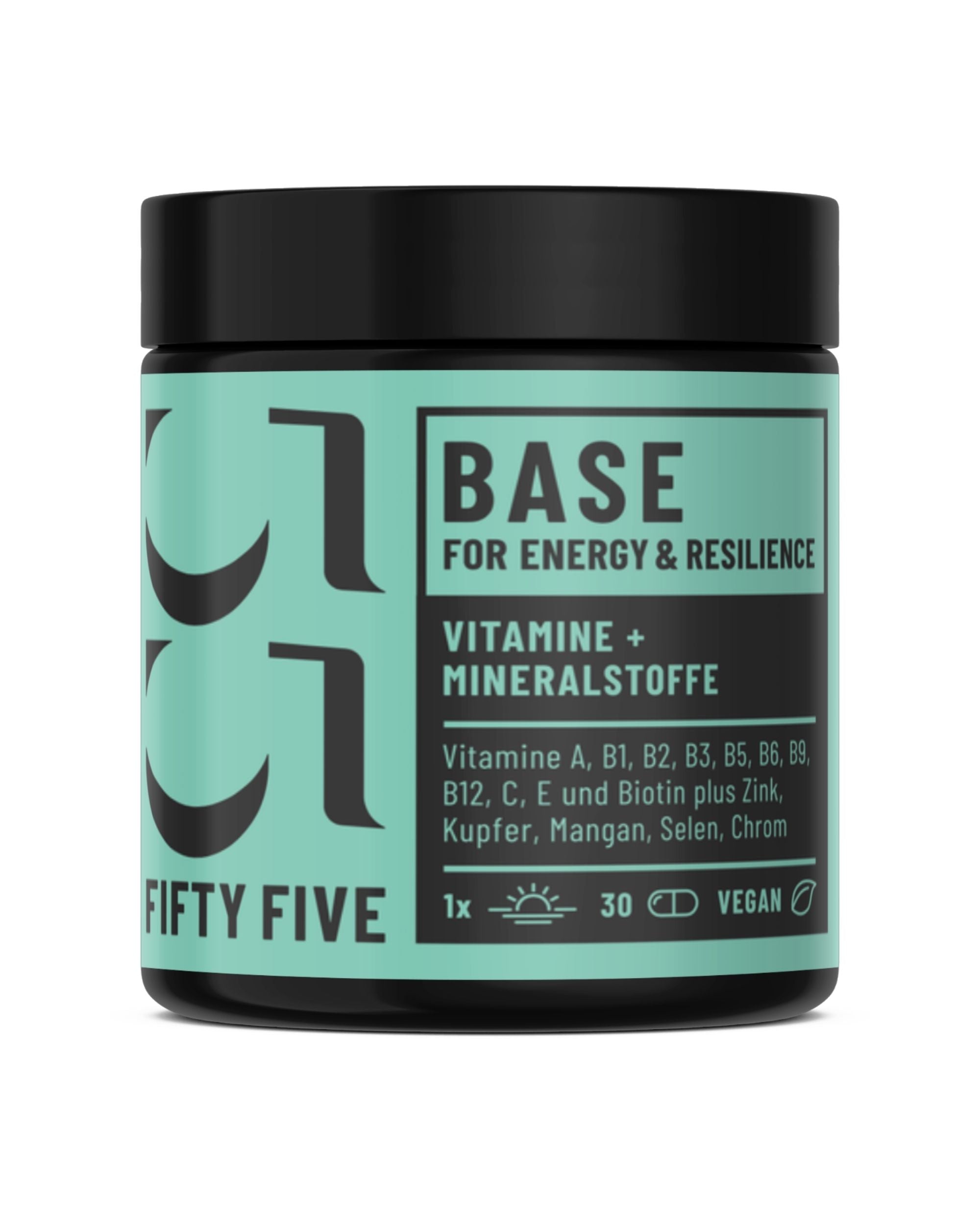
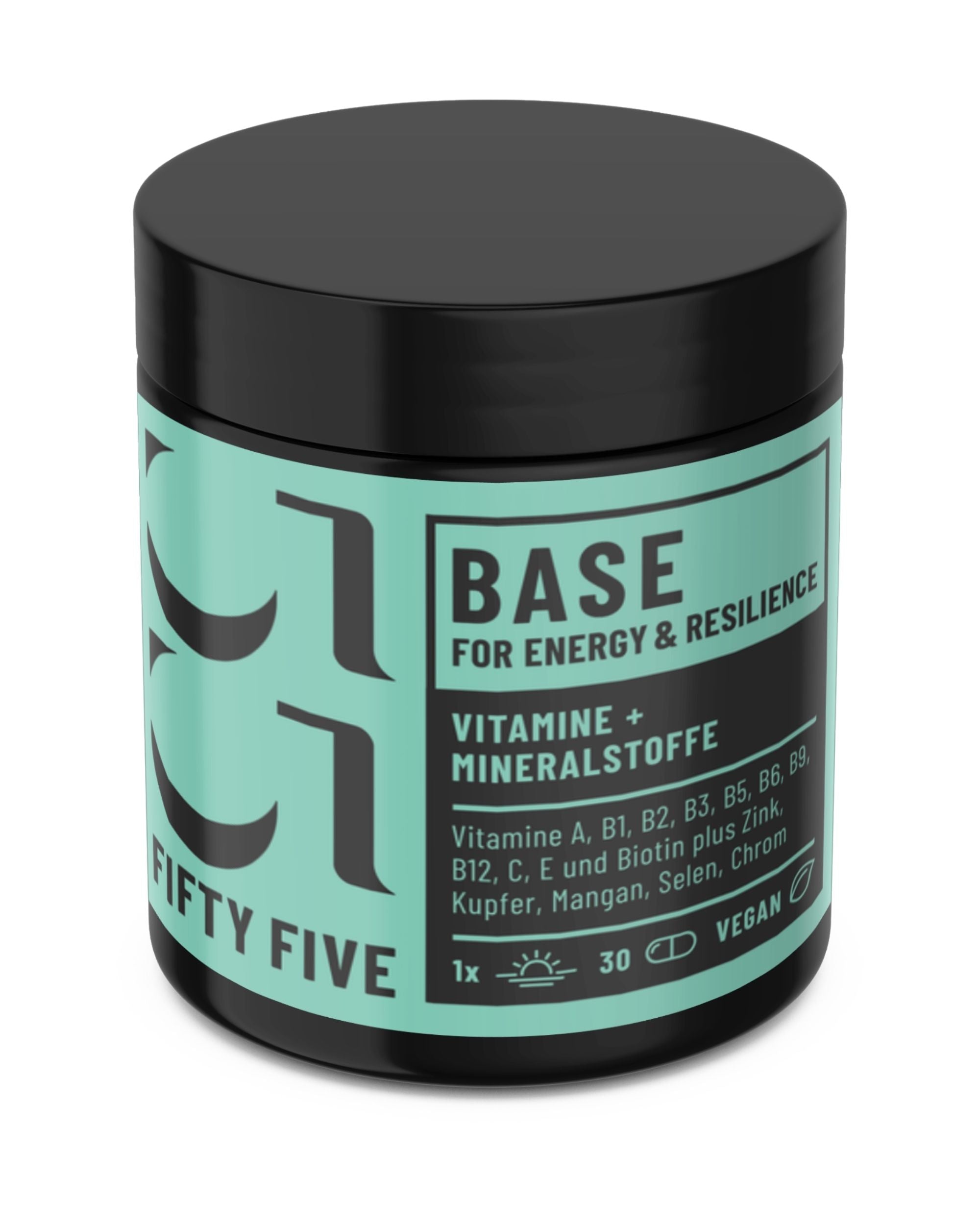
BASE by Fifty Five was created from exactly this clear logic.
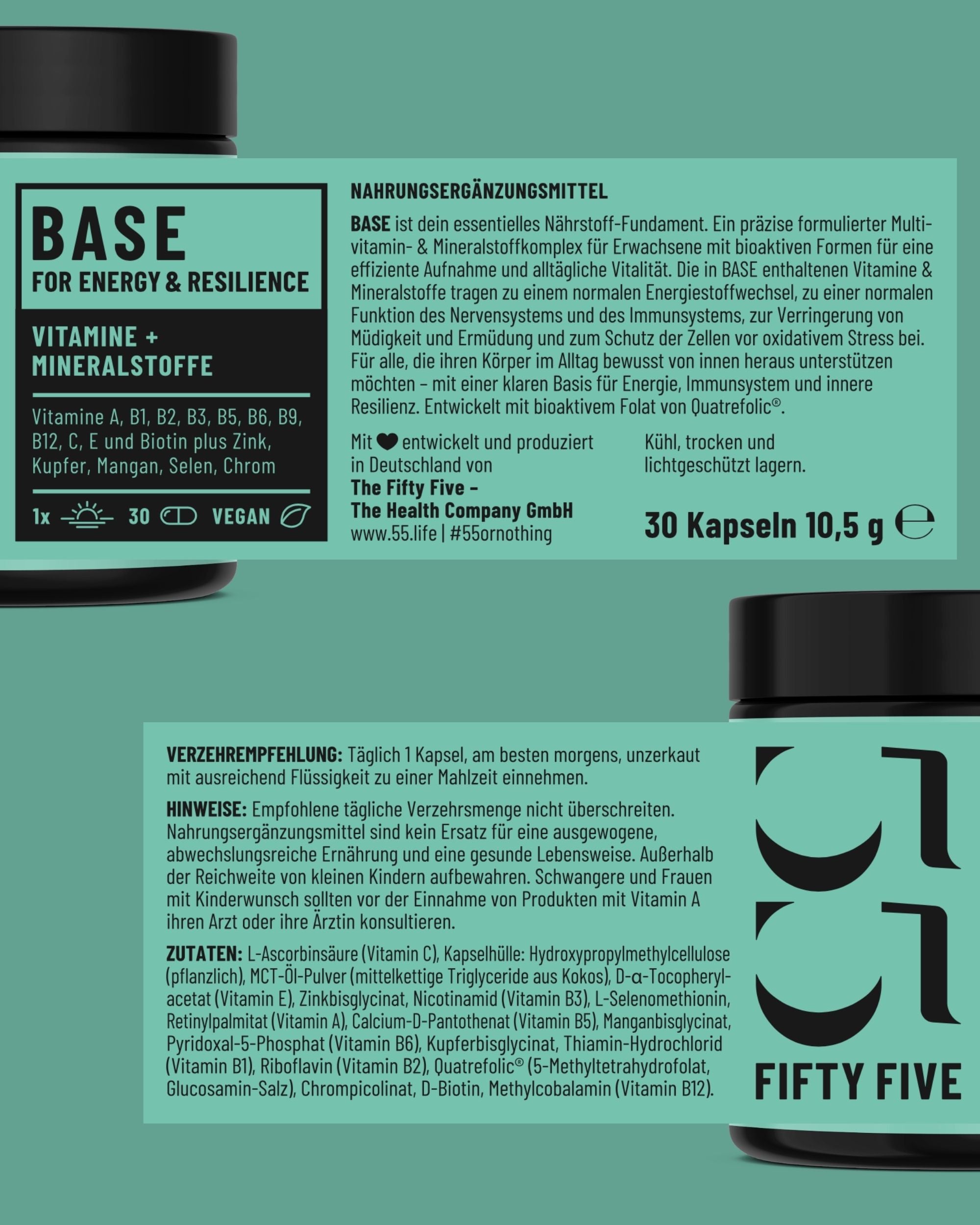
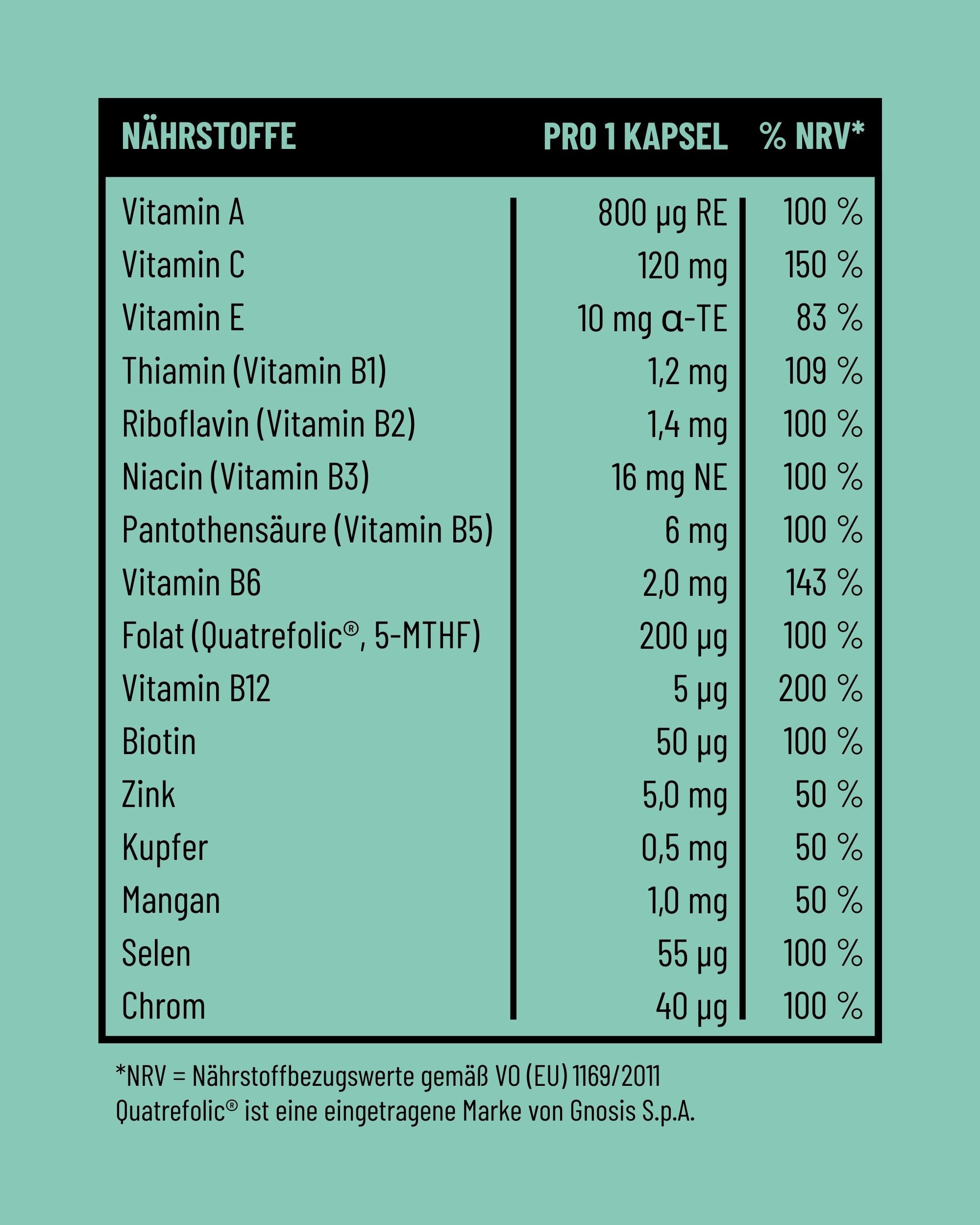
16 micronutrients in bioactive, highly available forms. No more, no less. No vitamin D (that is covered by RISE, with an appropriately matched daily dose). No magnesium (that is what CALM is for, in the evening, as a standalone product). No omega-3 (complemented by PULSE, a vegan omega-3 rich in EPA & DHA). No iron, no calcium.
Instead: all eight B vitamins, including the bioactive forms of B6 (pyridoxal-5-phosphate), folate (Quatrefolic® 5-MTHF), and B12 (methylcobalamin). Vitamins C and E for antioxidant protection, vitamin A for vision, skin, and the immune system. Zinc, copper, and manganese as chelates for good absorption and tolerability. Selenium as L-selenomethionine. Chromium for carbohydrate metabolism.
The vitamin E in BASE comes with an MCT oil carrier in the capsule, a technological building block that ensures the fat-soluble vitamin can be absorbed well even without a fat-containing meal. BASE is therefore designed for morning intake and can be taken on an empty stomach or with a light breakfast.
The doses range between 50 and 200 percent of the NRV: no symbolically low amounts, but no wildly exaggerated high-dose escalation either. Foundation over maximum. Substance over hype.
If you combine BASE with CALM, RISE, and PULSE, you cover the most important supply levels of everyday life, with each product in its right place, at the right time, in the right amount.
Taking a multivitamin: what is useful to know in practice
Timing: A multivitamin containing vitamin A, E, and B vitamins in balanced amounts can be taken in the morning, with or without a fat-containing meal. The fat-soluble vitamins A and E are secured by a carrier in the capsule. Exactly when the best time is, and which intake mistakes to avoid, is explained in the article Multivitamin: when to take it.
Consistency beats perfection: A multivitamin helps most when taken daily. A forgotten capsule on Tuesday is no catastrophe. A three-week break is more of one.
Interactions with medications: If you take medications long-term, always clarify supplements with your doctor's office or pharmacy. Certain medications can affect the absorption of micronutrients, and vice versa.
No substitute for diagnostics: If you have specific symptoms suggesting a nutrient deficiency, have it clarified through blood work, not through blanket supplementation. A multivitamin covers everyday gaps, not a diagnosed deficit.
FAQ
What should a good multivitamin contain?
A solid multivitamin contains all eight B vitamins (incl. folate and B12 in bioactive forms), vitamins C and E for antioxidant protection, vitamin A, and important trace elements like zinc, selenium, copper, manganese, and chromium. The forms should be bioavailable, the doses balanced, neither symbolically low nor excessively high.
Why does a good multivitamin contain no vitamin D?
Vitamin D is fat-soluble and is poorly absorbed without fat in the meal. A multivitamin designed for morning intake even without a fat-rich meal is a poor fit for vitamin D. On top of that, individual vitamin D needs vary widely, and an individually dosable solution makes more sense than a fixed share in a do-it-all tablet.
Why is the magnesium in most multivitamins useless?
Two reasons: First, no meaningful amount of magnesium fits into a multivitamin capsule without making the capsule impractically large. Second, magnesium is far better positioned for evening intake as a nervous system and muscle supporter than as a morning product. In a complex taken in the evening as a wind-down routine, magnesium at a meaningful dose makes far more sense.
What is the difference between folic acid and 5-MTHF?
Synthetic folic acid has to be enzymatically converted in the body into the active form 5-methyltetrahydrofolate (5-MTHF). In a relevant share of the population (people with certain MTHFR gene variants), this conversion runs inefficiently. 5-MTHF is the already active form and is directly available to the body. High-quality multivitamins therefore use the methylated form.
Why chelates instead of simple mineral salts?
Chelates are mineral compounds in which the mineral is bound to an amino acid (e.g. zinc bisglycinate instead of zinc oxide). This form is generally better absorbed, gentler on the gastrointestinal tract, and causes less irritation, which is especially relevant for daily intake over longer periods.
How long should I take a multivitamin?
With an everyday foundational supply, there is no reason for time limits. If you take a product daily that is formulated within sensible dosing limits, you can do so permanently. More important than a fixed duration is the question: does the product close real supply gaps, or are you only taking it because you once started?
Can I combine BASE with CALM, RISE, and PULSE?
Yes. The Fifty Five Daily Essentials are designed as a system. BASE delivers the micronutrient foundation (B vitamins, vitamins C/A/E, trace elements). CALM adds magnesium for the evening routine. RISE delivers vitamin D3 and K2. PULSE covers omega-3. The products barely overlap in content and are dosed so that combining all four does not push any nutrient into problematic ranges.
Disclaimer:
This article is for informational purposes only and does not replace medical advice, diagnosis, or treatment by a physician or pharmacist. The information provided here should not be used for self-diagnosis or self-treatment. Food supplements are no substitute for a balanced, varied diet and a healthy lifestyle. For any health questions or complaints, please always consult a doctor you trust. Fifty Five accepts no liability for any inconvenience or harm resulting from the use of the information presented here.
Sources
- German Nutrition Society (DGE). D-A-CH reference values for nutrient intake.
- EFSA. Dietary reference values (overview).
- German Federal Institute for Risk Assessment (BfR). Maximum levels for vitamins and minerals in food supplements.
- European Commission. EU Register of nutrition and health claims.
- Robert Koch Institute (RKI). DEGS – German Health Interview and Examination Survey for Adults.







Magnesium in Sports: Supporting Recovery & Avoiding Cramps
Vitamin D in Winter: Why Sunlight Is Not Enough and When Supplementation Kicks In
Share: