


Daily. Consistently. Regardless of whether your diet was good that day or not. That is the logic behind a daily multivitamin. Whether this logic applies to you hangs on a few questions that have little to do with frequency. What matters is how a product is formulated, which micronutrients it combines, and whether it is meant as a baseline supply or as a high-dose solution.
Exactly here, a lot of uncertainty arises in everyday life. Maybe you want to build a simple dietary routine, maybe you already use several supplements and wonder whether your stack is slowly becoming unmanageable. Maybe you are simply looking for orientation between two extremes: "nobody needs this" on one side and "more is better" on the other.
So let us get into it. You will learn when a daily multivitamin can be pragmatic, when "too much" actually becomes relevant, and how to recognize whether a formula relies on balance or on overload. By the end, you will be better able to assess whether a calm, daily base fits your everyday life and why BASE by Fifty Five is deliberately formulated from exactly this perspective.
Short answer: a daily multivitamin can make sense if it is formulated as a balanced base and does not rely on unnecessary overdosing.
- Daily intake is not automatically problematic.
- The formulation matters more than the frequency.
- Duplications within your stack increase the risk more.
- This is not meant as a blanket recommendation for everyone.
If you are looking for a simple base routine, check balance first instead of maximum dosage.
The real question is not "every day?" but "which formula? And what for?"
Many blanket judgments about multivitamins fall short. "Every day is too much" sounds clear but says almost nothing. A product designed for daily baseline supply follows a different logic than a product that works with very high dosages, as many ingredients as possible, and maximum signal effect.
A multivitamin is initially just an umbrella term for a product with several vitamins, often complemented by minerals. Whether that is sensible in everyday life depends on the nutrient profile, the dosing logic, and the question of what the formula is even meant for. A balanced formula wants to structure. An aggressive formula often wants to impress.
Especially for the daily routine, this difference is practically relevant. If you take a product every morning, you do not need an overloaded concept but a clear, calm supplementation strategy. Everyday usability in this context means: a comprehensible composition, sensible ratios, and no unnecessary complexity.
At Fifty Five, BASE follows exactly this way of thinking. The combination of forms is not designed to be as spectacular as possible but to serve as a functional foundation. The product is not meant to represent an overdosing strategy nor create unnecessary sensory overload. It is meant as a daily routine, not an escalation product.
Why blanket yes/no answers about multivitamins often miss the point
If you search online for "multivitamin daily," you often get extreme answers. Either a multi is portrayed as universally superfluous or as the standard solution for every daily life. Both are too crude.
A sensible assessment asks more precisely: is the formula built for a daily routine? Does it deliver a balanced baseline supply, or does it rely on the highest possible dosages? And does it fit your daily life, or are you just adding it to an already complex supplement stack? Only with this evaluation standard does the question become truly useful.
The difference between daily baseline supply and "more helps more" products
Baseline supply here means: a balanced supplementation logic for everyday life, not a therapeutic high dose. High dose means clearly elevated amounts of one or more nutrients, often with a strong focus on "a lot" instead of ratio and context.
In everyday life, that makes a big difference. If you are looking for a simple routine, an overloaded product with a maximum ingredient count does not automatically give you more. More often, it increases the likelihood that you will later add further products without still clearly seeing what you are actually combining daily.
When a daily multivitamin can make sense
A daily multivitamin can make sense in everyday life when it is understood not as a replacement for diet but as a structured complement. Not everyone needs it. But there are many situations in which a simple base routine is more pragmatic than a jumble of individual solutions.
This is typical for people whose diet is not equally plannable every day. Sometimes you manage a balanced week, sometimes you do not. Maybe you travel a lot, often eat spontaneously, or have phases in which variety on your plate is a goal but does not reliably happen. Exactly then a well-thought-out multivitamin can help simplify your supplementation strategy.
Even if you have been testing several individual products and notice your routine becoming unnecessarily complicated, a structured multi can make more sense than constant readjustment. Not because diet would become unimportant, but because daily life often does not run ideally. A good base formula takes this reality seriously without turning it into a deficit narrative.
BASE is meant for exactly this kind of daily life. The product logic bundles central micronutrients into an organized basic structure. The point is not to pack as much as possible into one product but to create a functional routine. The combination of bioactive forms follows this logic: understandable, reduced, and designed for daily usability. Here you can learn more about the fundamental assessment of when a multivitamin is worth it.
If you want to know which complaints can point to supply gaps and vitamin deficiency, we have sorted out the most common signs for you.
Typical everyday situations where a base supplement can be pragmatic
Maybe you know this: during the week you eat quickly in the morning, on the go at lunch, and in the evening however it fits. Or you do not want six jars in your cupboard just to cover a simple daily routine. In such situations, a multivitamin as a daily base can make more sense than many loose individual decisions.
Pragmatic does not mean arbitrary here. It is not about taking as much as possible "to be safe" every day but about reducing complexity. If a product fulfills this role cleanly, daily intake can be a logical form of structure.
Why "sensible" does not mean diet would be unimportant
A multivitamin does not replace a varied diet. That is not an obligatory sentence but the factual limit of every supplementation strategy. Food remains the foundation; supplements complement.
Precisely for this reason, a calm base logic is often more sensible than an exaggerated product promise. If you do not play diet and supplementation against each other but separate them cleanly, the purchase decision also becomes clearer: you are not looking for a miracle promise but an everyday-friendly foundation.
When "too much" becomes a realistic topic
"Too much" usually does not become relevant because a multivitamin is taken daily. The real risk arises more often through the sum of several products, through high-dose concepts, and through routines that become unmanageable over time.
This is particularly important with fat-soluble vitamins. Here the dosing context is sensitive because not just the individual product counts but the total dose from everything you use in parallel. Anyone taking a multivitamin in the morning, another "all-in-one" product at noon, and additional single substances in the evening quickly loses track.
This is also the point at which marketing myths become problematic. "More forms = better," "a lot helps a lot," or "fast = more effective" sound simple but are hardly useful as decision rules for everyday life. A good daily product does not have to be maximal. It has to work as part of a clear routine.
BASE is therefore meant as a foundation, not an escalation product. The formulation follows a balanced supply logic. That can help avoid indiscriminate adding up because the supplementation strategy is more structured from the start. If you want to question your stack, it is worth looking at typical stack duplications in everyday life.
Why high dose does not automatically mean high quality
High dosages often look like a quality feature at first glance. In everyday life, however, they say little about whether a product is well constructed. An aggressive dosing logic can even make a multi fit less well into a long-term routine.
High quality is not automatically the product with the biggest numbers on the label. High quality is more a formula that has a clear role, is transparently built, and does not have to create an artificial impression.
The real risk: duplications, stack errors, lack of overview
A supplement stack is the combination of several food supplements in everyday life. This is exactly where problems often arise. You add a B-complex product here, more minerals there, maybe a second multi on top, and suddenly several products deliver the same nutrients.
If you already supplement, this is usually the first practical question: does the new product complement your daily life or does it just duplicate what is already included? "Too much" often only becomes a topic through this unclear totaling.
Particularly sensitive: when several products deliver the same nutrients
Combination products in particular make it easy to overlook duplications. A multi, an energy complex, and a beauty product can overlap heavily on the same vitamins and minerals. Then the individual product is not the problem but the lack of overview.
Before a daily routine, a short reality check is therefore always worth it: what are you already taking? Where are the overlaps? And do you really need yet another product, or rather fewer, but used more clearly?
How to recognize a good multivitamin for daily intake
This is the central point for the purchase decision. You recognize a good multivitamin for everyday life not by how loud it appears but by whether the formula is comprehensibly built. A balanced formula is coherent in itself: dosage, forms, and combinations have a recognizable role.
First comes the dosing logic. For a daily routine, balance is usually more sensible than extremes. Then it is about form quality. Bioactive forms are, factually speaking, forms that are directly present in a functionally established structure. That is no guarantee of effect but a relevant quality criterion. Just as important is the selection: more ingredients do not automatically mean more quality if their role in the product remains unclear.
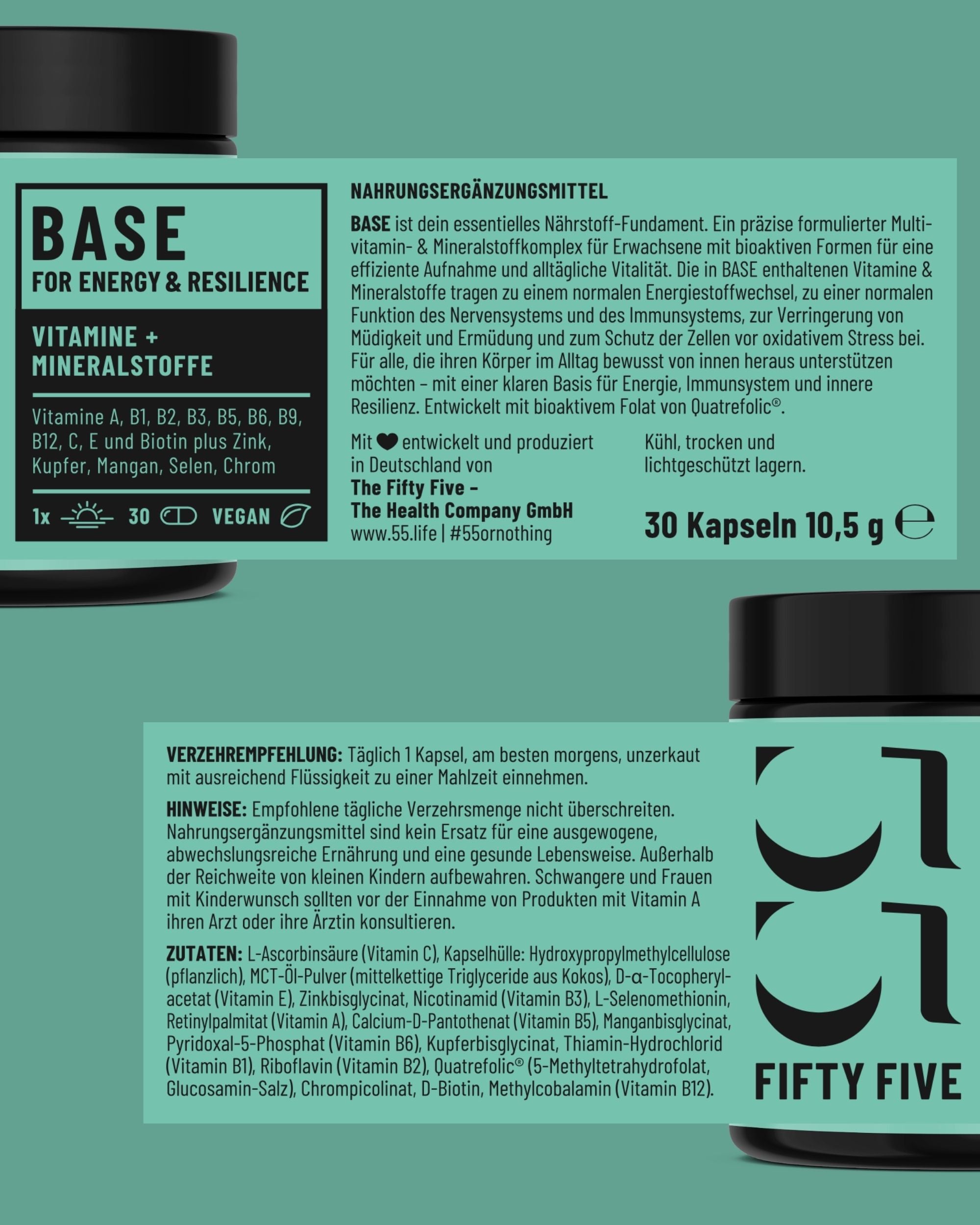
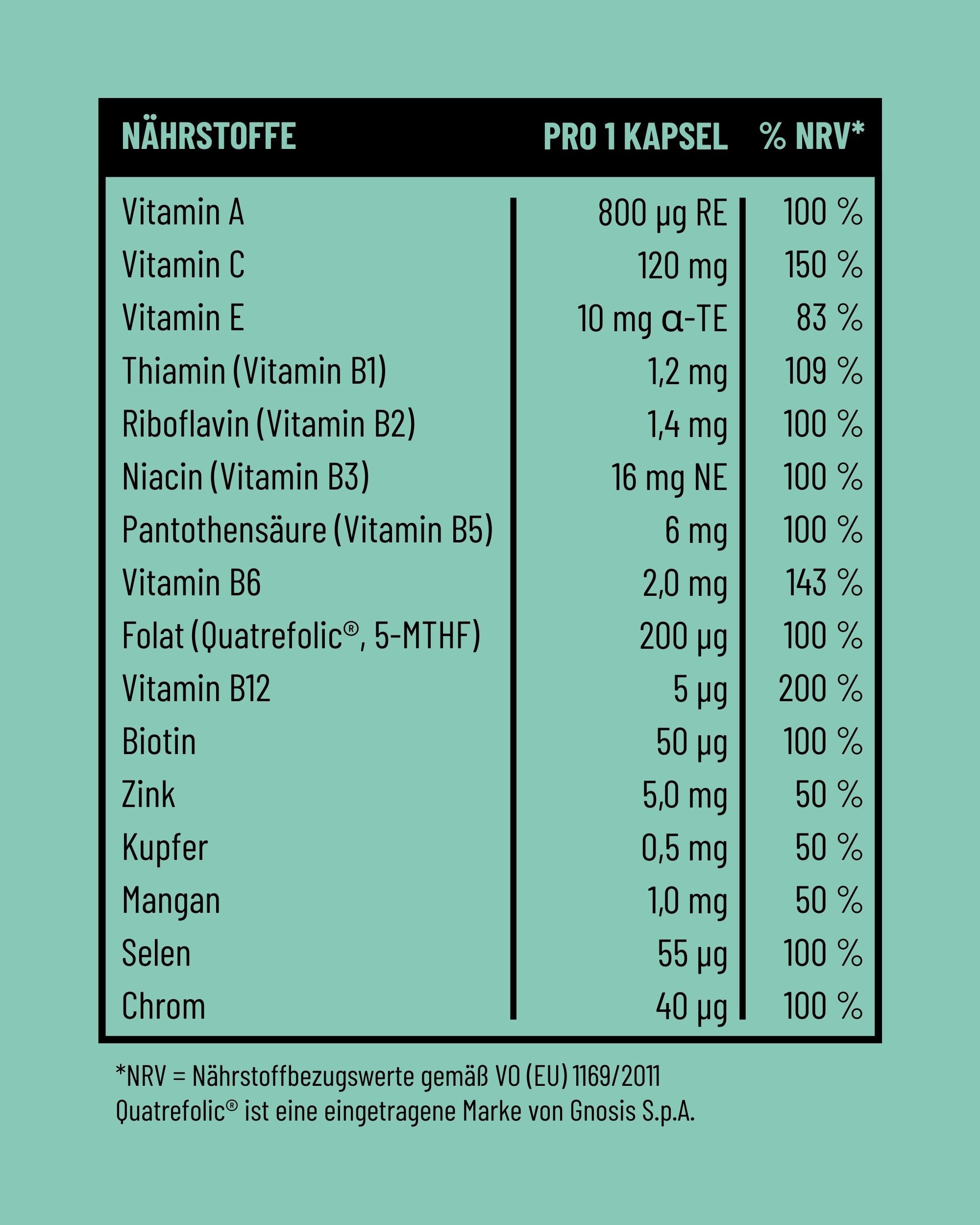
BASE follows exactly this architecture. The formula does not combine indiscriminately but along a functional logic. This includes Quatrefolic® 5-MTHF instead of a generic folic acid, methylcobalamin as the active B12 form, P-5-P monohydrate as the active B6 form, and selected minerals in well-established chelate forms such as zinc bisglycinate and copper bisglycinate. This logic is complemented by L-selenomethionine and chromium picolinate. The goal is not sensory overload but reliable basic supply.
For the comparison between a multivitamin or individual supplements, it is worth looking at the overall strategy.
| Feature | Sensible for daily use | Rather too much |
|---|---|---|
| Dosing logic | balanced and clearly positioned | aggressive and maximal |
| Nutrient selection | functional and comprehensible | overloaded and fuzzy |
| Forms | well-established, sensible forms | form mix without a clear role |
| Stack fit | complements the routine | duplicates existing products |
Dosage: why balance is often more everyday-friendly than extremes
If you take a product every day, reliability matters more than exaggeration. A balanced ratio of nutrients usually fits a long-term routine better than a label that mainly wants to attract attention through peak values.
In everyday life, this shows quickly: a balanced product is easier to assess, easier to combine, and usually also easier to use permanently. That is exactly what makes daily intake sensible in the first place.
Forms: why the chemical form is not a side issue
The form of a nutrient is no minor detail. It belongs to the product architecture. Using bioactive forms initially describes a factual form quality, not automatically superiority in every context.
For the purchase decision, it is still relevant. A daily routine lives on clarity and consistency. If the topic interests you more deeply, you can find more under understanding bioactive forms and in the article on why the form of a nutrient is relevant.
Complexity: why more ingredients are not automatically better
Many products try to appear high quality through a maximum ingredient count. For everyday life, that is often the wrong metric. The more unclear the role of individual components, the harder it becomes to place the product sensibly in your routine.
A good formula does not have as many ingredients as possible but a clear function. That is often less spectacular but considerably more useful.
Why BASE is deliberately conceived as a foundation and not a high-dose multivitamin
BASE is designed as a functionally balanced multivitamin and mineral complex. The guiding idea behind it is not maximum dosage but a structured daily routine. Exactly for this reason, the product logic appears calmer than with many multi complexes that communicate mainly through size and abundance.
From an everyday perspective, that is understandable. If you are looking for a base, you do not need a formula that wants to deliver everything maximally. You need a product that fits logically into a daily supplementation strategy. BASE is not meant to address every problem but to represent the foundation cleanly.
The selection of forms supports this perspective. Bioactive and functionally sensible forms are not an end in themselves here but part of an architecture that considers availability, tolerability, and routine capability without deriving an effect promise from it. Exactly for this reason, Fifty Five forgoes the typical multi marketing with as many ingredients as possible without a clear role. More on this under BASE as a daily foundation.
Short answer: BASE is meant as a balanced foundation: a daily micronutrient routine instead of a high-dose strategy with as many attention triggers as possible.
- Selected forms follow a clear functional logic.
- The formula prioritizes everyday usability and structure.
- The goal is baseline supply, not overload.
- Not meant is a replacement for diet or individual diagnostics.
If you want to reduce and structure, a foundation fits better than an aggressive multi complex.
The guiding idea behind BASE: foundation instead of high dose
"Foundation instead of high dose" is not an advertising formula but a product decision. BASE is meant to represent a base, not an escalation. That makes the formula particularly plausible for people who do not constantly add new products but are looking for a clear daily line.
In everyday life, that means: less escalation, more structure. That is exactly the difference.
Why bioactive forms can be logically sound in a daily routine
In a daily routine, it is not only what is included that counts but how consistently the formula is built. Quatrefolic® 5-MTHF, methylcobalamin, P-5-P monohydrate, zinc bisglycinate, copper bisglycinate, L-selenomethionine, and chromium picolinate follow a formulation logic that relies on quality and clarity.
That does not mean "more forms" would automatically be better. What is decisive is that the chosen forms have a recognizable role in a balanced formula.
For whom this product logic fits, and for whom it does not
This logic fits you more if you are looking for a calm base and want to reduce complexity. If you do not want to control every nutrient individually but prefer a clean foundation in everyday life, that is a plausible supplementation strategy.
It is less fitting if you already use a very complex stack or pursue a specialty goal with many individual products. Then the solution is often not the next multi but first more overview.
For whom daily intake is rather sensible, and when restraint can be wiser
Daily intake of a multivitamin is plausible above all when you are looking for structure. That is, when your diet is not always equally reliably plannable, when you deliberately want to build a simple base routine, or when you prefer a clear supplementation strategy over many individual products.
Restraint is usually wiser if you already take several vitamin and mineral products in parallel. In that case, the probability is high that what is missing is not an additional product but a clean overview. Individual special cases also cannot be solved across the board with a multivitamin.
Exactly here, the logic of BASE shows itself practically once more. The product fits people who want to reduce and structure. It fits less with routines that are already heavily stacked up. Anyone already using many products should first sensibly assess high doses and review their own stack.
Good use cases for a daily base routine
You want a clear, simple solution in the morning instead of making five individual decisions. You have no appetite for constantly changing individual products. Or you want to bring your supplementation strategy back to a comprehensible foundation. Then a daily base routine can make sense.
What matters is not perfection but everyday usability. A good routine holds even when your day does not run ideally.
When you should review your existing stack first
As soon as you already use several products with similar orientation, you should first check what overlaps. That applies especially to combination products with vitamins, minerals, or additional "all-round" blends.
Often this review gives you more than the next purchase. Fewer products, but used more clearly, are often the better decision in everyday life.
When a multivitamin is not the first construction site
If your routine is fundamentally chaotic, you permanently skip meals, or your supplement shelf has already become unmanageable, a multi is not automatically the first lever. Then order often helps first: what do you take, why do you take it, and what role is a product even supposed to fulfill?
A good multivitamin can support structure. But it does not replace the decision to make your own routine clear in the first place.
Conclusion: daily can be sensible, if the formula is made for daily
The simple decision rule for everyday life
A daily multivitamin can make sense if the formula is designed as a balanced baseline supply. It becomes problematic more where high doses, duplications, and an unmanageable supplement stack come together.
The real question is therefore not only whether you take it every day but whether the product is logically built for this daily use. BASE stands for exactly this perspective: foundation instead of exaggeration, clear form quality instead of stimulus overload, everyday usability instead of product noise.
Decision aid
- If you are looking for a simple basic routine, a balanced base formula fits better.
- If you already combine many products, check for duplications in your stack first.
- If you mainly look at maximum dosages, restraint is often more sensible.
- If you want to reduce and structure, a foundation fits better than a high-dose complex.
- If your daily life is not plannable, a daily base supplement can be more pragmatic than many individual products.
FAQ
Is a multivitamin every day healthy?
A daily multivitamin is not automatically "healthy" or unhealthy. What matters is whether the formula is built in a balanced way and whether it fits sensibly into your daily routine.
Can you take a multivitamin permanently?
That can be possible in everyday life if it is a balanced formula and the rest of your stack creates no problematic duplications. For the assessment, the overall context always counts, not just the individual product.
When is a multivitamin dosed too high?
This becomes relevant above all when individual nutrients are raised very strongly or when several products deliver the same vitamins and minerals in parallel. "Too high" is often a question of the sum, not just the package.
Do you even need a multivitamin?
No, not as a blanket rule. A multivitamin can make sense if you are looking for a structured base routine, but it replaces neither diet nor individual assessment.
What is the difference between baseline supply and high dose?
Baseline supply means a balanced supplementation logic for everyday life. High dose sets one or more nutrients considerably higher and is therefore not automatically better suited for a daily routine.
Can several supplements together be too much?
Yes, that is exactly where the real risk often arises in practice. When several products deliver the same micronutrients, duplications quickly become unmanageable.
How do you recognize a good multivitamin?
By a clear dosing logic, sensible forms, a transparent product architecture, and a role that remains comprehensible in everyday life. Not the biggest ingredient list decides but the coherent formula.
Why does BASE use certain bioactive forms?
Because BASE is formulated as a daily foundation and the forms are part of this functional logic. They are meant to make the product architecture clear and everyday-friendly, not artificially maximal.
→ To the complete multivitamin guide
Disclaimer:
This article is for informational purposes only and does not replace medical advice, diagnosis, or treatment by a physician or pharmacist. The information provided here should not be used for self-diagnosis or self-treatment. Food supplements are no substitute for a balanced, varied diet and a healthy lifestyle. For any health questions or complaints, please always consult a doctor you trust. Fifty Five accepts no liability for any inconvenience or harm resulting from the use of the information presented here.
Sources
- German Nutrition Society (DGE). D-A-CH reference values for nutrient intake.
- EFSA. Dietary reference values (overview).
- German Federal Institute for Risk Assessment (BfR). Maximum levels for vitamins and minerals in food supplements.
- European Commission. EU Register of nutrition and health claims.
- Robert Koch Institute (RKI). DEGS – German Health Interview and Examination Survey for Adults.









Magnesium Dosage: How Much per Day Is Sensible & Safe?
Vitamin D Overdose and Side Effects: What Really Happens When You Take Too Much
Share: