


The multivitamin market is unmanageable. Between a three-dollar drugstore house brand and a high-priced D2C product, there are sometimes fewer substantive differences than expected, but sometimes fundamental ones. The problem: from the outside, both look the same. This article explains where the real quality differences lie and how to recognize them.
Why nutrient forms are decisive
The most common quality difference between a cheap and a high-quality multivitamin lies not in the number of contained nutrients but in the form in which they are present. These forms determine how well a nutrient gets from the gut into the blood, the so-called bioavailability. A nutrient that is poorly absorbed is of little use, no matter what is printed on the packaging.
The most important quality indicators per nutrient
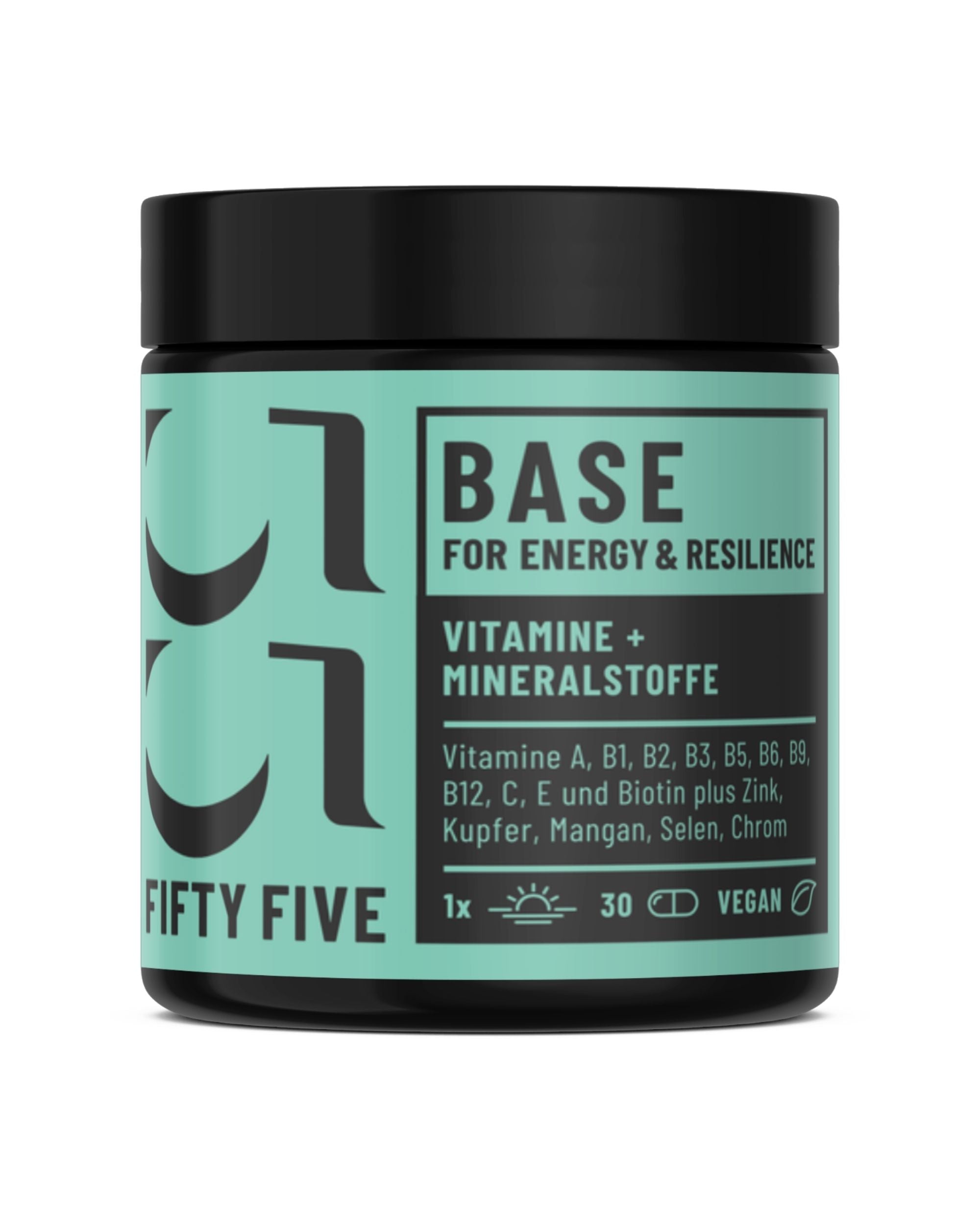
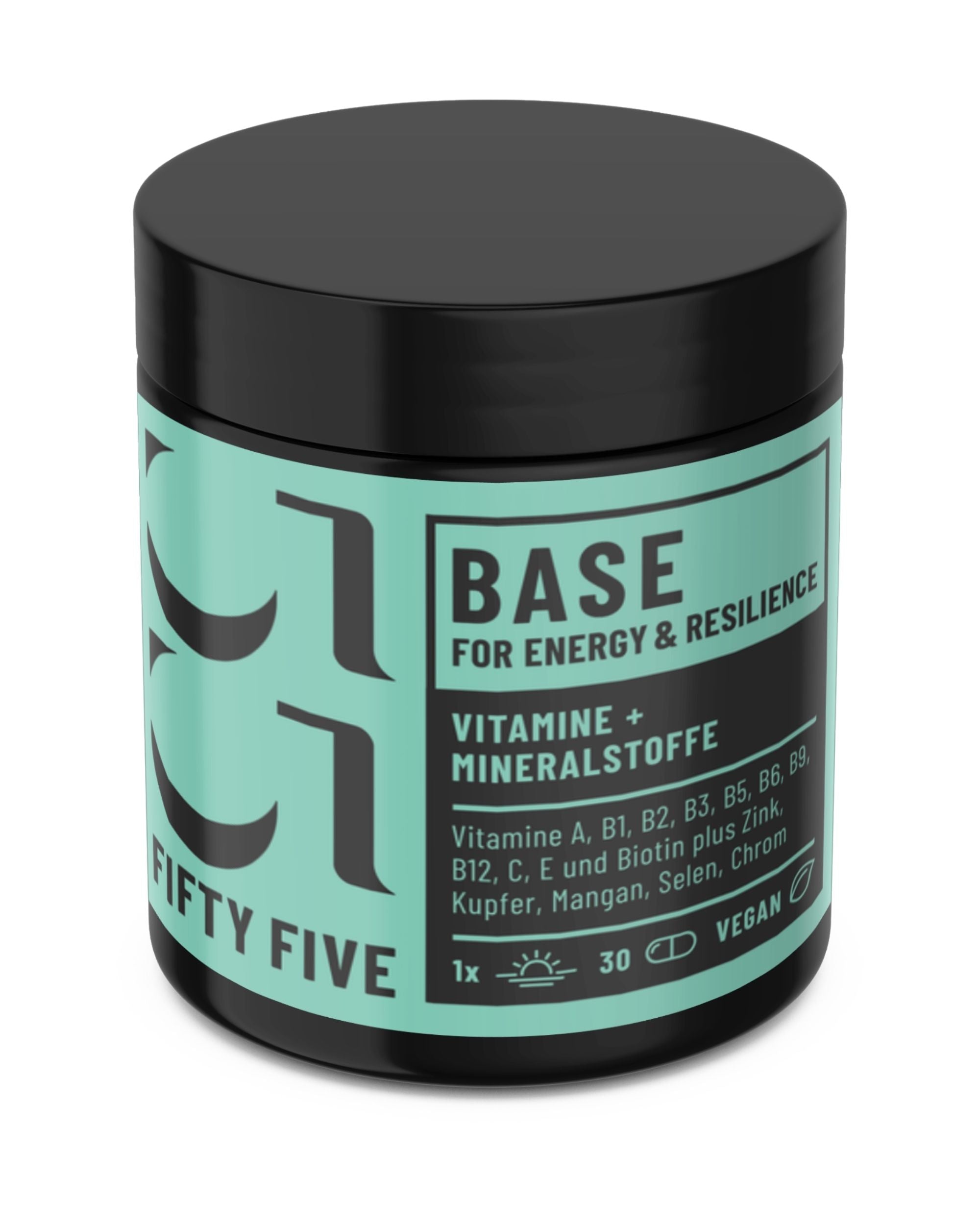
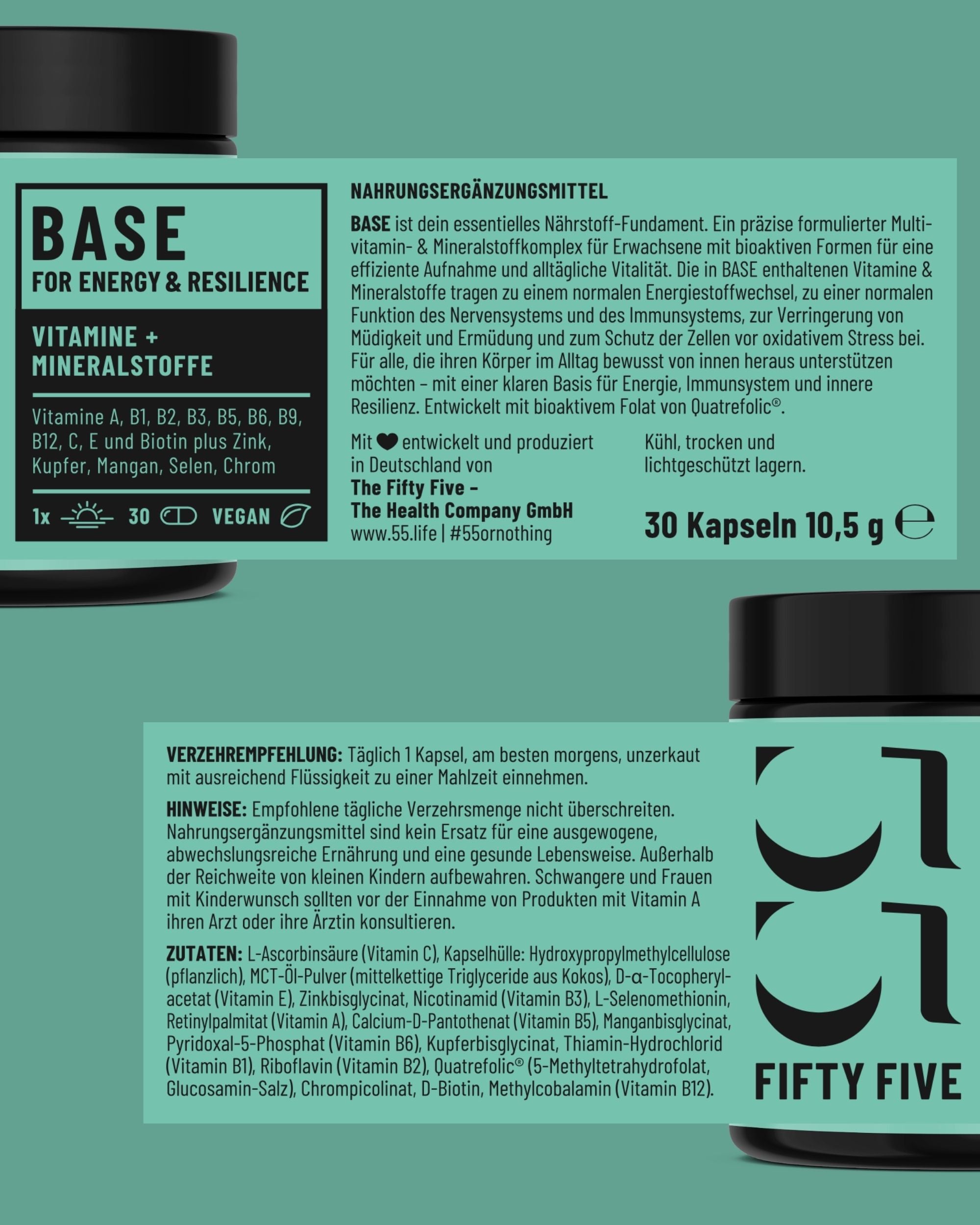
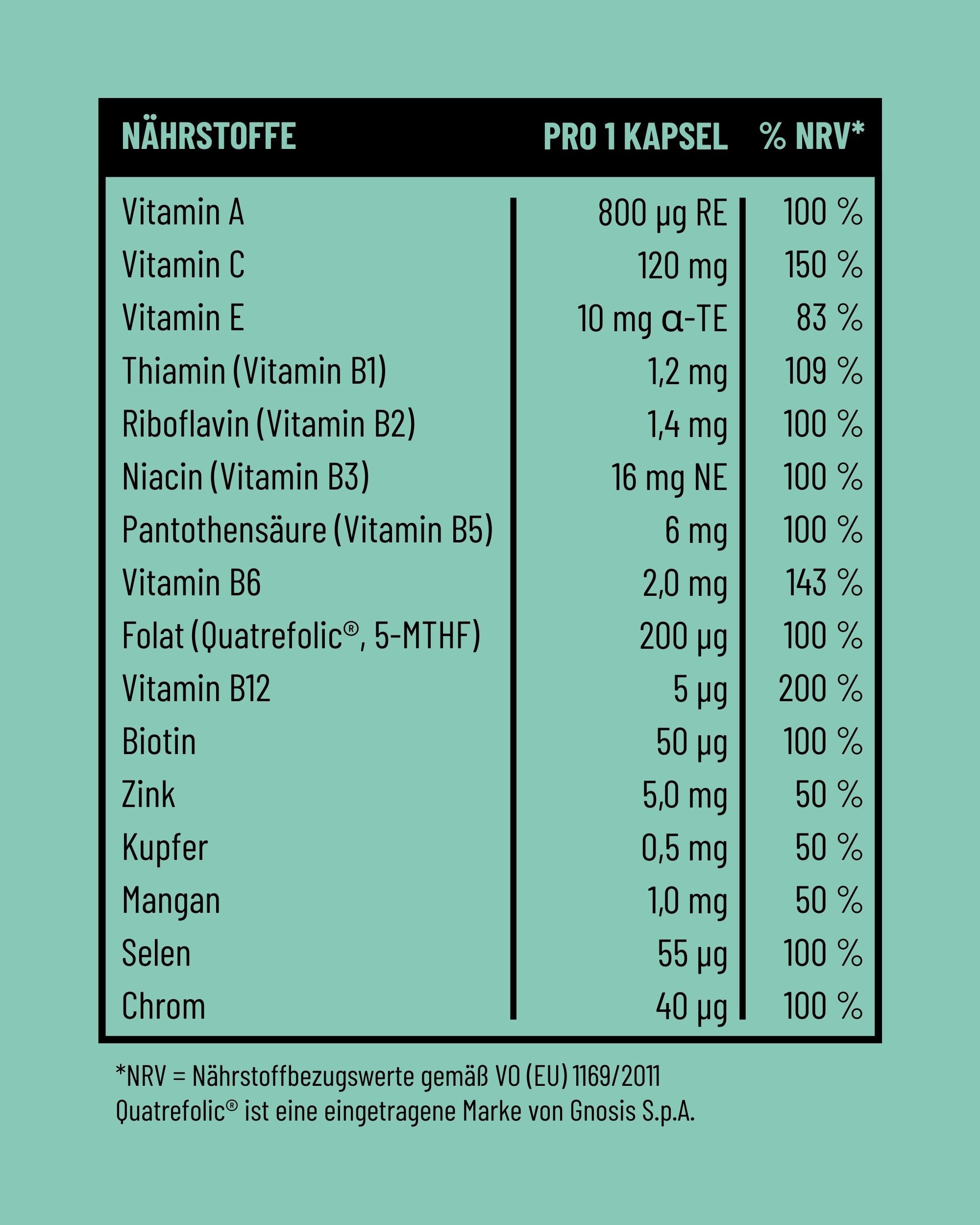
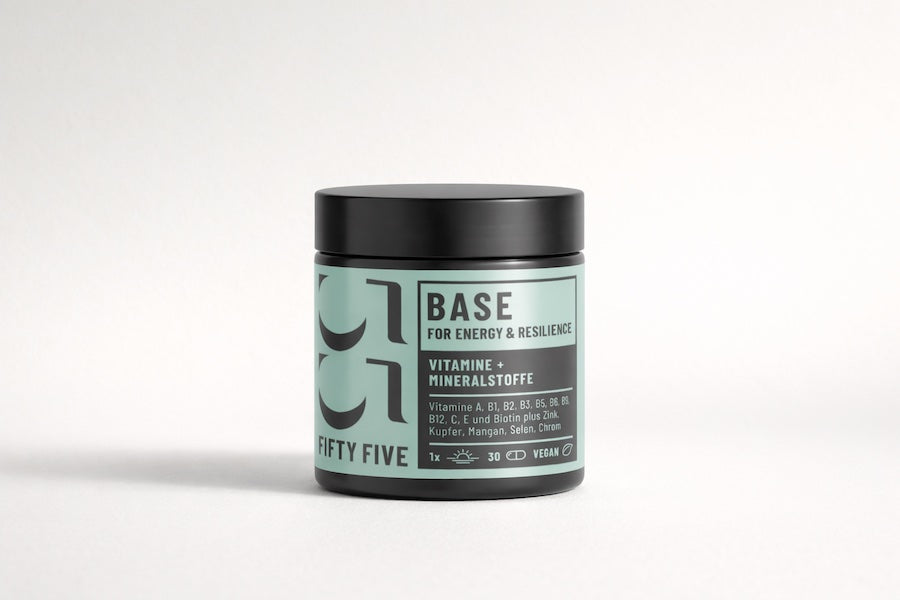
Zinc: Zinc oxide is the low-cost variant with poorer bioavailability. Considerably better absorbed is zinc bisglycinate. Our multivitamin BASE contains zinc bisglycinate.
Vitamin B6: Pyridoxine hydrochloride is the standard form. The bioactive form is pyridoxal-5-phosphate (P5P). Directly metabolically usable, without a conversion step in the body. BASE uses pyridoxal-5-phosphate.
Vitamin B12: Cyanocobalamin is the cheap and most widespread form. Methylcobalamin is the bioactive form the body can use without a conversion step. BASE contains methylcobalamin.
Folic acid: Synthetic folic acid is widespread. People with an MTHFR gene variant, however, cannot process it or process it less well. The directly usable form is 5-MTHF (methylfolate). BASE contains Quatrefolic®, a patented form of 5-MTHF.
Selenium: Sodium selenite is the inorganic, cheaper form. Better bioavailable is L-selenomethionine. BASE contains L-selenomethionine.
Copper and manganese: Chelated forms (copper bisglycinate, manganese bisglycinate) are generally better absorbed than inorganic salts. BASE contains both as bisglycinate.
What the ingredient list reveals
Do you recognize the nutrient forms? Good manufacturers spell out the chemical form: "zinc bisglycinate" instead of just "zinc." If only the nutrient name appears in the ingredient list without a concrete form, that is often a clear indication of the cheapest forms.
How many additives are included? Anti-caking agents, flow improvers, fillers, colorants: a clean product needs few of them.
How big is the capsule? Little fits into a small capsule. If a manufacturer promises 30 or more nutrients in a standard capsule, the amounts are either tiny or the forms cheap and compact. So beware of common "all-in-one" products with loud promises.
Transparency as a quality feature
A manufacturer that does not communicate its formulation transparently probably has a reason for it. Quality manufacturers explain why they made certain decisions, even if that means a nutrient is not included.
In BASE, for example, Fifty Five deliberately forgoes vitamin D3, iron, omega-3, and calcium. Not because these are unimportant, but because in a sensible multivitamin concept they either require standalone products (RISE, our D3/K2, PULSE, our vegan omega-3 from algae oil) or the individual risk-benefit ratio does not suggest universal supplementation. Communicating this decision openly is transparency, not an admission.
You can learn more about the formulation logic in our detailed multivitamin guide.
Lab testing: what that means
Many manufacturers write "lab-tested." What matters is what is tested: the raw materials, the finished product, or both? And by whom, an in-house lab or an independent, accredited testing institute? An independently lab-tested finished product is worth more than an in-house tested raw material. With all Fifty Five products, both the raw materials and the finished end product are tested.
FAQ
How do I recognize whether a multivitamin contains high-quality nutrient forms?
Look at the ingredient list and search for specific chemical designations: "methylcobalamin" instead of "vitamin B12," "pyridoxal-5-phosphate" instead of "vitamin B6," "zinc bisglycinate" instead of "zinc." The more specific the information, the more it points to deliberate formulation decisions.
Is an expensive multivitamin always better?
Price is no reliable quality indicator, but a very cheap product can only achieve its low costs through compromises in raw material quality or bioavailability. The mid to higher price range with declared nutrient forms is more reliable.
What is MTHFR and why is it relevant for folic acid?
MTHFR is an enzyme that converts synthetic folic acid into the active form 5-MTHF. Certain genetic variants lead to a limited conversion. Anyone taking 5-MTHF directly bypasses this step. From a precautionary perspective, 5-MTHF is the more robust choice for everyone.
Do more nutrients automatically mean a better product?
No. A product with 30 or more nutrients can be considerably worse than one with 16 if the amounts are so small that they provide no relevant supply. Quality over quantity applies here too.
How do I know the nutrients are really contained in the stated amounts?
Only through independent lab testing of the finished product. That should be communicated by the manufacturer.
Disclaimer:
This article is for informational purposes only and does not replace medical advice, diagnosis, or treatment by a physician or pharmacist. The information provided here should not be used for self-diagnosis or self-treatment. Food supplements are no substitute for a balanced, varied diet and a healthy lifestyle. For any health questions or complaints, please always consult a doctor you trust. Fifty Five accepts no liability for any inconvenience or harm resulting from the use of the information presented here.
Sources
- German Nutrition Society (DGE). D-A-CH reference values for nutrient intake.
- EFSA. Dietary reference values (overview).
- German Federal Institute for Risk Assessment (BfR). Maximum levels for vitamins and minerals in food supplements.
- European Commission. EU Register of nutrition and health claims.
- Robert Koch Institute (RKI). DEGS – German Health Interview and Examination Survey for Adults.






D3, K2, and Vitamin E: Why Fat-Soluble Vitamins Work as a System
Which Vitamins and Minerals Does Your Body Really Need?
Share: