


More tiredness than usual. Hair that sheds more. A feeling of simply not getting up to speed. A suboptimal supply can be behind such complaints. But they can just as well have many other causes. That is exactly why a feeling of uncertainty arises. So let us sort this out properly.
You do not have to interpret every diffuse signal immediately as vitamin deficiency. It is more productive to look at recurring symptom patterns: what occurs together, for how long, at what intensity, and in what kind of daily life? Exactly from this follows the real decision: is a look at diet and routine enough, are diagnostics sensible, or does a balanced baseline supply as a foundation fit better?
Quick definition: recognizing vitamin deficiency means classifying recurring complaints as a possible supply signal, not as a self-diagnosis.
- Tiredness is common but unspecific.
- Skin, hair, and nails can give hints.
- Diet and lifestyle shape your supply.
- A single symptom alone does not prove a deficiency.
If complaints persist or increase, prioritize medical evaluation over self-diagnosis.
What "recognizing vitamin deficiency" actually means in everyday life
"Vitamin deficiency" is often used as an umbrella term in everyday life. But it does not always mean a medically confirmed deficiency. Often it is more a perceived undersupply or a suboptimal supply: situations in which diet, stress, routines, or life stages do not interact ideally and you feel less stable as a result.
This distinction matters for the assessment. A diagnosed deficiency belongs in medical evaluation. A suboptimal supply, on the other hand, describes more of a gray zone in daily life where no single cause is immediately tangible. That is exactly why many people look for orientation before thinking about blood values, individual supplements, or doctor's appointments.
Tiredness, skin changes, concentration problems, or muscle cramps look unambiguous at first glance. In practice, they rarely are. Sleep, strain, calorie intake, training volume, diet quality, or other physical factors can look similar. More relevant than a single sign are therefore duration, combination, and repetition. When several everyday complaints occur in parallel, the supply situation can be assessed more clearly than through one symptom alone.
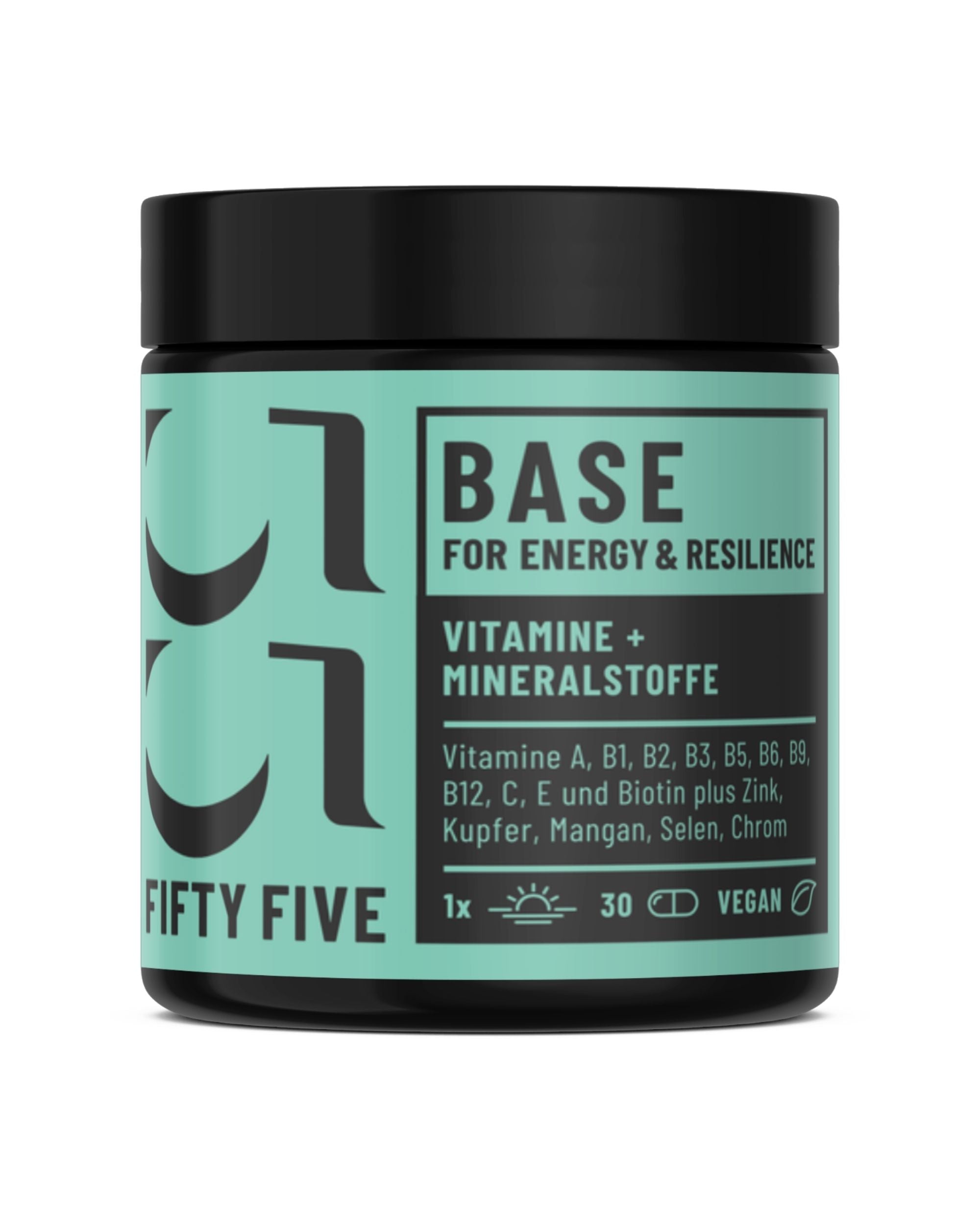
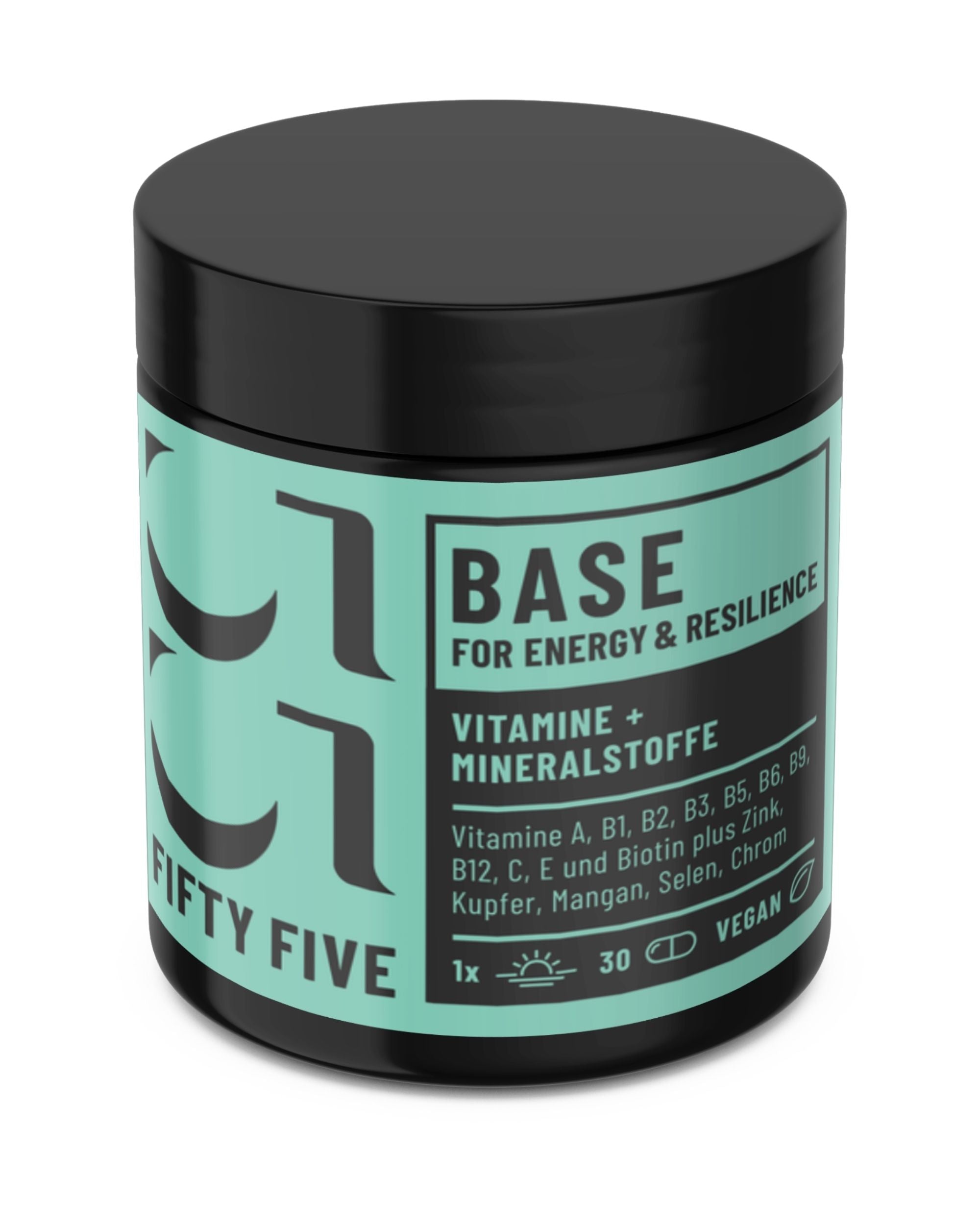
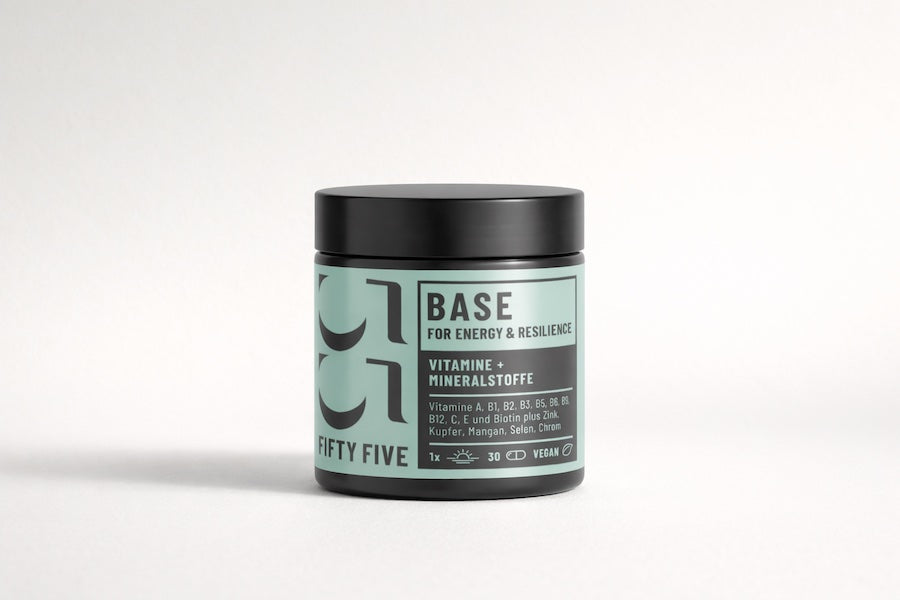
That is also why a foundation product like BASE is not aimed at one isolated complaint picture. In everyday life, supply gaps often do not show up monocausally. They tend to arise in phases of high mental strain, irregular eating, low food variety, or permanent stress. Then a balanced daily baseline supply is often more logical than trying to address each individual symptom with a separate substance.
These symptoms are frequently associated with vitamin or mineral deficiency
Many users look for a simple list. More practical is an organized overview by symptom clusters. That way you recognize more quickly which complaints are often thought of together and when a closer assessment makes sense. The following table serves orientation, not diagnosis.
| Symptom cluster | Possibly involved nutrients | When to get it checked? |
|---|---|---|
| Tiredness, exhaustion | B1, B2, B6, B12, folate, pantothenic acid | persistent, increasing, strongly limiting |
| Concentration, mental fog | B1, B6, B12, folate | with ongoing complaints or clear worsening |
| Skin, hair, nails | Vitamin A, biotin, zinc, riboflavin | with pronounced or long-lasting changes |
| Muscle cramps, weakness | B vitamins, manganese, general undersupply | with frequent recurrence or strain in daily life |
| Susceptibility to infections, recovery | Vitamin A, C, B6, B12, folate, zinc, selenium, E | with recurring strain and lack of recovery |
Tiredness and exhaustion
Tiredness is one of the most common reasons people think of a vitamin deficiency. That is understandable because reduced resilience is quickly noticeable: you struggle to get into the day in the morning, feel unusually empty in the afternoon, or do not feel properly recovered despite a break. Such states are often associated with B vitamins because several of them contribute to normal energy-yielding metabolism.
Still, the conclusion is not automatic. Tiredness can also be connected to sleep, stress, low calorie intake, high training load, or an overall unbalanced diet. The supply topic becomes more relevant when exhaustion recurs, is not well explained, and occurs together with other signals.
For everyday life, this means: observe not only whether you are tired but how the tiredness shows itself. Does it come in phases of irregular meals? During diet phases? Under high mental strain? Exactly these patterns are more helpful than the search for a single "tiredness vitamin."
If you want to go deeper into this topic, looking at concentration and nerves or at mental strain and micronutrients is often worthwhile, because exhaustion rarely occurs in isolation.
Concentration and nervous strain
Concentration problems are often described as mental fog: you read the same paragraph twice, lose the thread more quickly, or are more irritable than usual. Especially in intense work phases, it is natural to think of stress first. That is often correct too. At the same time, a suboptimal supply can be a factor when diet and routine are not well set up over a longer period.
Several B vitamins contribute to normal functioning of the nervous system. Some additionally contribute to normal psychological function or to energy metabolism. That explains why this area is discussed so frequently in the context of mental strain. It becomes practically relevant for you above all when declining concentration, exhaustion, and an irregular diet come together.
Typical is the daily life with a lot of coffee, few real meals, and a high cadence. Then a clear textbook deficiency does not necessarily arise, but certainly an environment in which supply gaps become plausible. Exactly for this reason, it is worth looking at B vitamins in daily life or at concentration and nerves instead of interpreting individual symptoms in isolation.
Skin, hair, nails
Changes in skin, hair, or nails are among the classic search triggers. Dry skin, brittle nails, or increased hair shedding are quickly connected with vitamin or mineral deficiency. That can be a hint, but it can only be interpreted correctly in context. Season, care routine, hormonal situation, energy intake, or general strain also play into this.
In this context, vitamin A, biotin, zinc, and riboflavin are mentioned particularly often. Some of these nutrients contribute to the maintenance of normal skin, hair, or nails. However, that does not mean visible changes are automatically attributable to a deficiency. Once again, the overall picture is decisive.
In everyday life, the more helpful question is: do these changes appear suddenly? Do they persist? Do they go along with tiredness, poor recovery, or strongly limited dietary variety? Then a structured assessment is more worthwhile than a premature self-diagnosis.
Muscles, cramps, physical strain
Muscle cramps, a feeling of general weakness, or lacking resilience are often attributed directly to a mineral deficiency. In practice, the picture is broader. Fluids, training management, recovery, sleep, and eating behavior can contribute here just as much as your micronutrient supply.
Especially among physically active people, a pattern often shows: high consumption, little recovery, irregular meals. Then it is less about a single substance and more about whether the overall foundation is stable enough. If you train a lot or have physically demanding days, that is a different context than occasional cramps without further complaints.
BASE starts exactly at this everyday perspective: not as an answer to an isolated symptom but as a micronutrient foundation for several typical strain clusters at once. That is plausible above all when complaints are diffuse and do not point cleanly to a single factor.
If you want to understand specifically when a magnesium deficiency is behind such complaints, we have prepared its causes, signs, and diagnostics.
Susceptibility to infections and general resilience
If you have the feeling that every phase of strain drags on longer or you recover less well, the immune system often comes to mind. Restraint is warranted here too. Frequent infections or delayed recovery have many influencing factors, including sleep, stress, calorie intake, training load, and general lifestyle.
Nevertheless, there are nutrients frequently placed in this context. Vitamin A, vitamin C, vitamin B6, vitamin B12, folate, zinc, and selenium contribute to the normal function of the immune system. Vitamin E and vitamin C are additionally often discussed in the context of cell protection and oxidative stress. That is relevant because everyday resilience rarely hangs on a single substance.
If you want to understand this connection better, looking at zinc and selenium, the immune system and micronutrients, or cell protection and supply is relevant. What remains practically decisive: recurring strain, low food variety, and little recovery together create a different picture than a one-off infection.
Which vitamins and minerals are particularly relevant here
Not every complaint is vitamin-specific. Still, there are nutrients that play a role particularly often in everyday life when it comes to energy metabolism, the nervous system, skin, mucous membranes, the immune system, and basic regulation. In BASE, these substances are not arranged as an arbitrary collection but conceived by functional clusters.
Energy, nerves, mental strain
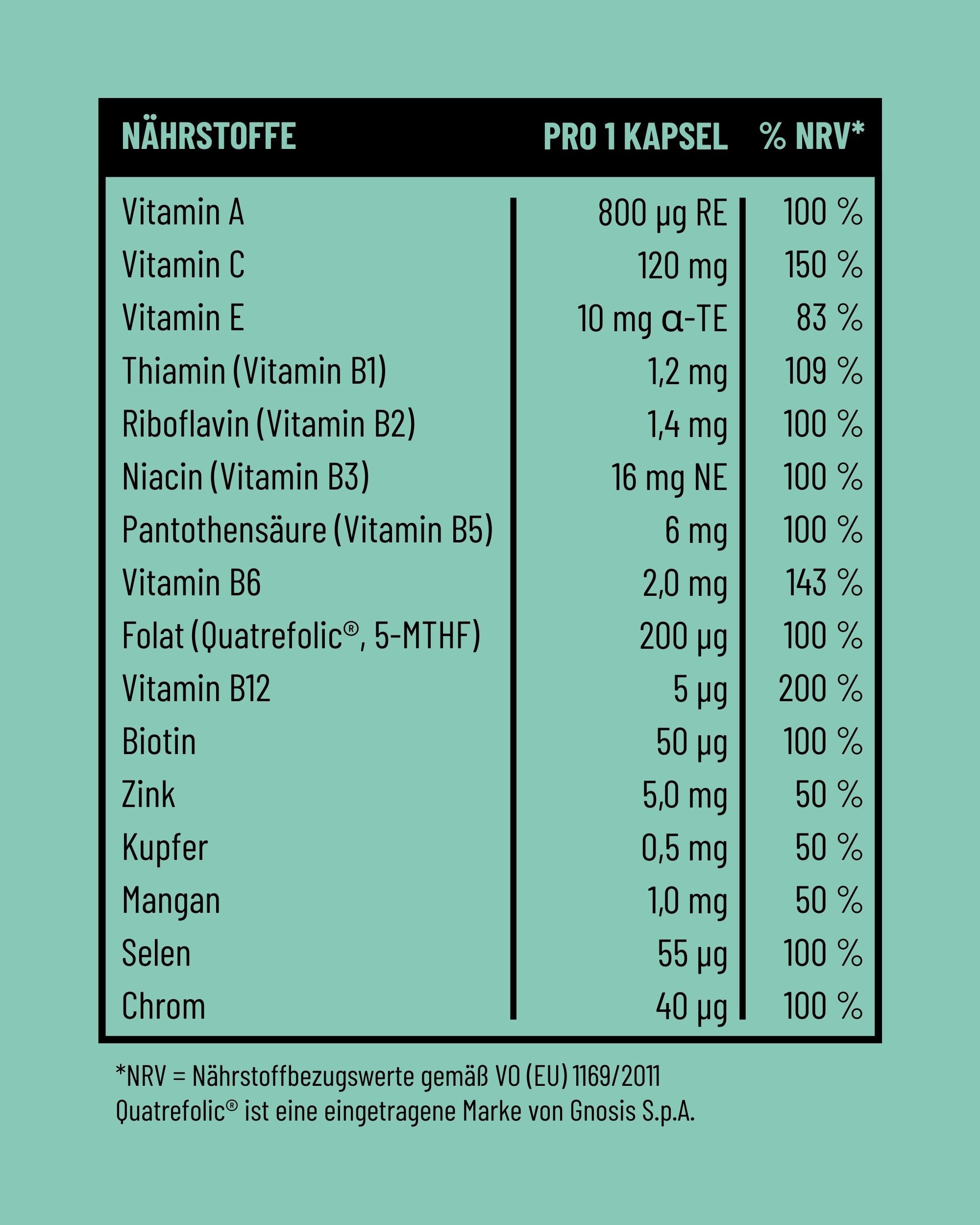
For this area, thiamine, riboflavin, vitamin B6, vitamin B12, folate, and pantothenic acid are most relevant. Several of these B vitamins contribute to normal energy-yielding metabolism. Some contribute to normal functioning of the nervous system, others to normal psychological function or to the reduction of tiredness and fatigue.
For everyday life, this is interesting above all in phases when you are mentally highly challenged, meals get skipped, or routines tip over. Then often no clear single deficiency shows up but a nutrient pattern that seems less stable. BASE addresses this area with functionally chosen forms, including P-5-P monohydrate as the active form of vitamin B6, methylcobalamin as the active form of vitamin B12, and Quatrefolic® 5-MTHF instead of a simplified folic acid logic.
Anyone wanting to assess the folate area more precisely benefits from a separate look at 5-MTHF or folate vs. folic acid.
Skin, mucous membranes, hair, nails
In this cluster, vitamin A palmitate, D-biotin, zinc bisglycinate, and riboflavin are in the foreground. These nutrients are frequently discussed when it comes to the maintenance of normal skin, hair, mucous membranes, or nails. For you, this is practically relevant when visible changes should not be read as purely cosmetic but viewed in the overall picture with diet and daily life.
Here too, the form selection is part of the product logic. It is not about a "beauty stack" but about a sober base architecture. Zinc bisglycinate is not a marketing effect but the expression of a deliberately chosen raw material form. The same applies to the integration of riboflavin and biotin in a ratio that aims not at isolated effects but at a balanced baseline supply.
Immune system and cell protection
Vitamin C in the form of L-ascorbic acid, vitamin A, vitamin B6, vitamin B12, folate, zinc, selenium, and vitamin E are among the central nutrients in this functional area. Several of them contribute to the normal function of the immune system. D-alpha-tocopheryl acetate and vitamin C are additionally often placed in the context of oxidative stress and cell protection.
The point here is not to explain every infection through nutrients. This cluster becomes practically relevant when high strain, irregular eating, and weak recovery coincide. Then a solid basic supply is more plausible than spontaneously stacking individual high-dose products.
Metabolism and basic regulation
Chromium picolinate, manganese bisglycinate, and copper bisglycinate are rarely the focus of everyday searches but belong to a complete baseline supply. Precisely because diffuse supply gaps are rarely monocausal, a well-thought-out architecture is more than a list of the best-known vitamins.
Chromium picolinate, manganese bisglycinate, and copper bisglycinate were not added to BASE to show "more of everything" but because metabolism and regulation do not consist only of the typical B vitamin narratives. Added to this are L-selenomethionine as a deliberately chosen selenium form and a balance that puts everyday usability above high-dose effect promises.
Anyone wanting to go deeper into the selection of raw material forms finds more context in the topic of bioactive forms or functionally chosen nutrient forms.
Typical risk factors: when you should look more closely
Not everyone needs the same attention on their supply. But there are typical everyday situations in which supply gaps become more likely. These are rarely spectacular extremes but often habits that add up over weeks and months.
Dietary patterns with increased risk
A one-sided diet is one of the most common factors. That can look very different: frequently the same few foods, permanently few fresh components, heavily processed routines, or diet phases with low calorie intake. Vegetarian or vegan diets can also work well but need planning. Without this planning, not only variety often drops but also the probability of a balanced micronutrient intake.
This becomes relevant for you especially when complaints and dietary routine match up. Someone who eats little in the morning, snacks irregularly during the day, and compensates in the evening has a different supply context than someone with stable food variety. Exactly for this reason, real supply gaps often arise from patterns, not textbook cases.
Stress, daily life, little recovery
High stress does not automatically change blood values, but it can change the behavior that is decisive for supply: meals get postponed, choices get worse, sleep drops, recovery falls away. In such phases, you often do not feel acutely ill, but not really stable either.
That is a typical field for suboptimal supply. Performance-oriented adults in particular experience this phase as a diffuse mix of exhaustion, concentration problems, and declining resilience. Then it is worth looking at daily life as a whole. Not only which nutrient is "missing," but whether the dietary routine still carries at all.
Life stages and individual factors
Older age, limited food variety, or particular life stages can also be reasons to look more closely. The same applies to people with permanently low calorie intake, very high athletic load, or recurringly poor recovery. The question here is not whether a deficiency definitely exists but whether the supply situation deserves attention.
A balanced multivitamin and mineral complex is therefore often more comprehensible in such situations than disordered individual supplements. Not because a product replaces diagnostics, but because the cause of real supply gaps in everyday life is frequently multidimensional.
Recognizing vitamin deficiency without misinterpretation: what symptoms cannot do
This section matters because with everyday complaints, too much is quickly read into individual signs. A symptom is not a nutrient. And a social media checklist approach does not replace a clean assessment.
Why tiredness does not automatically mean B12 or iron deficiency
Tiredness is one of the most unspecific symptoms there is. It is frequently connected with B12 or iron but can just as well arise from lack of sleep, psychological strain, low energy intake, training stress, or other causes. It is therefore not technically sound to conclude a specific substance from tiredness alone.
The better question: does tiredness occur in isolation or together with other patterns? How long has it existed? How strongly does it affect your daily life? Only this assessment makes the next step plausible.
Why skin and hair changes can have many causes
Dry skin, hair shedding, or brittle nails also often look unambiguous on search result pages. In everyday life, they rarely are. Care routines, hormones, calorie intake, season, mechanical strain, or general stress can play a role. Nutrients can be involved here, but they do not have to be.
That is why it is important never to view visible changes detached from the rest. When skin and hair changes occur in parallel with exhaustion, low dietary variety, and weak recovery, a different picture emerges than with isolated cosmetic topics.
When medical evaluation makes sense
With severe, persistent, or increasing complaints, medical evaluation is the right path. That applies especially when everyday function, resilience, or visible changes are clearly impaired. Blood values can be sensible, but they must fit the complaint picture and be interpreted correctly.
Exactly for this reason, BASE follows no spectacular single-solution logic. With fuzzy everyday symptoms, a sober foundation is often more effective than loud promises. That does not replace diagnostics but can help you think about supply in a structured way instead of symptom-driven.
The concrete next step: diet, diagnostics, or baseline supply?
Anyone wanting to recognize vitamin deficiency is ultimately looking not just for information but for a decision aid. Usually there are three paths: organize diet first, prioritize diagnostics, or use a balanced baseline supply as a pragmatic foundation.
When diet alone is enough first
If complaints are mild, have not existed long, and your daily life shows clearly recognizable weak points, a nutrition check is often the best first step. Look honestly at how regularly you eat, how varied your selection is, and whether fresh, nutrient-rich foods even appear consistently in your daily life.
Especially in phases with little structure, this assessment alone achieves a lot. Not every diffuse tiredness immediately needs a supplement. Sometimes the base is simply too irregular.
When diagnostics should be prioritized
If complaints are distinct, persistent, or increasing, you should not stop at search lists. Then diagnostics make more sense than self-interpretation. That also applies when you feel noticeably limited in everyday life or when several signals exist simultaneously over a longer period.
Blood values can be a helpful building block here. What matters is only that they are not read as a self-experiment but in the fitting context.
When a balanced micronutrient approach is logical
A balanced baseline supply is plausible above all when no clear single gap is recognizable but several everyday strain factors come together: irregular eating, lots of stress, little recovery, diffuse complaints. Then a micronutrient foundation is usually more logical than random individual substances stacked one after another.
That is exactly what BASE stands for: not as a replacement for diet or diagnostics, but as a balanced architecture for an everyday-friendly baseline supply.
Quick definition: a baseline supply is often more logical when no clear single gap but several strain factors come together.
- Supply gaps are often not monocausal.
- High doses do not automatically solve underlying problems.
- Balanced combinations limit symptom hopping.
- Not meant is a therapy for unspecific complaints.
If your diet is irregular and symptoms remain diffuse, a balanced foundation approach is more plausible than single-substance actionism.
Why BASE combines exactly these vitamins and minerals
This is where it shows whether a multivitamin and mineral complex seems well thought out or just stuffed full. BASE follows no logic of maximum dose or maximum ingredient count as often propagated in typical "all-in-one" products. The architecture is designed for baseline supply: several everyday-relevant vitamins and minerals, functionally chosen forms, and a balanced ratio instead of lots of single solutions.
Why not simply "more of everything"
More forms or higher amounts do not automatically make a product better. Especially with diffuse everyday complaints, this reflex often leads to unnecessary symptom hopping: first B12, then zinc, then another high-dose product. That feels active but rarely solves the underlying question cleanly.
A cleverly built multivitamin approach therefore thinks from the pattern. If real supply gaps often arise from stress, dietary routine, and lacking recovery, a foundation is usually more plausible than disordered individual substances. That is exactly what the logic behind foundation instead of high dose describes, and the question of why not simply more of everything.
Why active / well-classifiable forms make a difference
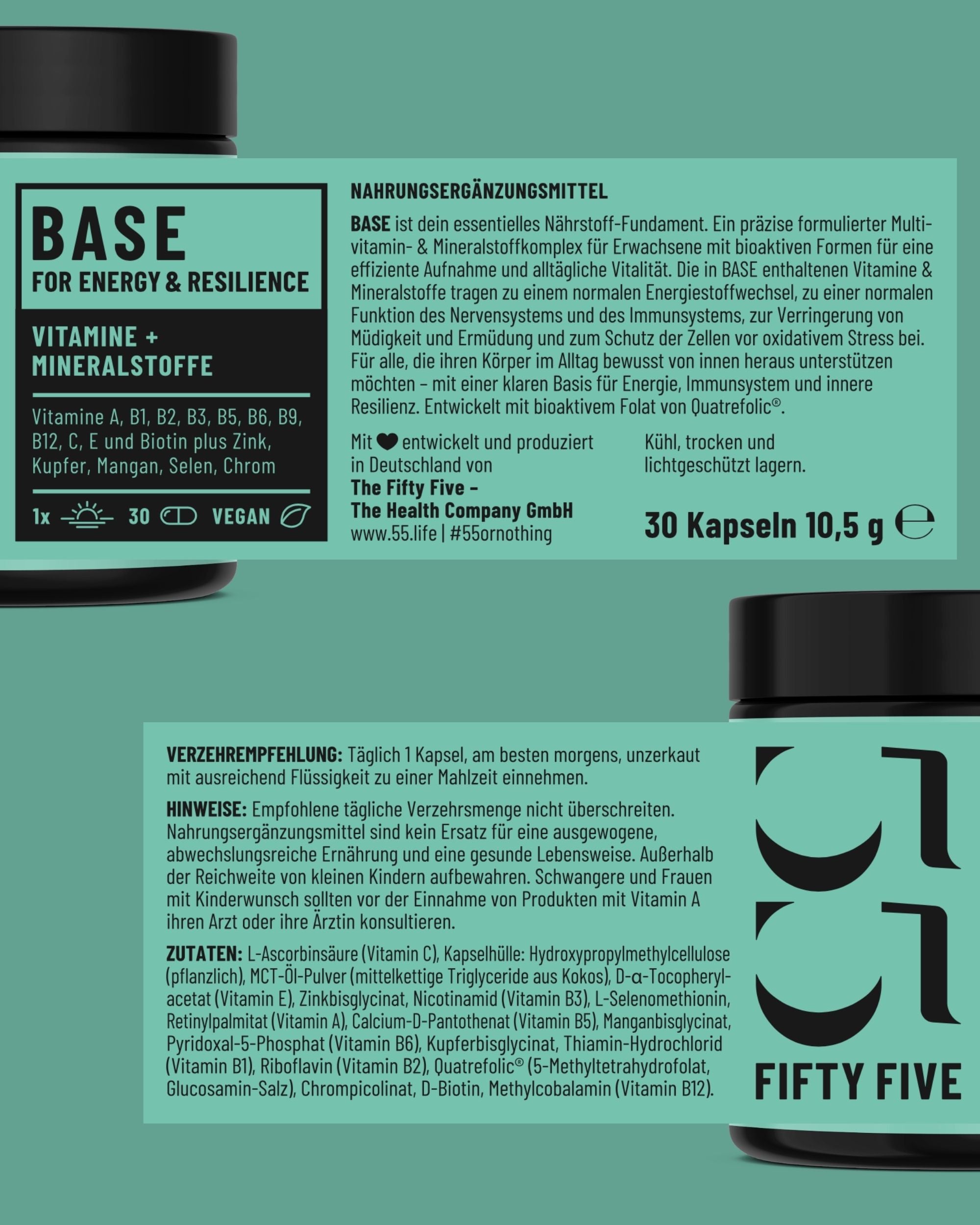
BASE deliberately combines forms that are functionally chosen and well classifiable in the context of the overall product. These include:
- Quatrefolic® 5-MTHF as the folate form
- Methylcobalamin as the active B12 form
- P-5-P monohydrate as the active B6 form
- Zinc bisglycinate
- Copper bisglycinate
- L-selenomethionine
- Manganese bisglycinate
- Chromium picolinate
This selection is no claim of superiority. It is not meant to suggest guarantees or serve a "mega stack" narrative. The idea behind it is more sober: bioactive or functionally chosen forms in a product architecture that considers raw material quality, everyday usability, and ratio. More on this is shown in the context of bioactive and functionally chosen nutrient forms.
Why a foundation is often more logical in everyday life than symptom hopping
If you have diffuse complaints, the biggest thinking error is often the search for the one spectacular cause. Daily life is rarely that clear. More often, several factors come together: little structure, high strain, weak recovery, too little variety in the diet. Then a base logic fits better than jumping from symptom to symptom.
BASE was combined exactly for this. Not to maximally address a single problem, but to build a micronutrient foundation that covers several functional areas: energy metabolism, the nervous system, the immune system, skin, and basic regulation. Form follows function here. Not maximal, but balanced.
Decision block
- If you have noticed individual mild complaints only recently → rather check diet and routine first.
- If tiredness, concentration problems, and poor recovery occur together → rather look at an overall pattern instead of a single symptom.
- If complaints are severe, persistent, or increasing → rather prioritize diagnostics.
- If your diet is irregular and no clear single gap becomes recognizable → rather a balanced baseline supply than several individual supplements.
- If you are not looking for a high-dose approach but a foundation → rather a balanced multivitamin and mineral complex.
FAQ: the most common questions about recognizing vitamin deficiency
Can you recognize vitamin deficiency in the eyes?
Changes in the eyes can provide hints but are not specific enough for a self-diagnosis. What matters is always the assessment in the overall picture of diet, other complaints, and the duration of the change.
Which deficiencies are often behind tiredness?
Tiredness is frequently associated with B vitamins, folate, or vitamin B12. But it is unspecific and can have many other causes, which is why it should never be evaluated in isolation.
Which symptoms occur with B12 deficiency?
B12 deficiency is frequently associated with tiredness, exhaustion, concentration problems, or nervous strain. However, these complaints are not conclusive and should be medically assessed if they persist.
Can skin and hair point to nutrient deficiencies?
Yes, skin, hair, and nails can give hints, for example with dry skin, brittle nails, or increased hair shedding. But such signs are multifactorial and should not automatically be interpreted as a deficiency.
Is diet always enough?
A good diet remains the foundation. In everyday life, however, it is not always consistent enough, especially with stress, low variety, or irregular routines, so a balanced baseline supply can be helpful.
When should you have blood values checked?
Blood values are helpful above all when complaints are severe, persistent, or increasing. They should always be interpreted in line with the complaint picture and do not replace a thorough assessment.
→ To the complete multivitamin guide
Disclaimer:
This article is for informational purposes only and does not replace medical advice, diagnosis, or treatment by a physician or pharmacist. The information provided here should not be used for self-diagnosis or self-treatment. Food supplements are no substitute for a balanced, varied diet and a healthy lifestyle. For any health questions or complaints, please always consult a doctor you trust. Fifty Five accepts no liability for any inconvenience or harm resulting from the use of the information presented here.
Sources
- German Nutrition Society (DGE). D-A-CH reference values for nutrient intake.
- EFSA. Dietary reference values (overview).
- German Federal Institute for Risk Assessment (BfR). Maximum levels for vitamins and minerals in food supplements.
- European Commission. EU Register of nutrition and health claims.
- Robert Koch Institute (RKI). DEGS – German Health Interview and Examination Survey for Adults.






Magnesium: How It Works, Daily Needs & Forms: The Ultimate Guide
Recognizing Vitamin D Deficiency: Symptoms, Causes & What Really Helps
Share: