


Your daily life is not equally plannable every day. Some days are well structured, others chaotic. Your micronutrient supply follows this rhythm. A multivitamin can create a calm base in this situation. Whether it does that for you depends on the formula, not the label.
So a multivitamin is neither automatically always necessary nor automatically just marketing. It can be a sensible complement when it is designed as a calm base and not as a spectacular high-dose solution. We explain whether a multivitamin is currently a priority for you, how to recognize a good product, and why forms, dosage, and balance often matter more than the longest possible ingredient list.
The short answer:
A multivitamin can make sense for you if your everyday diet does not always reliably cover all essential vitamins and minerals. Especially with a hectic lifestyle, irregular meals, or limited food variety, a balanced baseline supply can help fill typical supply gaps pragmatically.
A high-quality multivitamin is characterized by:
- balanced dosages instead of high-dose logic
- bioactive vitamin forms
- organic mineral compounds
- a comprehensible overall architecture
It does not replace your diet but can create a stable foundation.
Doesn't everyone need a multivitamin?
The real question is not "Doesn't everyone need a multivitamin?" but "Where do supply gaps arise in everyday life?" Or put differently: "How stable is your daily nutrient supply really?"
The general skepticism toward supplements is understandable and often quite justified. You do not automatically have to take a multivitamin just because the market constantly suggests it. At the same time, the counterposition "nobody needs this" is just as sweeping and superficial. In practice, what decides is less an abstract dietary ideal than your actual dietary reality.
Ideally, you cover micronutrients through a permanently balanced diet. In real daily life, it often looks different. Maybe you eat breakfast on the go, grab something quick between meetings at lunch, and do not cook fresh every evening. Maybe you travel frequently, work shifts, or have phases in which eating happens functionally rather than planned. Monotonous eating, diets, or a limited food selection can also lead to a supply that is not dramatically poor but permanently unsteady.
This is exactly the core of the question: not everyone has the same need for a safety net. But many have a routine that is not stable enough to deliver the same supply quality every day. This is not a moral topic and no judgment about "healthy" or "unhealthy." It is a routine topic. If your diet is very good on some days and rather random on others, the wish quickly arises for a sober base that is not supposed to solve everything but makes daily life a bit more robust.
A multivitamin can make sense in this context, not as a replacement for diet but as a complement to a dietary routine that is well-intentioned in principle but not always consistently executed. Especially for people with high workloads or little plannability, that is often the real search intent behind the question "Is a multivitamin worth it?": not optimization, but reliability.
That is also why the product logic matters later. If a product is meant as a foundation, its composition and forms must be everyday-friendly and balanced. It should not pursue an artificial spectacle logic but create a calm base that fits real routines. Exactly this is what later distinguishes whether a multivitamin only looks good or is functionally built.
We have sorted out which everyday complaints can point to supply gaps and vitamin deficiency in a dedicated article.
What a multivitamin is supposed to do, and what it is not!
A multivitamin is a combination of several essential vitamins and minerals in one product. A micronutrient foundation is a balanced base meant to fill typical supply gaps in everyday life. Baseline supply in this context means: not as much as possible, but a reasonable basic coverage on which further, more specific decisions can sensibly build.
This definition matters because many misunderstandings begin exactly here. A multivitamin is not there to intervene therapeutically, treat concrete deficiencies, or instantly "noticeably" compensate for a bad week. It is also not meant to be an all-in-one solution that suddenly makes diet, sleep, exercise, and medical evaluation secondary. Its role is considerably smaller and at the same time more practical: creating a stable foundation when your daily life does not run ideally every day.
The right expectation of a good multivitamin is therefore not the quick kick. It is about continuity rather than staged effects. Anyone expecting an immediate change in energy, focus, or performance from a base product loads it with tasks it is not designed for. That often leads either to disappointment or to the assumption that only a high-dose product could "really do something."
A different order makes more sense: foundation first, then specialty topics. If your basic supply is unclear or patchy, a stack of many individual products quickly becomes messy. Things get added without the foundation being clear. A multivitamin can organize this foundation, provided it is actually formulated as a foundation and not merely a collection basin of as many ingredients as possible.
From this also follows why form selection and dosage become so important later. If a multivitamin is supposed to be a micronutrient foundation, the contained nutrients must fit this role: broad, balanced, and routine-friendly. Not spectacular, not aggressive, not built on maximum doses. The most sensible version of a multivitamin is usually the one you buy not because of big promises but because it works logically in everyday life.
In summary:
The role of a multivitamin is relatively clear: it is meant to support a stable baseline supply.
What it is not supposed to do:
- treat therapeutic deficiencies
- replace diagnostics
- compensate for sleep, diet, or lifestyle
- deliver a noticeable instant effect
Many misunderstandings arise exactly here. A multivitamin is often either inflated ("it solves everything") or completely dismissed ("nobody needs it").
The realistic assessment lies in between. A good multivitamin is not a spectacular intervention. It is more of a routine structure. Similar to a solid foundation in house building: you do not notice it every day, but without it the structure becomes unstable.
When a multivitamin can make sense
A multivitamin can make sense when your everyday supply is repeatedly uncertain and you do not want to maintain a complex supplement routine. That applies to more people than it seems at first glance. Not because everyone is automatically poorly supplied, but because many dietary routines are less stable over weeks and months than people assume.
Typical situations are easy to recognize. You eat irregularly over a longer period because workdays are tightly scheduled. You frequently grab quick meals and notice that freshness, variety, and planning fall short in daily life. You are in a diet phase or are reducing certain food groups without thinking through every meal precisely. Or you deliberately want to manage fewer products and are not looking for a collection of five individual solutions but a solid base.
This distinction is useful in athletic daily life too. Protein, creatine, or other performance-related products do not cover a general baseline supply. If you train, that does not automatically mean your micronutrient routine is already in order. Many athletically active people sensibly separate exactly for this reason between foundation and specialty topic: the base first, then specific additions depending on the goal.
The decision logic is what matters. A multivitamin is not sensible because it is "always good" but because it is a pragmatic answer for certain life realities. If you regularly have gaps in your everyday supply, a balanced base can be a clean solution. If, on the other hand, you supplement purely by reflex without a real reason, even a good product quickly becomes a habit without a clear function.
This compact overview helps with orientation:
| Situation | Assessment | Why |
|---|---|---|
| Irregular diet in daily life | rather sensible | a base can fill supply gaps pragmatically |
| Diet phases or restricted eating | rather sensible | food variety is reduced |
| Many individual products without clear structure | rather sensible | a base can simplify the routine |
| Athletic routine without a micronutrient base | rather sensible | performance products do not replace basic supply |
| Very structured and varied diet | rather low priority | supply is usually stable |
A foundation formula must work for such everyday situations without simulating every life circumstance. Exactly for this reason, a combination of various essential micronutrients in balanced form is often more sensible than excessive specialization. The goal is not to cover every eventuality but to create a calm base that remains viable in real life.
Whether you can take a multivitamin daily or when that could become too much is explained in our assessment of taking multivitamins daily.
When a multivitamin is rather not a priority
Credible assessment also means saying clearly when a multivitamin is probably not the priority. If you eat in a very structured way long term, regularly plan fresh and varied meals, and your diet works reliably, a multivitamin is often not an urgent priority. Then the question is not whether it "hurts to take something just in case" but whether it addresses any meaningful gap in your current situation at all.
The same applies if you already supplement in a targeted, medically supervised way. In such cases, the blanket baseline question is usually too imprecise. If there is already a concrete context, such as lab values, medical recommendations, or a clearly defined individual strategy, then a multivitamin should not simply be stacked on top as a general feeling of safety. That rarely creates more structure.
The line is even clearer with a concrete suspicion of deficiency. If you have complaints or want a specific nutrient checked, the right path leads not through a blanket base product but through medical assessment. A multivitamin is no substitute for diagnostics. It is also no solution for problems rooted in sleep, recovery, load management, or general lifestyle habits.
This is exactly where the expectation matters. Anyone thinking "I take a multivitamin and solve everything with it" starts with the wrong assignment. Neither tiredness nor high strain nor an overall chaotic lifestyle can be replaced by a base product. A multivitamin can complement sensibly, but it cannot take over the function of other fundamentals.
This demarcation is not an argument against multivitamins but against overloading them. A good foundation does not claim to solve every special situation. And exactly therein lies its strength: it stays in its role. A product like BASE by Fifty Five is therefore only logically placed when you understand it as a daily basic structure, not as a universal answer to every health or performance question.
In summary:
When is a multivitamin probably not the priority?
For example, when:
- your diet is very structured and varied long term
- you already supplement in a targeted, medically supervised way
- there is a concrete suspicion of deficiency
Especially in the last case, a medical evaluation makes more sense than a blanket base solution.
A multivitamin is no substitute for diagnostics. It is an everyday structure, not a therapeutic intervention.
How to recognize a good multivitamin
You do not recognize a good multivitamin by the loudest packaging, nor by the longest ingredient list. What matters is whether the formulation works as a foundation. Three terms are central for this: bioactive forms, balanced dosage, and ratio logic.
1. Form quality
Bioactive forms are nutrient forms present in a functionally sensible, well-integrated form. The form of a nutrient determines how efficiently the body can absorb and use it. A few examples:
- Quatrefolic® (5-MTHF) instead of synthetic folic acid
- Methylcobalamin instead of cyanocobalamin
- P-5-P as the bioactive form of vitamin B6
- Bisglycinate chelates for minerals
These forms are not marketing elements but part of a functional architecture.
2. Dosage balance
Balanced dosage means nutrients are not inflated for the sake of big numbers. A foundation works differently than a high-dose strategy.
A good multivitamin therefore follows a balance logic:
- sufficient supply
- no unnecessary overdosing
- long-term everyday usability
More milligrams do not automatically mean more benefit.
3. Ratio logic
Ratio logic means the composition is conceived as a whole and does not just consist of individually strong labels. The ingredients must work as a system.
A product can contain many individually strong components and still have no good overall structure.
A good multivitamin is therefore precisely formulated rather than overloaded.
Many multivitamins work with mass instead of quality. As many ingredients as possible are meant to impress, often complemented by high-dose marketing. That looks convincing on the label but does not answer the more important question: is the formulation sensible in everyday life, well tolerated, and comprehensible as a base? A good product does not want to be as spectacular as possible but reliable.
Here is what you can concretely look for:
| Good multivitamin | Overloaded multivitamin | Practical consequence |
|---|---|---|
| Sensible forms | Label mass without clear logic | Harder to assess |
| Dosage balance | High dose as the main argument | More is not automatically better |
| Clear coverage of essential basics | Exotic fillers | Focus gets lost |
| Routine-friendly and comprehensible | Complex for complexity's sake | Lower everyday usability |
A small checklist also helps:
- Does it cover essential basics sensibly?
- Does the dosage seem balanced rather than aggressive?
- Are the forms chosen comprehensibly?
- Is the formulation clear rather than overloaded?
- Does the product fit into a daily routine?
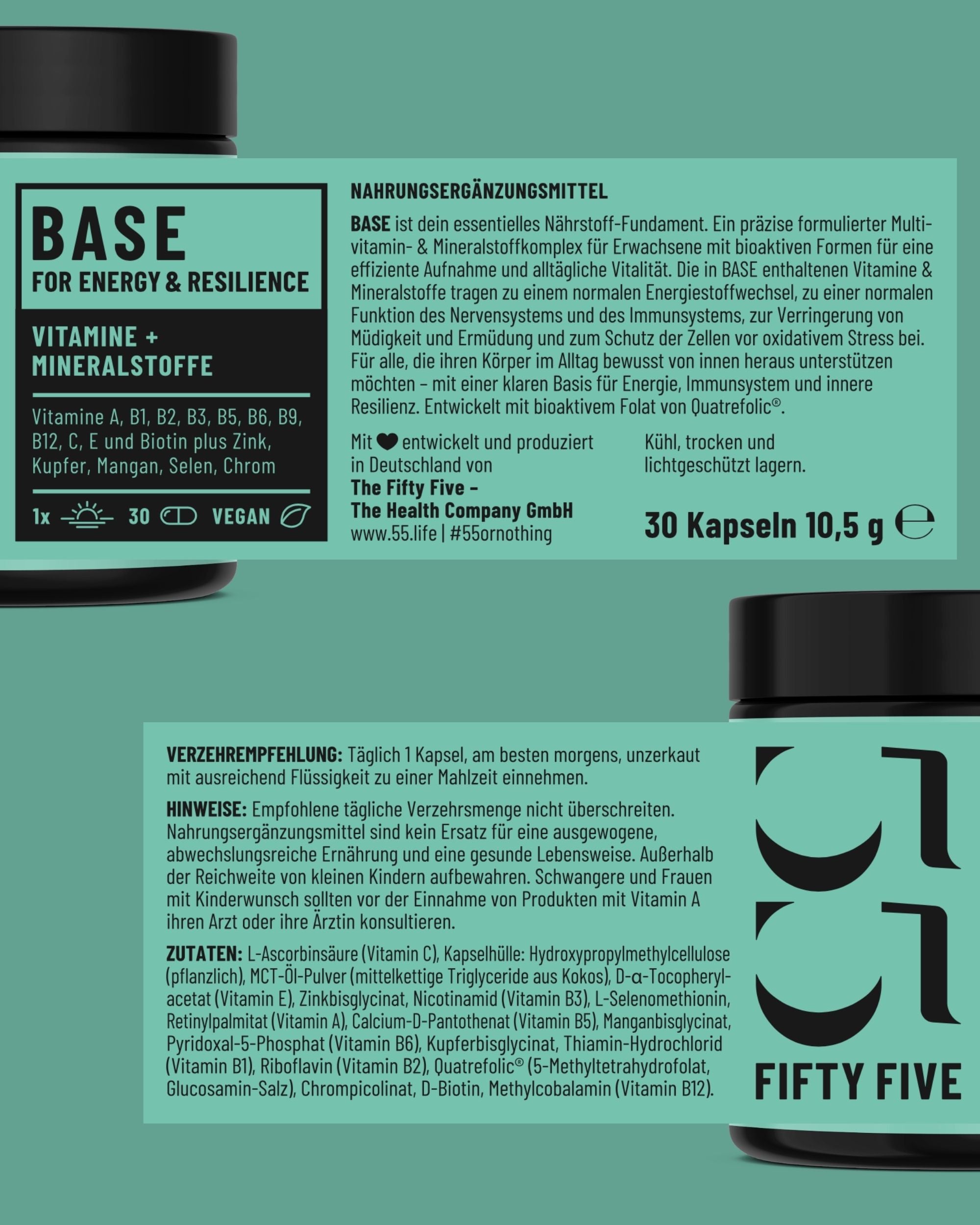
Especially with high-quality formulations, it is worth looking at the concrete form selection. BASE visibly follows this foundation logic: Quatrefolic® 5-MTHF, methylcobalamin, P-5-P, and bisglycinate forms for selected minerals are not show elements but signals of a clean base architecture. What matters here is not the claim "more effect for everyone" but the functional idea behind it: high-quality, sensible forms in an everyday-friendly balance instead of megadoses and ingredient overload.
Which micronutrients a foundation typically contains
A solid multivitamin covers several functional groups.
B vitamins: energy production and nervous system
B vitamins act as cofactors in numerous metabolic processes.
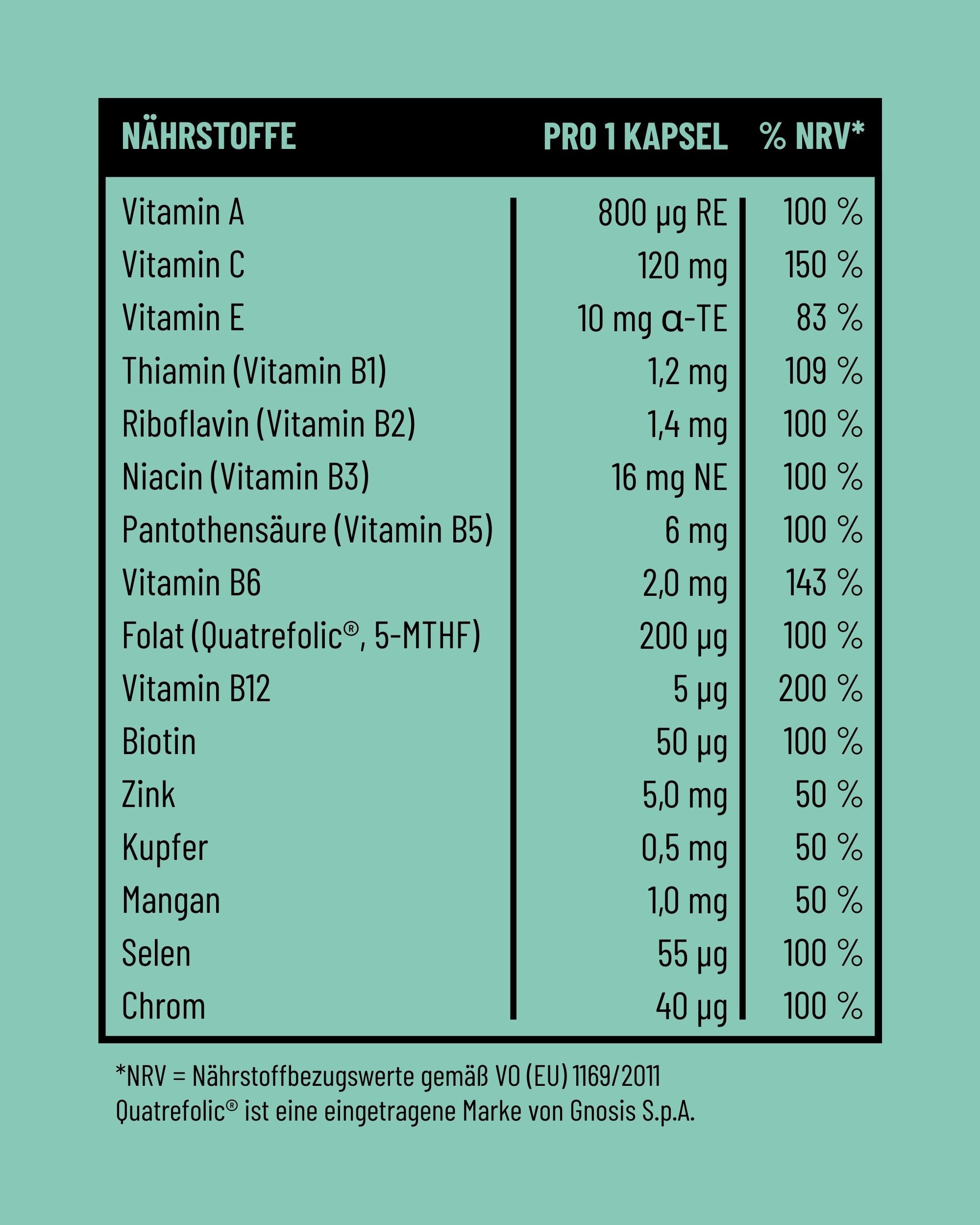
BASE contains:
- Vitamin B1 (thiamine)
- Vitamin B2 (riboflavin)
- Vitamin B3 (niacinamide)
- Vitamin B5 (pantothenic acid)
- Vitamin B6 as P-5-P
- Biotin (vitamin B7)
- Folate as Quatrefolic®
- Vitamin B12 as methylcobalamin
This group supports, among other things:
- energy metabolism
- the nervous system
- cell division
Antioxidant vitamins: cell protection
Metabolic processes generate free radicals that can put strain on cells.
The most important antioxidant vitamins include:
- Vitamin C (L-ascorbic acid)
- Vitamin E (D-alpha-tocopheryl acetate)
- Vitamin A (retinyl palmitate)
They contribute to the normal function of the immune system and the protection of cells from oxidative stress.
Trace elements: small amounts, big impact
Trace elements act as components of many enzymes.
BASE contains, among others:
- Zinc bisglycinate
- Selenium as L-selenomethionine
- Chromium picolinate
- Manganese bisglycinate
- Copper bisglycinate
These nutrients support various processes such as:
- metabolic regulation
- cell protection
- enzymatic functions
Using chelate forms can improve absorption in the digestive tract.
Why BASE was deliberately formulated as a foundation
BASE does not follow the logic of a "mega multivitamin" or an "all-in-one product."
The idea behind it is considerably simpler and clearer: creating a stable daily foundation.
That is why BASE combines:
- bioactive B vitamin forms
- antioxidant base vitamins
- organic trace elements
- balanced dosages
Instead of as many ingredients as possible, the formulation concentrates on essential micronutrients in high-quality form. The goal is not a spectacular high-dose strategy but a structure that works in everyday life long term.
With the evaluation framework in place, BASE can be assessed soberly. The product is meant as a daily foundation, not a high-dose intervention. Exactly for this reason, the formulation does not follow the logic of "as much as possible per capsule" but a broad, functional balance of vitamins and minerals. The goal is not a nutrient showcase but a base that fits into a daily routine.
Why a foundation is often more sensible than a jumble of individual products
Many supplement routines fail not from lack of information but from too much complexity. One single substance for focus here, something for training there, plus something "just in case," and suddenly the stack consists of products whose relationship to each other is barely clear anymore. Exactly at this point, a foundation often becomes more sensible than a jumble of individual products.
The practical advantage is simple: less complexity increases the probability that a routine actually works long term. If you do not want to make five decisions every morning, a clean base is often the more robust solution. Individual products are not fundamentally wrong. They can be very sensible when there is a clear reason. But without a foundation, they quickly become an unsorted construction in which specialty topics replace the basic logic.
That is why the order matters. A multivitamin can serve as the base on which specific additions can be sensibly placed. In the Fifty Five system, that is exactly the idea:
- BASE → foundation for daily baseline supply
- CALM → magnesium for recovery and relaxation
- RISE → the vitamin D system
- PULSE → omega-3 supply
BASE takes the foundation role, while CALM, RISE, and PULSE are conceived more topic-specifically. Baseline supply and specialization are not mixed. That is not only cleaner but also more honest about the actual function of the products.
For you, this is mainly relevant if you want to do something for your everyday supply but have no appetite for product chaos. A good routine does not have to be maximally complex. It has to be comprehensible and repeatable. This is exactly where the reduction principle shows: first a calm foundation, then and only then additions when a clear purpose is recognizable.
This also protects against two common misconceptions. First: more forms do not automatically mean more quality. Second: a lot does not automatically help a lot. A good foundation does not make specialty products superfluous, but it prevents you from projecting specialty roles into a base product or building a stack that is barely consistently executable in everyday life.
Briefly summarized
A multivitamin can make sense when:
- your dietary routine is irregular in everyday life
- you do not want to manage a complex supplement routine
- you are looking for a stable base instead of individual specialty solutions
A good foundation is characterized by:
- balanced dosage
- sensible nutrient forms
- a clear overall structure
Not meant is:
- a replacement for diet
- a solution for every health situation
- a high-dose product with a maximum ingredient list
Is a multivitamin currently sensible for you?
In the end, the decision comes down to a few clear questions. Is your diet patchy or unsteady over longer periods? Do you not want to manage complex stacks? Are you looking for a base instead of a performance-oriented specialty product? Then a multivitamin can be rather sensible. Not as an obligation, but as a pragmatic complement to a dietary routine that does not always succeed ideally in everyday life.
If you are already very consciously, structurally, and permanently well supplied, a multivitamin often has no high priority. Then it does not solve a real problem but supplements out of habit. And if you have concrete complaints, a suspected deficiency, or a medical question, the decision belongs not in a general baseline logic but in a targeted evaluation.
The same sobriety applies to the concrete product choice. If you are looking for a base, look first at balance, forms, and everyday usability. A long ingredient list or high-dose promises say little about whether the product is sensibly built for your situation. A good foundation is not loud but coherent.
BASE fits exactly this user situation: as a reliable daily base for people who are not looking for an overdose spectacle but a balanced formulation with functional form selection. Not more than diet, not less than a clean structure for everyday supply.
The practical decision rule
Ask yourself three simple questions:
Is my diet consistent and well plannable in everyday life?
If not → a baseline supply can make sense.
Do I want to manage several individual products?
If not → a multivitamin can create structure.
Do I have concrete complaints or a suspected deficiency?
If yes → medical evaluation instead of blanket supplementation.
FAQ
Is a multivitamin really worth it?
Yes, but not as a blanket answer for everyone. A multivitamin can make sense if your daily diet does not always reliably cover all essential micronutrients. Especially with a hectic daily life or irregular meals, a balanced baseline supply can help.
For whom is a multivitamin particularly sensible?
Above all for people with an irregular diet, high workloads, or limited meal plannability. It can also make sense within athletic routines when performance products are already being used but no clean baseline supply exists.
Can a multivitamin replace diet?
No. A multivitamin complements diet but does not replace it. It is meant as a foundation, not as a solution for an overall unbalanced lifestyle.
How do you recognize a good multivitamin?
By balance, sensible forms, a transparent formulation, and everyday usability. What matters is not the longest ingredient list but whether the product is logically built as a base.
Are high-dose multivitamins better?
No, not necessarily. More dosage does not equal more quality. For a daily foundation, a balanced, functional formulation is often more sensible than an aggressive high-dose logic.
What is the difference between a multivitamin and individual supplements?
A multivitamin covers the basic logic of a baseline supply. Individual supplements make more sense when there is a clear reason or a specific goal and the foundation is already in order.
Conclusion
The question "Is a multivitamin worth it?" has no universal answer.
It depends less on a theoretical ideal diet than on your real everyday routine.
If your diet is stable, varied, and plannable, a multivitamin is often not the priority.
If days are hectic, meals improvised, and routines shifting, a balanced baseline supply can help make your supply more robust.
A good multivitamin does not replace anything. But it can create a calm foundation on which your system operates.
→ To the complete multivitamin guide
Disclaimer:
This article is for informational purposes only and does not replace medical advice, diagnosis, or treatment by a physician or pharmacist. The information provided here should not be used for self-diagnosis or self-treatment. Food supplements are no substitute for a balanced, varied diet and a healthy lifestyle. For any health questions or complaints, please always consult a doctor you trust. Fifty Five accepts no liability for any inconvenience or harm resulting from the use of the information presented here.
Sources
- German Nutrition Society (DGE). D-A-CH reference values for nutrient intake.
- EFSA. Dietary reference values (overview).
- German Federal Institute for Risk Assessment (BfR). Maximum levels for vitamins and minerals in food supplements.
- European Commission. EU Register of nutrition and health claims.
- Robert Koch Institute (RKI). DEGS – German Health Interview and Examination Survey for Adults.









Recognizing Magnesium Deficiency: Symptoms, Causes & What Really Helps
Omega-3: How to Cover Your Needs and What DHA and EPA Really Do
Share: