


A, B, C, D, E, K. Magnesium, zinc, selenium, copper. Plus omega-3, folate, B12. The market turns micronutrients into a complexity problem. The basic question is simpler: what does your body really need, and what is just noise?
The right perspective matters here. Your body needs essential micronutrients, meaning vitamins and minerals it requires for normal body functions but cannot produce itself in sufficient amounts. Baseline supply in this context means a daily, balanced supply of essential micronutrients without high-dose logic. And bioactive forms are nutrient forms that are functionally directly usable or well established within a product logic.
So it is not about collecting as many substances as possible. It is about creating a solid foundation that fits your daily life. Diet remains the basis. Supplements can complement this basis but not replace it. If you want to go deeper into the principle of a baseline micronutrient supply, you will find the larger framework there.
Quick definition:
Your body needs above all essential vitamins and minerals that stably support daily basic functions, not as many individual substances as possible at maximum doses.
- Essential means: physically necessary, not optional.
- Relevance depends on function, diet, and daily life.
- Form and ratio count too, not just the name.
- Not meant is: the more ingredients, the better.
If you are looking for orientation, start with the baseline supply instead of stacking individual substances.
Your body needs a micronutrient foundation, not an endless list
Your body needs essential vitamins and minerals for normal body functions. Really needing them does not mean every person should immediately take every substance as a supplement. It means that certain micronutrients are physiologically fundamental and come into focus particularly often in a modern routine when it comes to a solid base.
Exactly here, foundation thinking helps. Instead of evaluating a new individual product every week, it is worth understanding the daily baseline supply first. For many people, the problem is not biohacking complexity but the opposite: too little overview combined with too many options. If you are looking for orientation in daily life between irregular meals, high strain, and a general interest in prevention, a clearly built foundation is often more helpful than an overloaded pile of individual solutions.
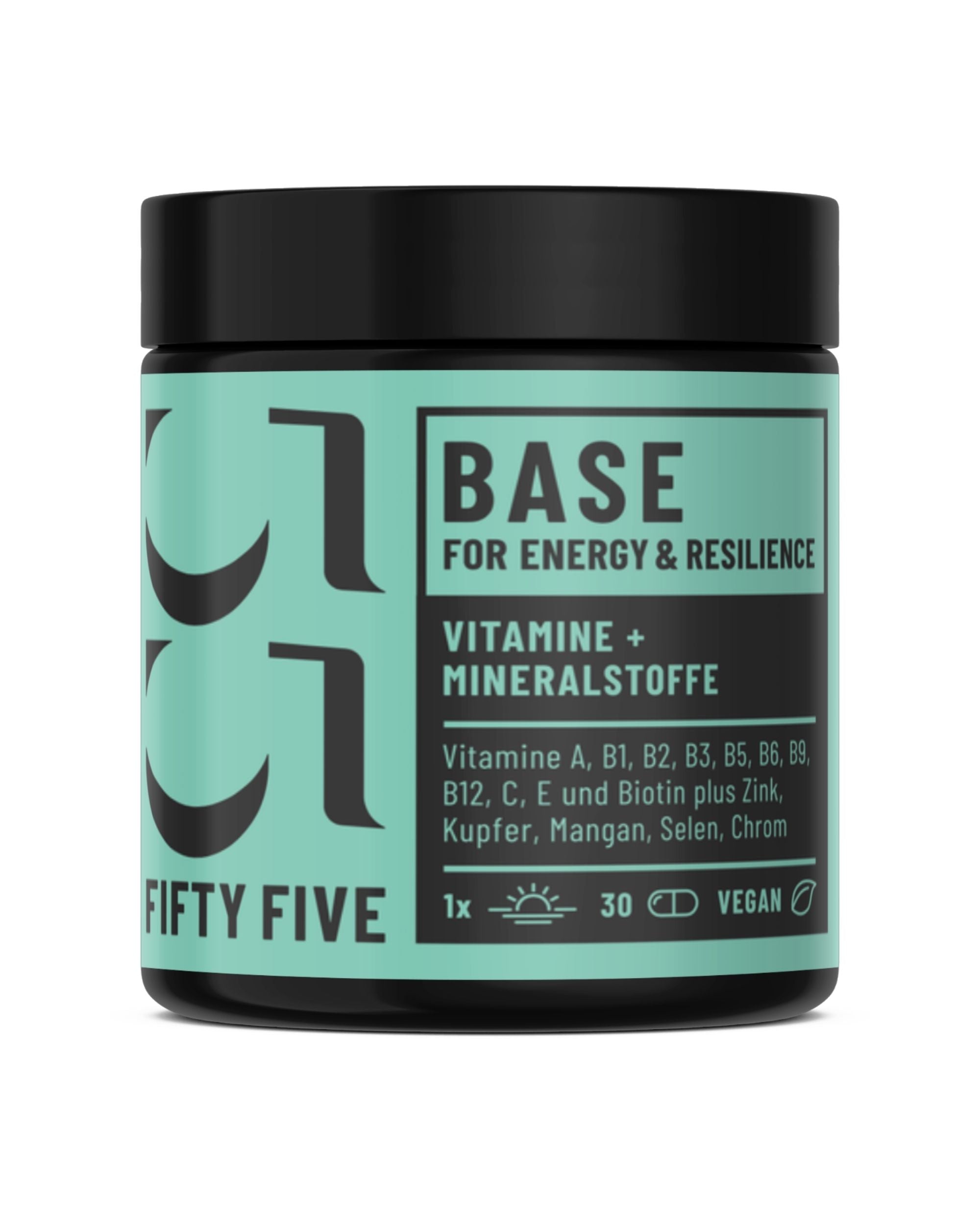
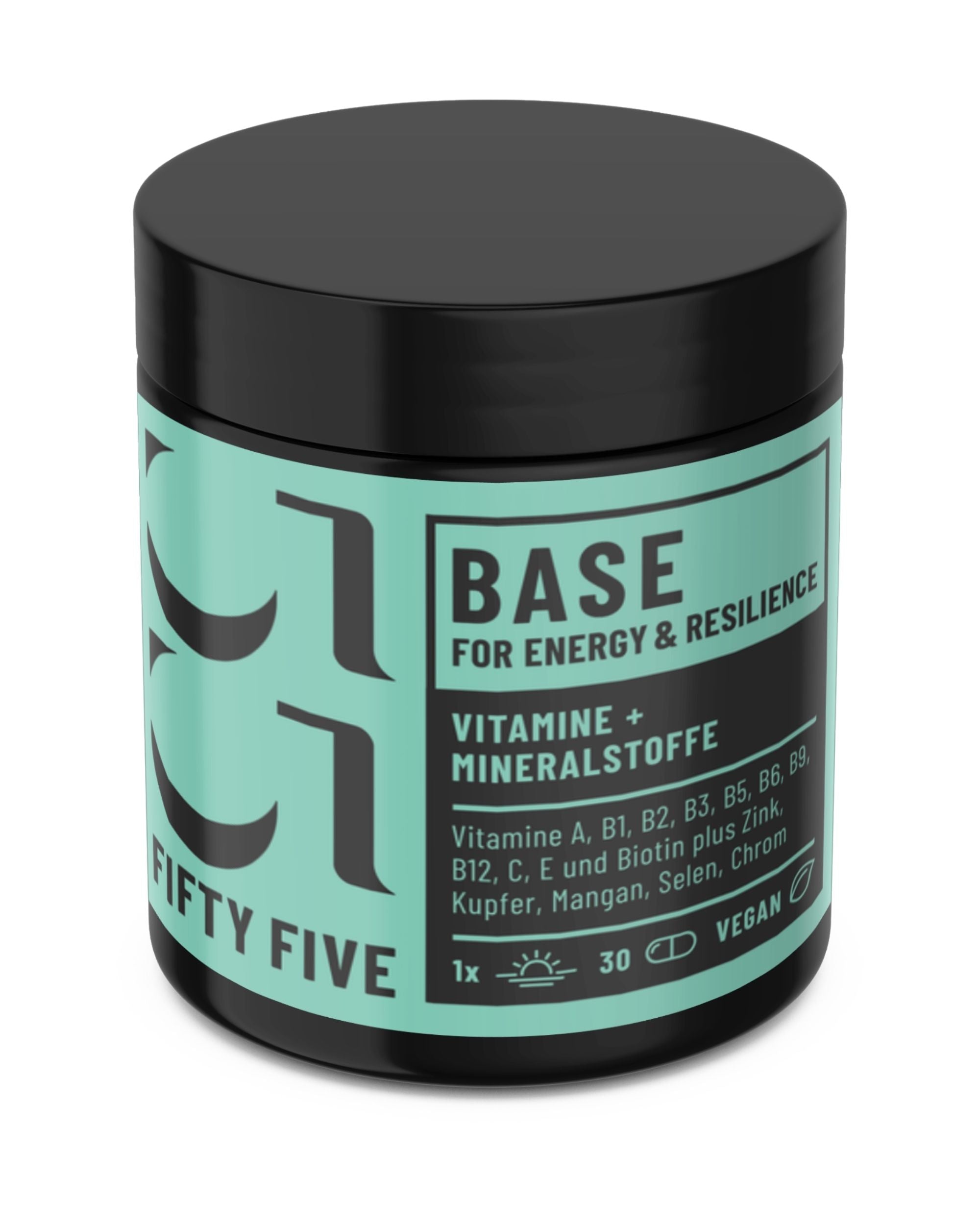
BASE by Fifty Five stands in this logic for a functionally balanced base. Not as a high-dose multivitamin that puts as much as possible on the label, but as a structured basic supply. Diet remains the basis of every routine. A product like BASE is not meant as a replacement for a varied diet but as a complement where an everyday-friendly, consistent supply can make sense.
The product separation also matters. RISE and CALM do not follow the idea of "more is better." They are meant as targeted additions when a context of its own is better represented separately. This role logic is deliberately kept simple:
| Product | Task | Central ingredients | Why separate or as the base |
|---|---|---|---|
| BASE | daily foundation | vitamins and trace elements | broad baseline supply |
| RISE | targeted system addition | vitamin D3, vitamin K2, vitamin E | its own D3/K2/E context |
| CALM | targeted magnesium logic | magnesium bisglycinate, magnesium citrate, vitamin B6 | its own magnesium and recovery context |
So if you are sitting in front of a shelf or browser tab wondering whether you really need ten different products, the sober answer is usually: probably not. What counts first is whether your foundation is solidly built. Everything else should follow from function and daily life, not from marketing pressure.
Which vitamins your body really needs
Vitamins belong to the essential micronutrients your body needs daily for normal processes. These include fat-soluble vitamins like vitamins A, D, E, and K as well as water-soluble vitamins like vitamin C and selected B vitamins. For a baseline supply, what matters is not taking along every conceivable vitamin idea but specifically covering those vitamins that carry many basic functions.
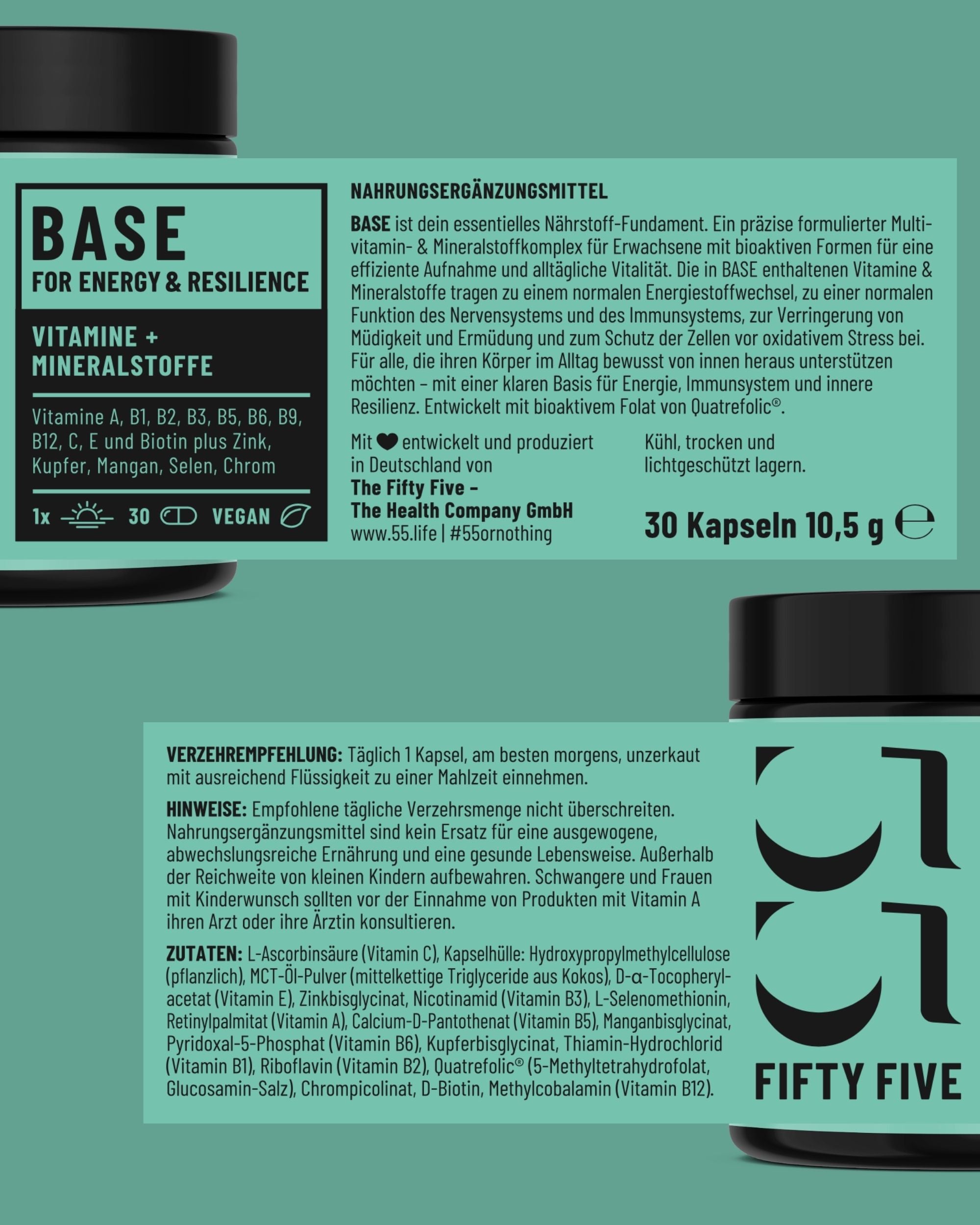
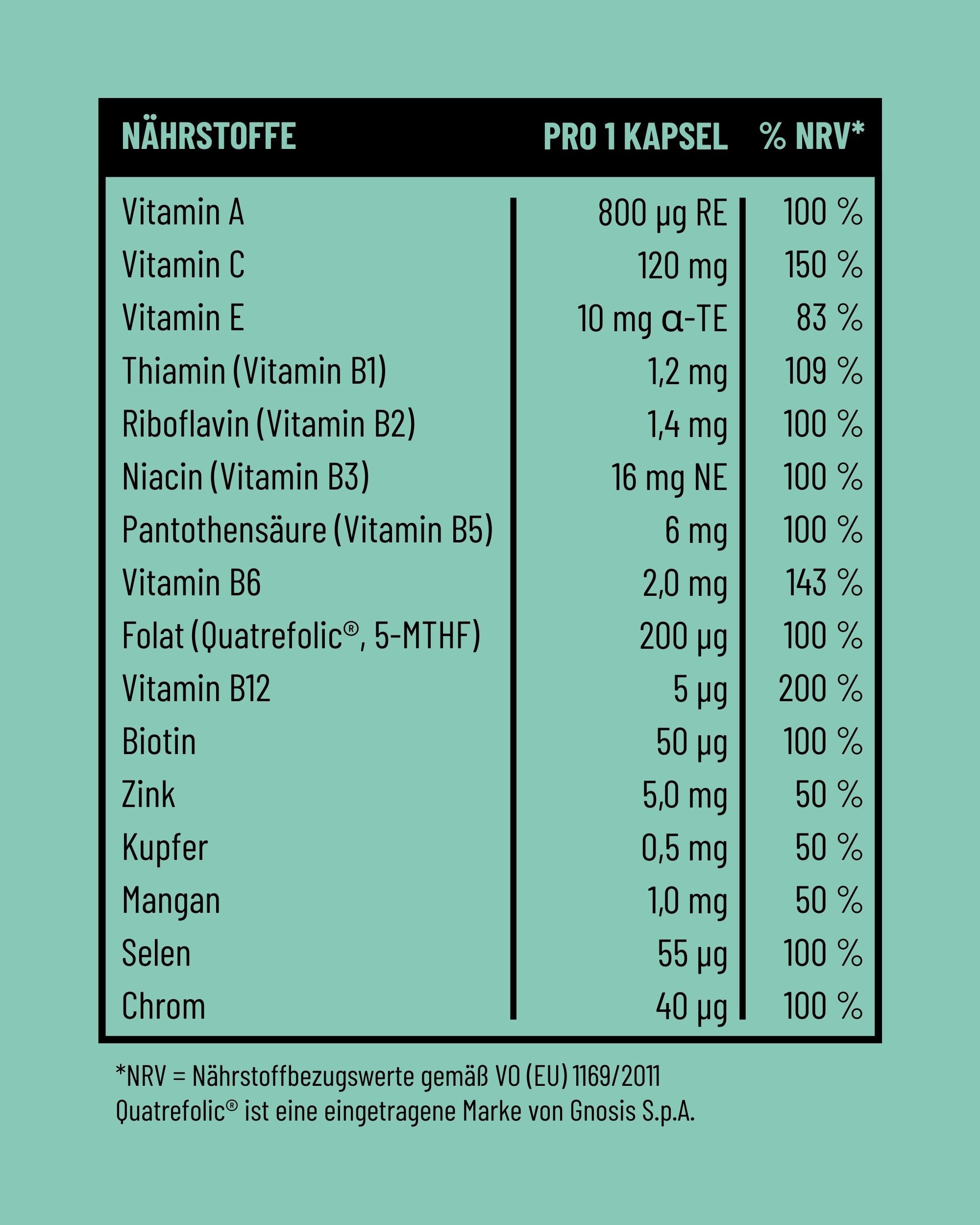
In Fifty Five BASE, the focus lies exactly on this logic. It contains vitamin A as retinyl palmitate, vitamin C as L-ascorbic acid, vitamin E as D-alpha-tocopheryl acetate, and central B vitamins: thiamine, riboflavin, P-5-P monohydrate as the active B6 form, Quatrefolic® 5-MTHF as the folate form, methylcobalamin as the B12 form, D-biotin, and calcium D-pantothenate. This selection follows no collecting passion but a functional coverage of relevant base roles.
Vitamin A contributes, among other things, to the normal function of the immune system, the maintenance of normal skin, and normal iron metabolism. Vitamin C contributes to the normal function of the immune system, normal energy-yielding metabolism, and the protection of cells from oxidative stress. Vitamin E likewise contributes to the protection of cells from oxidative stress. The B vitamins are particularly relevant because they are connected to areas like energy metabolism, nerve function, psychological function, blood formation, and homocysteine metabolism.
One thing stands out: vitamins D and K are often discussed together but are deliberately not tucked into a general base solution as a casual mini admixture here. In the Fifty Five logic, this context runs specifically through RISE with vitamin D3, K2, and vitamin E. That is no accidental omission but a clean system decision. If you want to understand vitamin D3 and K2 together, this separation quickly makes sense.
Especially with the B vitamins, the form question is often communicated in an unnecessarily complicated way. For the user, what mainly matters is that the chosen forms are functionally established and reduce the interpretation effort. So it is not about a "B complex for the complex's sake" but about a well-connected coverage of basic functions.
The base vitamins in everyday life
In everyday life, you rarely notice in isolation which vitamin theoretically stands for which reaction. Functional clusters are more relevant. That is exactly why a baseline supply is well conceived when it connects to typical everyday situations: long days, irregular meals, mental strain, little structure in eating behavior, or the wish to keep a routine simple and consistent.
Several of the vitamins contained in BASE contribute to normal energy-yielding metabolism. That applies in particular to vitamin C as well as B1, B2, B6, B12, biotin, and pantothenic acid. Others play a role in the normal functioning of the nervous system or psychological function. Still others contribute to normal blood formation, normal cell protection, or the maintenance of normal skin. For you in everyday life, this does not mean a single vitamin "solves everything." It means certain vitamin groups together support many basic functions your body depends on daily.
If you are wondering which vitamins are relevant daily, exactly this perspective helps more than any long ingredient list. What matters is not whether a product sounds spectacular but whether it cleanly represents the base for a daily routine. Especially with skin, hair, nails, nerve function, or energy metabolism: in everyday life, the topic is rarely a single hero nutrient but a reliable basic supply.
Why not every vitamin should be weighted equally
Not every vitamin is equally important in a daily baseline supply. That sounds counterintuitive at first because every vitamin list usually looks as if all points always had to be prioritized equally. Practically, that is not true. For a foundation, what counts above all are those vitamins that carry many basic functions simultaneously and are broadly relevant in an everyday routine.
That is why vitamin C and several B vitamins often play a particularly central role in base products. They are closely linked to everyday functional clusters many people can immediately relate to: energy metabolism, nerve function, psychological function, blood formation, and cell protection. Vitamin A and vitamin E round off this basic logic without it having to become a maximalist full program.
Other topics are better placed separately depending on the product logic. Exactly there it shows why not every good addition automatically belongs in a single multivitamin. A clear structure is often more helpful than leveling. For you as a reader, the decision becomes easier this way: first understand what belongs to the base. Then check whether an additional context is even relevant.
Which minerals your body really needs
Besides vitamins, your body needs essential minerals and trace elements. Here too: not every theoretically possible ingredient is automatically part of a well-thought-out daily baseline supply. More relevant is which minerals carry a lot systemically in small amounts and are logically integrated into a functionally balanced routine.
In Fifty Five BASE, the focus is on zinc bisglycinate, copper bisglycinate, L-selenomethionine, manganese bisglycinate, and chromium picolinate. This selection covers important trace elements without making the mistake of wanting to press every topic into a single product. Zinc contributes to normal acid-base metabolism, normal cognitive function, and the normal function of the immune system. Selenium contributes to normal thyroid function and the protection of cells from oxidative stress. Copper contributes to normal energy-yielding metabolism and the maintenance of normal connective tissue. Chromium contributes to the maintenance of normal blood glucose levels and the normal metabolism of macronutrients. Manganese contributes to normal energy-yielding metabolism and the protection of cells from oxidative stress.
These substances are typical quiet base players. They rarely dominate advertising but are relevant in the product architecture because they are not conceived in isolation as "heroes" but in relation to each other. Exactly for this reason, balance matters more here than label volume.
Magnesium is a special case in this logic. It is without question a relevant mineral but is not forcibly packed into every base product at maximum dose. Instead, it is worth representing a dedicated magnesium context cleanly. That is exactly what Fifty Five CALM stands for, with magnesium bisglycinate, magnesium citrate, and vitamin B6. That is no gap in the system but a deliberately separated use case. Anyone wanting to understand more deeply how to assess such differences will find the right deep dive in the article on magnesium forms compared.
Trace elements that are often underestimated
Trace elements often look inconspicuous on the label, precisely because they occur in smaller amounts. In everyday life, they are therefore easily underestimated. Yet their strength lies exactly there: small amounts, large systemic relevance. If you only look at big milligram numbers, you quickly overlook how important a good ratio within a baseline supply is.
Zinc, selenium, copper, chromium, and manganese are good examples. They are not meant as isolated marketing stars but as part of a nutrient matrix. For you, that practically means: a product is not automatically better because a single mineral is dosed particularly high. Often the calmer, more balanced solution is the more sensible one, especially if you are looking for a daily routine and want to avoid overstacking.
If you want to engage more closely with trace elements at a glance, this look is particularly worthwhile. Many wrong decisions arise not from too little interest but from too much focus on individual substances instead of the whole.
Why magnesium is often thought of separately
Magnesium is frequently discussed very broadly. Exactly for this reason, it is helpful to distinguish between baseline needs and a specific use occasion. Not every product has to solve every topic at the same time. If you are simply looking for a micronutrient base during the day, a clean baseline supply is something different from an addition that connects more strongly to calm, switching off, or recovery in everyday life.
CALM follows this targeted logic with two magnesium forms and vitamin B6. That makes sense above all because magnesium in everyday life is often perceived not just abstractly as "also important" but within a specific usage context. Anyone paying more conscious attention to recovery in the evening or wanting to structure their routine clearly often thinks about magnesium differently than a general multivitamin.
The demarcation matters: this is no healing claim and no promise against sleep or stress problems. It is a question of clean product architecture. A dedicated magnesium context can often be represented more understandably and more everyday-friendly than trying to half-explain it within a base product.
Everything worth knowing about effects, needs, forms, and supplementation is summarized in our comprehensive magnesium guide.
Why "which nutrients?" alone is not enough: form, ratio, and dosage
The pure question of which nutrients are included is not enough. Two products can look similar on paper and still differ noticeably in their logic. For a good baseline supply, what counts besides the nutrient name are the chemical form, the dosage, the ratio to other substances, tolerability, and the integration into a daily routine.
Exactly here, the philosophy behind Fifty Five BASE becomes visible. BASE is conceived as a foundation instead of a high dose. The product logic relies on bioactive or functionally established forms where they make sense for the daily structure. These include Quatrefolic® 5-MTHF instead of unspecific folate labels, methylcobalamin instead of a blanket B12 mention, P-5-P as the active B6 form, and selected bisglycinate compounds for minerals. These decisions are not meant to impress but to simplify: less interpretation effort, clearer roles, better connectivity in the routine.
The same principle applies to the separation within the system. RISE uses an oil-based matrix for D3, K2, and E because this context has a different product logic than a general foundation. CALM combines two magnesium forms because different roles can be smartly brought together within a magnesium product. Form follows function, not label aesthetics.
For you, this is relevant above all because "more forms," "more milligrams," or "more ingredients" are not reliable quality criteria. A good nutrient matrix arises not from overloading but from deliberate selection. Anyone wanting to understand why the form of a nutrient counts arrives exactly at this point: not everything that looks like a lot is better as an everyday system.
Why BASE is not an overloaded high-dose multivitamin
Many multivitamin products try to convince with maximum numbers. That sounds strong at first but often leads to overload in practice. BASE deliberately takes a different path. The product is not designed as a buzzword solution of "maximal" but for daily usability.
This restraint is not a sacrifice but a decision. A functionally balanced foundation can be more effective in everyday life than a high-dose approach where substances are merely added up. Less competition between ingredients, a clearer product role, and a comprehensible routine matter more here than an aggressive label. If you are fundamentally asking whether a multivitamin is worth it or not, exactly this distinction is decisive.
Why RISE and CALM are not simply "also included"
RISE and CALM are not separate because someone wanted to artificially create more products. They are separate because their tasks have their own contexts. BASE covers the base. RISE addresses the D3/K2/E system logic specifically. CALM addresses the magnesium and recovery context specifically.
Exactly this clear product boundary makes the system more understandable. You do not have to read out of an overloaded all-in-one solution which part is actually meant for which daily life. Instead, the role distribution stays clear. That reduces overwhelm and supports a routine that did not arise by chance.
Which nutrients are particularly relevant for daily baseline supply
If you want to condense the question to its essence, the nutrients most relevant for daily baseline supply are those that carry many normal basic functions and integrate well into a regular routine. These especially include B vitamins, vitamin C, vitamin A, vitamin E, and the trace elements zinc, selenium, copper, chromium, and manganese.
This group also forms the core logic of BASE. It covers no theoretical full assortment but a prioritized foundation. That is helpful above all if you do not want to manage every substance individually in everyday life but are looking for a structured, broad basic supply. From this perspective, it also becomes clear why not every user question should be answered with "take even more."
Depending on your individual context, vitamin D and K as well as magnesium can additionally be relevant. However, these topics are not automatically part of the same product role. Exactly for this reason, Fifty Five separates daily baseline supply from targeted addition. Omega-3 is also frequently discussed in connection with a comprehensive routine but does not automatically belong to the same logic and is deliberately not deepened here.
| Nutrient group | Examples | Role in everyday life | Why in BASE / why separate |
|---|---|---|---|
| Base vitamins | B vitamins, vitamin C, A, E | everyday energy, nerve function, cell protection | core of the daily baseline supply |
| Trace elements | zinc, selenium, copper, chromium, manganese | broad basic functions, balance | quiet base players in BASE |
| D/K system | vitamin D3, K2, E | its own supplementation context | targeted via RISE |
| Magnesium | bisglycinate, citrate | its own everyday and recovery context | targeted via CALM |
If you want to derive a practical evaluation logic from this overview, the article is a multivitamin worth it or not helps as the next step. There it is explained exactly how to recognize whether a foundation is logically built for you.
Quick definition:
Fifty Five deliberately separates baseline supply and targeted addition: BASE covers the foundation, RISE and CALM solve specific additional contexts.
- BASE relies on a balanced daily micronutrient base.
- RISE bundles D3, K2, and E specifically.
- CALM focuses the magnesium logic for calm and recovery.
- Not meant is: everything relevant must go into one product.
For whom a multivitamin like BASE fits
A multivitamin like BASE fits above all people who do not live a perfect dietary routine but are looking for a clear base instead of many individual products. That includes, for example, people with irregular meals, high everyday load, or the wish to avoid overstacking and unnecessary overload.
Maybe you know exactly this scenario: you eat consciously in principle, but not the same every day. Sometimes fresh meals are missing, sometimes the day is too packed, sometimes you simply do not want to coordinate five different jars and capsules. Then the first topic is often not the next specialty solution but a solid structure. BASE is conceived to connect to exactly this kind of daily life.
At the same time, the limit remains important. A base product is no diagnostics and no substitute for medical evaluation when a concrete deficiency is suspected. It is also not meant to cover medical special cases. Anyone navigating pregnancy, competitive sports, clinical deficiency therapies, or other special life stages frequently needs a more individual assessment.
The strength of a product like BASE therefore lies not in maximum promises but in its everyday usability. A foundation must be consistent, broadly connectable, and understandable. Exactly from this, benefit arises: less product chaos, more clarity in the daily routine.
Conclusion: your body does not need a micronutrient show but a functional base
Your body needs essential vitamins and minerals. But it needs them clearly structured, not randomly accumulated. What is really relevant is a functional foundation of micronutrients that broadly supports normal body functions in everyday life without slipping into high-dose or overload logic.
Exactly therein lies the system idea of Fifty Five. BASE stands for the baseline supply. RISE and CALM complement this base where a dedicated context can be represented more clearly, more focused, and more everyday-friendly. This separation makes decisions easier because product roles remain understandable.
So if you are facing the question of which vitamins and minerals your body really needs, the best answer is not "everything." The better answer is: foundation first, then targeted addition only where it is logical. You can find more on the long-term assessment in the article foundation instead of high dose.
Decision aid
- If you want to avoid many products → rather a clear baseline supply like BASE.
- If you are mainly looking for a daily foundation → rather prioritize vitamins and trace elements.
- If you want to cover the D3/K2 context specifically → rather add RISE.
- If you want to deliberately place magnesium in its own recovery/regeneration context → rather add CALM.
- If you suspect a concrete deficiency → rather get it medically evaluated instead of stacking on your own.
FAQ
Which vitamins should you have daily?
For daily baseline supply, B vitamins, vitamin C, vitamin A, and vitamin E are most relevant. Which supplement makes sense, however, depends on diet, daily life, and product logic.
Which minerals are really important?
Particularly relevant for a baseline supply are often zinc, selenium, copper, manganese, and chromium. Magnesium is also important but is often thought of separately depending on the context.
Is a healthy diet alone enough?
A varied diet remains the foundation. Supplements can help if you want to complement an everyday-friendly base, but they do not replace a good diet.
Is a multivitamin worth it?
A multivitamin can make sense if you are looking for orientation, consistency, and a broad base. What matters is that it is functionally balanced and not just maximally filled.
Which form of vitamin B12 or folate is better?
Forms like methylcobalamin for B12 and 5-MTHF for folate are often chosen when a clearly defined product logic is desired. What matters is less the form hype than an overall coherent nutrient matrix.
What is the difference between baseline supply and targeted addition?
Baseline supply means a daily foundation of essential micronutrients. Targeted addition addresses additional contexts that do not have to be sensibly packed into the same product role.
Why are vitamin D3 and K2 often combined?
Vitamin D3 and K2 are frequently discussed together because they are often thought of in a shared supplementation context. In a clear product architecture, this combination can therefore be well represented separately.
Why is magnesium often offered separately?
Magnesium frequently has its own usage context in everyday life. It is therefore often more understandable and everyday-friendly not to integrate it merely as a side substance into a base product.
Disclaimer:
This article is for informational purposes only and does not replace medical advice, diagnosis, or treatment by a physician or pharmacist. The information provided here should not be used for self-diagnosis or self-treatment. Food supplements are no substitute for a balanced, varied diet and a healthy lifestyle. For any health questions or complaints, please always consult a doctor you trust. Fifty Five accepts no liability for any inconvenience or harm resulting from the use of the information presented here.






Recognizing Multivitamin Quality: What Really Matters When Buying
Recovery Without Blind Spots: How Markus Actively Shapes His Recuperation
Share: