• Das Öl ist wirklich sehr klar und das Beste: absolut kein fischiger Nachgeschmack, was bei Omega-3 sonst oft ein Problem ist.

    David O. Verified purchase

  • Endlich muss ich nicht mehr diese riesigen Softgels schlucken. Die Flüssig-Kapseln sind super.

    Mia K. Verified purchase

  • Geschmacklich absolut neutral. Das Öl ist so klar wie Wasser, man sieht die Qualität sofort. Beste Entscheidung für meine vegane Ernährung.

    Lara Y. Verified purchase

For Heart & Mind

For heart, brain and eyes, without fish

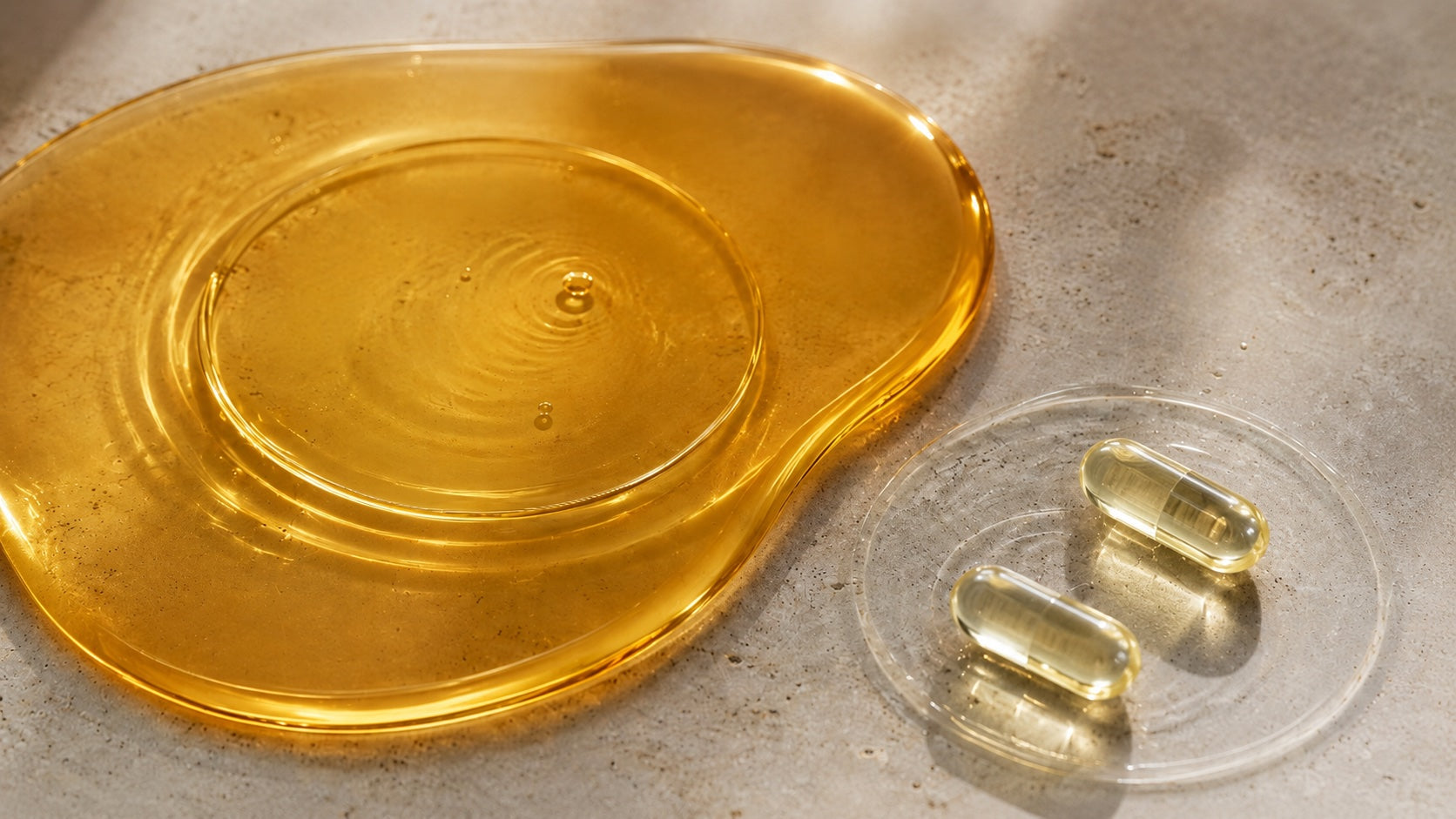
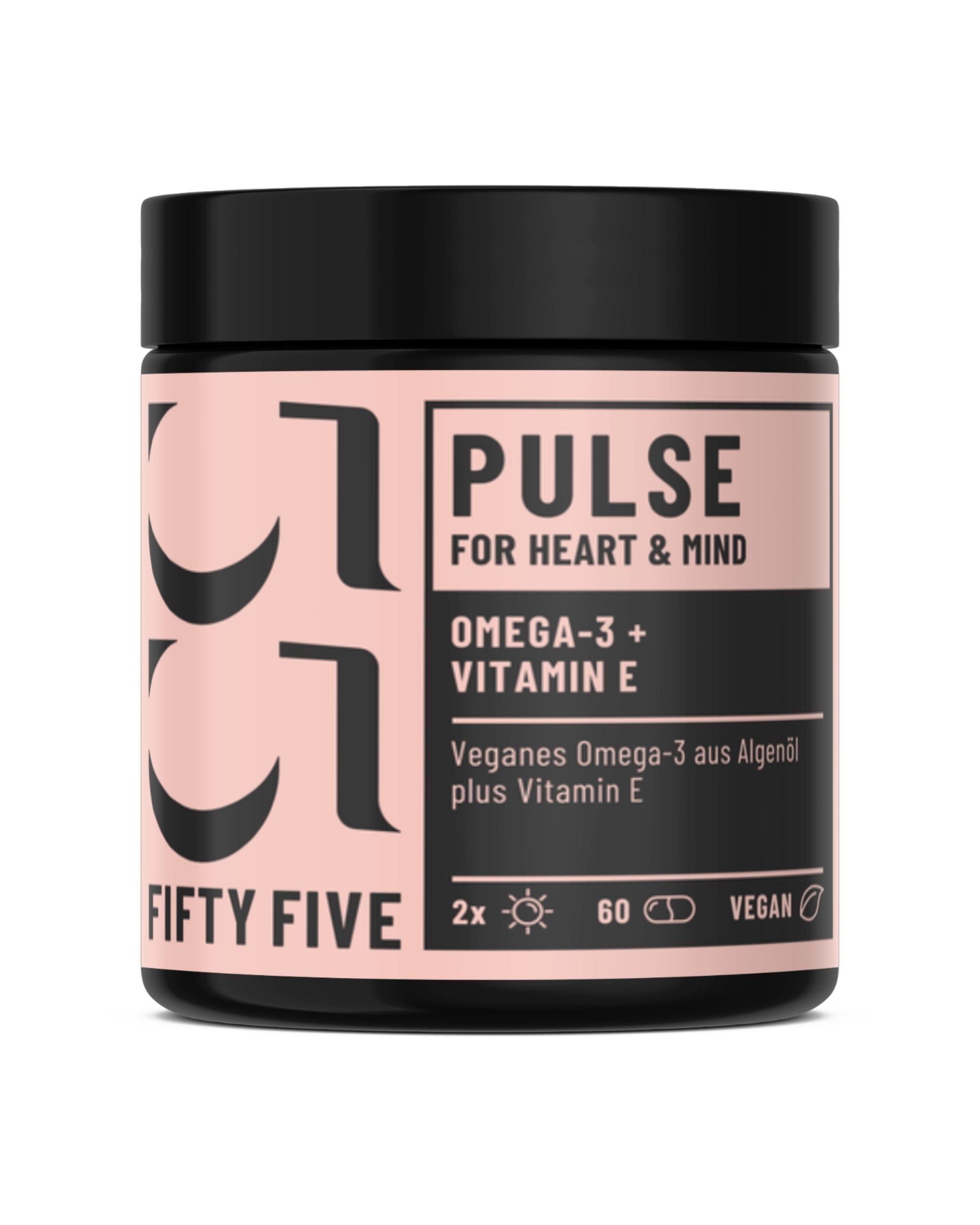
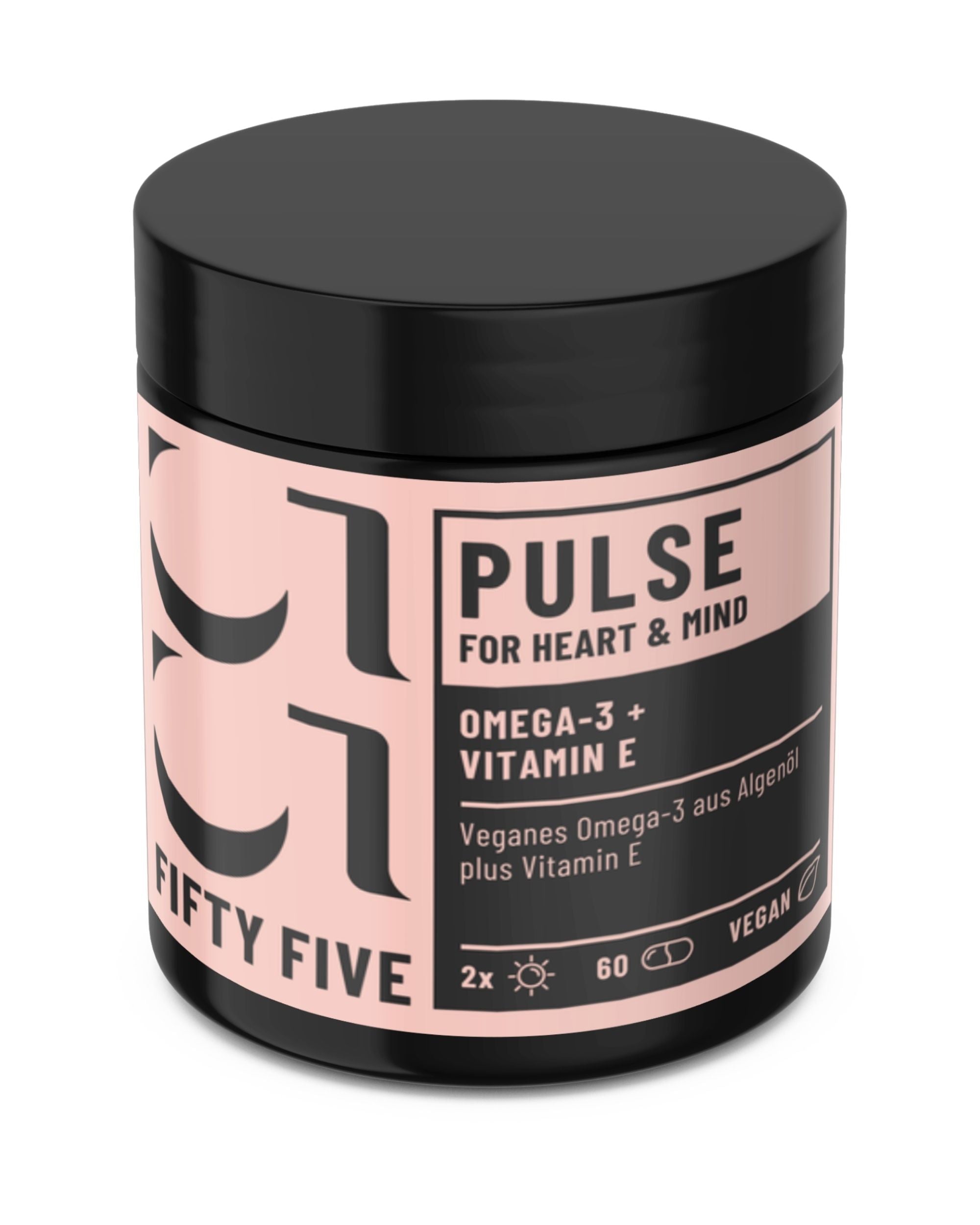
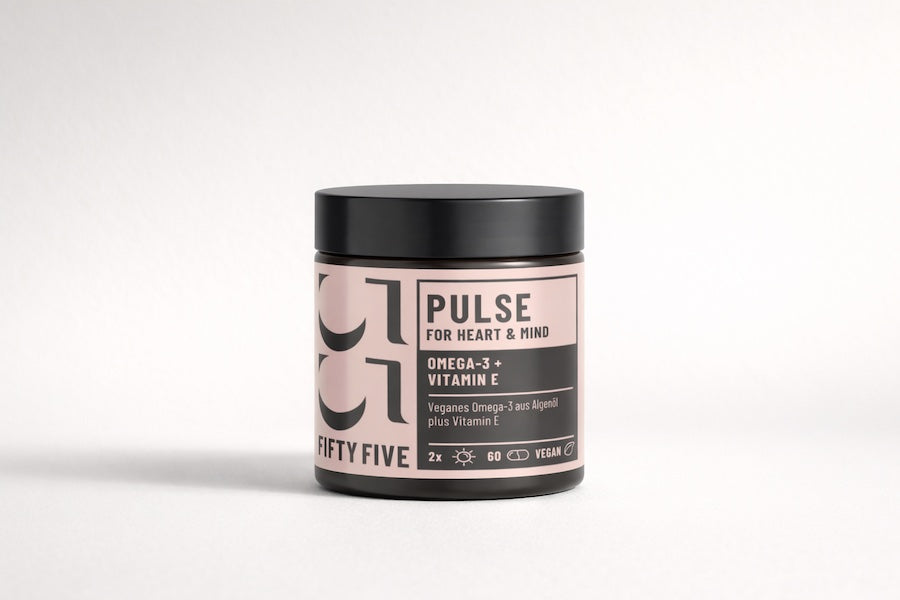
PULSE supplies you every day with vegan omega-3 from the premium algae oil life’s®OMEGA, in plant-based liquid caps that are pleasant to swallow.

No fish. No aftertaste. No compromise. Most people who supplement omega-3 rely on fish oil. Yet fish are not the source, algae are: fish store omega-3 because they eat algae. PULSE takes DHA and EPA straight from the source, in natural triglyceride form, which the body absorbs far better than the widespread ethyl ester form. Plus natural vitamin E, which protects the delicate fatty acids from oxidation.

Read more in the journal: Omega-3: effects, requirements and the best source. The complete guide →

The difference

How PULSE compares

Omega-3 is measured in EPA and DHA, not in how much oil sits in the capsule.

Comparison with typical products in each category. Individual products may differ.

Compare with
PULSE
Fish oil capsules Fish oil
Flaxseed oil & ALA sources Flaxseed
EPA + DHA directly available, not converted from ALA first

Plant oils supply ALA. Your body converts only a small share of it into EPA and DHA, and those two are the fatty acids this is about.

648 mg EPA + DHA per daily dose, amounts stated separately

It isn’t the amount of oil that counts, but the EPA and DHA in it. With PULSE both amounts are stated separately on the pack.

Natural triglyceride form

This is the form omega-3 fatty acids occur in naturally. Ethyl esters are created when fish oil is concentrated and are absorbed less well.

From cultivated algae, no fishing

The algae grow in closed systems. No pressure on stocks, no bycatch question.

No fishy taste, no repeating

The most common reason omega-3 ends up back in the cupboard after a few weeks.

Vegan, plant-based liquid caps instead of gelatine softgels

Softgels are usually made from bovine or fish gelatine. PULSE uses a plant-based shell.

Vitamin E as oxidation protection

Omega-3 fatty acids are sensitive to oxygen. Vitamin E keeps them stable, in the product and in the body.

  • applies
  • partly / depends on the product
  • typically not

The formula

Every ingredient, in its active form

Vegan omega-3 straight from the source: algae oil. Why we formulated PULSE exactly this way and deliberately chose branded algae oil over fish oil.

Omega-3: life’s®OMEGA algae oil, triglyceride form

Omega-3 is a family of essential fatty acids. The ones that matter are EPA and DHA, and those the body cannot produce in any meaningful amount itself.

TriglycerideEthyl ester
Why it matters

Fish oil contains EPA and DHA, but fish do not produce the two fatty acids themselves, they take them up from algae. So we go straight to the source and use life’s®OMEGA, a premium branded algae oil. It comes as a triglyceride, the way fat occurs in food, and not as an ethyl ester, which only appears when fish oil is concentrated.

DHA: Docosahexaenoic acid from algae oil

DHA is a long-chain omega-3 fatty acid and a building block of the brain and the retina. It contributes to the maintenance of normal brain function and normal vision.

6 double bonds
Bioavailable form
Why it matters

Through food, DHA comes almost only from oily sea fish. Anyone who does not eat it has hardly any source, since the body converts only a few per cent of plant-based ALA. That is why we dose 432 mg of DHA per daily serving in PULSE. The beneficial effect is obtained with a daily intake of 250 mg of DHA.

EPA: Eicosapentaenoic acid from algae oil

EPA is the second long-chain omega-3 fatty acid alongside DHA. Together, EPA and DHA contribute to the normal function of the heart.

5 double bonds
Bioavailable form
Why it matters

Most algae oils supply almost only DHA. The fact that this one also carries EPA in a meaningful amount is why we chose this particular raw material: together they add up to 648 mg per daily serving. The beneficial effect is obtained with a daily intake of 250 mg of EPA and DHA.

Vitamin E: D-alpha-tocopheryl acetate

Vitamin E is a fat-soluble vitamin that embeds itself in the cell membrane. It contributes to the protection of cells from oxidative stress.

1 natural 7 others
Bioavailable form
Why it matters

Omega-3 fatty acids are sensitive to oxygen. The natural vitamin E in PULSE keeps them stable, in the product and in the body.

Nutrients and ingredients

What is inside

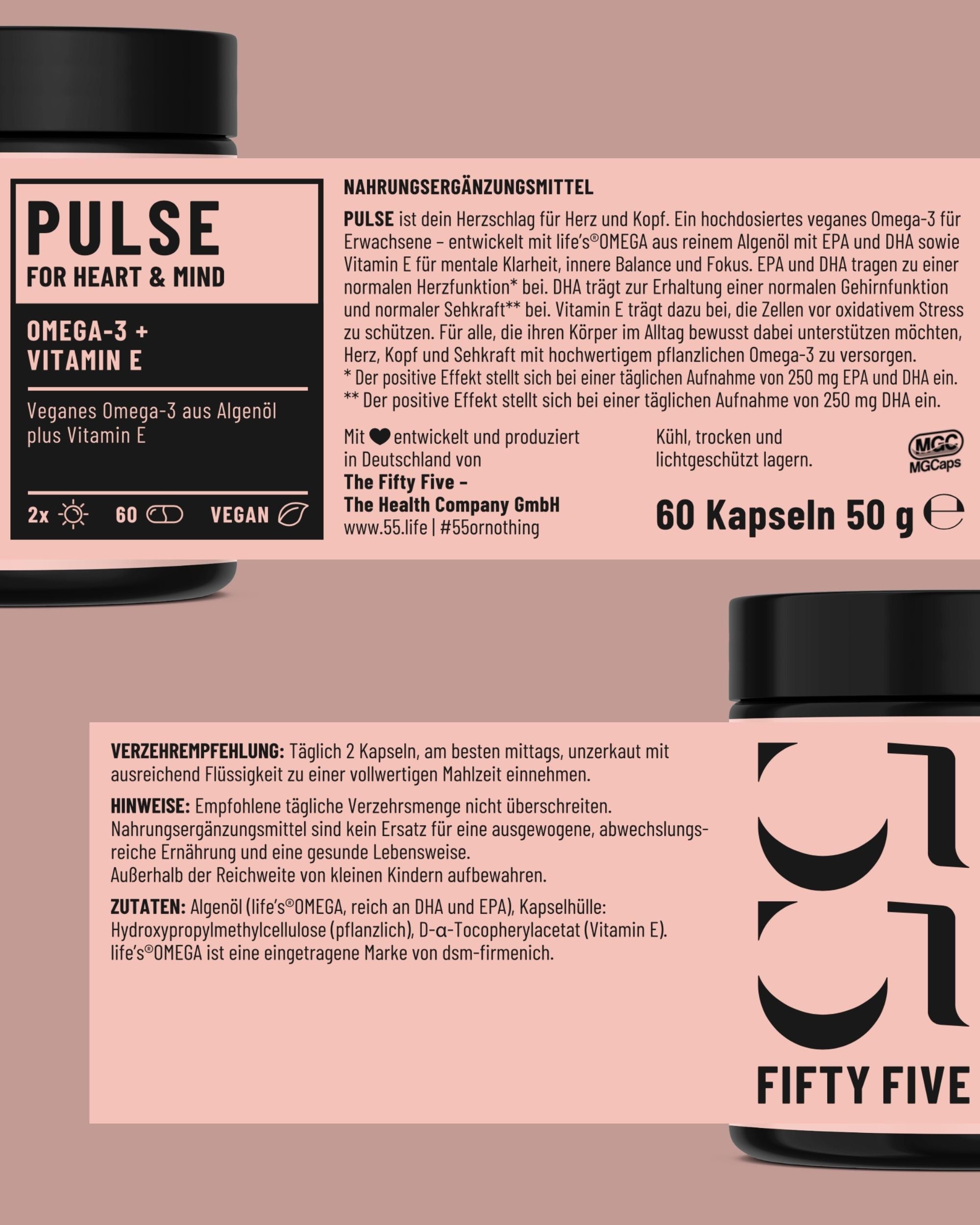
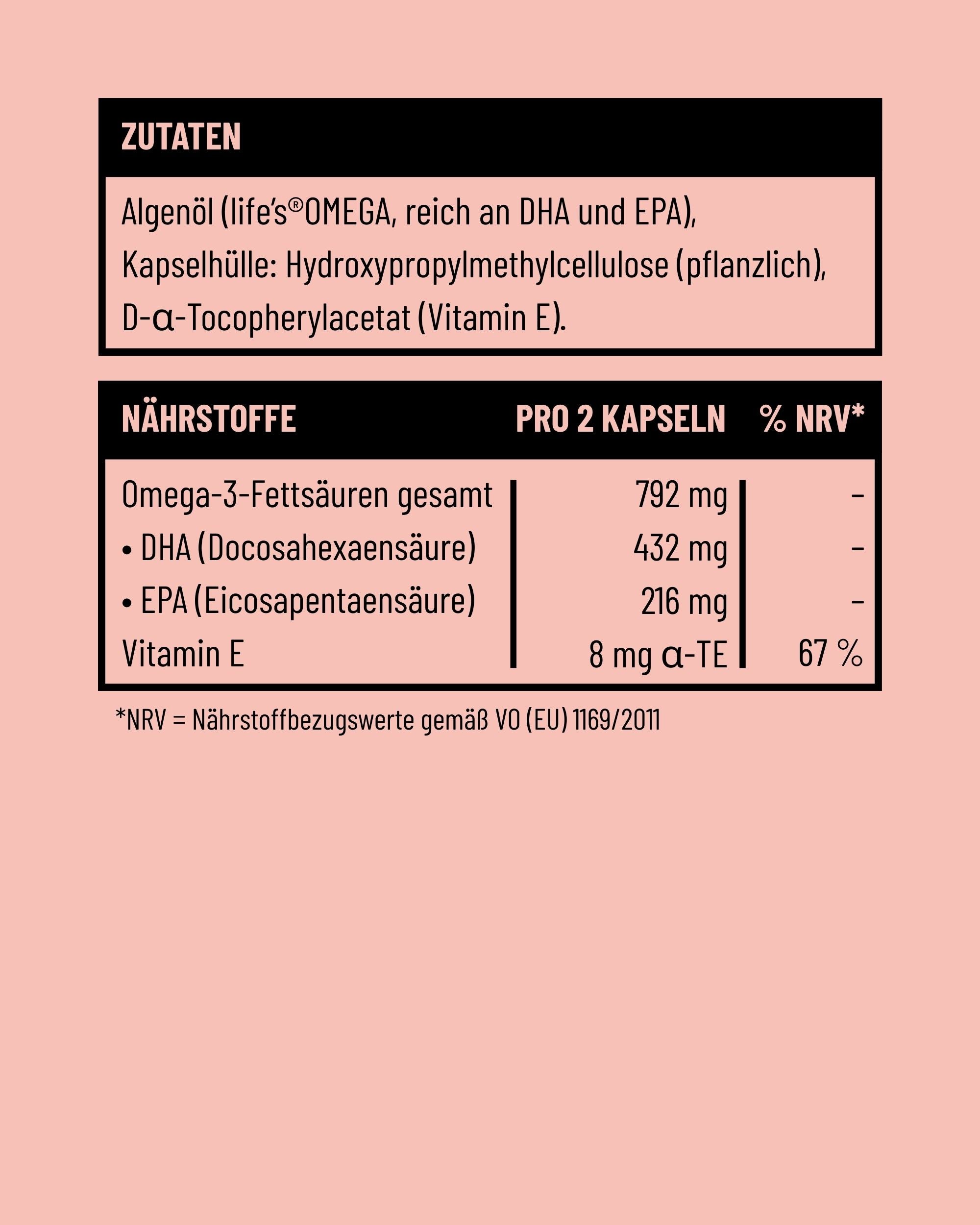
Nutrientsper 2 capsules% NRV*
Total omega-3792 mg-
- of which DHA (docosahexaenoic acid)432 mg-
- of which EPA (eicosapentaenoic acid)216 mg-
Vitamin E8 mg67%

*NRV = Nutrient Reference Values according to Regulation (EU) No. 1169/2011

Ingredients

Algenöl (life’s®OMEGA, reich an DHA und EPA), Kapselhülle: Hydroxypropylmethylcellulose (pflanzlich), D-α-Tocopherylacetat (Vitamin E).

Hand hält eine goldene PULSE Liquid-Cap zwischen Daumen und Zeigefinger

The capsule

Not a softgel, liquid caps

Omega 3 almost always comes in cheap soft gelatine softgels. We fill the algae oil into a plant based liquid capsule with a special seal instead. It takes more effort, and it is at the same time the reason PULSE does not feel like the usual fish oil supplement.

Format
Liquid cap with a clear, smooth shell. Easier to swallow than a softgel.
Intake
Two liquid caps daily.
When
With a main meal containing fat, so lunch or dinner. That is where absorption is best.
Shell
100 % vegan: capsule shell made from plant based cellulose (HPMC), gelatine free.

Your new daily routine

What changes for you in 90 days

Omega-3 is not a booster, it is building material. DHA and EPA build themselves into the membranes of your cells, in heart, brain and eyes, and those renew slowly, over months. That is exactly why PULSE tells the longest story in the current range.

  1. Day 1 Straight from the source

    Two liquid caps daily with a meal, ideally one with a little fat. They contain 1,440 mg of algae oil per daily dose, with 792 mg of important omega-3 fatty acids, of which 432 mg DHA and 216 mg EPA. You notice the first difference to fish oil right away: a clear capsule, no fishy smell, no aftertaste.

  2. Day 30 The routine is set

    One month, the same dose every day, and your blood shows it first: the plasma level follows intake within a few days. Cell membranes take longer, they are only restocked when cells are rebuilt. What is already there: heart, brain and eyes get daily what is otherwise missing without fish on the plate.

  3. Day 60 The membranes fill up

    Two months, and a good half of your red blood cells have by now been built with PULSE, they live around 120 days. The omega-3 index, which measures exactly that, rises demonstrably. This is the state PULSE builds: a heart that is supplied, a head that stays clear, and eyes that last through the screen day.

  4. Day 90 Next stop: the new normal

    Three months, three jars, supplied every day. The omega-3 index needs three to four months to reach its plateau: with jar three you are well on your way, with jar four you have arrived. Welcome to the new normal. Many only notice how much that is worth when they pause. So: do not pause. Stay with it, for good.

    Secure your 90-day supply3 jars · −6 %

Change takes time

60 to 90 days, to be precise.

First the supply: omega-3 only works if something comes in daily. Red blood cells live around 120 days, and every new cell builds its membrane from what is in the blood right now. Until then your account builds up day by day.

Then the routine: the bigger part of the change happens in your head. A new daily action takes 66 days* on average before it runs automatically. Until then the capsules are a resolution you make anew every day. Around day 60 they become a habit, from day 90 they are simply part of your day.

90 days, that is your path from the first resolution to the new normal, and with the fourth jar you have arrived.

* Lally et al., European Journal of Social Psychology 2010: 66 days on average.

What PULSE supports you with

  • Heart EPA and DHA contribute to the normal function of the heart.
  • Brain DHA contributes to the maintenance of normal brain function.
  • Eyes DHA contributes to the maintenance of normal vision.
  • Cell protection Vitamin E contributes to the protection of cells from oxidative stress.
  • Dose The beneficial effect is obtained with a daily intake of 250 mg of DHA, or of EPA and DHA. PULSE delivers 648 mg.

Morning to evening

Complete your day

PULSE builds from within. BASE, RISE and CALM complete the day.

Build your own routine: choose which Essentials belong to your day and how long your supply should last. From three Essentials you save, with a bigger supply even more.

  1. Morning
  2. Midday
  3. Evening
Your advantage: 10 % You save €11,26
Total €112,96€101,70 just €2,72 per day

incl. VAT Free shipping

No code needed, the advantage is already deducted in your cart.

Georg, the Founder of Fifty Five in a close-up portrait
Quote Icon

90 days are a promise you make to yourself. Here is mine: I believe real quality does not need explaining, it shows in what it does. That is why every jar holds only what your body really needs, and nothing that burdens it. No hidden additives, no gimmicks, no mediocrity. Just a clear formula, day after day. For you and for me, only one thing counts: #55ornothing.

— Georg Roscher, founder of Fifty Five

Answers to the most important questions

FAQ

Is PULSE the right product for me?

PULSE is ideal for anyone who wants to supply heart, brain and eyes with DHA and EPA every day. It makes particular sense if you rarely eat oily fish or follow a plant-based diet and want to add EPA and DHA entirely without fish.

Can I combine Pulse with other products?

Yes, PULSE complements our Daily Essentials perfectly: RISE, our vitamin D3/K2, CALM, our magnesium, and our multivitamin complex BASE. All Daily Essentials products are coordinated so they can be stacked perfectly.

Algae oil or fish oil: which is better?

Fish don't produce DHA and EPA themselves. They take up the fatty acids from microalgae and store them. Algae oil delivers the same omega-3 fatty acids straight from the source, without the detour via fish. That has practical advantages: the oil comes from algae grown under controlled conditions rather than from the open sea, it is 100 % vegan, tastes neutral and spares fish stocks. For the effect, the source doesn't matter: DHA and EPA contribute to normal heart function, and DHA additionally to the maintenance of normal brain function and vision. PULSE provides 432 mg DHA and 216 mg EPA per daily dose.

Read more in the Journal: Fish Oil or Algae Oil: Where Omega-3 Really Comes From

How much omega-3 (DHA and EPA) per day?

The European Food Safety Authority states 250 mg of DHA and EPA per day as the amount at which omega-3 contributes to normal heart function. If you rarely or never eat oily fish, you will hardly reach this amount through your diet. According to EFSA, an intake of up to 5 g of DHA and EPA daily from supplements is considered safe. With two liquid capsules, PULSE provides 648 mg of DHA and EPA per day, a good two and a half times the reference value. That is deliberately more than the minimum, but far from megadoses.

Read more in the Journal: Omega-3 Dosage: How Much DHA and EPA You Need Daily

When should you take omega-3, morning or evening?

The time of day doesn't matter, the meal does. Omega-3 fatty acids are absorbed much better with some fat. So take PULSE with a main meal, at lunch or in the evening, and not on an empty stomach. More important than timing is consistency: your omega-3 status builds up over eight to twelve weeks. If you want to know where you stand, you can have your omega-3 index measured with a blood test.

Read more in the Journal: Recognizing Omega-3 Deficiency: Which Symptoms Are Typical and How to Check Your Status

Is flaxseed oil enough as an omega-3 source?

Flaxseed oil is a good source, but of a different omega-3 fatty acid: alpha-linolenic acid (ALA). The body can convert ALA into EPA and DHA, but only to a small extent, for DHA usually below five percent. If you want to supply DHA and EPA directly, you need a direct source: oily fish or algae oil. Flaxseed oil still makes sense: ALA contributes to the maintenance of normal blood cholesterol levels. So PULSE and flaxseed oil complement each other, they don't replace each other.

Read more in the Journal: DHA or EPA: What Does What in Your Body?

What does triglyceride form mean and why is vitamin E included?

In natural oil, omega-3 fatty acids are present as triglycerides, just as in fish or in the alga itself. Many cheap concentrates, by contrast, are ethyl esters: they are formed during chemical concentration and are absorbed less well by the body, especially without a fat-containing meal. PULSE uses life’s®OMEGA algae oil in its natural triglyceride form. Vitamin E is not decoration: omega-3 fatty acids are sensitive to oxygen, and vitamin E contributes to the protection of cells from oxidative stress. It protects the oil in the capsule and complements the formula in the body.

Read more in the Journal: Omega-3: How to Cover Your Needs and What DHA and EPA Really Do

From the journal

Omega-3

Goldenes Öl und zwei transparente HPMC Liquid-Caps visualisieren die Balance zwischen Omega-6 und Omega-3.

Omega-6 and Omega-3: Why the Ratio Matters More Than the Absolute Amount

Most people think of amount when it comes to omega-3. Yet the ratio to omega-6 is just as decisive. In the Western diet, this ratio is on average 15:1; 4:1 would be optimal. That is no detail, that has consequences.
Read more

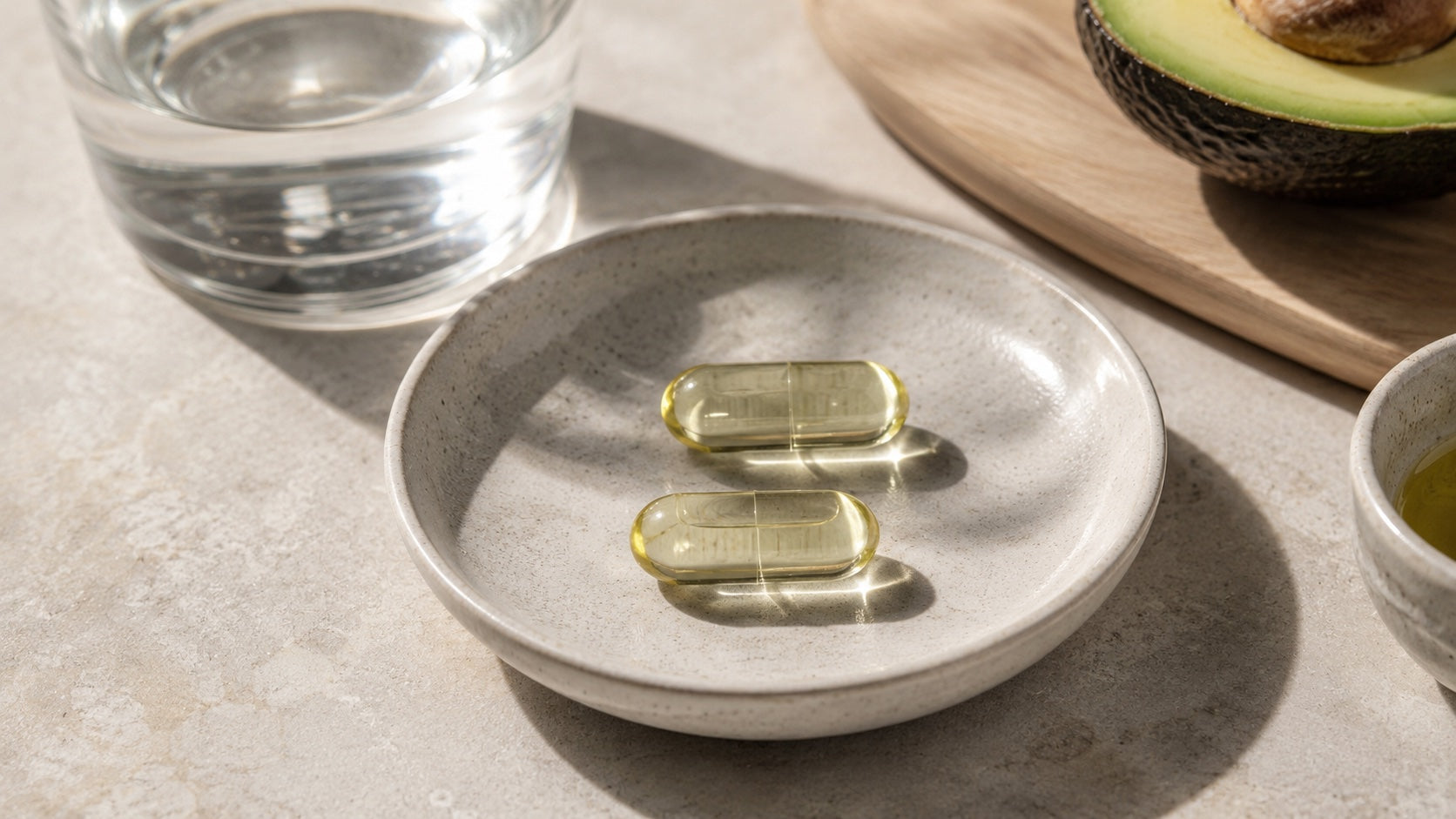
Zwei transparente Omega-3 HPMC Liquid-Caps auf einem Keramikteller mit Glas Wasser und Avocado.

Omega-3 Dosage: How Much DHA and EPA You Need Daily

The EFSA recommendation of 250 mg EPA+DHA daily is a minimum value, not a target. Anyone who wants to know how much omega-3 really fits their daily life needs more than a single number. What the recommendations say, when more makes sense, and how to optimize intake and timing. Everything on the right omega-3 dosage.
Read more

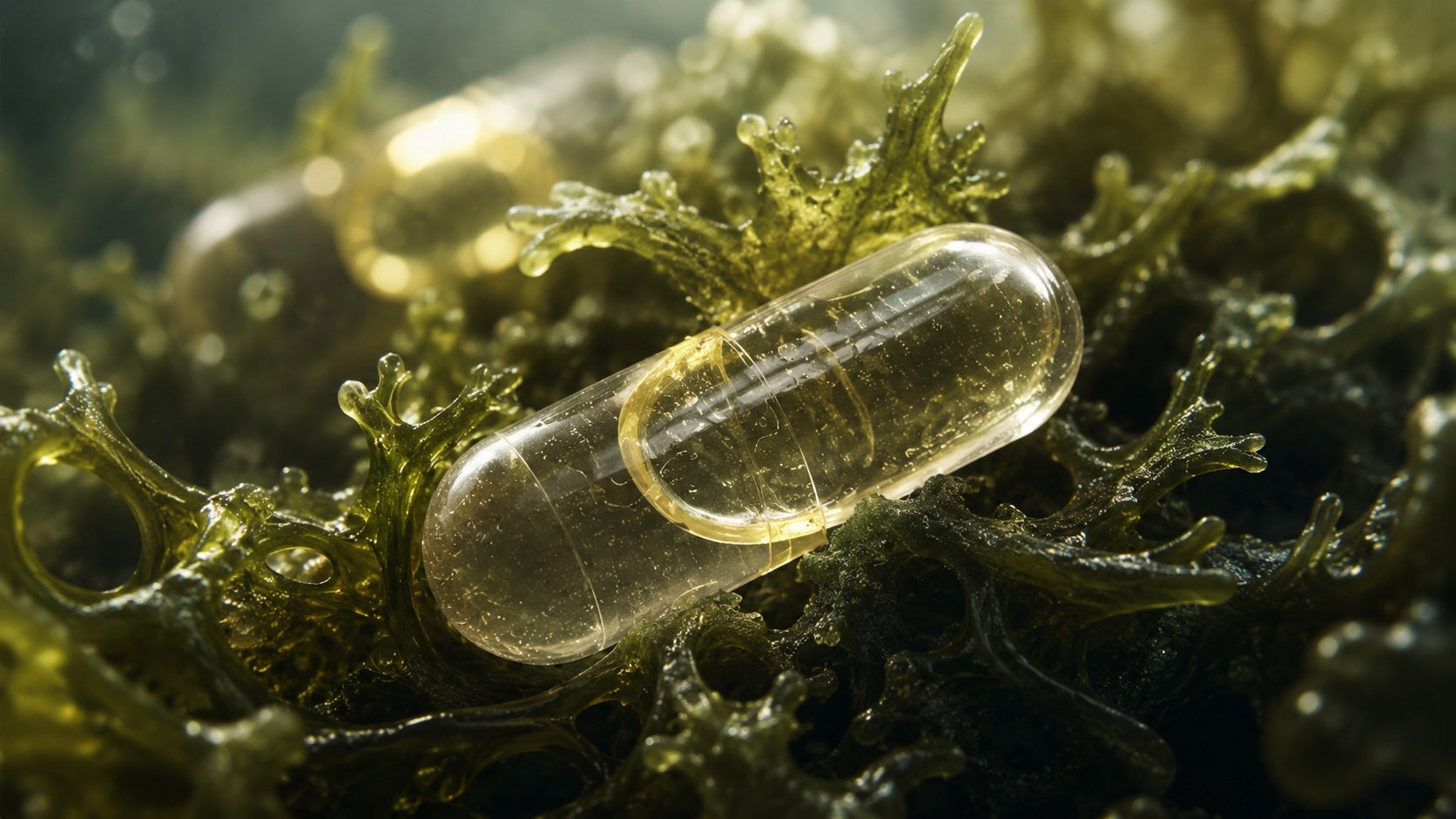
Omega-3 HPMC Liquid-Cap mit Algenöl liegt in einer grünen Mikroalgen-Struktur als Hinweis auf die pflanzliche Quelle.

Fish Oil or Algae Oil: Where Omega-3 Really Comes From

Fish is considered the omega-3 source par excellence. Yet fish do not produce DHA or EPA themselves. They eat it. Anyone who understands this also understands why algae oil is not the "vegan alternative" but the original source.
Read more

Zwei transparente HPMC Liquid-Caps mit Algenöl vermitteln den Unterschied zwischen DHA und EPA.

DHA or EPA: What Does What in Your Body?

DHA and EPA are named side by side on every omega-3 product, as if they were the same thing. But they are not. Anyone who understands what each fatty acid does in the body makes better decisions about their supply.

Read more

Frau Ende 50 liest entspannt auf dem Sofa in hellem Wohnzimmer.

Omega-3 After 50: Why Needs Rise and What That Means for Your Supply

After 50, omega-3 does not automatically become more important, but certain body functions for which DHA and EPA are essential become more relevant. At the same time, the body's own conversion efficiency declines. A good supply pays off especially in this life stage.

Read more

Frau Anfang 40 mit Tasse Tee in heller Küche als ruhiger Moment einer bewussten Morgenroutine.

Omega-3 for Women: What DHA and EPA Do in Every Life Stage

Omega-3 is relevant for everyone. But for women, there are specific life stages and physiological particularities in which needs rise and supply counts especially. From the cycle through pregnancy to postmenopause.

Read more

Mann Mitte 40 sitzt in natürlichem Licht und blickt aus dem Fenster.

Omega-3 for Men: The Underestimated Factor for Heart, Mind, and Performance

For men, omega-3 is seen above all as a heart topic. That is not wrong, but it falls short. Cognitive function, physical performance, and a statistically lower omega-3 index make the topic more substantial for men than often assumed.

Read more

Frau Anfang 40 sitzt morgens nachdenklich am Küchentisch mit Glas Wasser und Omega-3-Selbsttest.

Recognizing Omega-3 Deficiency: Which Symptoms Are Typical and How to Check Your Status

An omega-3 deficiency rarely shows up through a single, unambiguous symptom. Still, there are patterns that can point to a suboptimal supply. And there is a blood parameter that reliably shows where you really stand.

Read more

Zwei transparente HPMC Liquid-Caps mit hell goldfarbenem Algenöl auf mineralischem Untergrund.

Omega-3: How to Cover Your Needs and What DHA and EPA Really Do

Everyone has heard of omega-3. But few people know what DHA and EPA each do differently in the body, why plant sources alone are not enough, and why supply levels in Germany are systematically worse than assumed. The comprehensive omega-3 guide.

Read more