


Vitamin D has been one of the most discussed vitamins in Germany for years. Yet almost every second adult is undersupplied. Vitamin K2 appears even more rarely in everyday awareness, although it is functionally necessary for the sensible use of vitamin D. Vitamin E is known as an antioxidant, but its role in the interplay of fat-soluble vitamins is hardly ever discussed.
What connects these three vitamins: they are all fat-soluble. That means they are only absorbed in combination with fat, they accumulate in the body instead of being excreted daily, and they do not work in isolation but in interrelation with each other.
This guide covers all three vitamins: what they do in the body, where supply gaps arise, what to consider when dosing, and why the combination accomplishes more than the sum of single supplements.
Vitamin D3: what this vitamin really does
Vitamin D is not a classic vitamin in the strict sense. It is the precursor of a hormone the body can produce itself, under one condition: sufficient UV-B radiation on the skin.
In Germany, this condition is structurally impossible to meet from October to March. During this time, the sun's intensity is not enough to produce meaningful amounts of vitamin D through the skin, regardless of how much time someone spends outside. And even in summer: people who work mainly in offices, have darker skin, or consistently use sunscreen produce considerably less.
The result: according to data from the Robert Koch Institute, about 60 percent of adults in Germany are not optimally supplied with vitamin D, and around 30 percent have a manifest deficiency (25-OH vitamin D below 30 nmol/l in the blood).
Vitamin D contributes to the normal absorption and utilization of calcium and phosphorus, two minerals indispensable for bone structure and mineralization. Vitamin D contributes to the maintenance of normal bones and normal muscle function. It contributes to the normal function of the immune system and supports normal cell division.
The core mechanism: vitamin D controls gene expression in hundreds of cell types. It is not a vitamin with a single job, but a regulatory molecule with far-reaching functions in the organism.
More on symptoms and causes in the article Recognizing vitamin D deficiency: symptoms, causes & what really helps.
Vitamin K2: the underestimated second half
Vitamin K2 is still underrepresented in the supplementation discussion. Yet for the effectiveness of vitamin D, it should be considered anything but optional.
The connection: vitamin D promotes the absorption of calcium from the gut. More calcium in the blood is fundamentally desirable, for bones, muscles, and nerves. But calcium in the blood also has to get to where it is needed. Vitamin K2 activates two proteins that control exactly that: osteocalcin directs calcium into bones and teeth; matrix GLA protein keeps calcium away from the blood vessel walls.
In practice, this means: if you supplement vitamin D without paying attention to sufficient K2, you may raise the calcium level in your blood without ensuring this calcium ends up where it is supposed to work.
Among the forms of vitamin K2, MK-7 is the gold standard. Compared with MK-4, MK-7 has a biological half-life of about 72 hours (MK-4: around 1 hour), so it remains active considerably longer. Within MK-7, the all-trans configuration is the biologically effective form.
Vitamin K2 contributes to the maintenance of normal bones and contributes to normal blood clotting.
More on K2, MK-7, and the forms in the article Vitamin K2 MK-7: what K2 really does in the body.
Vitamin E: protection at the cellular level
Vitamin E is the best-known fat-soluble antioxidant. Vitamin E contributes to the protection of cells from oxidative stress. It neutralizes free radicals in fat-containing cell membranes, exactly where water-soluble antioxidants like vitamin C cannot work.
For combined supplementation of D3 and K2, vitamin E has an additional practical significance: fat-soluble vitamins are sensitive to oxidation. Vitamin E protects D3 and K2 in the capsule from degradation and supports their simultaneous absorption in the fat-based environment of the digestive tract.
In Germany, the DGE considers a supply level of 12 to 15 mg of vitamin E daily appropriate. If you regularly eat nuts, seeds, and plant oils, you reach this value through diet. If you do not do so consistently, you have a realistic supply risk.
More on the system logic of all three vitamins together in the article D3, K2, and vitamin E: why fat-soluble vitamins work as a system.
Dosage: what the recommendations say and what applies in practice
The DGE recommendation for vitamin D is 800 IU (20 µg) daily. That is a conservative minimum value for the general population, not necessarily the optimum for everyone. The EFSA tolerance value for safe daily doses is 100 µg (4,000 IU) for adults. In supplementation practice, 1,000 to 2,000 IU daily is a common target range.
For K2 MK-7, the recommended daily supplementation amount is typically 100 to 200 µg. For vitamin E, 200 mg daily is considered a safe supplementation amount; actual needs are considerably lower.
The interplay of these doses is the reason all three vitamins make sense in one product: they share intake timing, intake requirements (fat), and act on each other functionally.
More on the dosage question in the article Vitamin D dosage: how much D3 per day is sensible and safe?.
The system logic: why D3, K2, and E belong together
All three vitamins are fat-soluble. They therefore share three properties: First, they need fat for absorption in the gut, which determines the timing and manner of intake. Second, they accumulate in the body, which becomes relevant with overdosing. Third, they do not work in isolation but in functional interrelationships.
D3 and K2 depend directly on each other: D3 raises the calcium level in the blood, K2 controls where this calcium ends up. Without sufficient K2 during D3 supplementation, a potential functional imbalance arises.
Vitamin E acts as a protective factor for both: it stabilizes the lipid-based environment in which D3 and K2 are transported and stored, and as an antioxidant it protects cell membranes from oxidative damage.
If you supplement these three vitamins separately, with different products at different times, you risk inconsistency in your intake and overlook the connections. A combined formulation that brings all three vitamins together in coordinated amounts with a lipid-based carrier is the cleaner solution.
RISE: the consistent implementation
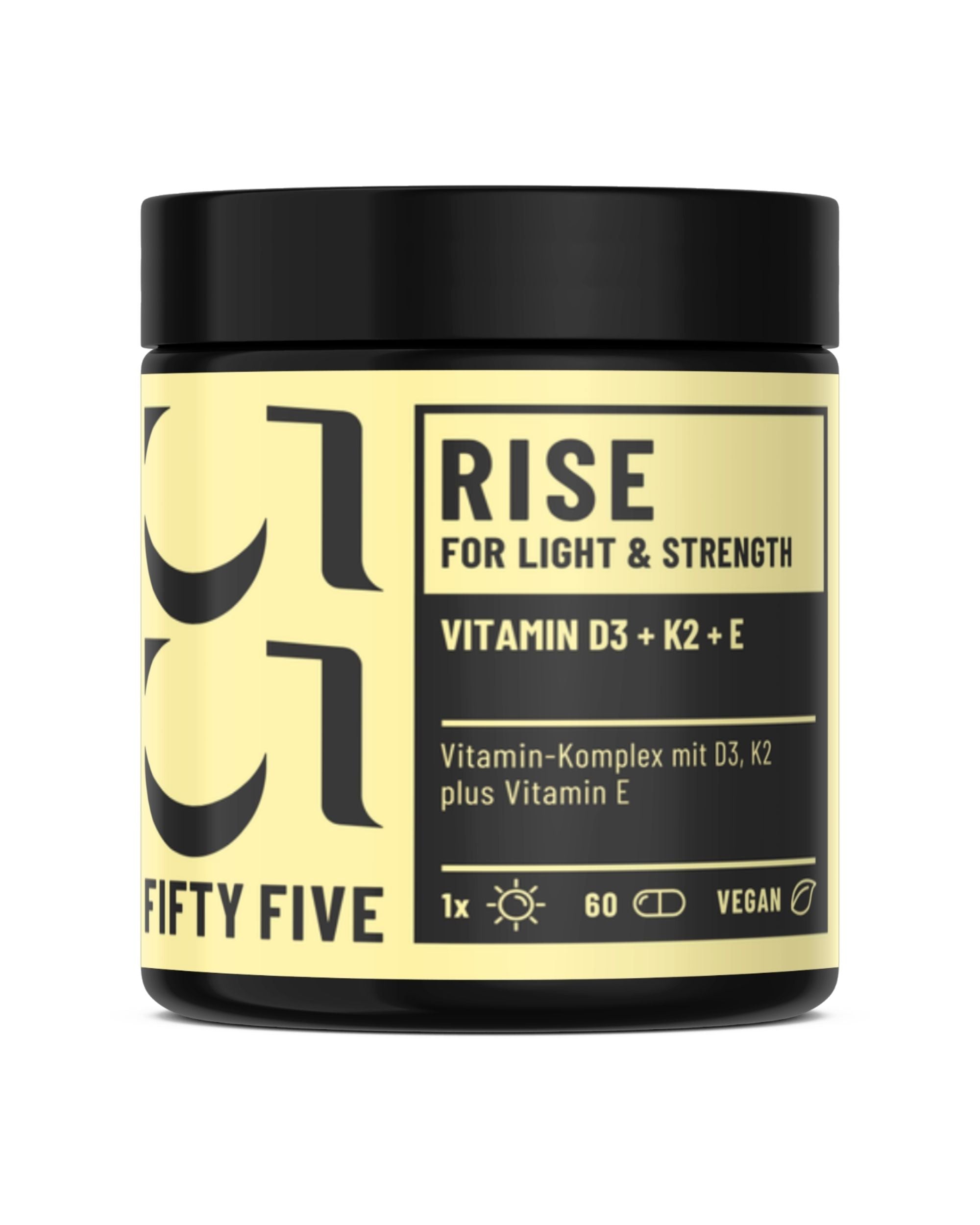
RISE by Fifty Five was developed from exactly this logic.
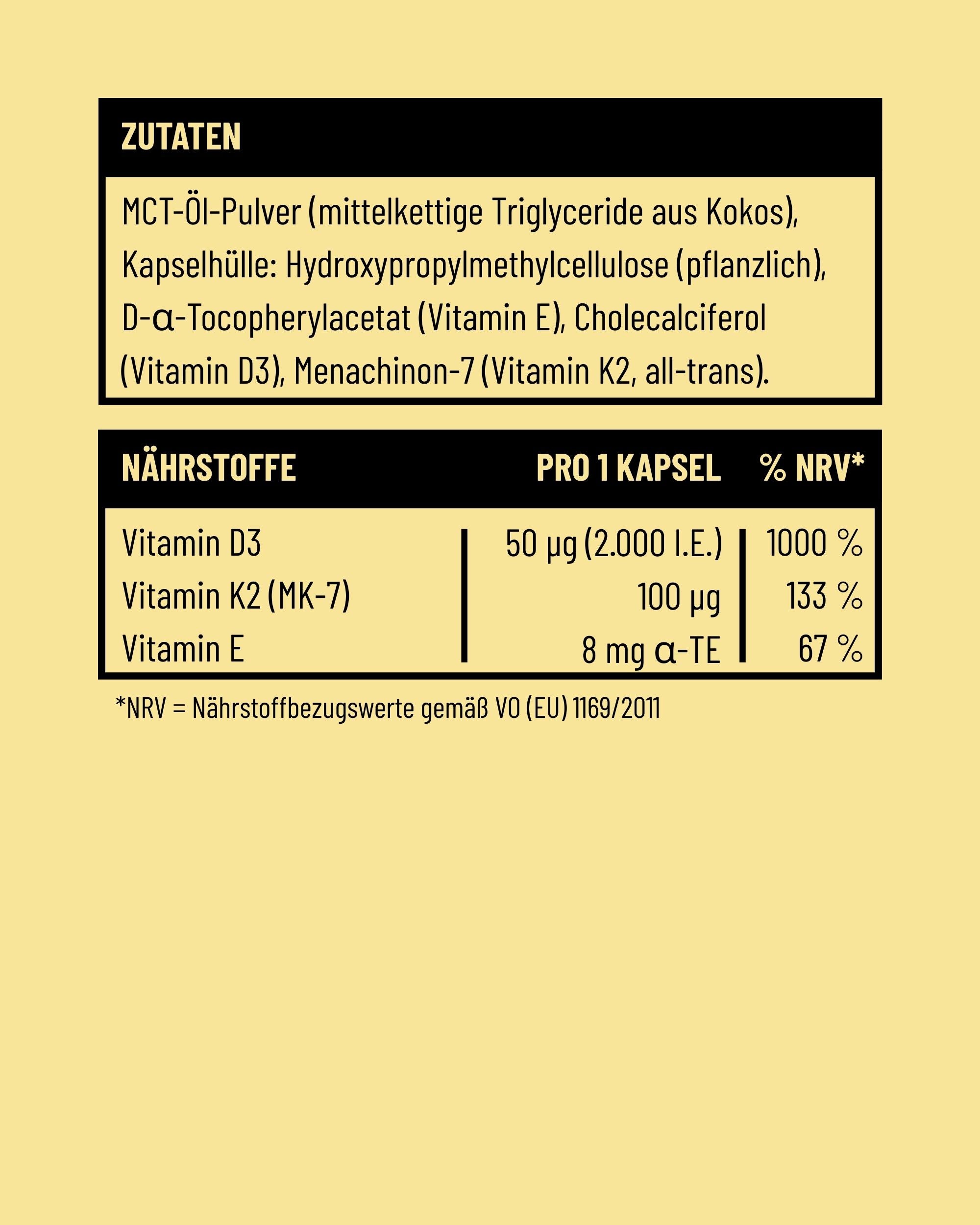
50 µg of vitamin D3 (cholecalciferol) per capsule, taken every two days. That results in an average daily dose of 25 µg (1,000 IU). The two-day dosing has a regulatory rationale: the BfR recommendation is a maximum of 20 µg daily. RISE delivers 50 µg every two days, staying within the safe range while enabling a considerably more effective supply than standard doses of 800 IU daily.
100 µg of vitamin K2 as MK-7 all-trans per capsule. All-trans is the biologically effective configuration, and the half-life of MK-7 means that 100 µg every two days remains active in the body long enough.
8 mg of vitamin E (D-alpha-tocopheryl acetate, the natural form) per capsule. Plus MCT oil as a carrier in the capsule, which supports the absorption of the fat-soluble vitamins even without a fat-containing meal.
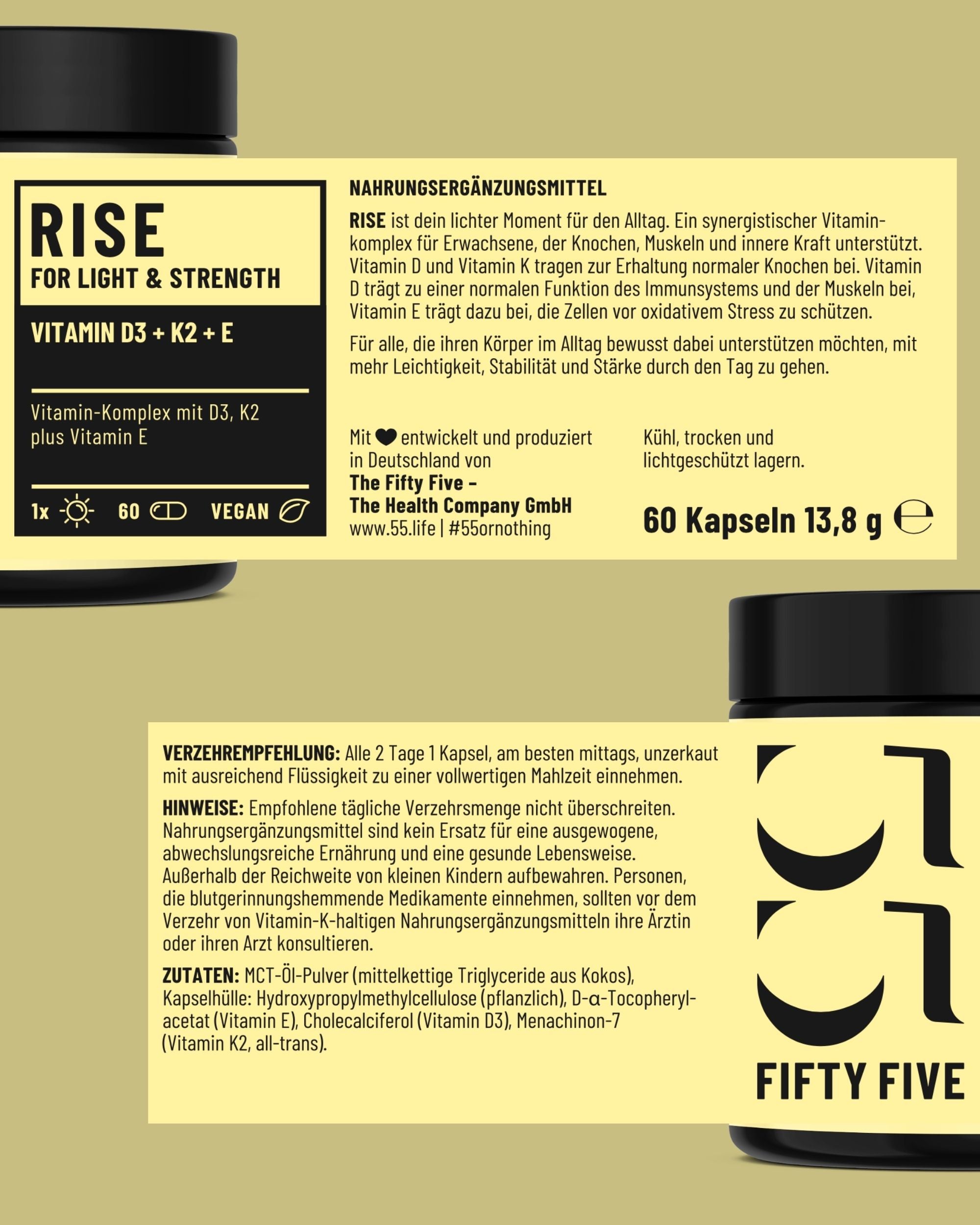
Ideally taken at midday, every two days. The micro capsule (size 3) is considerably smaller than standard capsules and easy to integrate into everyday life.
What is useful to know in practice
Every two days, not daily: RISE is deliberately designed for non-daily intake. That is not a drawback but the result of a decision grounded in regulation and physiology. Taking one capsule every other day gives you the same average supply as half a dose daily, but with a whole capsule and therefore more reliable adherence.
No substitute for blood work: If you have concrete reason to believe you have a severe vitamin D deficiency, have it clarified through blood work. Supplementing without knowing your status makes sense for general foundational supply. A diagnosed deficiency may require therapeutically higher doses.
Combine with BASE and CALM: RISE, BASE, and CALM barely overlap in content. BASE in the morning, RISE at midday every two days, CALM in the evening. No nutrient appears twice in problematic amounts.
FAQ
What makes vitamin K2 different from vitamin K1?
Vitamin K1 is found mainly in green vegetables and is used predominantly in the liver for blood clotting. Vitamin K2 is transported better into other tissues such as bones and blood vessels and has a considerably longer biological activity there. For supplementation aimed at bone health and vascular protection, K2 is the relevant form.
Can I take vitamin D without vitamin K2?
Yes, that is possible. Vitamin D increases calcium absorption in the gut. Vitamin K2 activates the proteins that direct this calcium into the bones and keep it away from the vessel walls. With higher D3 supplementation over longer periods, sufficient K2 is a smart addition.
When is the best time for RISE?
Midday, ideally with or after a meal. Fat-soluble vitamins are absorbed better with fat. The MCT carrier in the capsule supports absorption even with lighter meals without a high fat content.
How long does it take to correct a vitamin D deficiency through supplementation?
That depends on the starting point and the dose. With a moderate deficiency and daily supplementation of 1,000 to 2,000 IU, clear increases in the 25-OH vitamin D level can be observed within 2 to 3 months. A severe deficiency requires higher doses and more time.
Why does RISE contain MCT oil?
MCT oil (medium-chain triglycerides) is a lipid-based carrier that supports the absorption of fat-soluble vitamins directly in the capsule. This allows RISE to be absorbed well even without a fat-rich meal.
Can I combine RISE with CALM and BASE?
Yes. The Fifty Five Daily Essentials are designed as a system. BASE delivers the micronutrient complex in the morning, RISE delivers vitamin D3, K2, and E at midday, CALM delivers magnesium in the evening. No product contains vitamin D3, K2, or E except RISE. The combination does not push any nutrient into problematic ranges.
All RISE articles at a glance
These articles cover individual aspects of vitamin D3, K2, and E in detail:
- Recognizing vitamin D deficiency: symptoms, causes & what really helps
- Vitamin D dosage: how much D3 per day is sensible and safe?
- Vitamin D in winter: why sunlight is not enough and when supplementation kicks in
- Vitamin D3 and K2: why the combination accomplishes more than D3 alone
- Vitamin K2 MK-7: what K2 really does in the body
- Vitamin D overdose and side effects: what really happens when you take too much
- When to take vitamin D: timing, meals, and what really affects absorption
- Vitamin D for women: what the body really needs in different stages of life
- D3, K2, and vitamin E: why fat-soluble vitamins work as a system
Disclaimer:
This article is for informational purposes only and does not replace medical advice, diagnosis, or treatment by a physician or pharmacist. The information provided here should not be used for self-diagnosis or self-treatment. Food supplements are no substitute for a balanced, varied diet and a healthy lifestyle. For any health questions or complaints, please always consult a doctor you trust. Fifty Five accepts no liability for any inconvenience or harm resulting from the use of the information presented here.
Sources
- EFSA. Dietary reference values for vitamin D. EFSA Journal 2016;14(10):4547.
- EFSA. Scientific Opinion on the Tolerable Upper Intake Level of vitamin D. EFSA Journal 2012;10(7):2813.
- EFSA. Dietary reference values for vitamin K. EFSA Journal 2017;15(5):4780.
- German Nutrition Society (DGE). D-A-CH reference values – vitamin D.
- Robert Koch Institute (RKI). DEGS – German Health Interview and Examination Survey for Adults (vitamin D status).








Omega-3: How to Cover Your Needs and What DHA and EPA Really Do
Magnesium: How It Works, Daily Needs & Forms: The Ultimate Guide
Share: