


Magnesium accompanies you, often without you noticing: when you think, move, breathe, work, exercise, and fall asleep. It is one of the most important minerals and electrolytes and is involved in numerous processes in the nervous system, the muscles, and energy metabolism.
Here you will find everything that matters: from how magnesium works in the body to the right form and your individual dosage. You will learn which functions magnesium performs in the body, how to assess your needs realistically, and how to recognize whether a low magnesium intake could be playing a role. After that, we look at how common forms of magnesium differ, which variants suit sleep, stress, exercise, or a sensitive digestion, and what a sensible intake routine can look like.
You will also see how magnesium fits into a minimalist supplement strategy: when diet is enough, and when a targeted magnesium product like CALM by Fifty Five can fill the gap. Without a high-dose approach and without a supplement drawer full of single ingredients.
Deepen your magnesium knowledge
- Magnesium deficiency: recognizing symptoms & fixing causes
- Magnesium forms compared: citrate, bisglycinate, or oxide?
- Magnesium for stress & sleep: finding calm
- Magnesium in sports: recovery & muscles
- Magnesium dosage: how many mg per day?
- When to take magnesium? Morning or evening?
- Magnesium side effects & interactions
- Magnesium for women: help with PMS & your cycle
Magnesium at a glance: what you should know
Magnesium is an essential mineral and electrolyte. Your body needs it, among other things, for the normal function of nerves and muscles, for energy metabolism, and for stable bones.[1] You get magnesium primarily from food, but you can also supplement it when needed.
In everyday life, magnesium is often associated with muscle cramps, inner restlessness, sleep quality, and recovery after exercise. At the same time, the line between an actual magnesium deficiency and simply an unfavorable diet is not always clear. Official reference values provide orientation but need to be weighed against your lifestyle.
Magnesium comes in different compounds: as citrate, bisglycinate, oxide, or carbonate, for example. These forms differ in elemental magnesium content, bioavailability, and tolerability, and therefore in how well they suit specific goals such as sleep, exercise, or digestive concerns.
If you mainly want to understand what magnesium does in the body, the section on functions is the one for you. If you would rather know whether you might be getting too little magnesium, the part on possible signs and diagnostics will help. And if you are specifically looking for the right form for sleep, stress, exercise, or a sensitive digestion, you will find it in the section on magnesium forms and their uses.
Do you need a magnesium supplement, and if so, which form?
Quick definition:
Whether you need a magnesium supplement depends primarily on your diet, the demands you face, and your health status.
- Your most important factors are: diet quality, stress level, training volume, medications
- Choosing a form: tolerability, goal (sleep, stress, exercise, digestion), everyday practicality
- No substitute for medical diagnostics or treatment. Complaints belong in a doctor's hands.
Mini decision rule:
If you face typical demands despite a magnesium-friendly diet, a magnesium supplement with a well-tolerated form like CALM by Fifty Five can make sense.
What does magnesium do in the body? Functions & effects
Magnesium is an essential mineral that serves as a cofactor for more than 300 enzymatic reactions in the human body, particularly in energy metabolism and in nerve signal transmission.
As a mineral, magnesium is present in nearly every cell of the body. It acts as a cofactor for numerous enzymes, a kind of "helper" that makes enzymatic reactions possible or more efficient in the first place. Without sufficient magnesium, many of these processes cannot run optimally.
Magnesium for the nervous system & mind
Magnesium is especially important for your nervous system. It supports normal signal transmission between nerve cells and plays a role in how excitable your nerves are. In everyday terms, this can mean that magnesium creates a foundation for processing stimuli, concentrating, and winding down in the evening. Without promising that magnesium alone solves sleep problems.
Muscle function & recovery
Your muscles also depend on magnesium. The mineral supports normal muscle contraction and relaxation. That matters for everyday movement as well as for training. If you sit at a computer a lot, drive long distances, or train intensively, your muscles are constantly working in the background. Magnesium helps keep these processes running in an orderly way.
Energy metabolism & bones
Magnesium also plays a central role in energy metabolism. It is involved in producing and using ATP, the "energy currency" of your cells. When your energy metabolism runs steadily, everyday life often feels easier. From phases of deep concentration to training sessions.
Beyond that, magnesium contributes to the maintenance of normal bones and teeth and is involved in protein metabolism. That makes it a foundational building block that matters not only in demanding situations, but every day. Many people still manage fine with their everyday supply. What matters is how your diet, lifestyle, and demands fit together.
How much magnesium do you really need? Requirements & reference values
Reference values such as the D-A-CH reference values or the European NRV [2] ("Nutrient Reference Value") provide orientation. They roughly indicate how much magnesium an average healthy person should take in daily at a given stage of life to cover their needs.
Typically, the reference ranges for adults are roughly in the area of 300 to 400 mg of magnesium per day [2], with slightly higher values for men than for women. Needs can be elevated in certain stages of life such as adolescence, pregnancy, and breastfeeding. These figures are guide values and do not account for every individual case. [6]
Factors that can influence your needs include: frequent or intense physical activity, heavy sweating, a very one-sided or heavily processed diet, and prolonged periods of stress. Certain life stages such as growth or pregnancy are already factored into recommendations but may still call for extra attention in everyday life.
The following overview offers rough orientation across life stages (guide values, rounded):
| Life stage | Recommended daily intake (approx.) | Note |
|---|---|---|
| Adult women | 300 mg | slightly higher when breastfeeding |
| Adult men | 350-400 mg | depends on body size/activity |
| Adolescents (approx. 15-18 years) | 350-400 mg | growth phase |
| Pregnancy | 310-350 mg | medical guidance advisable |
Besides intake, measuring magnesium in the blood also plays a role, though with limitations. Serum magnesium reflects only a small portion of total body stores, while much of your magnesium sits inside the cells. Individual lab values alone are therefore not always conclusive.
More important is the combination of dietary history, symptoms, and lab values where appropriate. If you are unsure whether your magnesium intake is sufficient, a medical or nutritional assessment can help put the situation in realistic perspective.
For more detail on how to calculate your individual magnesium dosage, see our guide.
Magnesium deficiency: recognizing signs & causes
In short: what is magnesium deficiency?
Magnesium deficiency means your body has less magnesium available over the long term than it needs for normal functions; a reliable diagnosis requires medical evaluation.
The key distinction is between a true magnesium deficiency and a low magnesium intake. A low intake means you take in less magnesium than recommended over a longer period. An actual deficiency only exists once the body's reserves are clearly depleted and this can be medically verified.
Commonly cited possible signs of an insufficient supply include muscle cramps, muscle twitching, inner restlessness, or tiredness. These symptoms are unspecific, however, and can have many other causes, from dehydration to strain to medical conditions. Magnesium is one possible factor, rarely the only explanation.
Possible causes of a low magnesium intake include a heavily processed, magnesium-poor diet, strongly calorie-restricted diets, or low consumption of whole grains, nuts, and legumes. Increased losses can be driven by heavy sweating, certain medications, or gastrointestinal issues.
Diagnostics always include a thorough history alongside lab values: How do you eat, what symptoms do you have, which medications do you take, are there pre-existing conditions? Serum magnesium has limited significance because the body often keeps blood levels stable for a long time. [3]
If you experience new, severe, or persistent symptoms, seek medical advice. When a deficiency should be medically evaluated is covered in detail in our guide. But a guide does not replace diagnostics.
Magnesium forms compared: citrate, bisglycinate & co.
In supplements, magnesium does not come as a pure metal but in the form of compounds, for example bound to organic acids or inorganic salts.
Organic vs. inorganic compounds
Organic magnesium compounds contain magnesium bound to organic acids or amino acids (e.g. citrate, bisglycinate). Inorganic magnesium compounds couple magnesium to inorganic components such as oxide, carbonate, or chloride.
In short: elemental magnesium
Elemental magnesium refers to the actual amount of magnesium in a product, regardless of how much the entire compound with citrate, bisglycinate, or other partners weighs.
Bioavailability describes how much of the ingested magnesium actually arrives in the body and can be used. It depends on the compound, the dose, your digestion, and other nutrients.
A brief overview of some important forms:
| Form | Characteristics | Tolerability | Typical use |
|---|---|---|---|
| Magnesium citrate | organic compound, highly soluble, widely used | often good, laxative at high doses | everyday use, sports, occasional digestive support |
| Magnesium bisglycinate | organic compound with the amino acid glycine | usually very good, gentle on the stomach | everyday use, evenings, sensitive stomach |
| Magnesium oxide | inorganic, high elemental magnesium content | rather lower absorption, laxative | deliberate laxative effect, selected cases only |
| Magnesium carbonate | inorganic, converted to other forms in the stomach | individual, can cause belching | effervescent tablets, powders |
| Magnesium chloride | inorganic, highly soluble | depends on dose, sometimes intense taste | drinking solutions, special applications |
| Magnesium malate | organic, bound to malic acid | usually well tolerated | everyday use, sometimes in sports contexts |
In short: magnesium bisglycinate
Magnesium bisglycinate is an organic compound of magnesium and the amino acid glycine that is often well tolerated and a popular choice in capsules for everyday use and evening routines.
There is no "magic" form of magnesium that is superior for everyone, always. However, solubility, tolerability, and individual perception can differ considerably. Organic compounds like citrate or bisglycinate are often experienced as well absorbed and well tolerated in everyday use [5], while inorganic forms like oxide tend to be used in situations where the laxative effect is desired.
Quick comparison: which magnesium form is best?
- Magnesium bisglycinate: very well tolerated, suited to everyday use and evening routines.
- Magnesium citrate: highly soluble, well absorbed, can stimulate digestion.
- Magnesium oxide: high magnesium content, lower bioavailability, rather laxative.
- Magnesium malate: well tolerated, often used for everyday life and sports.
You will find a detailed comparison of magnesium forms in our guide: Magnesium forms: citrate, bisglycinate, or oxide.
Which magnesium for which goal? (Sleep, stress, sports, digestion)
In practice, the question quickly becomes: which form of magnesium fits your specific goal and your daily life? The important thing to remember is that magnesium is always just one building block. Sleep hygiene, stress management, training planning, and diet remain the foundation. Magnesium can support these basics, but not replace them.
Magnesium for sleep & inner calm
Magnesium supports the normal function of your nervous system and contributes to the orderly processing of stimuli. Many people therefore reach for magnesium in the evening in particular, when they want to support their evening routine and the process of winding down, without any claim to treat sleep disorders.
Forms with good tolerability and without strong laxative effects are especially interesting here. Magnesium bisglycinate is widely used because it is usually gentle on the stomach and integrates well into an evening routine. Magnesium citrate at a moderate dose can also make sense in the evening, provided your digestion is not too sensitive.
What remains important: a calm sleep environment, consistent times, less screen time in the evening, and an overall stable rhythm have at least as much influence as any capsule. Magnesium can complement these measures, but not replace them.
Magnesium for stress & winding down
During demanding phases with heavy workloads, mental pressure, or emotional stress, your body as a whole is under greater strain. It is debated whether stress can influence magnesium needs; what is certain is that diet and recovery often fall short in such phases.
Well-tolerated magnesium forms without strong digestive effects are practical here because they fit smoothly into a working day. Splitting the daily dose moderately, for example morning and evening, can also help improve tolerability.
Vitamin B6 (pyridoxine) plays a role alongside magnesium in the energy and nervous systems. A combination of magnesium and vitamin B6 is therefore often used when the nervous system, energy metabolism, and resilience are in focus. Important: supplements do not replace stress management strategies; at most, they can be one building block in a larger setup.
Magnesium for sports & recovery
With sports, several aspects come together: you work your muscles harder, sweat more, and place greater demands on your energy metabolism. Magnesium supports normal muscle function and is involved in energy metabolism, which is why it comes up so often in sports contexts.
If you train intensively, forms that are well absorbed and remain tolerable even at somewhat higher intakes make sense. Magnesium citrate is widely used because it is highly soluble and integrates well into drinking solutions or capsules. Magnesium bisglycinate can also be a good fit if you value gentleness on the stomach. Splitting the dose across the day or around training and main meals can support tolerability.
Magnesium for digestion & sensitivity
Some magnesium forms noticeably affect digestion. Higher-dose magnesium citrate or magnesium oxide in particular can have a laxative effect and loosen stool consistency. This can be used deliberately when a mildly stimulating effect on the bowel is desired, but it can also be unpleasant for sensitive people.
If you tend toward soft stools or fast digestion, forms like magnesium bisglycinate can make sense, as they are often experienced as gentler on the stomach and bowel. A more moderate dose and taking it with meals also often help improve tolerability.
CALM by Fifty Five: the intelligent combination
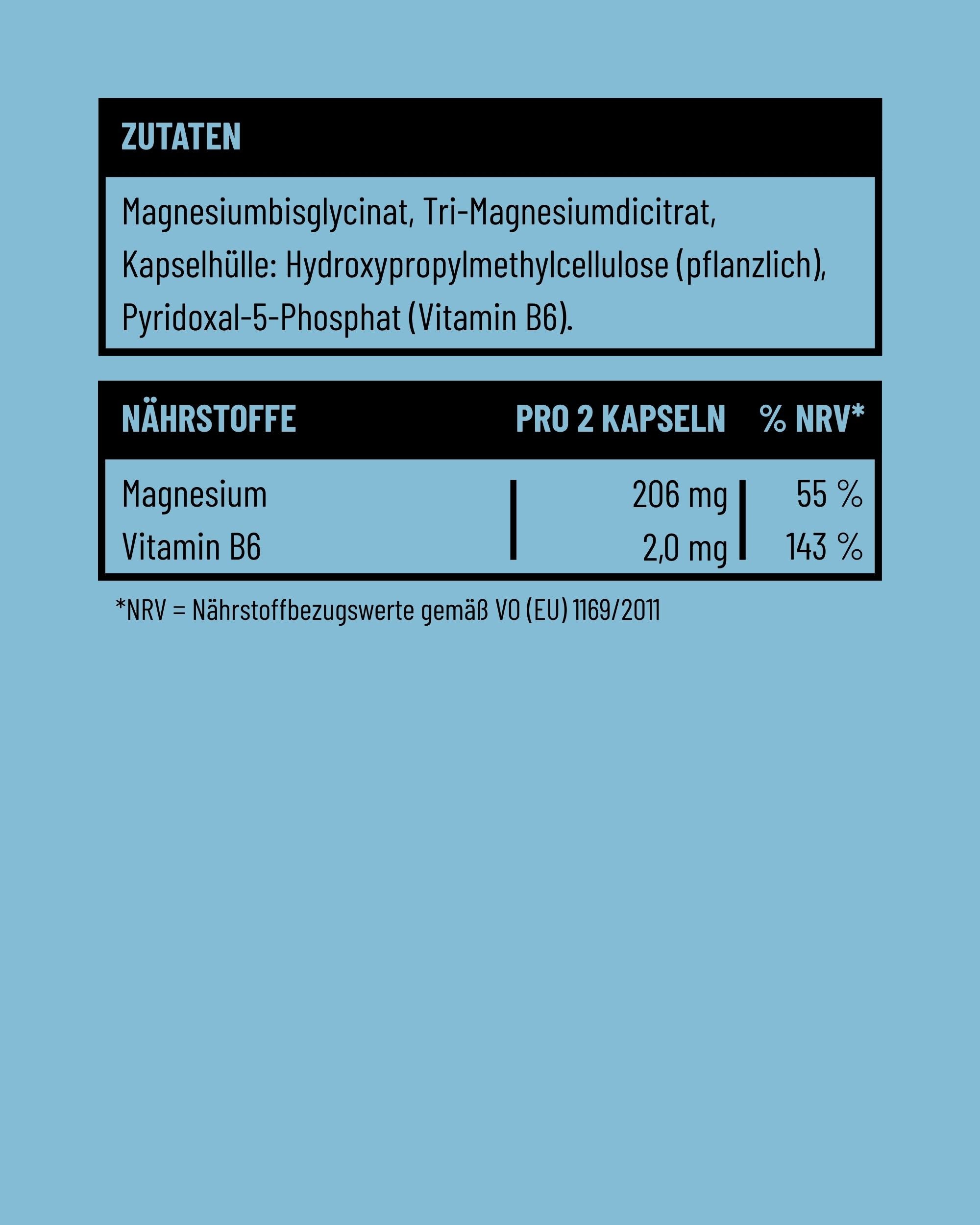
CALM combines two magnesium forms and vitamin B6 with a clear idea:
- Magnesium bisglycinate forms the core at 65% for a well-tolerated, gentler supply suited to everyday life and evenings.
- Magnesium citrate complements it at 35% for good solubility and availability, especially during activity and higher demands.
- Vitamin B6 supports functions in the energy and nervous systems and complements magnesium in these areas.
The combination aims for synergy and everyday practicality, not maximum high dosing. The decision for CALM or other products should always fit your overall system of diet, basic supply, and lifestyle.
Magnesium in everyday life: intake & dosage
For magnesium supplements to work well, it is not just the form that matters but also dosage, timing, and combination. The goal is a supply that supports your needs without causing digestive problems or competing with other nutrients.
Reference values provide orientation, and typical dosing ranges for supplements are derived from them. Many people use a moderate additional intake that, together with their diet, stays within the recommended total. Extreme high-dose use should be avoided without medical supervision.
It can make sense to split the daily amount into two or three portions, for example morning and evening. This often supports tolerability, especially with sensitive digestion. Taking it with or after a meal is more comfortable for many people than on a completely empty stomach.
For timing, many people orient themselves by their goal:
- Focus on sleep and inner calm: rather in the evening, tested as part of the evening routine
- Focus on sports/recovery: around active phases, but well distributed across the day
- Everyday life/stress: a combination of daytime and evening doses
Magnesium and vitamin B6 complement each other because both are involved in the energy and nervous systems. Combining magnesium with a foundational supply like BASE also makes sense: BASE by Fifty Five delivers a balanced mix of vitamins and trace elements, deliberately without magnesium. At Fifty Five, magnesium is positioned as its own product so it can be added in a targeted and, above all, adequately dosed way when needed.
As for duration: many people use magnesium for weeks or months when clearly demanding phases lie ahead. With pre-existing conditions, especially regarding kidney function, or with regular medication, discuss the dosage with your doctor or pharmacist. With other minerals such as iron, it can also make sense to leave a time gap from your magnesium intake so absorption is not unnecessarily affected.
Magnesium from food vs. supplements: what does your everyday diet cover?
As a rule, you should cover your magnesium needs as much as possible through a balanced diet. Particularly magnesium-rich foods include whole grains, nuts and seeds, legumes, certain vegetables, and some mineral waters with higher magnesium content.
A sample day of magnesium-friendly eating could look like this:
- Breakfast: oatmeal with nuts and seeds, plus a glass of mineral water with higher magnesium content
- Lunch: whole-grain rice or whole-grain pasta with legumes and vegetables
- Snack: a small handful of nuts
- Dinner: whole-grain bread or potatoes with vegetables and a protein-rich component
In practice, many people find it hard to eat this way consistently. Common reasons: little time, lots of processed foods, few whole grains and nuts, diets, or simply habits. This is where supplements can help close gaps. Always as a complement, never as a substitute for a fundamentally balanced diet.
A dedicated magnesium product like CALM by Fifty Five can make sense if you face particular demands (e.g. high stress or training), want to account for a sensitive digestion, or want targeted support for sleep and relaxation routines. Then magnesium complements your nutritional foundation.
Safety, side effects & overdose
At sensible doses, magnesium is considered well tolerated. Nevertheless, side effects can occur, especially at high intakes from supplements, mainly in the gastrointestinal area. Soft stools or diarrhea are typical.
With normal diet alone, an oversupply of magnesium is very rare in people with healthy kidney function. Your body usually excretes excess magnesium through the kidneys. It can become problematic when very high doses are taken over longer periods, especially with impaired kidney function.
For magnesium, there is a guide value for a tolerable upper intake level from supplements, above which side effects become more likely. This value does not refer to the total from food and supplements combined, but only to the additional intake from products. [4]
Warning signs can include persistent, severe digestive complaints, nausea, or other unexplained symptoms. In such cases, pause your intake and consider a medical evaluation. People with kidney disease, certain heart or blood pressure medications, and other relevant pre-existing conditions should be particularly careful; for them, magnesium belongs in a medical consultation.
Magnesium in a minimalist supplement setup: how does it fit?
Many people want to simplify their supplement routine: away from many single products toward a clear, reduced setup. Magnesium plays an important role here but should be viewed as part of an overall system.
A sensible principle is "foundation first." Meaning: first clarify whether your basic supply is secured. Through diet and, where appropriate, through a balanced multivitamin/mineral product such as BASE. BASE by Fifty Five delivers a broad mix of vitamins and minerals at sensible doses.
Only as a second step does the question of a targeted magnesium product arise. Reasons can include: high training loads, pronounced stress phases, recurring challenges with sleep, or a digestion that does not tolerate certain forms well. Then an additional magnesium product that matches form and dosage to your goal can make sense.
CALM by Fifty Five was developed with exactly this idea: as a magnesium product that fits well into a minimalist system. The combination of 65% magnesium bisglycinate and 35% magnesium citrate plus vitamin B6 brings together gentleness on the stomach and good solubility while accounting for the nervous system and energy metabolism.
Together with BASE and products like RISE (vitamin D3+K2+E) and PULSE (omega-3 + E), this creates a structure of a few deliberately chosen pillars:
- BASE as the foundation for vitamins and minerals
- CALM as the targeted magnesium product for everyday life, demanding phases, and evening routines
- RISE as vitamin D/K2 for bone and immune system support
- PULSE as the omega-3 supporting the cardiovascular and inflammatory pathways
A simple decision logic can help:
- "Foundation only": You eat a balanced diet and face moderate demands: diet + BASE.
- "Foundation + targeted magnesium": You face additional demands (stress, lots of training, an evening routine): diet + BASE + CALM.
- "Foundation + magnesium + further pillars": A particular focus on bones, immune system, or cardiovascular health: add RISE and/or PULSE, ideally in coordination with medical advice.
How do you sensibly integrate magnesium into your existing supplement setup?
Quick definition:
Your magnesium setup should fit your diet, your demands, and the foundational products you already use.
- Influencing factors: diet quality, stress, sports, pre-existing conditions, existing supplements
- Role of the form: choose well-tolerated, everyday-friendly forms for your main goals
- Base vs. extra: BASE as the foundation, CALM as a targeted addition when needed
- No substitute for medical supervision with illnesses or long-term medication.
Mini decision rule:
If you already use a foundational product like BASE and additionally face frequent demands or specific goals (e.g. sleep, sports), a complementary magnesium product like CALM by Fifty Five can make sense.
Which magnesium setup fits you?
- If you generally eat a balanced, magnesium-rich diet and have no typical demand factors: that is usually a good foundation in itself, possibly supported by BASE.
- If you are frequently stressed or work long hours at a screen: foundation plus a well-tolerated magnesium at a moderate dose can accompany your day and evening routine.
- If you train intensively or sweat a lot: foundation plus magnesium with good bioavailability, sensibly distributed across the day, can support your muscle function.
- If your digestion is sensitive: lean toward glycinate-based or stomach-friendly forms and split your doses.
- If you have pre-existing conditions or take multiple medications: always coordinate your supplement setup with your doctor or pharmacist.
FAQ: common questions about magnesium
How do I know if I have a magnesium deficiency?
A possible magnesium deficiency can show up through unspecific signs such as muscle twitching, muscle cramps, inner restlessness, or tiredness. However, these complaints can have many other causes. A reliable answer is only possible through medical diagnostics. Seek medical advice if symptoms persist.
When is the best time to take magnesium?
Many people take magnesium in the evening when sleep and relaxation are the priority. At higher intakes, splitting into two or three portions across the day can improve tolerability. What matters is what works in your daily life. Try whether taking it with meals feels better for your stomach.
How long can you take magnesium?
Depending on your needs, magnesium can be supplemented for weeks or months as long as reference values are respected. For longer-term use, pre-existing conditions, or ongoing medication, discuss dosage and duration with your doctor or pharmacist. Also watch for digestive reactions and pause if complaints persist.
Which magnesium is gentlest on the stomach?
Many people find organic forms like magnesium bisglycinate particularly gentle on the stomach. Moderately dosed magnesium citrate can also be well tolerated when the dose is adjusted and combined with meals. With a very sensitive stomach, smaller portions spread across the day often make sense.
Can I take magnesium together with other supplements?
Yes, magnesium generally combines well with other supplements, such as a multivitamin/mineral product like BASE, vitamin D, or omega-3. Sometimes a time gap from certain minerals like iron makes sense. With medications, always clarify possible interactions with your doctor or pharmacist.
Can diet alone cover my magnesium needs?
If your diet regularly includes whole grains, nuts, seeds, legumes, vegetables, and possibly magnesium-rich mineral water, you can often cover your needs completely. In everyday life, however, many people fall short. Then a moderately dosed supplement can help close gaps without replacing your diet.
What is the difference between magnesium citrate and bisglycinate?
Magnesium citrate is an organic compound with citric acid, highly soluble and widely used, but it can have a laxative effect at higher doses. Magnesium bisglycinate is bound to the amino acid glycine and is often described as very well tolerated, especially for evening routines and sensitive digestion. Which form fits better depends on your goal and your tolerance.
Disclaimer:
This article is for informational purposes only and does not replace medical advice, diagnosis, or treatment by a physician or pharmacist. The information provided here should not be used for self-diagnosis or self-treatment. Food supplements are no substitute for a balanced, varied diet and a healthy lifestyle. For any health questions or complaints, please always consult a doctor you trust. Fifty Five accepts no liability for any inconvenience or harm resulting from the use of the information presented here.
Sources
- EFSA. EU Register of Nutrition and Health Claims – Magnesium.
- German Nutrition Society (DGE). D-A-CH reference values for nutrient intake – Magnesium.
- Elin RJ. Assessment of magnesium status. Clin Chem.
- EFSA. Tolerable Upper Intake Levels for vitamins and minerals.
- Gröber U, Schmidt J, Kisters K. Magnesium in Prevention and Therapy. Nutrients.
- Institute of Medicine (US). Dietary Reference Intakes for Calcium, Phosphorus, Magnesium, Vitamin D and Fluoride.










Vitamin D3, K2, and E: Function, Deficiency & Dosage: The Complete Guide
Recognizing Vitamin Deficiency: Which Signs Really Matter
Share: