


Most people know vitamin K as "the vitamin for blood clotting." That is true but only half the story. Beyond that, vitamin K2 has a distinct and well-documented function in the body's calcium regulation: it directs where calcium ends up and where it does not.
That is one of the most practically significant functions among micronutrients, because calcium should not end up where it causes harm, for example in the walls of the blood vessels.
Vitamin K1 and K2: what distinguishes them
Vitamin K is a group of fat-soluble compounds that has two main forms.
Vitamin K1 (phylloquinone) occurs in green vegetables and is used by the body mainly in the liver for blood clotting. After absorption, K1 disappears from the blood relatively quickly, before it reaches other tissues to any meaningful degree.
Vitamin K2 (menaquinones, MK for short) is contained in fermented foods (natto, cheese, fermented dairy products) and has a different distribution in the body. K2 stays in the blood longer, is better transported into extrahepatic tissues, and is active there: in bones, vessel walls, and other soft tissues.
This different tissue availability is the reason K2 is the more relevant form for bone and vascular health, while K1 is sufficient for blood clotting.
What K2 concretely does in the body
Vitamin K2 is a cofactor for an enzyme (gamma-glutamyl carboxylase) that activates certain proteins by converting glutamic acid residues into gamma-carboxyglutamic acid. That sounds technical but has clear functional consequences.
Osteocalcin: This protein is produced by bone cells (osteoblasts). Osteocalcin binds calcium and anchors it in the bone matrix. Without sufficient K2, osteocalcin remains in the inactive (undercarboxylated) form and cannot bind calcium. With K2, it is activated. Vitamin K2 contributes to the maintenance of normal bones.
Matrix Gla protein (MGP): This protein is the strongest known inhibitor of vascular calcification. It prevents calcium from depositing in vessel walls and other soft tissues. MGP is present in almost all body tissues but is especially highly concentrated in vessel walls. Without sufficient K2, MGP remains inactive. Studies have shown that people with low K2 levels have considerably higher proportions of inactive MGP and carry an increased risk of vascular calcification.
MK-7 versus MK-4: the decisive difference
Vitamin K2 exists in various subforms (MK-4 to MK-13). Particularly relevant for supplementation are MK-4 and MK-7.
MK-4 has a biological half-life of about one hour. The level rises shortly after intake and then drops rapidly again. For continuous activity of osteocalcin and MGP, very frequent dosing would be necessary. In studies, MK-4 was used in therapeutic dosages of 15 mg daily, far above usual supplementation amounts.
MK-7 has a half-life of about 72 hours. A single daily dose stays active in the body considerably longer. Studies show that MK-7, even at significantly lower dosages (100 to 200 µg daily), increases the proportion of carboxylated osteocalcin and active MGP.
MK-7 is therefore the more obvious choice for everyday supplementation.
All-trans versus cis isomers
Within MK-7 there is a further distinction: the spatial configuration. All-trans MK-7 is the biologically active form. Cis isomers arise during production and have shown no relevant biological efficacy.
When selecting a product, all-trans MK-7 should be specifically stated, either on the label or through certification of the raw material (e.g. K2VITAL, which is considered nearly 100% all-trans).
How much K2 do you need?
Official recommendations for K2 MK-7 as a supplement do not exist in Germany in the classic sense. The BfR (the German Federal Institute for Risk Assessment) recommends no more than 25 µg of K2 daily for food supplements. Much study data and expert opinion, especially from bone density and vascular research, work with 100 to 200 µg of MK-7 daily. This range is considered well tolerated with MK-7.
One exception: people taking vitamin K antagonists (blood thinners like phenprocoumon/warfarin) must not supplement K2 without medical supervision.
RISE: K2 as part of the system
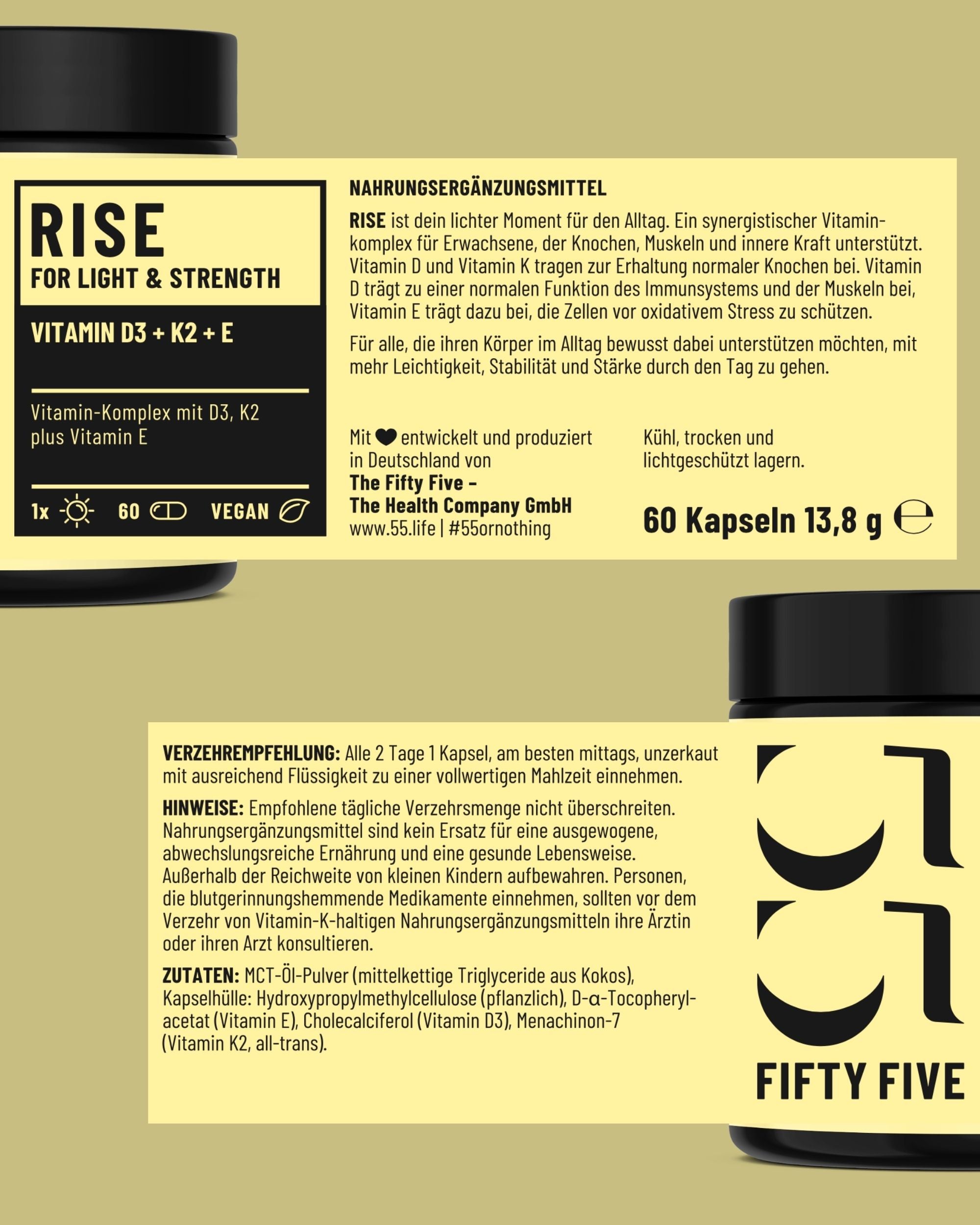
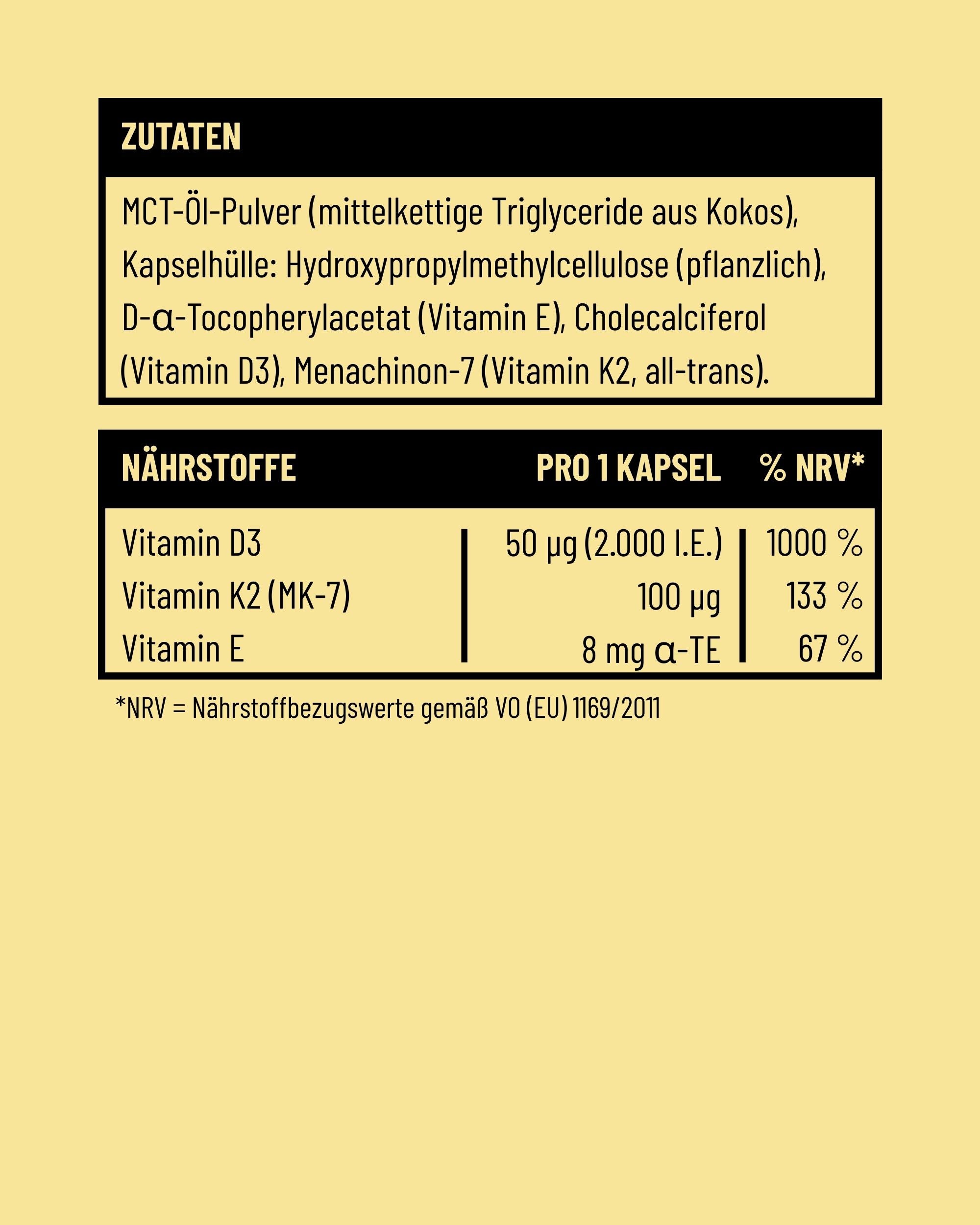
RISE by Fifty Five contains 100 µg of vitamin K2 as MK-7 all-trans per capsule, to be taken every two days. That corresponds to an average daily dose of 50 µg, in a form with a long half-life that stays active beyond the day. The combination with 50 µg of vitamin D3 per capsule has a functional rationale: D3 increases calcium absorption, K2 directs its distribution. More on the system logic in the complete RISE guide.
FAQ
Can I get enough K2 through my diet?
The best food source for K2 is natto, a Japanese soy product. Not widespread in the West. Cheese and fermented dairy products also contain K2, but in considerably lower amounts. Anyone who eats a lot of them reaches 10 to 50 µg daily. For the effects on bones and vessels described above, 100 µg and more are discussed.
Does K2 have side effects?
K2 MK-7 is well tolerated at the usual supplementation amounts. A relevant contraindication exists when taking vitamin K antagonists (blood thinners). With this medication group, K2 can influence the drug's effect.
Why is K2 not included in many vitamin D products?
Because it is more expensive and the combination is more complex to formulate. Many manufacturers opt for the simpler D3-only formulation. The biological logic argues for the combination, which is reflected in an increasing number of combined products.
How do I notice whether I need K2?
There is no simple everyday test for K2 status. Lab values (e.g. undercarboxylated osteocalcin) are possible but not routine. As a rule of thumb: anyone who supplements vitamin D, eats mostly few fermented foods, or wants to actively support bone health has good reason for K2.
Disclaimer:
This article is for informational purposes only and does not replace medical advice, diagnosis, or treatment by a physician or pharmacist. The information provided here should not be used for self-diagnosis or self-treatment. Food supplements are no substitute for a balanced, varied diet and a healthy lifestyle. For any health questions or complaints, please always consult a doctor you trust. Fifty Five accepts no liability for any inconvenience or harm resulting from the use of the information presented here.
Sources
- EFSA. Dietary reference values for vitamin D. EFSA Journal 2016;14(10):4547.
- EFSA. Scientific Opinion on the Tolerable Upper Intake Level of vitamin D. EFSA Journal 2012;10(7):2813.
- EFSA. Dietary reference values for vitamin K. EFSA Journal 2017;15(5):4780.
- German Nutrition Society (DGE). D-A-CH reference values – vitamin D.
- Robert Koch Institute (RKI). DEGS – German Health Interview and Examination Survey for Adults (vitamin D status).









Multivitamin for Vegans: Which Nutrients Are Really Missing, and What a Supplement Can Do
Omega-6 and Omega-3: Why the Ratio Matters More Than the Absolute Amount
Share: