


Three fat-soluble vitamins, a shared absorption principle, and functional dependencies that are often overlooked in supplementation practice. Vitamin D3, vitamin K2, and vitamin E are usually considered individually. Thought of as a system, however, their combination amounts to more than the sum of its parts.
This article explains what each of the three vitamins does, how they influence each other, and why a combined formulation with a lipid-based carrier functionally achieves more than three separate products taken at different times in different meal contexts.
What fat-soluble really means
Fat-soluble vitamins, including A, D, E, and K, share an absorption principle: they are absorbed in the small intestine only in combination with fat. Fat from food or a lipid carrier in the capsule is necessary to package these vitamins into micelles, which are then transferred into the lymphatic system.
That has two practical consequences:
First: intake without fat reduces absorption considerably. With vitamin D3 in a simple powder capsule without a fat carrier, studies observed a reduction in absorption of 50 percent when the intake happened on an empty stomach instead of with a high-fat meal.
Second: fat-soluble vitamins accumulate in the body instead of being excreted daily. That makes overdoses theoretically possible but at the same time creates a buffer within the body.
D3, K2, and E share these two properties completely, which makes them natural partners in supplementation.
Vitamin D3: calcium absorption and gene regulation
Vitamin D3 increases calcium absorption from the gut through the production of specific transport proteins. Vitamin D contributes to the normal absorption and utilization of calcium and phosphorus, contributes to the maintenance of normal bones, contributes to the maintenance of normal muscle function, and contributes to the normal function of the immune system.
Beyond that, vitamin D3, as a hormone precursor, is involved in the regulation of several hundred genes, which explains the breadth of its function in the body.
Vitamin K2: calcium distribution and vascular protection
Vitamin K2 activates two calcium-regulating proteins. Osteocalcin binds calcium in the bone matrix. Matrix Gla protein (MGP) inhibits calcium deposits in vessel walls and soft tissue.
Vitamin K2 contributes to the maintenance of normal bones and contributes to normal blood clotting.
The connection to D3: vitamin D3 increases the calcium level in the blood. Vitamin K2 determines whether this calcium is built into bones or deposited in vessels. Both vitamins work at different stages of the same calcium pathway.
Vitamin E: cell protection and stabilization in the lipid-based environment
Vitamin E (here: D-alpha-tocopherol, the natural form) is the most important fat-soluble antioxidant. Vitamin E contributes to the protection of cells from oxidative stress.
For the supplementation of D3 and K2, vitamin E has two additional functions that are rarely discussed:
Protection of fat-soluble vitamins in the capsule: Vitamin D3 and K2 are sensitive to oxidation. Vitamin E protects them from degradation through oxidation in the fatty carrier substance of the capsule. That is not just theory, it is the reason vitamin E is routinely used as a stabilizer for fat-soluble active substances in pharmacology.
Shared transport route: All three vitamins are absorbed via the same mechanisms, packaged into chylomicrons, and transported via the lymphatic system. They share the absorption capacity and support each other in doing so: a sufficient fat contingent in the capsule (MCT oil plus vitamin E itself as a lipid) creates optimal absorption conditions for all three.
Why the combination amounts to more than separate intakes
Anyone supplementing D3, K2, and E separately fights against three intake contexts: fat is necessary with each product, the timing should fit all three, and the consistency of intake suffers with several separate products.
Three products also mean three opportunities for lapses. In supplementation practice, consistency is the decisive factor for building a stable level. One product, once every two days, is more reliable than three products daily.
Beyond that, the biological interactions apply: D3 increases the calcium's need for K2 control. K2 protects vessels from the consequences of an elevated calcium level. Vitamin E protects the other two vitamins during their journey through the digestive system and lipid environment.
RISE: the system in one capsule
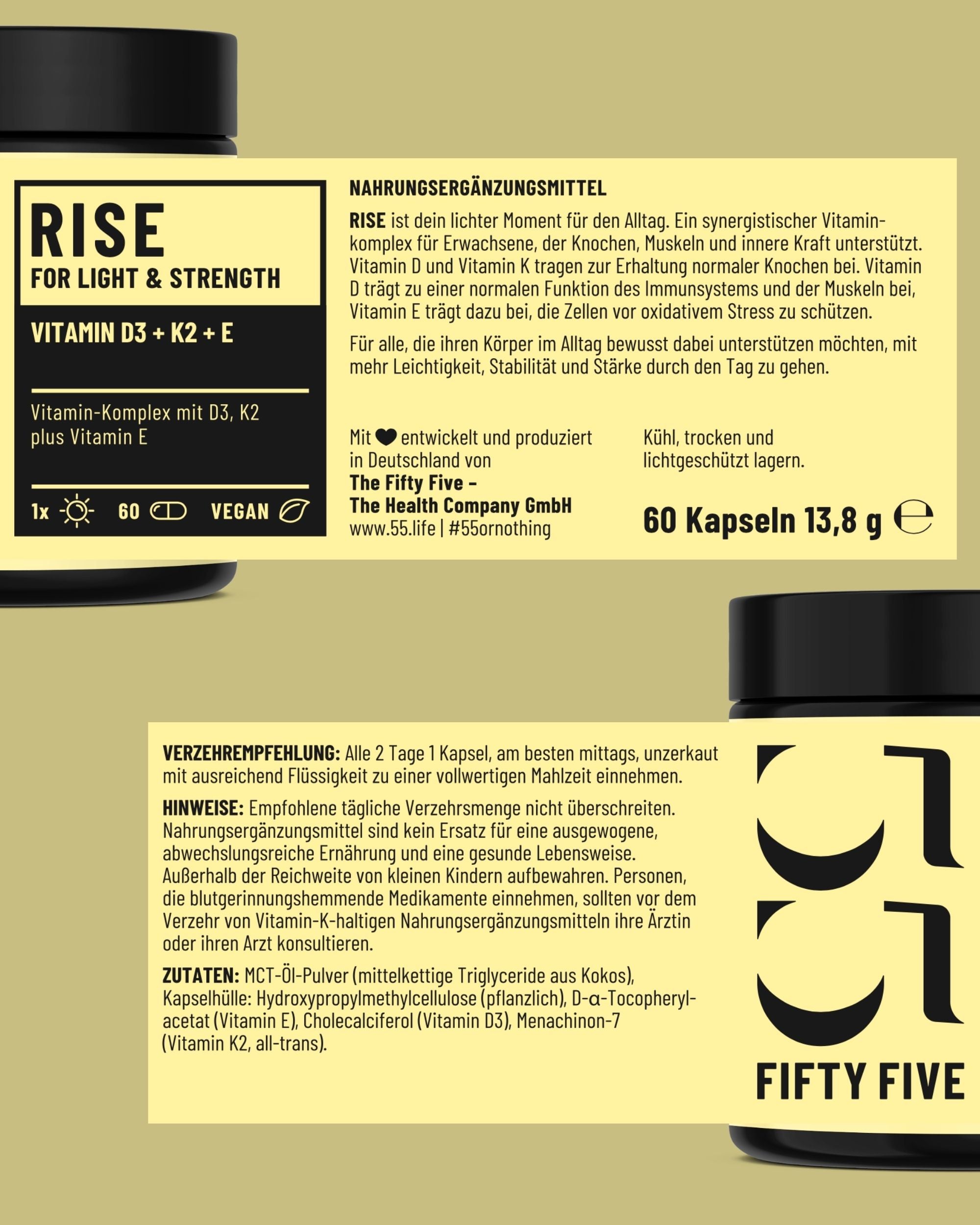
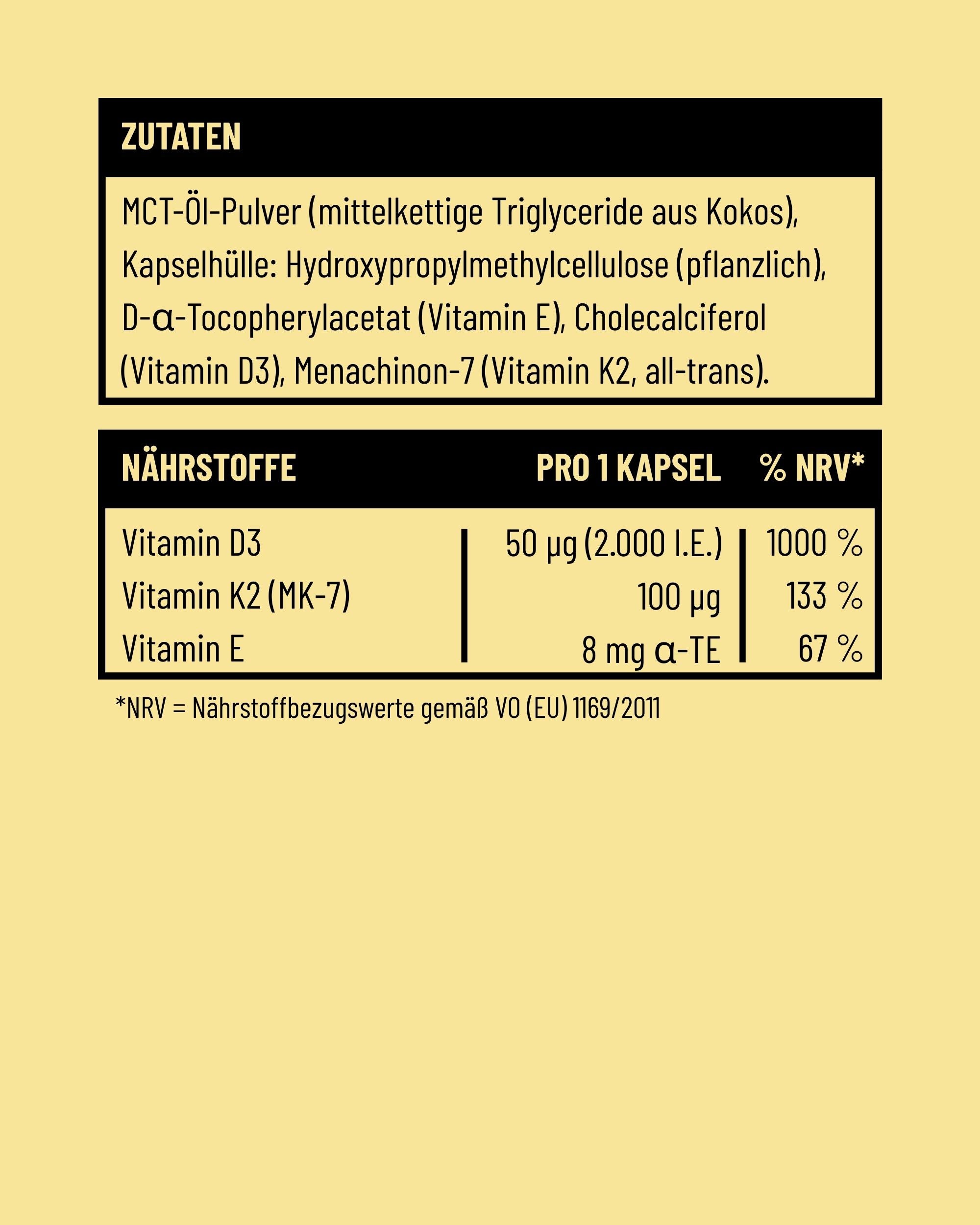
RISE by Fifty Five is the only one of the four Fifty Five formulations that unites all three fat-soluble vitamins. 50 µg of vitamin D3, 100 µg of K2 MK-7 all-trans, and 8 mg of vitamin E (D-alpha-tocopheryl acetate) per capsule, in a micro capsule with MCT oil as a carrier.
MCT oil (medium-chain triglycerides) is no filler here but a function: it provides the fat necessary for the absorption of all three fat-soluble vitamins, even when the simultaneous meal is low in fat.
That results in a product that does not simply add three vitamins but combines them in a shared lipid-based system that accounts for their absorption, stability, and interactions. All details on the dosing logic in the complete RISE guide.
FAQ
Are D3, K2, and E the only fat-soluble vitamins that belong together?
The other fat-soluble vitamins are vitamin A and vitamin K1. Vitamin A is part of the BASE formulation (as retinyl palmitate). Vitamin K1 is mainly relevant for blood clotting and occurs abundantly in vegetables. For calcium regulation and oxidation protection, the combination of D3, K2, and E is the most relevant group for daily supplementation.
Can vitamin E influence the effect of vitamin K2?
At very high vitamin E dosages (well over 1,000 mg daily, far above usual supplementation amounts), there are theoretical indications of a possible interaction with vitamin K-dependent processes. At the 8 mg of vitamin E contained in RISE, that is not a relevant issue.
Which foods deliver all three fat-soluble vitamins together?
Cod liver oil contains D3, K2, and E in meaningful amounts and is thus a natural source for all three. Fatty fish delivers D3 and E but hardly any K2. Getting all three in optimal amounts through a normal diet is practically barely achievable, which makes supplementation justifiable for many people.
Is combining all three in one product a limitation?
Only if you want to dose one of the three nutrients specifically differently than the product provides. Anyone who has to dose vitamin D very high therapeutically (e.g. 10,000 IU daily under medical supervision), for example, needs D3 separately in different amounts. For general baseline supply, the combination is an advantage, not a disadvantage.
Do I need additional vitamin E if I take RISE?
BASE also contains 8 mg of vitamin E per capsule. Anyone combining BASE (mornings) and RISE reaches a total supply that is sufficient for most adults. Separate vitamin E supplementation is not necessary in this case.
Disclaimer:
This article is for informational purposes only and does not replace medical advice, diagnosis, or treatment by a physician or pharmacist. The information provided here should not be used for self-diagnosis or self-treatment. Food supplements are no substitute for a balanced, varied diet and a healthy lifestyle. For any health questions or complaints, please always consult a doctor you trust. Fifty Five accepts no liability for any inconvenience or harm resulting from the use of the information presented here.
Sources
- EFSA. Dietary reference values for vitamin D. EFSA Journal 2016;14(10):4547.
- EFSA. Scientific Opinion on the Tolerable Upper Intake Level of vitamin D. EFSA Journal 2012;10(7):2813.
- EFSA. Dietary reference values for vitamin K. EFSA Journal 2017;15(5):4780.
- German Nutrition Society (DGE). D-A-CH reference values – vitamin D.
- Robert Koch Institute (RKI). DEGS – German Health Interview and Examination Survey for Adults (vitamin D status).









Omega-6 and Omega-3: Why the Ratio Matters More Than the Absolute Amount
Recognizing Multivitamin Quality: What Really Matters When Buying
Share: