


Tiredness that sleep cannot fix. Infections that come more often than they used to. Bone pain without a clear cause. In everyday perception, these symptoms are rarely connected to a vitamin deficiency. Yet vitamin D deficiency is no fringe phenomenon in Germany, where our products are formulated. According to current data from the Robert Koch Institute, it affects around 30 percent of adults, and noticeably more in the winter months.
The problem: the symptoms of insufficient vitamin D supply are unspecific. They fit many possible causes and are therefore frequently misinterpreted or ignored. This article describes which signs can point to a vitamin D deficiency, who is particularly at risk, and what actually helps.
Why vitamin D deficiency is so widespread in northern latitudes
The body produces vitamin D itself, under one condition: UV-B radiation from the sun on the skin. In northern latitudes, the sun sits too low from October through March to set this reaction in motion, regardless of how long someone is outside.
Even in summer, supply is no given. Anyone who works mostly in an office absorbs hardly any sun at midday. Anyone who uses sunscreen (which is recommended for skin protection) reduces UV-B absorption considerably. Anyone with darker skin needs significantly more time in the same sun exposure to produce the same amount of vitamin D.
Diet can hardly cover a major share of the need. Natural vitamin D sources like fatty sea fish, egg yolk, and certain mushrooms deliver far too little at realistic consumption amounts.
The result is a structural undersupply that is not a question of individual carelessness but a consequence of latitude, lifestyle, and dietary reality.
Symptoms that can point to vitamin D deficiency
The most common symptoms of insufficient vitamin D supply are:
Persistent tiredness and exhaustion are among the most frequently reported complaints with confirmed vitamin D deficiency. The connection is biologically plausible: vitamin D is involved in energy production in the mitochondria. At the same time, tiredness is so unspecific that on its own it is no diagnostic feature.
Frequent infections are also connected with vitamin D supply. Vitamin D contributes to the normal function of the immune system. Anyone who gets sick regularly, more often than before or for longer than usual, should consider that a possible hint.
Low mood, especially in the winter months. Vitamin D deficiency and a depressed mood frequently occur in parallel. A causal connection is described in studies, though not conclusively settled. Seasonally dependent mood lows are a relevant indicator symptom.
Diffuse muscle or bone pain. Vitamin D contributes to the maintenance of normal bones and normal muscle function. Chronic back, leg, or bone pain without a clear orthopedic cause is associated with vitamin D deficiency in the literature.
Hair loss. Some studies describe a connection between low vitamin D levels and diffuse hair loss. The data here is less clear than for the other symptoms.
Important: none of these symptoms proves a vitamin D deficiency. They are hints, not a diagnosis. Anyone who recognizes several of these symptoms and has a concrete suspicion should have it checked through a blood test.
Who is particularly at risk
Some groups have a structurally higher risk of vitamin D undersupply:
Older people produce less vitamin D through the skin because the skin contains less of the precursor substance with age. At the same time, many older people spend less time outside.
People with darker skin need significantly more time at the same sun exposure for the same vitamin D synthesis, since melanin acts as a UV filter.
People with significant excess weight: vitamin D is fat-soluble and stored in fat tissue. With a higher body fat percentage, less vitamin D is available for active metabolism.
People who spend most of their time indoors: office workers, shift workers, people in care facilities.
People with certain conditions that influence vitamin D absorption, including Crohn's disease, celiac disease, or kidney disease.
Diagnosis: what a blood test says
The relevant lab value is 25-OH vitamin D (calcidiol) in blood serum. This value reflects the overall status best.
How to read the values:
- Below 30 nmol/L (12 ng/mL): deficiency, action needed
- 30-50 nmol/L (12-20 ng/mL): undersupply
- 50-125 nmol/L (20-50 ng/mL): sufficient supply
- Above 125 nmol/L: potentially too high (watch this when supplementing)
A simple blood test at your primary care doctor is enough for this measurement. Anyone who supplements regularly or has a concrete suspicion should have the value checked once a year, ideally in the fall when the summer reserve is still present.
What really helps: supplementation as the most obvious solution
In most cases, a vitamin D deficiency cannot be fixed through diet alone. Regular time outside in the summer months (without sunscreen, at midday, 15 to 30 minutes) contributes to supply but is not enough across the year.
Supplementation is the most obvious and most effective measure. For a general baseline supply, 1,000 to 2,000 IU daily is a common target range. With a diagnosed deficiency, temporarily higher doses can make sense, but that should be medically supervised.
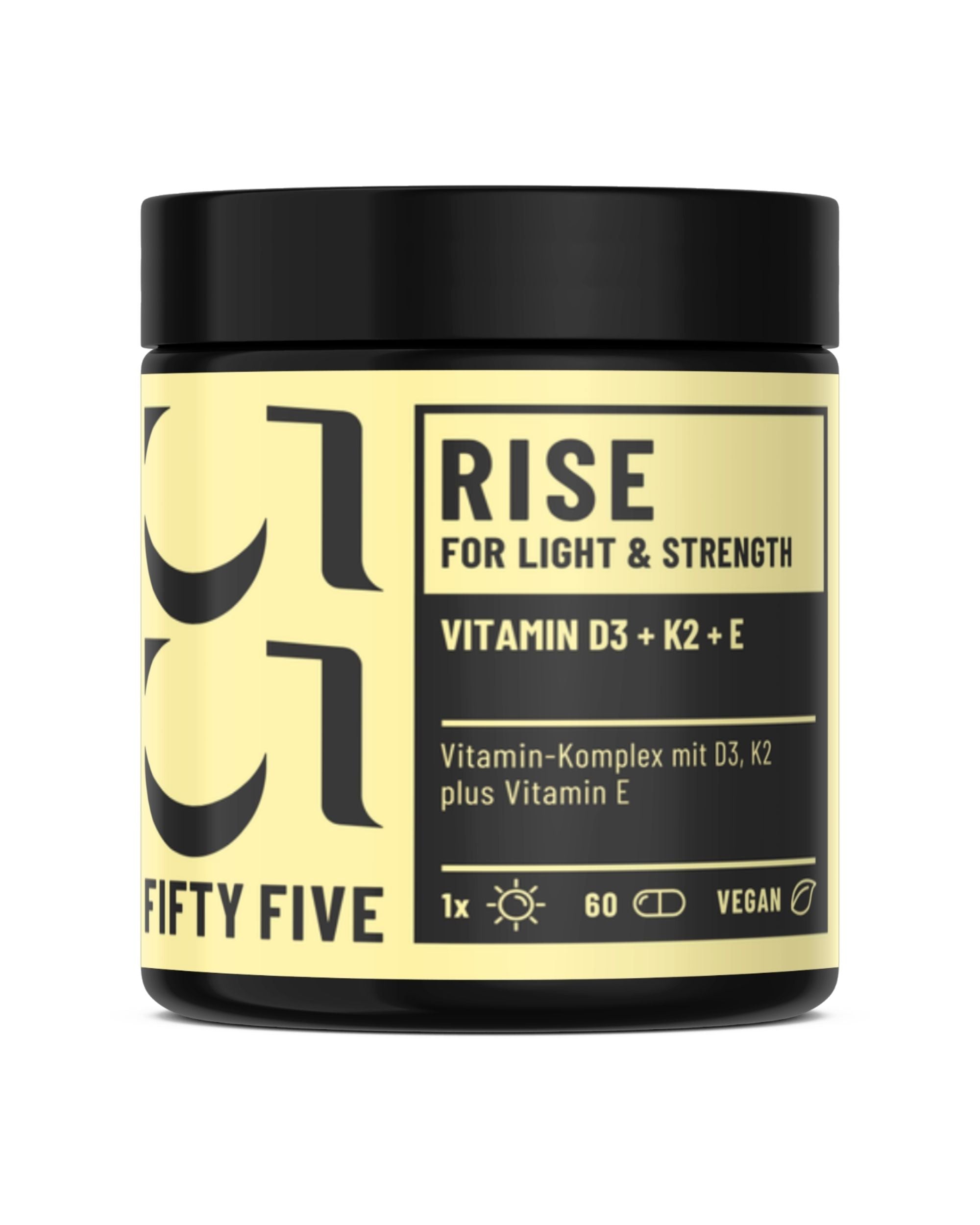
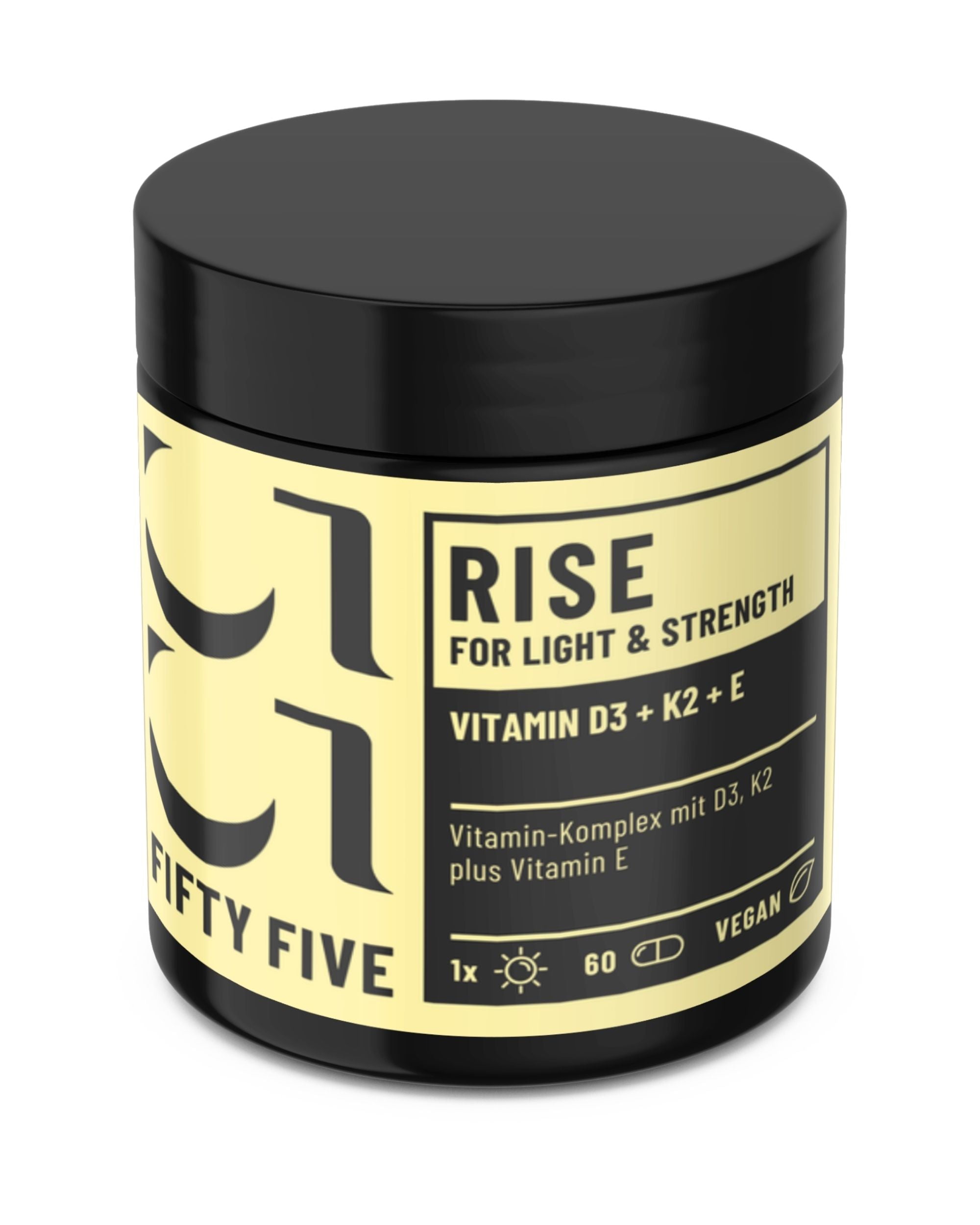
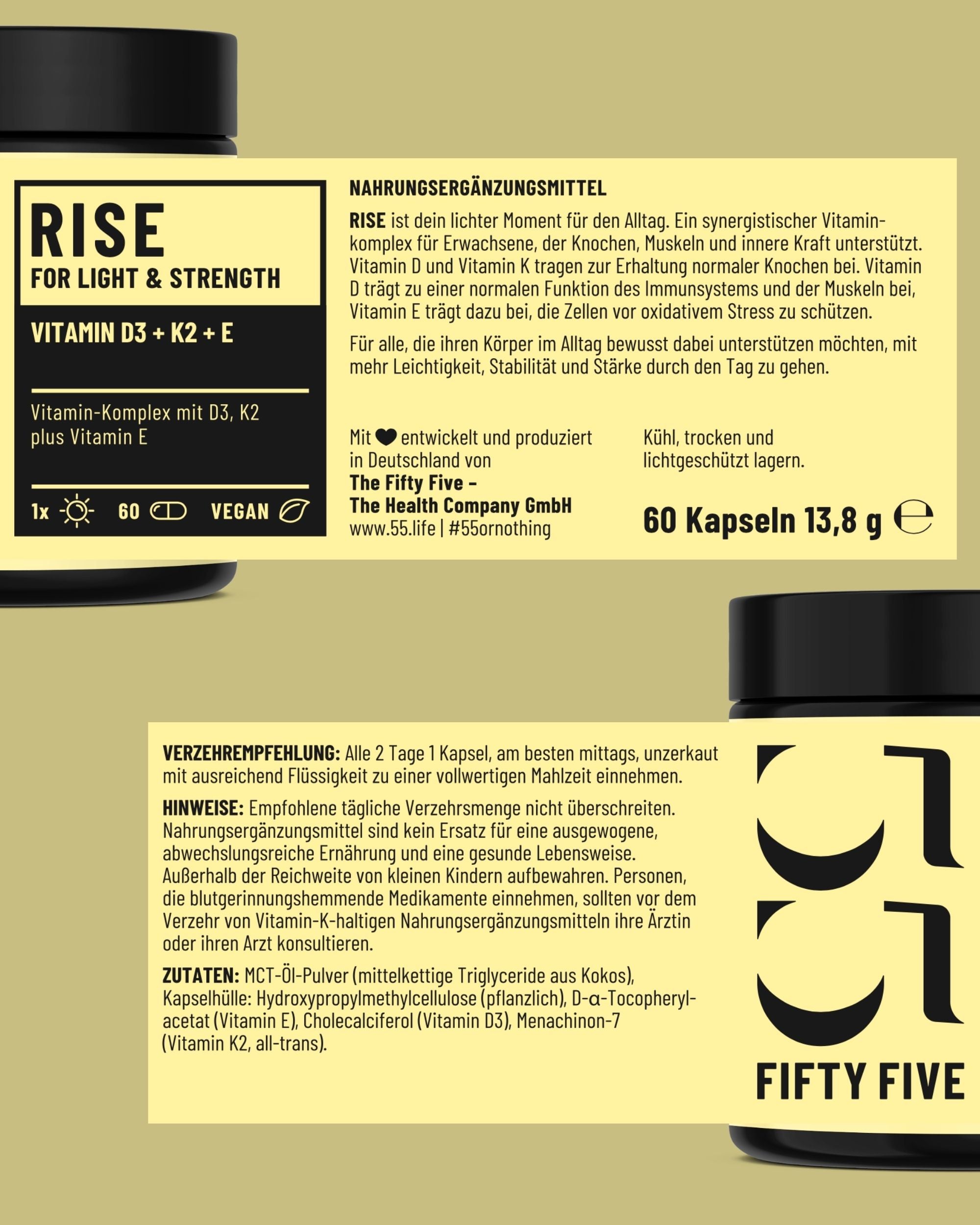
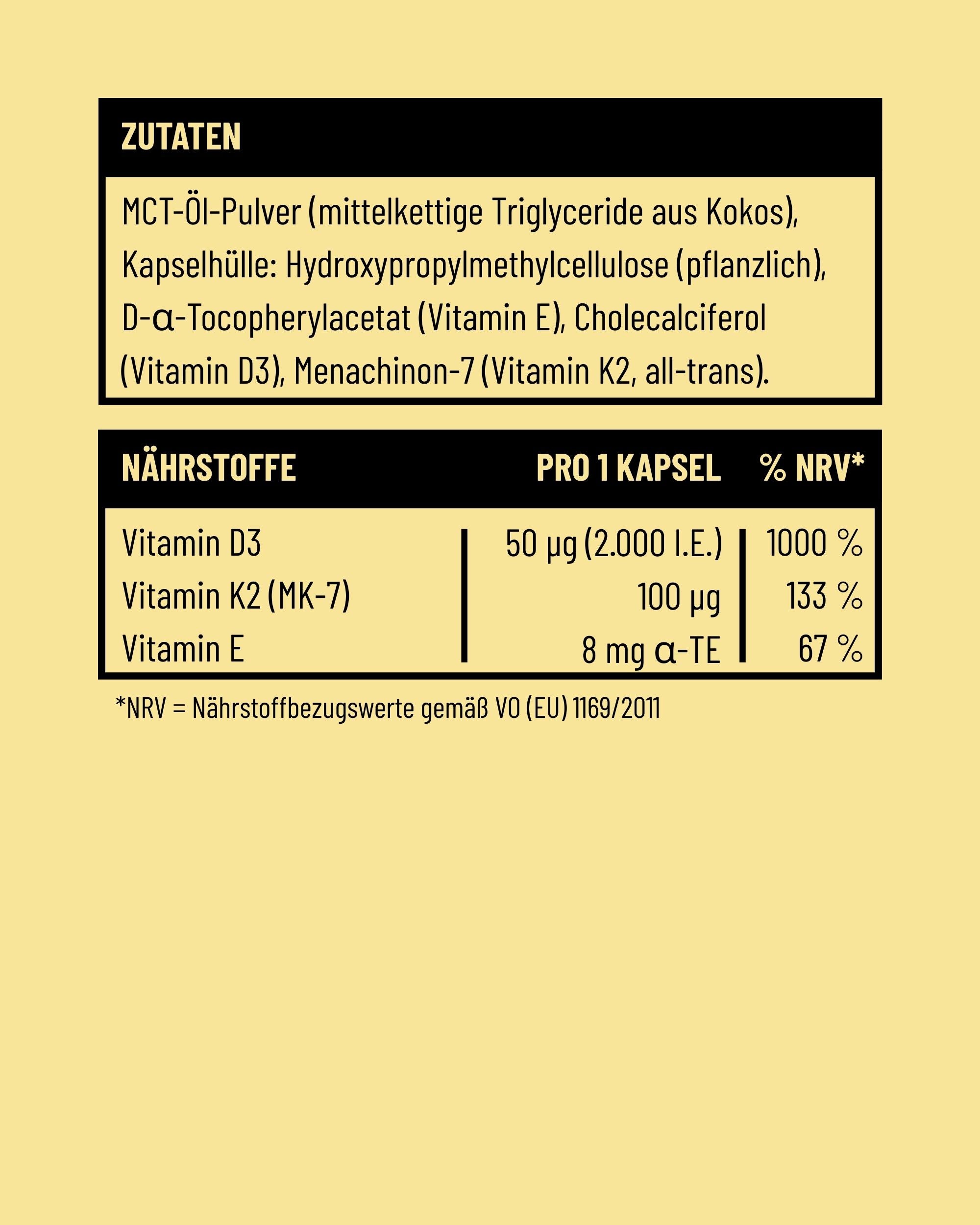
RISE by Fifty Five combines 50 µg of vitamin D3 per capsule with 100 µg of vitamin K2 MK-7 (all-trans) and vitamin E. The combination with K2 is relevant for the reasons described above: vitamin D increases calcium absorption, K2 ensures this calcium arrives where it is needed. MCT oil as a carrier supports absorption even without a high-fat meal. More on dosage and intake in the complete RISE guide.
FAQ
At what point does a vitamin D deficiency need treatment?
From a 25-OH vitamin D value below 30 nmol/L, one speaks of a deficiency that calls for action. Values between 30 and 50 nmol/L count as undersupply. In both cases, supplementation makes sense; with a pronounced deficiency, medical supervision should follow, since therapeutically higher doses may be necessary.
Can I determine a vitamin D deficiency myself?
Not reliably. The symptoms are too unspecific. A blood test is the only reliable method. Anyone who recognizes several of the described symptoms and belongs to a risk group has good reason to have it checked.
How quickly can a deficiency be balanced through supplementation?
That depends on the starting value and the dosage. With a moderate deficiency and 1,000 to 2,000 IU daily, clear increases in blood levels can be expected within 2 to 3 months. A severe deficiency needs more time and possibly higher doses.
Is vitamin D addictive, or does the body build a tolerance?
No. Vitamin D is a micronutrient, not an active substance that creates dependence. The body regulates activation in the tissue itself. With ongoing supplementation, the body does not become "lazy" in its own production, since that is seasonally limited anyway.
Can you get too much vitamin D?
Yes, at very high doses over a longer time. The EFSA tolerable level is 100 µg (4,000 IU) daily for adults. Typical supplementation doses of 1,000 to 2,000 IU daily lie well below that. An overdose from sun exposure alone is not possible. More on this in the article Vitamin D overdose and side effects.
Do I need vitamin K2 if I take vitamin D?
At a daily dose in the low range (800 IU), the question is less pressing. Anyone dosing higher or supplementing long term should pay attention to sufficient K2: vitamin D increases calcium absorption, K2 directs where this calcium ends up in the body. More on this in the article Vitamin D3 and K2: why the combination matters.
Disclaimer:
This article is for informational purposes only and does not replace medical advice, diagnosis, or treatment by a physician or pharmacist. The information provided here should not be used for self-diagnosis or self-treatment. Food supplements are no substitute for a balanced, varied diet and a healthy lifestyle. For any health questions or complaints, please always consult a doctor you trust. Fifty Five accepts no liability for any inconvenience or harm resulting from the use of the information presented here.
Sources
- EFSA. Dietary reference values for vitamin D. EFSA Journal 2016;14(10):4547.
- EFSA. Scientific Opinion on the Tolerable Upper Intake Level of vitamin D. EFSA Journal 2012;10(7):2813.
- EFSA. Dietary reference values for vitamin K. EFSA Journal 2017;15(5):4780.
- German Nutrition Society (DGE). D-A-CH reference values – vitamin D.
- Robert Koch Institute (RKI). DEGS – German Health Interview and Examination Survey for Adults (vitamin D status).







Recognizing Vitamin Deficiency: Which Signs Really Matter
Recognizing Omega-3 Deficiency: Which Symptoms Are Typical and How to Check Your Status
Share: