


Vitamin D deficiency affects men and women equally. But there are life stages and biological realities that, for women, call for a particularly close look at vitamin D status: pregnancy, breastfeeding, and the time after menopause.
These three phases have in common that calcium metabolism, and thus the function of vitamin D in the body, plays a special role, and that an undersupply has concrete consequences.
Vitamin D and bone health: the women-specific context
Osteoporosis is a condition that affects women considerably more often than men. After menopause, estrogen levels drop sharply, and estrogen is one of the most important factors for maintaining bone density. Bone loss accelerates considerably in the years after menopause.
Vitamin D contributes to the maintenance of normal bones. This mechanism is gender-independent, but the risk it cushions is considerably greater in women after menopause than in other groups.
A sufficient vitamin D supply already before menopause lays a better starting position for bone density in older age. Vitamin D is no osteoporosis therapy, but it is a relevant building block in long-term bone maintenance.
Vitamin K2 is a further relevant factor in this context: K2 activates osteocalcin, which incorporates calcium into the bone matrix. For women with an increased osteoporosis risk, the combination of D3 and K2 is biologically coherent. More on this in the article Vitamin D3 and K2: why the combination matters.
Pregnancy: increased needs, often insufficiently covered
Vitamin D needs rise during pregnancy. Vitamin D is transferred to the fetus via the placenta and is relevant for the child's bone development, immune development, and possibly other aspects of fetal development.
Studies show that vitamin D deficiency during pregnancy is widespread at northern latitudes. The German Nutrition Society (DGE) recommends the same estimate for pregnant women as for other adults (800 IU) but acknowledges that many women do not cover this need through diet.
The German Society for Gynecology and Obstetrics recommends that pregnant women know their vitamin D status and supplement in case of deficiency. Since vitamin D crosses the placenta, the child benefits directly from a sufficient maternal level.
Important: pregnant women should discuss dosage and supplementation with their gynecologist or attending physician. High-dose supplementation without medical supervision is not advisable during pregnancy.
Breastfeeding: vitamin D for mother and child
Breast milk naturally contains little vitamin D, independently of the maternal level. Breastfed infants therefore often do not receive enough vitamin D through breast milk alone. The DGE recommends specific vitamin D products in the children's dosage for breastfed infants.
For breastfeeding mothers, at the same time: their own vitamin D needs remain high. A sufficient supply for the mother is relevant both for her own bone health and indirectly for the quality of the breast milk.
Immune system and mood: two further women-specific aspects
Vitamin D contributes to the normal function of the immune system. Women have a more strongly activated immune response than men, which is advantageous on the one hand but increases the risk of autoimmune diseases on the other. The exact connection between vitamin D supply and autoimmune diseases is still being intensively researched, but a basic connection is considered established.
Seasonally dependent mood swings (seasonal mood lows) affect women more frequently than men. Vitamin D deficiency occurs in the same winter months in which these mood lows are most common. A causal connection is discussed; the data is not yet conclusive. Still, vitamin D supplementation in winter is an obvious step for women who recognize this pattern.
What this means in practice
Women in menopause or shortly before, with an increased risk of bone density loss, have particular reason to know and optimize their vitamin D level.
Women wishing to conceive or in pregnancy should have their vitamin D status clarified early, since the supply has direct relevance for fetal development.
Women in general benefit from a year-round baseline supply with vitamin D3 and K2, since bone health is a long-term topic that does not only become relevant from menopause onward.
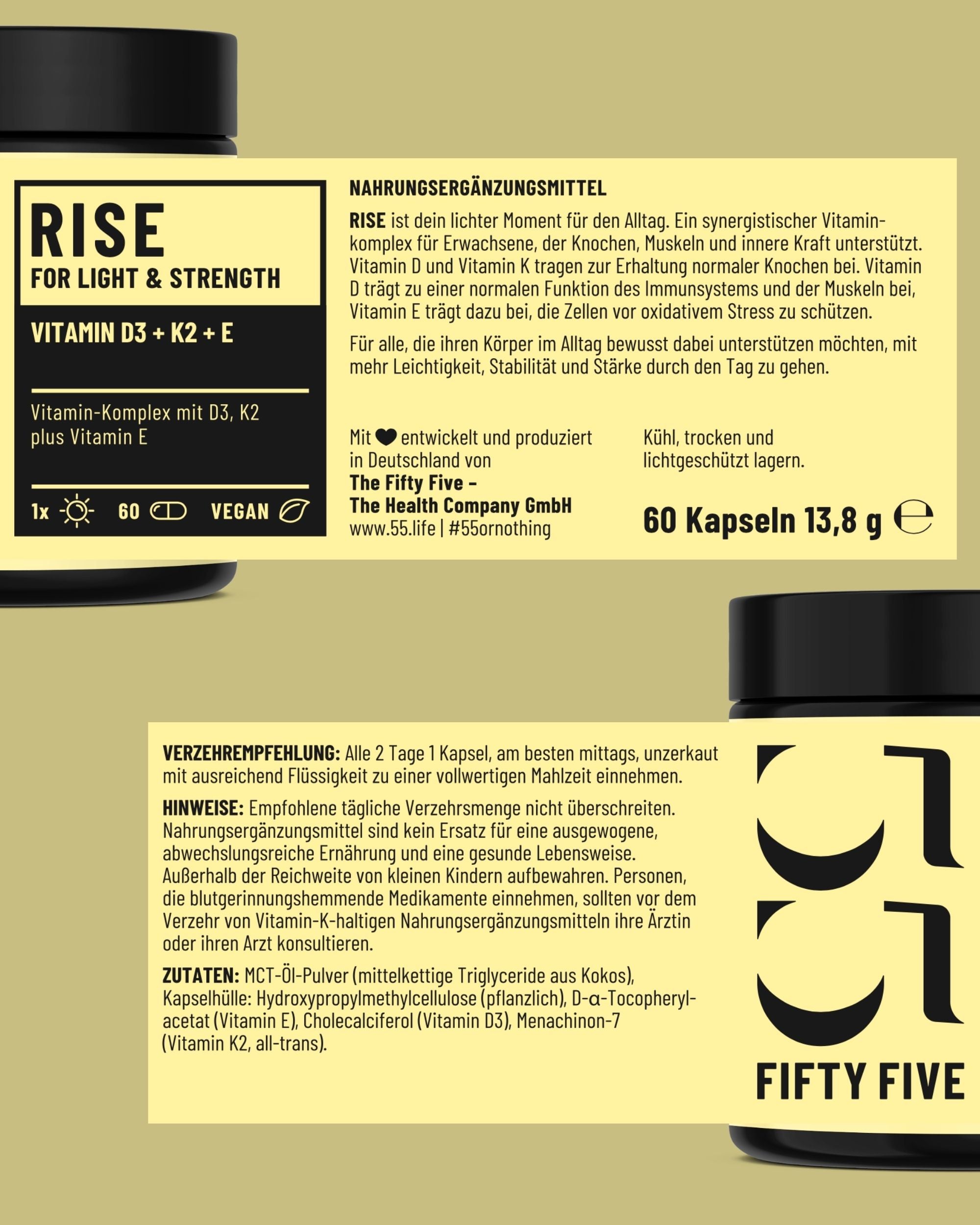
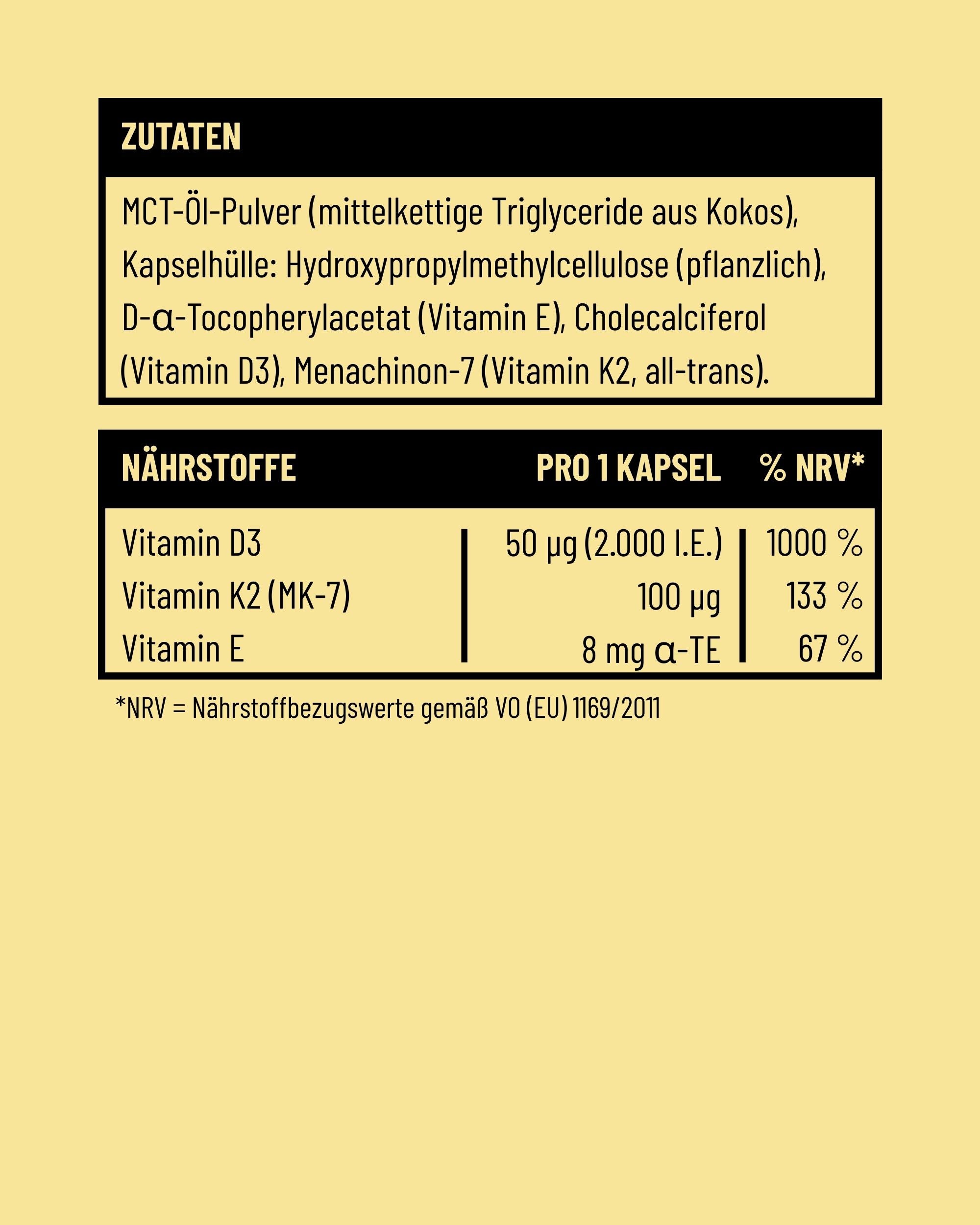
RISE by Fifty Five delivers 50 µg of vitamin D3 in combination with 100 µg of K2 MK-7 all-trans and vitamin E, with MCT oil as an absorption carrier. As part of the daily system together with BASE and CALM, RISE covers the fat-soluble supply level. More in the complete RISE guide.
FAQ
Do women need more vitamin D than men?
The general need is similar. The specific risks (bone density loss after menopause, increased autoimmune risks) make a sufficient vitamin D status particularly relevant for women. No higher dose is necessary, but more attention to the status is justified.
Can I take RISE during pregnancy?
Vitamin D3 and K2 are fundamentally relevant for pregnant women too. The dosage of RISE (50 µg D3 every two days, equivalent to 25 µg daily average) lies in the sensible range. Still: supplementation during pregnancy should always be coordinated with the attending physician. That applies to all food supplements.
Does vitamin D help against PMS?
The data on vitamin D and premenstrual complaints is not as clear as for magnesium. Individual studies report positive connections, but there is no consistent evidence base yet. For PMS symptoms, magnesium is better documented in the literature. More on this in the article Magnesium for women.
Should I have my vitamin D level measured regularly?
For women with an increased osteoporosis risk or in menopause: yes, at least once a year, ideally in the fall. For generally healthy women without specific risk factors, a measurement every 2 to 3 years is a reasonable frame if reliable supplementation takes place.
Does the pill influence vitamin D supply?
Some studies suggest that oral contraceptives (the pill) can slightly raise the 25-OH vitamin D level, possibly through changed vitamin D-binding protein levels. That does not mean women on the pill need less vitamin D; the overall status should still be checked regularly.
Disclaimer:
This article is for informational purposes only and does not replace medical advice, diagnosis, or treatment by a physician or pharmacist. The information provided here should not be used for self-diagnosis or self-treatment. Food supplements are no substitute for a balanced, varied diet and a healthy lifestyle. For any health questions or complaints, please always consult a doctor you trust. Fifty Five accepts no liability for any inconvenience or harm resulting from the use of the information presented here.
Sources
- EFSA. Dietary reference values for vitamin D. EFSA Journal 2016;14(10):4547.
- EFSA. Scientific Opinion on the Tolerable Upper Intake Level of vitamin D. EFSA Journal 2012;10(7):2813.
- EFSA. Dietary reference values for vitamin K. EFSA Journal 2017;15(5):4780.
- German Nutrition Society (DGE). D-A-CH reference values – vitamin D.
- Robert Koch Institute (RKI). DEGS – German Health Interview and Examination Survey for Adults (vitamin D status).









When to Take a Multivitamin: Morning, Evening, or with Meals?
Omega-3 After 50: Why Needs Rise and What That Means for Your Supply
Share: