


For your heart, brain and eyes, omega-3 is first and foremost a building block. It's about two long-chain omega-3 fatty acids, EPA (eicosapentaenoic acid) and DHA (docosahexaenoic acid). They build into the membranes of your cells and need a steady supply from food. That all three need them to work normally is something the EU has even officially confirmed, and at perfectly everyday amounts. What studies have found beyond that is more mixed than the many promises online would suggest. Blood lipids and blood pressure move mainly at amounts in the gram range. And for memory and eyes, big studies in healthy people have so far measured little difference.
That's why we tell you about the big studies the way they actually turned out, including where nothing came of them. The basics of omega-3 are in our omega-3 guide.
What can omega-3 do for your heart, brain and eyes?
The EU has officially authorized three health claims for EPA and DHA, which you can look up in the EU list of authorized claims: "EPA and DHA contribute to the normal function of the heart", "DHA contributes to maintenance of normal brain function" and "DHA contributes to the maintenance of normal vision". For the heart, this applies from 250 mg of EPA and DHA a day, for brain and eyes from 250 mg of DHA.
There are two more claims for blood pressure and blood triglycerides. But they only apply from 3 g and 2 g of EPA and DHA a day respectively, meaning twelve and eight times the 250 mg. And they always come with the note not to take in more than 5 g a day in total from food supplements. What studies show beyond that, you can see here at a glance:
| Area | What officially applies in the EU | From what amount per day | What studies show beyond that |
|---|---|---|---|
| Heart | normal function of the heart | 250 mg EPA and DHA | mixed, depending on the amount and whether healthy people or patients took part |
| Blood pressure | normal blood pressure | 3 g EPA and DHA | a few mmHg lower, the most at 2 to 3 g |
| Blood lipids | normal blood triglyceride levels | 2 g EPA and DHA | triglycerides around 15% lower, LDL cholesterol not |
| Brain | normal brain function | 250 mg DHA | slight advantage for memory, no difference for thinking overall |
| Eyes | normal vision | 250 mg DHA | no added benefit for eye diseases |
Does omega-3 lower blood pressure?
A little, yes, most clearly at 2 to 3 g of EPA and DHA a day. That's far more than a normal supply. A review of 71 studies with just under 5,000 participants found an average of around 2.6 mmHg less in the upper reading in that range. At 1 g a day, it was still just under 2 mmHg, and a bit more in older people and people with high blood pressure. So it's measurable, but on the monitor it's only a few ticks. That's why high blood pressure belongs in a doctor's hands.
Does omega-3 lower cholesterol and blood lipids?
Blood lipids yes, cholesterol not really. Omega-3 mainly lowers triglycerides, the fats your body uses to distribute energy through the blood. In a review of 86 studies with over 160,000 people, the Cochrane Collaboration found values around 15% lower. And this independent research network rates exactly this finding as highly reliable. According to the European Food Safety Authority (EFSA), LDL cholesterol actually rises slightly, by around 3%, at 2 to 6 g a day. In EFSA's assessment, though, that probably doesn't increase cardiovascular risk. An authorized claim on cholesterol exists only for ALA, the plant omega-3 fatty acid from flaxseed oil, walnuts and chia. More on this in flaxseed oil and ALA.
Omega-3 and the heart: what do VITAL, REDUCE-IT and STRENGTH show?
In healthy people, the big studies found no difference in the main outcome, but they did find positive signals alongside it. The strongest results come from studies with patients and drug-level doses. The most important one for healthy people is VITAL, with almost 26,000 adults aged 50 and over. For just over five years, they got 840 mg of EPA and DHA from fish oil every day, while the comparison group got a placebo. For all major cardiovascular events combined, meaning heart attack, stroke and cardiovascular death, there was no difference. Heart attacks alone, however, numbered 145 instead of 200 with omega-3, around a quarter fewer, or one in about 235 participants, a secondary finding the researchers themselves interpret with caution. A Harvard review of 13 studies with healthy people and patients found a small overall advantage for heart attacks and cardiovascular deaths, one that grew with the dose.
The effects only get really big in people who are already sick, and with prescription drugs. In the patient study REDUCE-IT, major cardiovascular events dropped from 22.0 to 17.2% with 4 g of pure EPA a day. The placebo, however, was mineral oil. And in an analysis of the blood values, inflammation and cholesterol markers rose in exactly that group. How much of the advantage is down to the comparison oil is therefore still open today. STRENGTH also gave 4 g, but EPA and DHA combined, and compared it with corn oil. The study found no advantage, but one in four participants had gastrointestinal complaints, compared with one in seven on corn oil. Both studies were paid for by pharmaceutical companies. They can't be applied to a daily supply under 1 g.
| Study | Who | Amount per day | Result |
|---|---|---|---|
| VITAL (2019) | 25,871 healthy men aged 50 and over and women aged 55 and over, just over five years | 840 mg EPA and DHA from fish oil | main outcome unchanged, fewer heart attacks as a secondary finding |
| REDUCE-IT (2019) | 8,179 patients with heart disease or diabetes, just under five years | 4 g pure EPA as a prescription drug | fewer major events, comparison oil disputed |
| STRENGTH (2020) | 13,078 high-risk patients | 4 g EPA and DHA as a prescription drug | no advantage, more gastrointestinal complaints |
Atrial fibrillation, a common heart rhythm disorder, occurred slightly more often with omega-3 in several large studies, especially at amounts over 1 g a day. The numbers are in our article on omega-3 side effects. If you have heart rhythm problems or take blood thinners, talk to your doctor first.
What does omega-3 do in the brain: memory, focus, mood?
In the brain, DHA is the most abundant omega-3 fatty acid. The brain can hardly make it on its own, so it has to come from your food. In the MIDAS study with 485 people aged 55 and over with mild memory complaints, participants got 900 mg of DHA a day or a placebo. After six months, those on DHA made fewer errors in a learning and memory test. The study did come from a manufacturer of algae DHA. But a review of 25 studies in adults without dementia also found a slight advantage for memory, though none for thinking overall.
Where the mind is already working well, less happened. In the VITAL study with over 4,000 healthy people aged 60 and over, 1 g of fish oil a day didn't measurably change mental performance over two to three years. In VITAL-DEP with over 18,000 adults aged 50 and over, mood also stayed the same after just over five years, and depression didn't become any less common. Positive results tend to come from patients with depression and supplements high in EPA, which shows nicely that DHA and EPA have different focus areas in the body.
Can omega-3 protect against dementia?
That hasn't been shown so far. A Cochrane review on people with mild to moderate Alzheimer's dementia found no benefit from omega-3 supplements in three studies with 632 participants. In healthy older people, too, thinking didn't change measurably in large studies.
Omega-3 and the eyes: what does the retina get out of it?
First of all, DHA is an important building block there. A review on the retina describes that around half of all fatty acids in its light-sensing cells are DHA. In most other tissues, the share is only 1 to 5%. For eye diseases, on the other hand, studies have found little so far. In the AREDS2 study with over 4,000 people with early stages of age-related macular degeneration, a disease of the center of the retina, 1 g of omega-3 a day over five years brought no added benefit. And for dry eyes, the DREAM study with 3 g a day did no better than olive oil after one year.
Does omega-3 help skin, hair and joints?
In healthy people, that hasn't been shown, and there's no authorized claim for any of the three.
Skin and hair
You read pretty often that omega-3 makes your skin softer or your hair shinier. But there are no solid studies on it. Visible skin changes are only known from people who were fed through a stomach tube for years. With a normal diet, a deficiency like that hasn't been described.
Joints
Here there are only studies with patients: a review of 42 studies with just over 2,700 arthritis patients found a small advantage for pain in rheumatoid arthritis, an inflammatory joint disease, and none in osteoarthritis, the wear and tear of the joints.
Omega-3 for athletes and over 50: what changes?
Your requirement doesn't change, EFSA's 250 mg apply to all adults. Whether it can still be a bit more from 50 on, we work out in our article getting the EPA and DHA dose right. In sports, a review on omega-3 and performance sees first signs of better endurance and faster recovery after hard training. For more muscle building, though, the evidence isn't sufficient.
In the European DO-HEALTH study, over 2,000 healthy people aged 70 and over took just under 1 g of omega-3 from algae oil a day for three years. The study was co-funded by, among others, nutrient and pharmaceutical companies. Blood pressure, fitness, memory and bone fractures didn't change measurably. Only infections tended to be less common, by around 11%, but that wasn't statistically confirmed. For muscles and bones in later life, vitamin D and magnesium are the more obvious topics anyway, more on that in our vitamin D3 and K2 guide and our magnesium guide.
How much fish is enough, and what if you don't eat any?
For adults, EFSA considers 250 mg of EPA and DHA a day adequate. On paper, a single serving of oily sea fish a week already gets you there, farmed salmon for example, while lean cod doesn't, as the values in the US nutrient database show. Germany's Federal Institute for Risk Assessment (BfR) also considers an "adequate supply of EPA and DHA" reached with one to two servings of oily sea fish a week. Which fish brings how much is in our table of foods with omega-3.
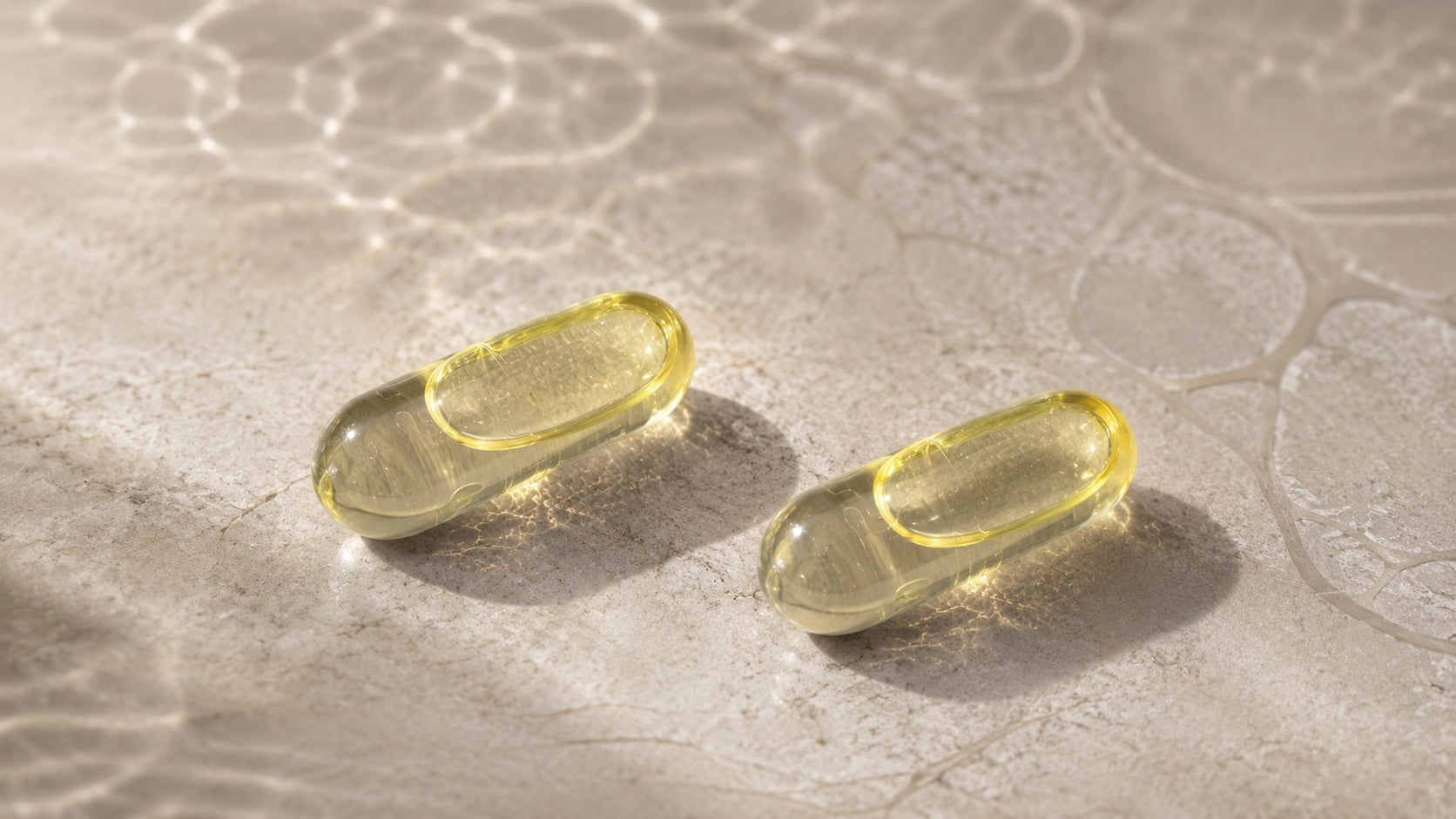
If you rarely or never eat fish, though, DHA gets tricky. Outside of oily sea fish, there's hardly any in food, and your body makes only a little EPA from ALA and hardly any DHA, usually under five percent for DHA. For this case, the German Nutrition Society (DGE) explicitly names microalgae as a good alternative. And that's exactly where we come in. PULSE by Fifty Five brings 648 mg of EPA and DHA a day with two Liquid-Caps. That's deliberately more than the reference amount, but far from the gram amounts in the studies above, because PULSE is made for your daily supply and not as a treatment. The shell is plant-based, clear and smooth, and easier to swallow than a softgel.
Together with the other Essentials, it all fits into your day like this: BASE in the morning, RISE in the morning or at lunch, PULSE with lunch or dinner, CALM in the evening. Why algae oil instead of fish oil is covered in our comparison fish oil or algae oil. What it looks like in everyday life is told in Sophia's story. And the right time to take it is in when to take omega-3.
FAQ
Is omega-3 anti-inflammatory?
EPA and DHA really do play a part in inflammatory processes. For example, they're the starting material for messengers like resolvins, which help inflammatory responses wind down again. That's how the nutrition researcher Philip Calder describes it in a review. So far, though, a benefit in humans has mainly been shown in patients, for example with rheumatoid arthritis, and usually with well over 1 g a day.
Does omega-3 help you sleep?
So far there are no solid studies on that and no authorized claim. If you're after calmer evenings, magnesium is the more obvious topic, more on that in our magnesium guide.
Do men need more omega-3 than women?
Officially no, the same reference amount applies to all adults. With DHA, though, women have a small head start. From plant ALA, young women in a very small study made an estimated 9% DHA, while in young men no DHA formation was measurable at all. For men, ready-made DHA from fish or algae oil is therefore the more reliable route. What applies specifically to women is in our article omega-3 in pregnancy and menopause.
Does omega-3 improve testosterone levels?
There's no evidence for that. What's known is more the reverse relationship: in a study on hormones and fatty acids, giving testosterone lowered the DHA share in the blood by just over a fifth. Estrogen, on the other hand, promotes the body's own production, which is why women have around 15% more DHA on the same diet.
Is omega-3 still worth it at 60 or 70?
For a good supply, there's no reason to go without it at 60 or 70 either, because omega-3 is absorbed and tolerated well at that age too. In MIDAS, the DHA in the blood of participants aged 55 and over had doubled after six months. In DO-HEALTH, people aged 70 and over tolerated just under 1 g of algae oil a day well for three years. And the EU claims on DHA for brain and vision apply with no age limit. Whether your supply is enough is shown by the omega-3 index, a blood test for EPA and DHA in your red blood cells. How to get it measured, we explain in our article on omega-3 deficiency and the omega-3 index.
Disclaimer:
This article is for informational purposes only and does not replace medical advice, diagnosis, or treatment by a physician or pharmacist. The information provided here should not be used for self-diagnosis or self-treatment. Food supplements are no substitute for a balanced, varied diet and a healthy lifestyle. For any health questions or complaints, please always consult a doctor you trust. Fifty Five accepts no liability for any inconvenience or harm resulting from the use of the information presented here.
Sources
- Verordnung (EU) Nr. 432/2012 der Kommission vom 16. Mai 2012 zur Festlegung einer Liste zulässiger anderer gesundheitsbezogener Angaben über Lebensmittel als Angaben über die Reduzierung eines Krankheitsrisikos sowie die Entwicklung und die Gesundheit von Kindern (Commission Regulation (EU) No 432/2012 of 16 May 2012 establishing a list of permitted health claims made on foods, other than those referring to the reduction of disease risk and to children's development and health), consolidated version of May 17, 2021 (including the amendments by Regulation (EU) No 536/2013). eur-lex.europa.eu
- Zhang X, Ritonja JA, Zhou N et al.: Omega-3 Polyunsaturated Fatty Acids Intake and Blood Pressure: A Dose-Response Meta-Analysis of Randomized Controlled Trials. Journal of the American Heart Association, 2022. pubmed.ncbi.nlm.nih.gov/35647665
- Abdelhamid AS, Brown TJ, Brainard JS et al.: Omega-3 fatty acids for the primary and secondary prevention of cardiovascular disease. Cochrane Database of Systematic Reviews, 2020. pubmed.ncbi.nlm.nih.gov/32114706
- EFSA Panel on Dietetic Products, Nutrition and Allergies (NDA): Scientific Opinion on the Tolerable Upper Intake Level of eicosapentaenoic acid (EPA), docosahexaenoic acid (DHA) and docosapentaenoic acid (DPA). EFSA Journal, 2012. efsa.onlinelibrary.wiley.com
- Manson JE, Cook NR, Lee IM et al.: Marine n-3 Fatty Acids and Prevention of Cardiovascular Disease and Cancer. The New England Journal of Medicine, 2019. pubmed.ncbi.nlm.nih.gov/30415637
- Hu Y, Hu FB, Manson JE: Marine Omega-3 Supplementation and Cardiovascular Disease: An Updated Meta-Analysis of 13 Randomized Controlled Trials Involving 127 477 Participants. Journal of the American Heart Association, 2019. pubmed.ncbi.nlm.nih.gov/31567003
- Bhatt DL, Steg PG, Miller M et al.: Cardiovascular Risk Reduction with Icosapent Ethyl for Hypertriglyceridemia. The New England Journal of Medicine, 2019. pubmed.ncbi.nlm.nih.gov/30415628
- Ridker PM, Rifai N, MacFadyen J et al.: Effects of Randomized Treatment With Icosapent Ethyl and a Mineral Oil Comparator on Interleukin-1β, Interleukin-6, C-Reactive Protein, Oxidized Low-Density Lipoprotein Cholesterol, Homocysteine, Lipoprotein(a), and Lipoprotein-Associated Phospholipase A2: A REDUCE-IT Biomarker Substudy. Circulation, 2022. pubmed.ncbi.nlm.nih.gov/35762321
- Nicholls SJ, Lincoff AM, Garcia M et al.: Effect of High-Dose Omega-3 Fatty Acids vs Corn Oil on Major Adverse Cardiovascular Events in Patients at High Cardiovascular Risk: The STRENGTH Randomized Clinical Trial. JAMA, 2020. pubmed.ncbi.nlm.nih.gov/33190147
- Lacombe RJS, Chouinard-Watkins R, Bazinet RP: Brain docosahexaenoic acid uptake and metabolism. Molecular Aspects of Medicine, 2018. pubmed.ncbi.nlm.nih.gov/29305120
- Yurko-Mauro K, McCarthy D, Rom D et al.: Beneficial effects of docosahexaenoic acid on cognition in age-related cognitive decline. Alzheimer's & Dementia, 2010. pubmed.ncbi.nlm.nih.gov/20434961
- Alex A, Abbott KA, McEvoy M et al.: Long-chain omega-3 polyunsaturated fatty acids and cognitive decline in non-demented adults: a systematic review and meta-analysis. Nutrition Reviews, 2020. pubmed.ncbi.nlm.nih.gov/31841161
- Kang JH, Vyas CM, Okereke OI et al.: Marine n-3 fatty acids and cognitive change among older adults in the VITAL randomized trial. Alzheimer's & Dementia: Translational Research & Clinical Interventions, 2022. pubmed.ncbi.nlm.nih.gov/35415212
- Okereke OI, Vyas CM, Mischoulon D et al.: Effect of Long-term Supplementation With Marine Omega-3 Fatty Acids vs Placebo on Risk of Depression or Clinically Relevant Depressive Symptoms and on Change in Mood Scores: A Randomized Clinical Trial. JAMA, 2021. pubmed.ncbi.nlm.nih.gov/34932079
- Liao Y, Xie B, Zhang H et al.: Efficacy of omega-3 PUFAs in depression: A meta-analysis. Translational Psychiatry, 2019. pubmed.ncbi.nlm.nih.gov/31383846
- Burckhardt M, Herke M, Wustmann T et al.: Omega-3 fatty acids for the treatment of dementia. Cochrane Database of Systematic Reviews, 2016. pubmed.ncbi.nlm.nih.gov/27063583
- Querques G, Forte R, Souied EH: Retina and omega-3. Journal of Nutrition and Metabolism, 2011. pubmed.ncbi.nlm.nih.gov/22175009
- Age-Related Eye Disease Study 2 Research Group: Lutein + zeaxanthin and omega-3 fatty acids for age-related macular degeneration: the Age-Related Eye Disease Study 2 (AREDS2) randomized clinical trial. JAMA, 2013. pubmed.ncbi.nlm.nih.gov/23644932
- Dry Eye Assessment and Management Study Research Group; Asbell PA, Maguire MG et al.: n-3 Fatty Acid Supplementation for the Treatment of Dry Eye Disease. The New England Journal of Medicine, 2018. pubmed.ncbi.nlm.nih.gov/29652551
- Bjerve KS, Mostad IL, Thoresen L: Alpha-linolenic acid deficiency in patients on long-term gastric-tube feeding: estimation of linolenic acid and long-chain unsaturated n-3 fatty acid requirement in man. The American Journal of Clinical Nutrition, 1987. pubmed.ncbi.nlm.nih.gov/2879436
- Senftleber NK, Nielsen SM, Andersen JR et al.: Marine Oil Supplements for Arthritis Pain: A Systematic Review and Meta-Analysis of Randomized Trials. Nutrients, 2017. pubmed.ncbi.nlm.nih.gov/28067815
- Philpott JD, Witard OC, Galloway SDR: Applications of omega-3 polyunsaturated fatty acid supplementation for sport performance. Research in Sports Medicine, 2019. pubmed.ncbi.nlm.nih.gov/30484702
- Bischoff-Ferrari HA, Vellas B, Rizzoli R et al.: Effect of Vitamin D Supplementation, Omega-3 Fatty Acid Supplementation, or a Strength-Training Exercise Program on Clinical Outcomes in Older Adults: The DO-HEALTH Randomized Clinical Trial. JAMA, 2020. pubmed.ncbi.nlm.nih.gov/33170239
- EFSA Panel on Dietetic Products, Nutrition, and Allergies (NDA): Scientific Opinion on Dietary Reference Values for fats, including saturated fatty acids, polyunsaturated fatty acids, monounsaturated fatty acids, trans fatty acids, and cholesterol. EFSA Journal, 2010. efsa.onlinelibrary.wiley.com
- U.S. Department of Agriculture: FoodData Central (SR Legacy), Fish, salmon, Atlantic, farmed, raw. fdc.nal.usda.gov
- Bundesinstitut für Risikobewertung (BfR) [German Federal Institute for Risk Assessment]: Omega-3-Fettsäuren: Wichtig, aber in Maßen (omega-3 fatty acids: important, but in moderation). Fragen und Antworten (questions and answers), April 30, 2026. bfr.bund.de
- Deutsche Gesellschaft für Ernährung (DGE) [German Nutrition Society]: Gut essen und trinken, DGE-Empfehlungen: Fisch jede Woche (eating well, DGE recommendations: fish every week). 2024. dge.de
- Calder PC: Omega-3 fatty acids and inflammatory processes: from molecules to man. Biochemical Society Transactions, 2017. pubmed.ncbi.nlm.nih.gov/28900017
- Burdge GC, Wootton SA: Conversion of alpha-linolenic acid to eicosapentaenoic, docosapentaenoic and docosahexaenoic acids in young women. British Journal of Nutrition, 2002. pubmed.ncbi.nlm.nih.gov/12323090
- Burdge GC, Jones AE, Wootton SA: Eicosapentaenoic and docosapentaenoic acids are the principal products of alpha-linolenic acid metabolism in young men. British Journal of Nutrition, 2002. pubmed.ncbi.nlm.nih.gov/12323085
- Giltay EJ, Gooren LJ, Toorians AW et al.: Docosahexaenoic acid concentrations are higher in women than in men because of estrogenic effects. The American Journal of Clinical Nutrition, 2004. pubmed.ncbi.nlm.nih.gov/15531662




Vitamin D Overdose: Symptoms, How Much Is Too Much and What Helps
Magnesium for Women: Periods, PMS, Pregnancy, and Menopause
Share: