

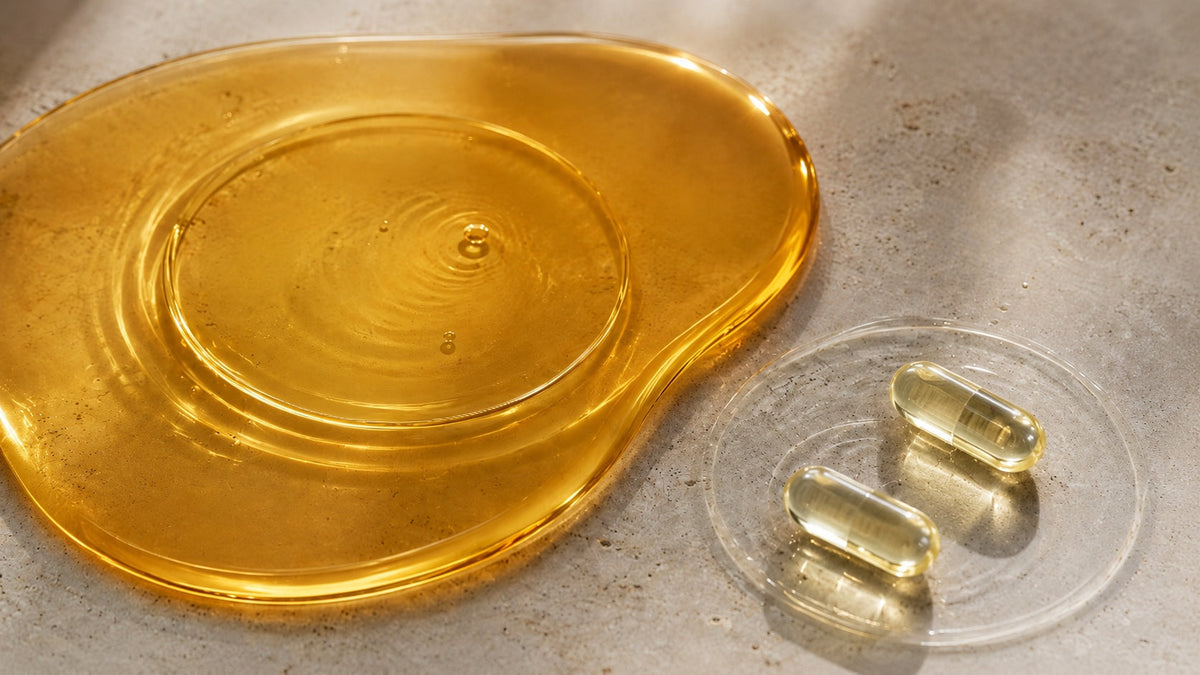
When it comes to omega-3, no plant beats flaxseed oil. More than half of its fatty acids are omega-3, and just one teaspoon a day covers your need for ALA, the plant-based omega-3 fatty acid. ALA just isn't the same thing as EPA and DHA, though. Those are the two long-chain omega-3 fatty acids from oily fish and algae, and when it comes to heart, brain and eyes, they're exactly the ones that matter. Your body turns ALA into only a little EPA and hardly any DHA, usually less than five percent in the case of DHA.
Flaxseed oil can do quite a lot, just not everything people hope for from omega-3. What it's good enough for, we work out here with the numbers from the studies. You'll find the big picture in our omega-3 basics.
How much omega-3 is in flaxseed oil?
One tablespoon of flaxseed oil provides a good 5 g of ALA, roughly five times what you need in a day. The US nutrient database USDA lists about 53 g of ALA per 100 g for cold-pressed flaxseed oil. That puts it far ahead of everything else: flaxseeds come to just under 23 g, walnuts and canola oil to a little over 9 g each.
The German Nutrition Society (DGE) derives the daily requirement from energy: for ALA it sets an estimated value of 0.5% of daily energy, which at 2,000 kcal comes to a little over 1 g a day. Germany's Federal Institute for Risk Assessment (BfR) calculates with slightly more energy and arrives at about 1.3 g. It has a very down-to-earth way of putting it, too: this amount "can already be reached with about one tablespoon of flaxseeds (6 to 7 g) or one tablespoon (15 milliliters (ml)) of canola oil, or by eating about 13 g of shelled walnuts (about four walnuts)".
So a single tablespoon of flaxseed oil brings roughly as much ALA as 10 g of flaxseeds, a handful of walnuts and a tablespoon of canola oil combined. That's calculated with the 10 g the DGE uses for a tablespoon of oil. None of them contains EPA or DHA, though. How fish and plants compare per serving is shown in our table of foods with omega-3.
What is alpha-linolenic acid (ALA)?
Alpha-linolenic acid, ALA for short, is the omega-3 fatty acid from plants like flax, walnut, chia and canola. Your body needs it but can't make it itself. The DGE writes about ALA and its omega-6 counterpart linoleic acid that they "cannot be produced by the body itself and must be supplied through food". That's why both are called essential.
Chemically, ALA is a chain of 18 carbon atoms, EPA (eicosapentaenoic acid) has 20 and DHA (docosahexaenoic acid) 22. To turn ALA into one of these long fatty acids, your body has to lengthen and rebuild the chain step by step. Think of ALA as the bare shell of a house and DHA as the fully furnished home. Your body can do the finishing work, but it does so only reluctantly, and a good part of the material simply gets burned as energy along the way. What EPA and DHA then do in detail, we explain in our article on DHA vs. EPA: the difference.
How much ALA does your body convert to EPA and DHA?
Depending on the study, your body converts a few percent of ALA into EPA, and young women considerably more. With DHA, on the other hand, it almost always stays at very little, and in men none at all could be detected in the measurements.
The most precise numbers come from studies with labeled ALA, whose path through the blood can be traced over three weeks. In six young men, it turned into about 8% EPA, while DHA could not be measured right up to the end. They had already breathed out about a third of the ALA as carbon dioxide after just one day. In six young women things looked considerably friendlier: there, about 21% of the ALA became EPA and 9% became DHA. The authors suspect estrogens play a role. Both results, however, are based on six people each and a single dose.
A large review from 2016 pulled these and other measurements together. In men, the values range from 0.3 to 8% for EPA and stay below 1% for DHA, with most studies coming out considerably lower still. The 9% in young women is the highest DHA value the review mentions. Whether conversion declines further with age has hardly been studied so far. But it's already low in young adults.
Conversion can also be slowed by a lot of linoleic acid, the omega-6 fatty acid found in many plant oils. In a 2009 science advisory, the American Heart Association notes that more omega-6 can inhibit the already low conversion of ALA to EPA. Even so, it explicitly advises against cutting omega-6, because linoleic acid tends to come out favorably in its data. More on this in our article on the omega-6 to omega-3 ratio.
Why does flaxseed oil barely raise DHA?
The conversion usually stalls halfway, at EPA and one intermediate step after it. Practically nothing makes it all the way to DHA. A 2009 review states this clearly: more ALA raises EPA in the blood, but hardly DHA, while ready-made DHA from food does.
You can see it even more clearly in the omega-3 index. It measures the EPA and DHA content in your red blood cells and builds up over months. An analysis of 13 randomized studies found that high-dose flaxseed oil didn't raise the index in any of them, and in some studies with plant oils it even dropped. Oil from microalgae, on the other hand, raised it in every study. That's no argument against flaxseed oil. It just shows the division of labor very clearly: you get your ALA from flaxseed oil, and your DHA from a source where it's already ready-made. How you can get your own index measured is in our article on the omega-3 index: values and testing.
How much flaxseed oil per day?
One teaspoon of flaxseed oil a day is completely enough for your ALA needs, and you don't need more than a tablespoon even if you like to be generous with it. Translated into spoons, it looks like this, calculated with 10 g for a tablespoon and about half that for a teaspoon:
| Measure | Flaxseed oil | ALA in it |
|---|---|---|
| DGE daily value (at 2,000 kcal) | about 2 g, just under half a teaspoon | 1.1 g |
| Daily value in the BfR example (at 2,400 kcal) | about 2.5 g, half a teaspoon | 1.3 g |
| One teaspoon | about 5 g | a good 2.5 g |
| One tablespoon | 10 g | 5.3 g |
Flaxseed oil becomes a habit most easily when it gets a fixed place in your day. Stirred into quark with boiled potatoes, the German classic, drizzled over your salad in the evening, or as a teaspoon in your muesli. If you'd rather chew than spoon, go for flaxseeds or a handful of walnuts, which also gets you comfortably past the daily value.
How healthy is flaxseed oil?
Flaxseed oil has a strength of its own that has been officially reviewed, and it concerns cholesterol. In the EU, exactly one health claim is authorized for ALA, in the official wording: "ALA contributes to the maintenance of normal blood cholesterol levels". It applies with a daily intake of 2 g of ALA, which is just under 4 g of flaxseed oil and so not even a tablespoon. For heart, brain and vision, on the other hand, the EU has only authorized claims for EPA and DHA, for the heart from 250 mg of EPA and DHA a day, for brain and vision from 250 mg of DHA. Flaxseed oil alone can't support those. With your teaspoon of flaxseed oil a day you already meet the condition for the ALA claim, but for EPA and DHA you need a second source.
Flaxseed oil with DHA and EPA: what's behind it?
If a bottle of flaxseed oil says DHA or EPA on it, it has been added from another oil. According to the USDA, flaxseed oil itself contains neither. In that case, look at the amount per tablespoon and compare it with the 250 mg of EPA and DHA a day that the European Food Safety Authority (EFSA) considers adequate for adults. That way you'll see pretty quickly whether the bottle actually does something for you or mainly decorates the label. How much EPA and DHA you need a day, we work out in our article on your daily omega-3 dose.
Flaxseed oil, fish oil or algae oil?
For ALA, there's no simpler source than flaxseed oil. For EPA and DHA you need oily fish, fish oil or algae oil. Because they don't deliver the same thing at all, they also get along well side by side:
| Source | Typical serving | Which omega-3 | What reaches your blood |
|---|---|---|---|
| Flaxseed oil | 10 g (one tablespoon) | 5.3 g ALA, no EPA or DHA | EPA rises a little, DHA hardly, the omega-3 index not at all |
| Farmed salmon | 150 g | about 2,950 mg EPA and DHA | EPA and DHA directly, DHA in the blood rises clearly |
| Fish oil | Depends on the product, amount in mg on the label | EPA and DHA | EPA and DHA directly, just like from fish |
| Algae oil | Depends on the product, amount in mg on the label | EPA and DHA | DHA arrives just as it does from salmon, the omega-3 index rises |
We calculated the salmon value with the USDA data for farmed salmon, and farmed salmon varies quite a bit depending on its feed. That algae oil keeps up with fish when it comes to DHA has even been compared directly: people who took algae oil capsules for two weeks ended up with just as much additional DHA in their blood as the group eating cooked salmon. The study didn't run any longer than that, though. We compare algae oil, fish oil and krill oil in detail in our article on algae oil: vegan omega-3 compared.
For us, flaxseed oil and PULSE by Fifty Five therefore both belong on the table, because they don't replace each other, they complement each other. The flaxseed oil brings the ALA, PULSE the ready-made DHA and EPA from algae oil that your body would only build from ALA in small amounts. And since PULSE belongs with a meal anyway, ideally one with a bit of fat, a salad with flaxseed oil is of course exactly the right occasion.
How should you store and use flaxseed oil?
Flaxseed oil belongs in the fridge, tightly closed, and once opened it's best to use it up quickly. More than half of it consists of omega-3 fatty acids, and those are sensitive to oxygen. A small bottle that's empty quickly is therefore the better choice than the big one that sits in the fridge door for months.
Flaxseed oil doesn't belong in the frying pan, because its delicate fatty acids don't handle heat well. Add it only once the food is on your plate. I like to drizzle flaxseed oil over my Bircher muesli, by the way, but I still get my DHA elsewhere, and that is exactly the distinction I wanted to make clear here. Fresh flaxseed oil tastes mild and slightly nutty, and once it turns noticeably bitter, its best days are behind it.
FAQ
How much flaxseed equals one tablespoon of flaxseed oil?
For the same amount of ALA as in one tablespoon of flaxseed oil, you need about 23 g of flaxseeds, which by the BfR's tablespoon measure is three to four tablespoons. As a pressed oil, flaxseed oil is simply much more concentrated. For your daily needs, though, a single tablespoon of flaxseeds is already enough.
Are flaxseed oil capsules worth it?
You don't need a capsule for ALA, a teaspoon of flaxseed oil from the bottle already covers your needs. Flaxseed oil capsules contain the same ALA as the oil, so they also contain no EPA or DHA. If you want to take omega-3 as a capsule because you're short on EPA and DHA, algae or fish oil is the right choice.
Is flaxseed oil enough for vegans?
For ALA, flaxseed oil is completely enough, but for EPA and DHA vegans can hardly get around algae oil. Even the DGE, in its recommendations on fish, considers microalgae a good alternative, as long as the products are authorized in the EU. What a switch like that looks like is told by Sophia, who moved from fish oil capsules to algae oil.
Is algae oil worth it if I already take flaxseed oil every day?
Yes, especially then, because the two split the work. Your flaxseed oil covers the ALA, but hardly any of it ends up as DHA: in the 13 studies mentioned above, algae oil raised the omega-3 index every single time, flaxseed oil not once. Ideally take both with the same meal, since a bit of fat in your food helps absorption anyway.
Can you have too much flaxseed oil?
You don't need to keep count for safety reasons, because EFSA hasn't set any upper limit for ALA in its reference values for fats. A tablespoon of flaxseed oil does have about 90 kcal, though. And you don't need more than a tablespoon a day for ALA anyway, your needs are more than covered with that.
Disclaimer:
This article is for informational purposes only and does not replace medical advice, diagnosis, or treatment by a physician or pharmacist. The information provided here should not be used for self-diagnosis or self-treatment. Food supplements are no substitute for a balanced, varied diet and a healthy lifestyle. For any health questions or complaints, please always consult a doctor you trust. Fifty Five accepts no liability for any inconvenience or harm resulting from the use of the information presented here.
Sources
- U.S. Department of Agriculture, Agricultural Research Service: FoodData Central (SR Legacy), Oil, flaxseed, cold pressed (FDC 167702). fdc.nal.usda.gov
- Deutsche Gesellschaft für Ernährung (DGE) [German Nutrition Society]: DGE/ÖGE-Referenzwerte für die Nährstoffzufuhr, Fett, essenzielle Fettsäuren (reference values for nutrient intake: fat, essential fatty acids). Derivation as of 2000. dge.de
- Bundesinstitut für Risikobewertung (BfR) [German Federal Institute for Risk Assessment]: Omega-3-Fettsäuren: Wichtig, aber in Maßen (omega-3 fatty acids: important, but in moderation). Questions and answers of April 30, 2026. bfr.bund.de
- Burdge GC, Jones AE, Wootton SA: Eicosapentaenoic and docosapentaenoic acids are the principal products of alpha-linolenic acid metabolism in young men. British Journal of Nutrition, 2002. pubmed.ncbi.nlm.nih.gov/12323085
- Burdge GC, Wootton SA: Conversion of alpha-linolenic acid to eicosapentaenoic, docosapentaenoic and docosahexaenoic acids in young women. British Journal of Nutrition, 2002. pubmed.ncbi.nlm.nih.gov/12323090
- Baker EJ, Miles EA, Burdge GC et al.: Metabolism and functional effects of plant-derived omega-3 fatty acids in humans. Progress in Lipid Research, 2016. pubmed.ncbi.nlm.nih.gov/27496755
- Harris WS, Mozaffarian D, Rimm E et al.: Omega-6 fatty acids and risk for cardiovascular disease: a science advisory from the American Heart Association Nutrition Subcommittee of the Council on Nutrition, Physical Activity, and Metabolism; Council on Cardiovascular Nursing; and Council on Epidemiology and Prevention. Circulation, 2009. ahajournals.org
- Brenna JT, Salem N, Sinclair AJ et al.: alpha-Linolenic acid supplementation and conversion to n-3 long-chain polyunsaturated fatty acids in humans. Prostaglandins, Leukotrienes and Essential Fatty Acids, 2009. pubmed.ncbi.nlm.nih.gov/19269799
- Lane KE, Wilson M, Hellon TG, Davies IG: Bioavailability and conversion of plant based sources of omega-3 fatty acids - a scoping review to update supplementation options for vegetarians and vegans. Critical Reviews in Food Science and Nutrition, 2022 (online 2021). pubmed.ncbi.nlm.nih.gov/33576691
- Verordnung (EU) Nr. 432/2012 der Kommission vom 16. Mai 2012 zur Festlegung einer Liste zulässiger anderer gesundheitsbezogener Angaben über Lebensmittel als Angaben über die Reduzierung eines Krankheitsrisikos sowie die Entwicklung und die Gesundheit von Kindern (Commission Regulation (EU) No 432/2012 establishing a list of permitted health claims made on foods), consolidated version of May 17, 2021. eur-lex.europa.eu
- EFSA Panel on Dietetic Products, Nutrition, and Allergies (NDA): Scientific Opinion on Dietary Reference Values for fats, including saturated fatty acids, polyunsaturated fatty acids, monounsaturated fatty acids, trans fatty acids, and cholesterol. EFSA Journal, 2010. efsa.onlinelibrary.wiley.com
- U.S. Department of Agriculture, Agricultural Research Service: FoodData Central (SR Legacy), Fish, salmon, Atlantic, farmed, raw (FDC 175167). fdc.nal.usda.gov
- Arterburn LM, Oken HA, Bailey Hall E et al.: Algal-oil capsules and cooked salmon: nutritionally equivalent sources of docosahexaenoic acid. Journal of the American Dietetic Association, 2008. pubmed.ncbi.nlm.nih.gov/18589030
- Deutsche Gesellschaft für Ernährung (DGE) [German Nutrition Society]: Gut essen und trinken, DGE-Empfehlungen, Fisch jede Woche (eating and drinking well, DGE recommendations: fish every week). 2024. dge.de


Omega-3 Side Effects: How Much Is Too Much and What You Should Know
Vitamin B12 Deficiency: Symptoms, Daily Needs and Which Form of B12 to Take
Share: