


• Mir hilft es wirklich beim Abschalten. Es ist Magnesium und sicher kein Wundermittel, aber ich fühl mich spürbar ruhiger.

    Laura F. Verified purchase

  • Ich schlafe besser und fühle mich morgens deutlich erholter.

    Kevin S. Verified purchase

  • Ich habe schon viele Magnesium-Präparate ausprobiert, aber dieses hier ist von der Verträglichkeit her bisher das Beste.

    Sebastian P. Verified purchase

For Balance & Quiet

Your balance for muscles, nerves and inner calm

CALM supports your nervous system, your muscles and your inner calm with a formula that is gentle and effective. No magnesium oxide. No compromises.

Magnesium is one of the most underrated minerals and at the same time one of the most important. Not because it “relaxes” you, but because it is involved in over 300 enzymatic processes: nerve function, muscle contraction, energy metabolism, mental balance.

You often don’t notice when it’s missing. But you feel it when it works. CALM provides 206 mg of elemental magnesium from two of the most bioavailable compounds, bisglycinate and citrate, plus active vitamin B6, which helps magnesium get into the cell.

Read more in the journal: Magnesium: effects, requirements and forms. The complete guide →

The difference

How CALM compares

With magnesium, the compound decides. It determines how much arrives and how well you tolerate it.

Comparison with typical products in each category. Individual products may differ.

Compare with
CALM
Magnesium oxide Oxide
Magnesium gummies Gummies
Magnesium from bisglycinate + citrate

Organically bound magnesium is absorbed considerably better than oxide. Bisglycinate is particularly well tolerated, citrate is used quickly.

With active vitamin B6 (P-5-P)

Pyridoxal-5-phosphate is the form your body uses directly. Vitamin B6 contributes to normal energy metabolism and to the normal function of the nervous system.

206 mg elemental magnesium per daily dose, fully declared

What counts isn’t the amount of the compound, but how much magnesium is actually in it. With gummies that number is often missing from the pack entirely.

Well tolerated when taken daily

Only a small share of magnesium oxide is absorbed, the rest binds water in the gut. Bisglycinate is considered particularly well tolerated.

No sugar, sweeteners or flavourings

A gummy needs sugar or sweeteners to taste of anything. A capsule doesn’t.

Vegan capsule, no gelatine

Capsule shell made from plant cellulose. Gummies usually contain gelatine, more rarely pectin.

Under €1 per day

60 capsules for 30 days, €0,93 per day.

  • applies
  • partly / depends on the product
  • typically not

The formula

Every ingredient, in its active form

Two magnesium compounds with different strengths that complement each other perfectly, plus vitamin B6 in its active form. Why we formulated CALM exactly this way.

Magnesium: Magnesium bisglycinate

Magnesium bisglycinate is a chelate: two molecules of glycine, the smallest amino acid, close around the magnesium ion like a pair of claws.

N O N O Mg²⁺ Mg²⁺ BisglycinateOxide
Bioavailable form
Why it matters

Because the magnesium stays enclosed in that bond, it does not sit in the gut as a free ion. Magnesium oxide, by contrast, binds water and can have a laxative effect. Bisglycinate is therefore gentle on the stomach even taken daily, and that is exactly what we chose for CALM.

Magnesium: Tri-magnesium dicitrate

Tri-magnesium dicitrate is the magnesium salt of citric acid, which the body also produces itself in its energy metabolism.

O O O O Mg²⁺ Mg²⁺ CitrateOxide
Bioavailable form
Why it matters

Citrate dissolves readily and is therefore available to the body quickly, while bisglycinate works more slowly and is particularly well tolerated. We combine both because they complement each other perfectly: together they make up 206 mg of elemental magnesium.

Vitamin B6: Pyridoxal-5-phosphate

Vitamin B6 is a water-soluble vitamin and a coenzyme in more than a hundred enzyme reactions. It contributes to normal psychological function.

P P-5-PPyridoxine
Bioavailable form
Why it matters

B6 is not sitting next to the magnesium by chance: it is involved in transporting it into the cell. The vitamin only becomes active once a phosphate group is attached to it. That is why we use exactly the form in CALM that already carries it.

Nutrients and ingredients

What is inside

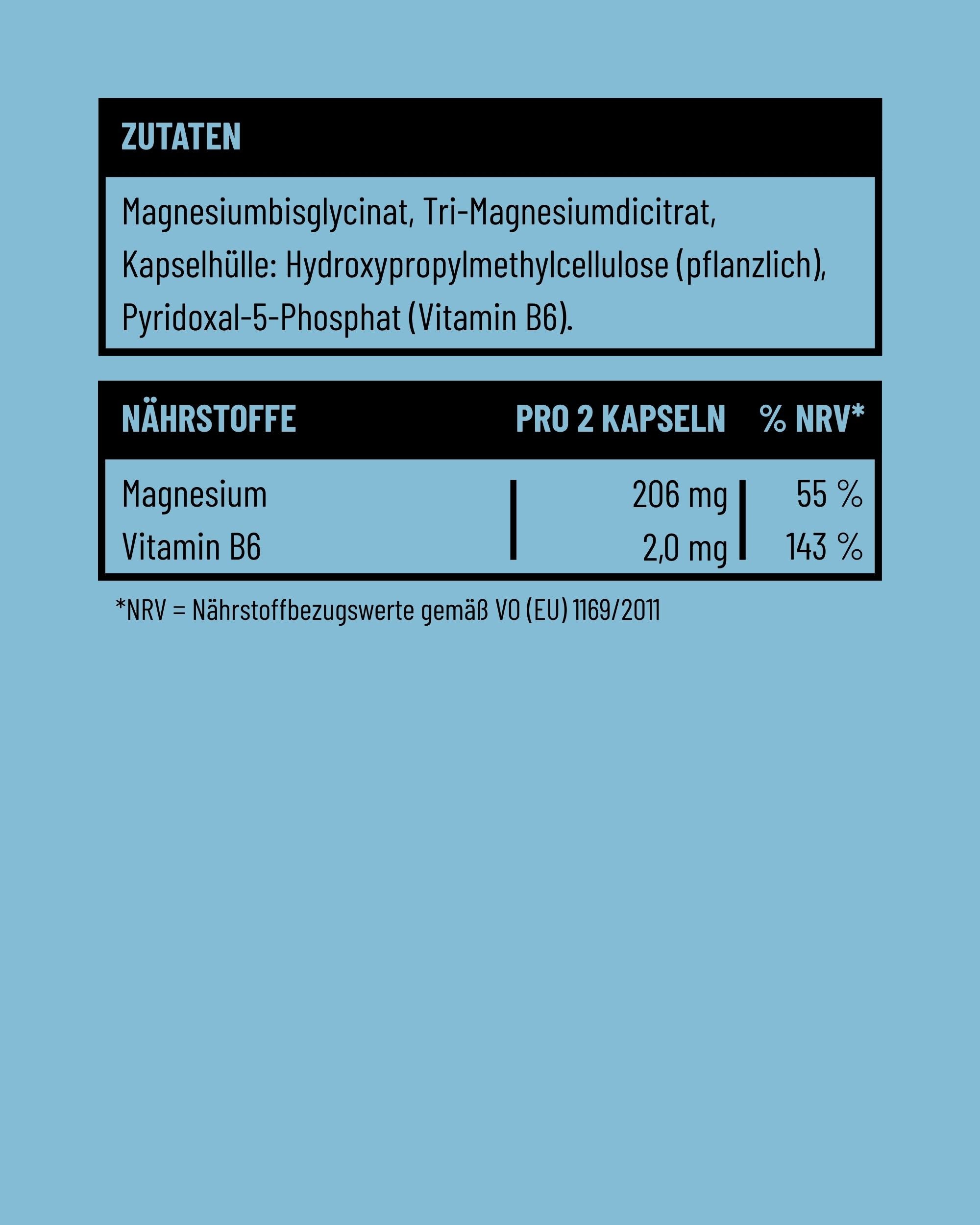
Nutrientsper 2 capsules% NRV*
Magnesium206 mg55%
Vitamin B62 mg143%

*NRV = Nutrient Reference Values according to Regulation (EU) No. 1169/2011

Ingredients

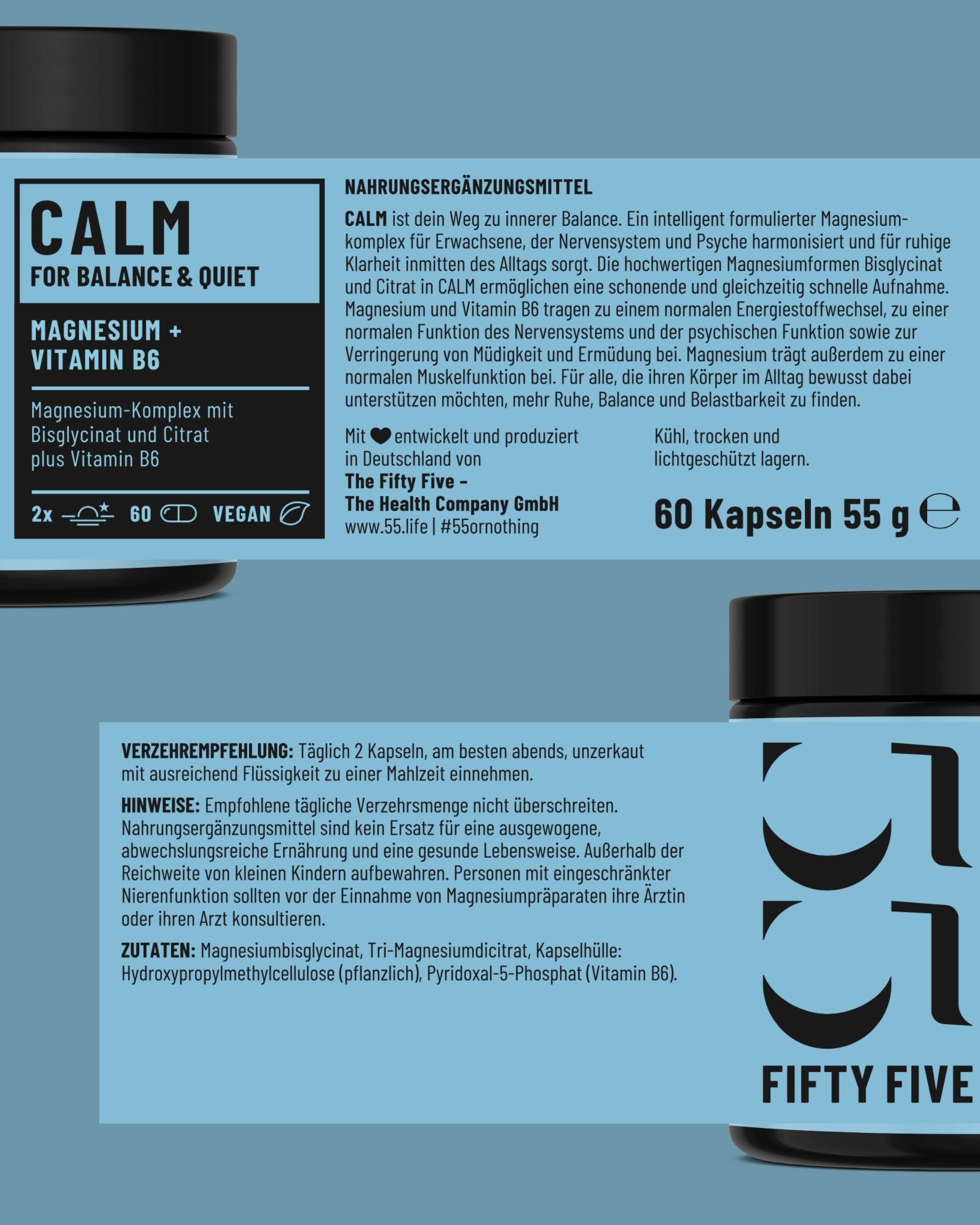
Magnesiumbisglycinat, Tri-Magnesiumdicitrat, Kapselhülle: Hydroxypropylmethylcellulose (pflanzlich), Pyridoxal-5-Phosphat (Vitamin B6).

Hand hält eine weiße CALM Magnesium-Kapsel zwischen Daumen und Zeigefinger

The capsule

206 mg of magnesium in 2 capsules

Others cram as much magnesium as they can into the largest capsule they can find, using cheap oxide. We don’t. Two standard capsules, no magnesium oxide.

Format
A standard capsule instead of a mega capsule. Easy to swallow, and the dose stays divisible.
Intake
Two capsules daily, including your portion of vitamin B6.
When
Ideally in the evening with a meal. If you prefer, take one capsule in the morning and one in the evening.
Shell
100 % vegan: capsule shell made from plant based cellulose (HPMC).

Your new daily routine

What changes for you in 90 days

Magnesium is not a sleeping pill. It is not a switch you flip in the evening. Only about one percent of it is in the blood. It works where your day has settled in: in muscles and nerves. CALM tops up your stores exactly there, evening after evening. That is how you come to rest, and a simple evening routine gradually becomes your new normal.

  1. Day 1 The first evening

    Two capsules with dinner, that is all. Citrate works quickly, bisglycinate follows more slowly, steadily and gentle on the stomach, vitamin B6 helps the magnesium into the cell. What you notice today above all: how easy this routine is. Dinner, two capsules, done for the day. No powder, no mixing.

  2. Day 14 The evening gets calmer

    Two weeks, and your body starts refilling its reserves in muscles and nerves bit by bit. Where you notice it first: in your legs that relax faster after a long day, in your shoulders that are no longer so hunched, and in a day that no longer echoes into the evening as long as it used to.

  3. Day 30 The evening is yours again

    After a month your tissue status is refilled, muscles and nerves work on a full reserve. This is the state CALM is made for: muscles that settle down, a head that really switches off after work, and a morning you feel refreshed instead of dragging the day before along.

  4. Day 90 Your new normal

    Three months, three jars, 90 calm evenings. Welcome to your new normal: you wind down in the evening without thinking about it and start the morning refreshed. Many only notice how much that is worth when they pause. So: do not pause. Keep your new routine running.

    Secure your 90-day supply3 jars · −6 %

Change takes time

60 to 90 days, to be precise.

First the supply: magnesium only works if something comes in every evening, because the body excretes it continuously. Tissue status in muscles and bones fills up over weeks. Until then your account builds up evening by evening.

Then the routine: the bigger part of the change happens in your head. A new daily action takes 66 days* on average before it runs automatically. Until then the capsules are a resolution you make anew every evening. Around day 60 they become a habit, from day 90 they are simply part of your evening.

90 days, that is your path from the first resolution to the new normal.

* Lally et al., European Journal of Social Psychology 2010: 66 days on average.

What CALM supports you with

  • Muscles Magnesium contributes to normal muscle function and to the maintenance of normal bones.
  • Nerves and mind Magnesium and vitamin B6 contribute to the normal functioning of the nervous system and to normal psychological function.
  • Tiredness Magnesium and vitamin B6 contribute to the reduction of tiredness and fatigue.
  • Energy Magnesium and vitamin B6 contribute to normal energy-yielding metabolism.
  • Electrolytes Magnesium contributes to electrolyte balance.

Morning to evening

Complete your day

CALM belongs to the evening. The day before it belongs to BASE, RISE and PULSE.

Build your own routine: choose which Essentials belong to your day and how long your supply should last. From three Essentials you save, with a bigger supply even more.

  1. Morning
  2. Midday
  3. Evening
Your advantage: 10 % You save €11,26
Total €112,96€101,70 just €2,72 per day

incl. VAT Free shipping

No code needed, the advantage is already deducted in your cart.

Georg, the Founder of Fifty Five in a close-up portrait
Quote Icon

90 days are a promise you make to yourself. Here is mine: I believe real quality does not need explaining, it shows in what it does. That is why every jar holds only what your body really needs, and nothing that burdens it. No hidden additives, no gimmicks, no mediocrity. Just a clear formula, day after day. For you and for me, only one thing counts: #55ornothing.

— Georg Roscher, founder of Fifty Five

Answers to the most important questions

FAQ

Is this product right for me?

CALM is ideal for anyone experiencing stress, inner restlessness or muscular tension in their daily life, whether at the office, during sports or in demanding phases of life. CALM also provides valuable support for those facing sleep issues caused by inner tension.

Can CALM be combined with other products?

Yes, CALM is the perfect addition to our Daily Essentials: RISE, our vitamin D3/K2, PULSE, our omega-3, and our multivitamin complex BASE. All Daily Essentials products have been intentionally and carefully developed to complement each other, so they can be stacked at any time.

Magnesium bisglycinate or citrate: which is better?

Both are organically bound forms of magnesium that the body absorbs well. Bisglycinate is magnesium bound to the amino acid glycine and is known for being especially gentle on the stomach. Citrate dissolves easily and is quickly available, but in high amounts it tends to have a laxative effect. With CALM you don't have to choose: around two thirds of the magnesium comes from bisglycinate, one third from citrate. You get the advantages of both forms in one capsule, without magnesium oxide, the cheap form the body absorbs poorly.

Read more in the Journal: Magnesium Forms Compared: Which One Is Best for You?

How much magnesium per day makes sense?

The German Nutrition Society gives an estimated requirement of 300 mg (women) to 350 mg (men) per day; the EU reference value is 375 mg. A good part of this comes from food, such as nuts, whole grains, legumes and green vegetables. For food supplements, the German Federal Institute for Risk Assessment recommends a maximum of 250 mg per day. CALM provides 206 mg of elemental magnesium per daily dose (2 capsules). That is a deliberate choice: enough to complement your diet in a meaningful way, and within the range considered safe and well tolerated.

Read more in the Journal: Magnesium Dosage: How Much per Day Is Sensible & Safe?

When should you take magnesium, morning or evening?

Consistency matters more than the time of day. We recommend taking CALM in the evening with a meal: magnesium contributes to normal functioning of the nervous system and to normal muscle function, and for many people the evening is the natural moment to wind down. If you are sensitive, you can split the two capsules across two meals. If you take medication, for example certain antibiotics or thyroid hormones, leave a gap of two to three hours and check with your doctor if in doubt.

Read more in the Journal: When to Take Magnesium? The Best Time for Your Routine

Can magnesium cause diarrhea?

Yes, it can, especially with high doses and poorly absorbed forms such as magnesium oxide. Magnesium that is not absorbed in the gut binds water and has a laxative effect. That is why the form matters so much. CALM relies mainly on bisglycinate, the form with the best tolerability, complemented by citrate, and contains no oxide at all. At 206 mg per daily dose, CALM also stays below the amount at which the German Federal Institute for Risk Assessment recommends a warning about a possible laxative effect. If you are very sensitive, take the capsules with a meal or spread them across the day.

Read more in the Journal: Magnesium Side Effects: Avoiding Diarrhea & Interactions

Why does CALM contain vitamin B6?

Because magnesium and vitamin B6 work in the same areas. Both contribute to normal functioning of the nervous system and to normal psychological function; vitamin B6 additionally contributes to the reduction of tiredness and fatigue. CALM contains B6 as pyridoxal-5-phosphate (P-5-P), the active form the body can use directly without first converting it in the liver. The dose of 2 mg per day is deliberately moderate and stays below the maximum the German Federal Institute for Risk Assessment recommends for food supplements.

Read more in the Journal: Magnesium for Stress and Sleep: How Nutrients Support Your Nervous System

From the journal

Magnesium

Magnesiumformen im Vergleich: Welche ist die beste für dich?

Magnesium Forms Compared: Which One Is Best for You?

Wondering which magnesium really suits you? Here you will learn how citrate, bisglycinate, oxide & co. differ, what to watch for in tolerability, and how to choose the right magnesium form for your everyday life in just a few steps.

Read more

Wann Magnesium einnehmen? Der beste Zeitpunkt für deine Routine

When to Take Magnesium? The Best Time for Your Routine

You may be wondering whether to take magnesium in the morning or in the evening? In this guide, you get a clear decision structure: oriented around your goal (sleep, stress, sports), your tolerability, and your daily life. Including practical examples of how supplement forms and your magnesium routine fit together sensibly.

Read more

Magnesium Nebenwirkungen: Durchfall & Wechselwirkungen vermeiden

Magnesium Side Effects: Avoiding Diarrhea & Interactions

You supplement magnesium. Suddenly your gut speaks up, not in a good way, and you wonder: could these be connected? This guide sorts out which side effects can be typical, why diarrhea in particular depends on form and dose, which forms are usually better tolerated, and how to minimize interactions with medications.

Read more

Magnesium im Sport: Regeneration fördern & Krämpfe vermeiden

Magnesium in Sports: Supporting Recovery & Avoiding Cramps

You train regularly but struggle with muscle cramps, fast fatigue, or restless sleep after sports? This article shows you the role magnesium really plays in sports, how to assess needs, diet, and supplements, and which forms are suited to training and recovery.

Read more

Magnesium bei Stress und Schlaf: wie Nährstoffe dein Nervensystem unterstützen

Magnesium for Stress and Sleep: How Nutrients Support Your Nervous System

Magnesium can support your nervous system in phases of stress and sleep problems in a targeted way, especially when forms like bisglycinate and citrate are sensibly combined. You will learn how magnesium works, which forms matter for inner calm, and how to integrate it into your daily life without overdoing it.

Read more

Magnesium für Frauen: Hilfe bei PMS & Regelschmerzen

Magnesium for Women: Support for PMS & Period Cramps

Regular PMS, cramps, mood swings, and poor sleep, and you are wondering whether magnesium can support your cycle? Here you will learn what role magnesium really plays in PMS, which forms make sense, and how to assess intake, dosage, and your nutrient foundation for yourself.

Read more

Magnesium Dosierung: Wie viel pro Tag ist sinnvoll & sicher?

Magnesium Dosage: How Much per Day Is Sensible & Safe?

You take magnesium, but is the dose right? In this guide, you will learn how high your daily needs are, how much comes from your diet, when supplements become critical, and why moderate amounts are often more sensible than high-dose products.

Read more

Auswahl magnesiumreicher Lebensmittel: Blattspinat, Avocado, Mandeln, Haferflocken und dunkle Schokolade.

Magnesium: How It Works, Daily Needs & Forms: The Ultimate Guide

Stress, poor sleep, muscle cramps, or recovery after an intense workout. Magnesium quickly enters the conversation. But what is actually true? In this Fifty Five guide, we show you the role magnesium plays in your body, how to assess your needs realistically, and which form of magnesium can make sense for you.

Read more

Magnesiummangel erkennen: Symptome, Ursachen & was wirklich hilft

Recognizing Magnesium Deficiency: Symptoms, Causes & What Really Helps

Muscle cramps, restlessness, or sleep problems. Magnesium deficiency can show up through a wide range of symptoms, but it is less clear-cut than it sounds. Here you will learn what happens in the body, how to put blood values and risks into realistic perspective, and when diet, lifestyle, or magnesium supplements can make sense.

Read more