


For many women, PMS, cramps, sleep problems, and mood swings are not an exception but a recurring part of the month. When appointments, responsibility, and mental load are high, the cycle quickly feels as if it were co-managing your calendar. At the same time, the information out there is often contradictory: everything from "balance your hormones" to "nothing can be done" is on offer.
This article is about soberly assessing what role magnesium plays in the body and how that plausibly connects with the cycle and PMS. You will not get a "magnesium is the solution" approach but a realistic assessment: magnesium can be one building block, alongside sleep, nutrition, stress management, and medical evaluation where needed.
You will learn which magnesium forms can make sense in the cycle context, how to think about intake and timing across the month, and how magnesium fits into an overall nutrient setup with B vitamins, vitamin D, omega-3, and a nutrient foundation like BASE. Whether magnesium support makes sense for you depends on your cycle, your complaints, and your current supply. We also say clearly when the next step to your gynecologist matters more than the next supplement.
Short answer: does magnesium help with PMS?
Through its role for nerves, muscles, and energy balance, magnesium can support well-being during PMS, but it does not replace medical treatment.
-
-
supports normal nerve and muscle function, relevant for tension and cramps
-
contributes to normal psychological function and energy supply
-
the effect depends on overall lifestyle, diet, and individual situation
-
it is not a medication and does not treat PMS complaints in a targeted way
If PMS regularly limits you, have the causes evaluated medically and then check with professionals whether magnesium supplements suit you.
-
When the cycle runs your daily life: PMS & hormonal balance
Maybe you know those days when you notice in the morning meeting: the fuses are shorter. Small things trigger you more strongly, your head feels full, and at the same time you are tired. Then you look at the calendar: your period is around the corner. PMS, premenstrual syndrome, describes exactly this bundle of physical and psychological complaints in the time before your period.
Typical examples: menstrual cramps, a feeling of tension in the lower abdomen, headaches, breast tenderness, water retention, but also inner restlessness, irritability, mood swings, or "brain fog." Many women fall asleep less easily in this phase or wake up more often at night. Especially when work, studies, or care work demand a lot of focus, this can massively affect daily life, relationships, and performance.
Common short-term strategies are painkillers, more coffee, sugar, or quick snacks to "push" energy and mood. That sometimes works for the moment but changes nothing about the underlying strain. At the same time, many sense: something in the system seems to have slipped out of balance, whether you call it "hormonal balance" or simply "not feeling like myself."
Important: when we speak of "hormonal balance" here, we mean your subjective sense of inner equilibrium, not a lab value that a single supplement could directly "set." Exactly in this tension, tangible strain but complex causes, the question arises: what role can nutrients like magnesium even play?
Magnesium in a woman's body: functions & benefits
Before we get to PMS, it is worth looking at magnesium independently of the cycle. Magnesium is an essential mineral involved in many biochemical reactions in the body. It acts as a cofactor for numerous enzymes and is thus involved in processes concerning energy, nerves, muscles, and metabolism.
From a regulatory perspective, four functions are particularly relevant and worth remembering:
-
Magnesium contributes to normal energy-yielding metabolism.
-
Magnesium contributes to normal functioning of the nervous system.
-
Magnesium contributes to normal muscle function.
-
Magnesium contributes to normal psychological function.
Magnesium is therefore not a specialty nutrient just "for PMS" but a kind of basic building block in many body processes. If you are heavily challenged physically or mentally, do a lot of sports, or experience frequent stress, this building block is in particularly high demand.
Through your diet, you take in magnesium via whole grains, legumes, nuts, and seeds, for example. In reality, especially with a very full daily life, lots of processed food, or high caffeine intake, supply and needs do not always line up optimally. You can always go deeper into magnesium basics, meaning effects, needs, and safe dosages, in our master guide.
Right here it is important: the functions just mentioned are the basis on which the bridge to cycle and PMS is built later. Magnesium does not automatically "make" you symptom-free, but it can support processes that are heavily taxed during demanding phases.
Magnesium & the female cycle: the biochemical connection
The menstrual cycle typically runs in phases: in the follicular phase after your period, the uterine lining and follicles in the ovary build up. Ovulation follows, then the luteal phase, in which the body prepares for a possible pregnancy. If it does not occur, menstruation begins.
Across these phases, hormones, energy levels, and mood often change noticeably. Many women experience more drive in the first half of the cycle and more tiredness, tension, or emotional sensitivity in the second half, especially shortly before their period. This varies greatly between individuals, but the basic idea is: the body does a lot in the background, and you feel it.
Where does magnesium come in?
-
Via the nerve and stress axis: Magnesium contributes to normal functioning of the nervous system. In phases with more stress, inner restlessness, or sleep problems, this can be relevant because strain can cause more magnesium to be used or excreted.
-
Via the muscles: The uterus is a muscle. When it contracts during menstruation, menstrual cramps and tension in the lower abdomen can occur. Magnesium contributes to normal muscle function and is generally involved in muscle relaxation.
-
Via the electrolyte and fluid balance: Magnesium is part of the interplay of electrolytes. It can thus indirectly influence water balance and how your tissue feels, without being a "diuretic."
Important: magnesium does not control your cycle and does not replace hormonal regulation by estrogen or progesterone. But it can support processes that run at full speed during the cycle, especially in the luteal phase, and slip out of balance more quickly under strain.
PMS symptoms: where magnesium can help (and where it cannot)
PMS and magnesium describes the approach of supporting typical premenstrual complaints via the known functions of magnesium for nerves, muscles, and energy balance.
Magnesium plays no hormone-replacing role in PMS, but through its involvement in nerve, muscle, and energy metabolism it can contribute to supporting your well-being around your cycle. What matters are a fitting form, a sustained, sufficient intake, and your individual lifestyle.
The PMS spectrum includes:
-
psychological aspects like irritability, mood swings, inner restlessness, "overwhelm"
-
physical complaints like cramps, breast tenderness, headaches, pronounced tiredness
These complaints can be logically connected with the known magnesium functions: magnesium contributes to normal functioning of the nervous system and to normal psychological function. That is relevant for inner tension and irritability. At the same time, it contributes to normal muscle function, which seems plausible in the context of menstrual cramps and tension. Via energy metabolism, it can also influence tiredness and fatigue.
Studies and reviews provide indications that magnesium can ease PMS-related complaints or improve subjective well-being in some women. However, the data is not clear enough to speak of a definitive treatment. What is more certain: magnesium can be one building block, especially when sleep, nutrition, stress management (e.g. exercise, yoga, breaks), and possibly other nutrients are attended to at the same time.
But: magnesium does not replace diagnostics. With very severe symptoms or suspected conditions like endometriosis or PCOS, the path to your gynecologist matters more than reaching for a capsule.
Magnesium needs in women: sports, the pill & stress factors
Nutrition societies in the D-A-CH region recommend a daily magnesium intake for adult women in the range of around 300 mg per day, depending on age and situation. That is a guide value, not an individual target. Your actual needs may be somewhat above or below it.
Needs are not just a number; they are shaped by daily life. Factors that can influence your magnesium balance include, for example:
-
a very stressful daily life with permanently high cortisol load
-
lots of sports and heavy sweating, especially endurance or HIIT training
-
mostly processed food, little whole grain, legumes, nuts, and seeds
-
high coffee consumption or many caffeinated drinks
-
certain medications that can influence excretion (clarify medically)
In life stages like pregnancy, breastfeeding, or menopause, needs and priorities can shift again. These topics are covered in depth in dedicated articles, such as "Magnesium in pregnancy & breastfeeding" or "Magnesium during menopause."
The distinction also matters: a true magnesium deficiency diagnosis belongs in the hands of physicians, including lab values and assessment of the overall picture. If you are unsure whether your intake is sufficient, a nutrition check, a look at typical magnesium sources in your diet, and a conversation with a professional can be a good first step. We have summarized everything about signs of magnesium deficiency and how to recognize them in a dedicated guide.
The best magnesium forms for cycle & PMS
Not every magnesium supplement is the same. The compound in which magnesium is present influences absorption and tolerability. For cycle and PMS, forms that are well available on the one hand and do not unnecessarily irritate the gastrointestinal tract on the other are particularly interesting.
A simplified overview:
| Form | Bioavailability | Tolerability | Typical use context |
|---|---|---|---|
| Magnesium bisglycinate | high | usually very good, "gentle" | nervous system, evening routine, sensitive stomach |
| Magnesium citrate | good | good, can have a laxative effect | daily life, sports, increased demands |
| Magnesium oxide | rather low | can promote bloating | cheap, rather for short-term high amounts |
| Magnesium chloride | good | taste can be off-putting | drinking solutions, sometimes topical applications |
| Magnesium sulfate | variable | laxative | medical, e.g. for constipation |
For many women in the PMS context, magnesium bisglycinate is attractive because it has high bioavailability and is often described as gentle on the stomach. The binding to glycine, an amino acid, is frequently perceived as "calmer," especially in the evening. Magnesium citrate is well soluble and absorbed quickly but can have a laxative effect at higher amounts.
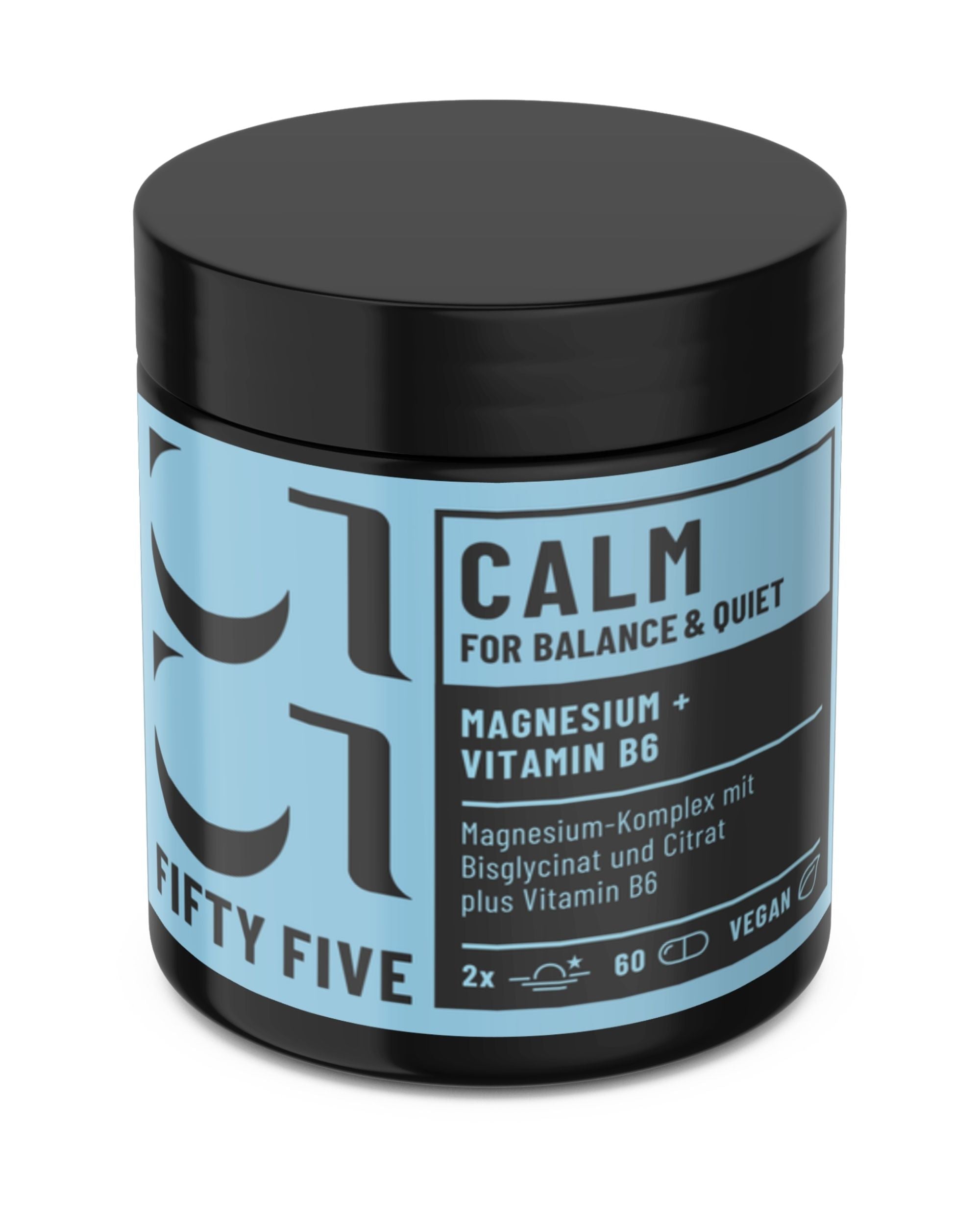
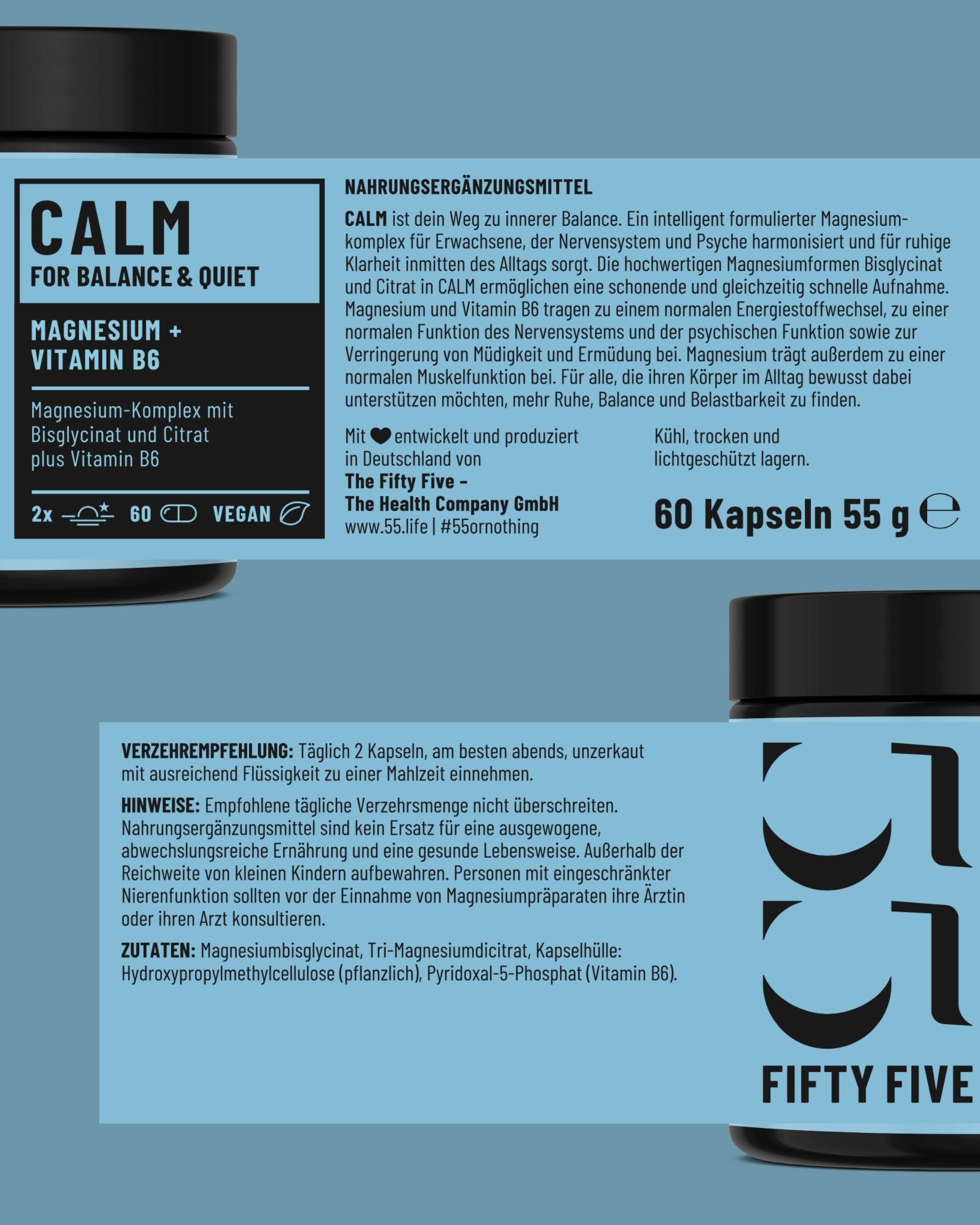
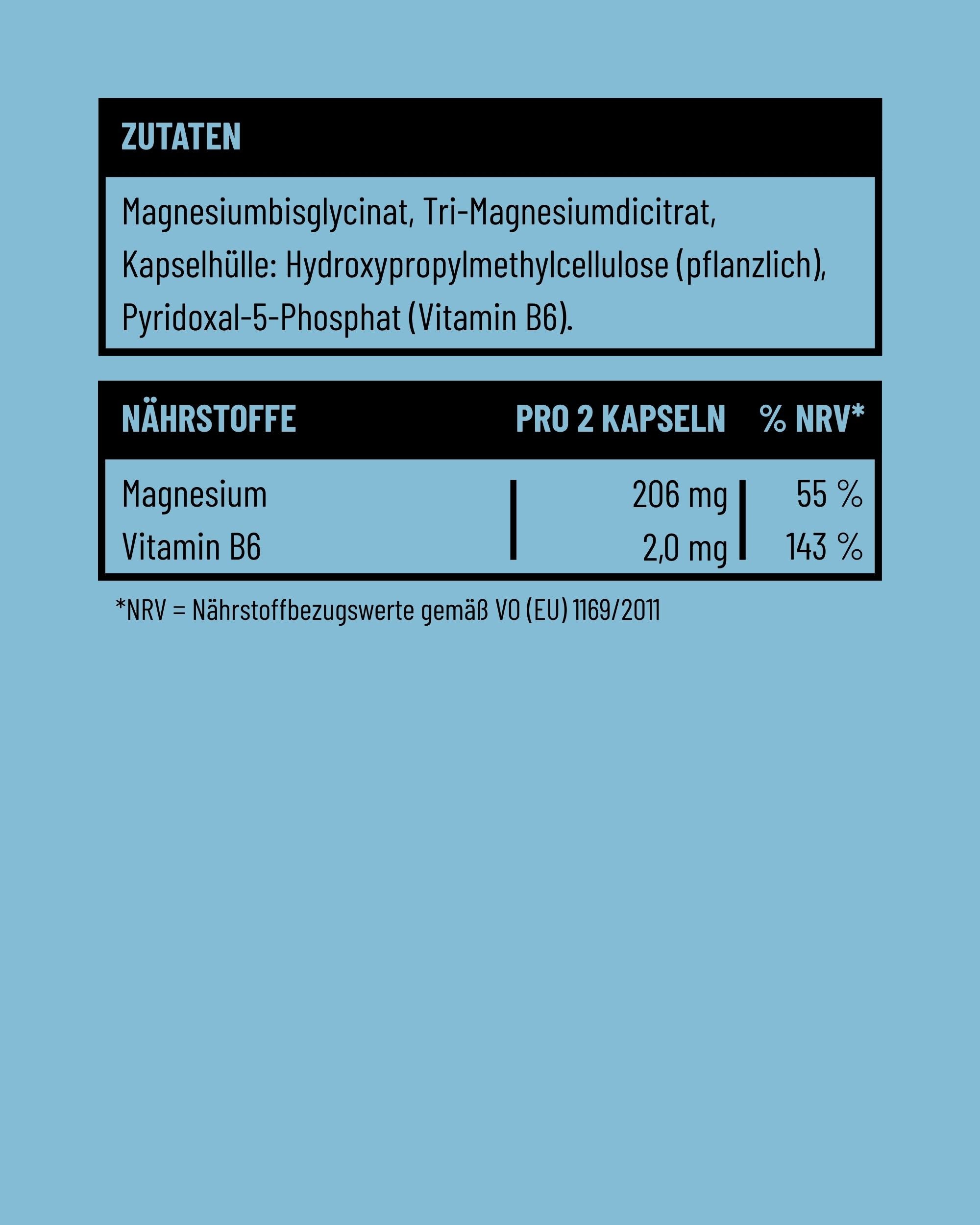
In CALM, Fifty Five deliberately combines about 65% magnesium bisglycinate with 35% magnesium citrate. The idea behind it:
-
Bisglycinate as the base for calm, switching off, and a rather evening-oriented intake.
-
Citrate as well-available magnesium for phases with higher demands or sports.
Added to this is vitamin B6, which contributes to normal functioning of the nervous system and normal energy-yielding metabolism. Instead of "everything at maximum dose," CALM relies on a reduced, well-thought-out combination of a few forms that integrates well into daily life. You can find more on the differences between magnesium bisglycinate and citrate in a dedicated forms comparison.
Intake & timing: using magnesium correctly across the month
If PMS is your main concern, it is tempting to take magnesium only in the "hot phase" just before your period. A different approach is usually better: continuous, daily intake across the entire cycle so that stores and processes are not repeatedly interrupted.
For adult women, daily amounts in the range of about 200-400 mg of magnesium from all sources are frequently discussed. How much of that fits for you as a supplement is something to discuss individually with your medical practice or a nutrition professional, especially if you already take medications or have pre-existing conditions.
Possible strategies, without being a treatment plan:
-
A moderate base dose across the entire cycle, adapted to your diet.
-
In the second half of the cycle (luteal phase), a slightly increased intake if that is when your complaints are strongest.
-
Timing: Many women find an evening intake pleasant, especially with bisglycinate-based products like CALM that fit well into a sleep and relaxation routine.
-
At higher amounts, splitting into 2 portions (e.g. morning and evening) can improve tolerability.
In interplay with other nutrients, a routine can look like this: in the morning, a nutrient foundation like BASE with a broad micronutrient base; in the evening, CALM with magnesium bisglycinate, citrate, and vitamin B6 for nerves, muscles, and wind-down moments. What remains important: observe how your body reacts and adjust in coordination with professionals.
Short answer: how much and which magnesium makes sense for women with PMS?
Magnesium amounts in the range of the usual reference values can make sense for women with PMS but must fit your diet, daily life, and individual situation.
-
-
a total intake of 200-400 mg per day is frequently discussed
-
well-tolerated forms are often bisglycinate and moderately dosed citrate
-
a combination of baseline supply (e.g. BASE) and a targeted calm product can be fitting
-
it is no substitute for gynecological diagnostics or therapy
If several PMS complaints limit your daily life, have the causes clarified medically and coordinate form and amount of magnesium supplements with professionals.
-
Safety, tolerability & medical evaluation
As with all supplements, the same applies to magnesium: "natural nutrient" does not automatically mean "limitless." Most people tolerate moderate amounts well, but especially with high-dose products or a sensitive gut, side effects can occur.
Typical, mostly harmless reactions include, for example:
-
soft stools or diarrhea, especially with citrate, oxide, or sulfate at higher amounts
-
bloating or stomach rumbling if you react very sensitively
-
short-term discomfort when magnesium is taken on a completely empty stomach
Caution is warranted with kidney disease or if you combine several magnesium-containing products (e.g. multivitamin plus isolated magnesium plus powder drink). Certain medications can also interact with magnesium; here you should definitely talk to your medical practice or pharmacy.
Clear signals for a medical evaluation are:
-
very severe or suddenly clearly changed menstrual pain
-
a very irregular cycle or bleeding that clearly falls outside the norm
-
suspected conditions like endometriosis, PCOS, or pronounced iron deficiency states
-
depressive moods or anxiety that go beyond PMS
Magnesium supplements are no alternative to gynecological diagnostics or therapy. They can be used supportively once the medical basis is clarified and you decide together with professionals what role nutrients like magnesium, vitamin D, B vitamins, or omega-3 can play for you.
Nutrient synergies: why vitamin B6 is the perfect partner
Magnesium does not act in isolation but is part of a larger nutrient network. Especially in the context of cycle, PMS, and strain, it is worth looking at other micronutrients.
B vitamins like vitamin B6, B12, and folate are involved in nerve metabolism, energy production, and blood formation. Vitamin B6, for example, contributes to normal functioning of the nervous system and to normal psychological function. That is why B6 is deliberately integrated into CALM. As a cofactor, not as a solo star.
You will find a complete overview of which vitamins and minerals your body needs daily in our guide to micronutrient supply.
Vitamins D and K, as combined in RISE, play a role in bone metabolism and the immune system. A stable vitamin D status can indirectly affect general well-being, which can be relevant in the cycle context, without vitamin D itself being a PMS remedy. You will find more on vitamin D, K, and omega-3 in the context of your hormonal health in a dedicated article.
Omega-3 fatty acids in PULSE influence cell membranes and certain inflammatory processes. DHA contributes to the maintenance of normal brain function. A building block that can stand in interplay with sleep, stress management, and mental health.
CALM & BASE: the Fifty Five setup for women's health
BASE follows the approach of a nutrient foundation: a balanced micronutrient base with bioactive forms instead of very high single doses. The logic behind it: stabilize the foundation first, then add in a targeted way. With CALM for sleep, stress, and nerve-related PMS strain.
Does magnesium support make sense for you?
Whether magnesium is relevant for you in the cycle context cannot be determined by a lab value alone. A simple checklist can help you assess your situation.
Signs that a look at your magnesium supply could be worthwhile:
-
You regularly have strong cramps before or during your period.
-
Before your period, you are more irritable and internally restless than usual.
-
Your sleep quality drops noticeably in the second half of your cycle.
-
You have a lot of stress, few real breaks, and a lot of responsibility.
-
You drink a lot of coffee or energy drinks in daily life.
-
Whole grains, legumes, nuts, and seeds rarely make it onto your plate.
-
You do a lot of sports and sweat intensely several times a week.
-
You hardly consume other magnesium-rich foods.
If you answer "yes" to several of these points, it is definitely worth taking a closer look at your diet, strengthening typical magnesium sources, and discussing with professionals whether a supplement fits for you.
Quick checklist: cycle support with magnesium
-
-
Several moderate complaints, high daily stress: First optimize diet and lifestyle, then consider a supplement.
-
Pronounced PMS complaints, daily life impaired: Priority is your doctor / gynecologist; supplements only after diagnostics.
-
Mild complaints, rather irregular diet: A nutrient foundation (e.g. BASE) plus targeted magnesium use (e.g. CALM in the evening) can be a pragmatic approach.
-
This pairs well with deeper content on magnesium basics, on effects, needs, and safe dosages, and on magnesium for sleep and switching off after the workday, which place CALM in everyday context once more.
Your decision aid summarized:
-
If PMS dominates your daily planning → medical evaluation first, then a nutrient strategy.
-
If stress, sleep, and diet are the main construction sites → think of magnesium as one building block in an overall routine.
-
If your diet is low in magnesium → upgrade your foods first, then consider a nutrient foundation like BASE.
-
If you are mainly restless in the evening → a bisglycinate-focused product like CALM can be worth testing in your evening routine.
FAQ on magnesium, PMS & the cycle
Does magnesium help with PMS?
Magnesium can be a supporting building block for PMS because it contributes to normal functioning of the nervous system, muscles, and psychological function. Many women report feeling somewhat more balanced and less tense during the PMS phase with sufficient magnesium intake.
Important: this is no guarantee of being symptom-free and no direct "treatment" of PMS. Magnesium always works in the context of sleep, diet, stress level, and other nutrients. With pronounced complaints, you should seek medical advice and see magnesium only as part of an overall strategy.
Which magnesium is good for women during the cycle?
For many women, well-tolerated, bioavailable forms like magnesium bisglycinate and moderately dosed magnesium citrate are the best fit. Bisglycinate is often perceived as "gentler" on the digestive tract and fits well into an evening routine around relaxation and sleep. Citrate is well soluble and can be used additionally during demands, sports, or daily life.
More important than as many forms as possible at once is a well-thought-out approach with a clear function: for example, bisglycinate-focused for calm plus some citrate for daily life and demands, as implemented in CALM. We have put together details on which magnesium form fits you.
How long should I take magnesium for PMS?
Magnesium does not work like an acute painkiller that you take once and immediately feel an effect. Better is a continuous intake over several weeks so that stores and processes can stabilize. Many professionals recommend observing at least two to three cycles before drawing a conclusion.
When you start with a supplement, you should integrate it into a stable routine, for example daily in the evening. With persistent or increasing complaints, a medical evaluation is important, regardless of how long you have already been taking magnesium.
Can I take magnesium together with the pill?
In principle, magnesium is frequently taken by women who use hormonal contraception, for example the pill. Most products are combinable with it, yet individual interactions or particularities can exist, especially when other medications are added.
It therefore makes sense to openly discuss your pill, other medications, and planned supplements at your medical practice or pharmacy. That way you can clarify whether spacing between intakes is advisable and which dosage fits for you in the overall picture.
When should I see a doctor about PMS complaints?
At the latest when PMS complaints noticeably limit your daily life, you regularly have to cancel appointments or social activities, or pain is very severe, you should seek medical advice. Sudden changes in your cycle, very heavy or unusually long bleeding, or suspected endometriosis or PCOS also belong in gynecological hands.
Magnesium or other supplements should never be used to delay necessary diagnostics. They can complement a medically guided strategy but not replace it.
Disclaimer:
This article is for informational purposes only and does not replace medical advice, diagnosis, or treatment by a physician or pharmacist. The information provided here should not be used for self-diagnosis or self-treatment. Food supplements are no substitute for a balanced, varied diet and a healthy lifestyle. For any health questions or complaints, please always consult a doctor you trust. Fifty Five accepts no liability for any inconvenience or harm resulting from the use of the information presented here.
Sources
- EFSA. Scientific Opinion on Dietary Reference Values for magnesium. EFSA Journal 2015;13(7):4186.
- German Nutrition Society (DGE). D-A-CH reference values – magnesium.
- German Federal Institute for Risk Assessment (BfR). Maximum levels for vitamins and minerals in food supplements.
- European Commission. EU Register of nutrition and health claims.








Omega-3 for Men: The Underestimated Factor for Heart, Mind, and Performance
Multivitamin for Women: What the Body Really Needs, and When a Standard Product Falls Short
Share: