


With omega-3, the time of day hardly matters, but the meal really does. In the only study so far that compared morning and evening head to head, omega-3 levels in the blood rose just as much with breakfast as with dinner. Food is a different story. Ethyl esters in particular, a form that only comes about when fish oil is concentrated, are poorly absorbed when there's no fat in your meal. In one study, a high-fat meal tripled their absorption. So take your capsules with a proper meal that contains a bit of fat, ideally always the same one. Omega-3 builds up in your cells over months and relies on a fresh supply arriving every day.
What omega-3 actually does in your body is covered in our omega-3 overview. How much EPA (eicosapentaenoic acid) and DHA (docosahexaenoic acid) you need, we work out in our article on daily omega-3 needs. This one is about something more practical: a moment in your day where your capsules simply belong.
Should you take omega-3 in the morning or at night?
Based on what studies show so far, it barely makes a difference. You can take omega-3 in the morning just as well as in the evening, as long as there's a meal involved.
So far only one team in Japan has compared the two, in a pilot study with 20 healthy adults. For eight weeks they got 1,010 mg of DHA and 240 mg of EPA every day, one half with breakfast, the other with dinner. At the end, the omega-3 content in the blood had risen equally in both groups. The fish oil was hidden in sausages, a format that probably won't catch on in our part of the world anytime soon. Twenty people is a small group, and three of the authors work for a seafood company. For such a practical question, the result is still pretty clear.
In our view, a fixed point in your day matters more than the clock, otherwise at some point you'll just forget the capsules. If you actually eat something for breakfast, bread with butter or yogurt with nuts, that works too. That's exactly what the people in Japan did, after all. If all you have in the morning is a coffee, you're better off with lunch or dinner.
Should you take omega-3 before, with, or after a meal?
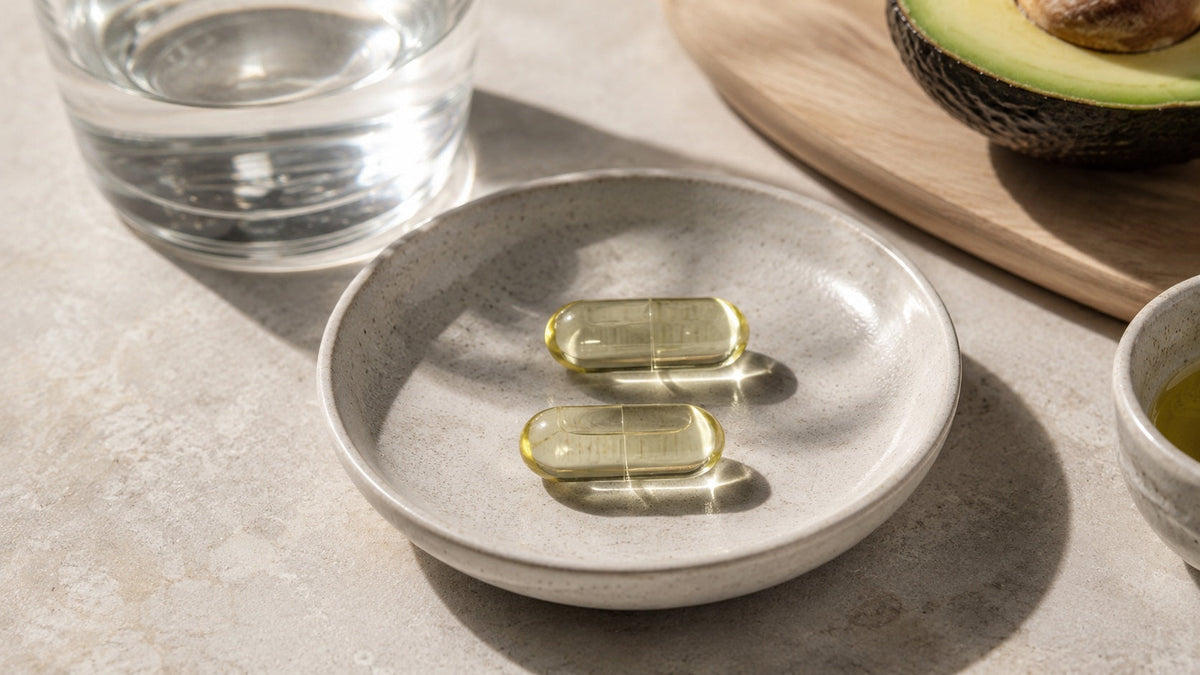
With a meal, and one that has some fat in it. You don't need to time it to the minute, as long as the capsule and the food reach your stomach at roughly the same time.
How much the meal matters depends on the form, though. In fish and algae, omega-3 naturally comes as a triglyceride, built just like almost every other fat in your food. Many cheap concentrates contain ethyl esters instead, and your body absorbs those less well, especially without a fatty meal. Two researchers from a manufacturer measured this back in the 1980s. In eight men eating a low-fat meal with 8 g of fat, the ethyl esters were absorbed only about a fifth as well as free fatty acids, while the triglycerides reached 57 to 68%. The free fatty acids served purely as the benchmark. With a high-fat meal of 44 g of fat, absorption of the ethyl esters tripled. For the triglycerides, EPA rose from 69 to 90% and DHA stayed the same. Only single servings in a few men were measured, but for omega-3 in triglyceride form that's good news: it gets absorbed well even with just a little fat.
Over a period of weeks, the gap narrows. When 66 healthy people took 1.3 g of EPA and DHA daily for four weeks, the ethyl esters still came out lowest in the blood on average. For EPA and DHA combined, though, the difference from the triglyceride was no longer statistically significant, keeping in mind that five of the six authors worked for the maker of the fish oils being tested. For an ethyl ester supplement, a meal with fat still isn't optional, it's a must. More on the different forms is in our article on algae oil, fish oil and their forms.
That's why the algae oil in PULSE by Fifty Five goes into the capsule as a triglyceride, the form that's absorbed well even with a little fat. We also didn't fill it into the cheap soft gelatin softgels that hold omega-3 almost everywhere, but into plant-based Liquid-Caps with a special seal and a clear, smooth shell that's easier to swallow than a softgel. Taking it stays really simple: two Liquid-Caps with a meal that contains some fat, at lunch or dinner, because for the best possible tolerability we recommend a main meal with some fat in it. I take PULSE with lunch myself and RISE at breakfast, and since both are tied to a meal, I practically never forget them.
Can you take omega-3 on an empty stomach?
You can, but you're giving away absorption, and the more ethyl esters there are in the capsule, the more you lose. For triglycerides this hasn't been measured directly. We still wouldn't leave it to chance: if even a low-fat meal slows the ethyl esters down that much, an empty stomach probably has even less to offer.
If you do intermittent fasting or simply never eat in the morning, your capsules can just wait until the first proper meal of the day lands on your plate.
Can you take omega-3 with vitamin D, K2 and magnesium?
Yes, and with vitamin D and K2 even at the same meal. In our view, nothing speaks against taking omega-3 together with vitamin D or with magnesium, though that's our assessment and not a study result.
Like omega-3, vitamins D and K2 are fat-soluble and are also absorbed better with a bit of fat. More on that in when to take vitamin D and in our vitamin D3 and K2 guide. In VITAL, the large US study with almost 26,000 adults aged 50 and over, omega-3 and vitamin D were also assigned crosswise, so some of the participants took both for a little over five years.
| Taken together with | Does it work? | How we would do it |
|---|---|---|
| Vitamin D3 and K2 | Yes | At the same meal, because all three like a bit of fat in your food. |
| Magnesium | Yes | At the same meal or a different one, more on this in when to take magnesium and combining magnesium. |
| A second omega-3 supplement or lots of oily fish | Yes, with an eye on the total | Add it all up: Germany's Federal Institute for Risk Assessment (BfR) advises no more than 1.5 g of EPA and DHA a day from all sources combined. |
In our own everyday routine it all looks pretty relaxed: BASE in the morning, RISE in the morning or at lunch, PULSE with lunch or dinner, CALM in the evening. If you have heart rhythm problems or take blood thinners, talk to your doctor first. The background is in omega-3 side effects and interactions.
How long should you take omega-3, and when will you notice a difference?
Omega-3 is better not taken as a short course. It builds up in your cells slowly, and without a steady supply it disappears just as slowly. In the blood, levels rise within a few days. In your red blood cells, most of the work is done after two to three months, and you're fully there after about half a year.
EPA and DHA sit in the membranes of your cells. A red blood cell lives for about 120 days, and every new cell builds its membrane from whatever is in the blood at the time. In a study from Wageningen in the Netherlands with 58 men, some on large amounts of fish oil, the incorporation of EPA into red blood cells had a half-life of about 28 days. So after four weeks, half of the increase was done, and after about 180 days a new balance was reached. From that, you can roughly work out where you stand:
| Since you started taking it daily | How far the increase in your red blood cells has come |
|---|---|
| After four weeks | About half of the way is done. |
| After eight weeks | About three quarters. |
| After twelve weeks | Just under nine tenths. |
| After about half a year | Practically complete, the new balance has been reached. |
This is calculated for EPA, DHA followed a less regular curve. How high your level climbs in the end depends mainly on the amount, as a dose study with 115 healthy adults shows. Where you stand yourself and whether a test is worth it for you, we explain in testing your omega-3 index.
So don't expect an energy boost after a week. That actually fits well with the claims the EU has reviewed and authorized for omega-3. In the official wording, EPA and DHA contribute to the normal function of the heart, DHA contributes to maintenance of normal brain function, and DHA contributes to the maintenance of normal vision, each with a daily intake of 250 mg, for the heart from EPA and DHA combined, for brain and vision from DHA alone. Two of the three explicitly say "maintenance", and with omega-3 that really hits the mark. It's about a state you keep up day after day, not something you feel after a few days. What studies show beyond that, we've collected in studies on heart, brain and eyes.
How should you store omega-3 capsules?
Tightly closed, cool and dark, in a cupboard and not on the windowsill or in the glove compartment. Whether they belong in the fridge once opened is on the label. What matters more is that you screw the lid back on the jar tightly after every use.
Omega-3 reacts with oxygen and goes rancid in the process. So freshness is anything but a given. In New Zealand, half of 32 fish oil supplements exceeded the recommended oxidation level, and neither the price nor the best-before date gave it away. In Canada, half of 171 omega-3 supplements exceeded at least one oxidation limit. That survey came from an omega-3 pharmaceutical company, but sealed capsules without flavoring did clearly better in it than oil from a bottle.
FAQ
Can I take omega-3 with coffee?
Yes, your cup at breakfast can stay, as long as there's something on your plate too. As far as we know, there's no evidence that coffee gets in the way of omega-3. With fish oil, the combination tends to fail on taste instead. Sophia, a tax advisor, took her fish oil capsules only on and off for years, because the fishy aftertaste just didn't go with her morning coffee. How she solved that, she tells in her story about vegan omega-3.
How do you avoid fishy burps from omega-3?
Mostly by taking the capsules in the middle of a meal and sticking to usual amounts. In the VITAL study mentioned above, 840 mg of EPA and DHA a day over a little more than five years caused no more stomach and gut complaints than a placebo. The fishy part of the burps is a fish oil issue anyway, because algae oil has at most a light, natural hint of algae.
I forgot a dose. What now?
Just take your usual amount the next day and let the missed day go. With a half-life of about 28 days, a single day practically disappears in the average over the weeks. If it happens to you more often, put the jar where you'll see it when you eat, for example in the kitchen cupboard next to the plates.
Is it safe to take omega-3 for years?
Yes, in usual amounts that's well established. The European Food Safety Authority (EFSA) considers up to 5 g of EPA and DHA a day to be safe. The BfR advises no more than 1.5 g from all sources combined. A usual daily serving from a capsule plus what adults take in on average from their food stays clearly below both values.
Disclaimer:
This article is for informational purposes only and does not replace medical advice, diagnosis, or treatment by a physician or pharmacist. The information provided here should not be used for self-diagnosis or self-treatment. Food supplements are no substitute for a balanced, varied diet and a healthy lifestyle. For any health questions or complaints, please always consult a doctor you trust. Fifty Five accepts no liability for any inconvenience or harm resulting from the use of the information presented here.
Sources
- Konishi T, Takahashi Y, Shiina Y et al.: Time-of-day effects of consumption of fish oil-enriched sausages on serum lipid parameters and fatty acid composition in normolipidemic adults: A randomized, double-blind, placebo-controlled, and parallel-group pilot study. Nutrition, 2021. pubmed.ncbi.nlm.nih.gov/33962365
- Lawson LD, Hughes BG: Human absorption of fish oil fatty acids as triacylglycerols, free acids, or ethyl esters. Biochemical and Biophysical Research Communications, 1988. pubmed.ncbi.nlm.nih.gov/3358766
- Lawson LD, Hughes BG: Absorption of eicosapentaenoic acid and docosahexaenoic acid from fish oil triacylglycerols or fish oil ethyl esters co-ingested with a high-fat meal. Biochemical and Biophysical Research Communications, 1988. pubmed.ncbi.nlm.nih.gov/2847723
- Yurko-Mauro K, Kralovec J, Bailey-Hall E et al.: Similar eicosapentaenoic acid and docosahexaenoic acid plasma levels achieved with fish oil or krill oil in a randomized double-blind four-week bioavailability study. Lipids in Health and Disease, 2015. pubmed.ncbi.nlm.nih.gov/26328782
- Manson JE, Cook NR, Lee IM et al.: Marine n-3 Fatty Acids and Prevention of Cardiovascular Disease and Cancer. New England Journal of Medicine, 2019. pubmed.ncbi.nlm.nih.gov/30415637
- Bundesinstitut für Risikobewertung (BfR) [German Federal Institute for Risk Assessment]: Omega-3-Fettsäuren: Wichtig, aber in Maßen. Fragen und Antworten (omega-3 fatty acids: important, but in moderation; questions and answers), April 30, 2026. bfr.bund.de
- Katan MB, Deslypere JP, van Birgelen AP et al.: Kinetics of the incorporation of dietary fatty acids into serum cholesteryl esters, erythrocyte membranes, and adipose tissue: an 18-month controlled study. Journal of Lipid Research, 1997. pubmed.ncbi.nlm.nih.gov/9374124
- Flock MR, Skulas-Ray AC, Harris WS et al.: Determinants of erythrocyte omega-3 fatty acid content in response to fish oil supplementation: a dose-response randomized controlled trial. Journal of the American Heart Association, 2013. pubmed.ncbi.nlm.nih.gov/24252845
- Verordnung (EU) Nr. 432/2012 der Kommission vom 16. Mai 2012 zur Festlegung einer Liste zulässiger anderer gesundheitsbezogener Angaben über Lebensmittel als Angaben über die Reduzierung eines Krankheitsrisikos sowie die Entwicklung und die Gesundheit von Kindern (Commission Regulation (EU) No 432/2012 establishing a list of permitted health claims made on foods), consolidated version of May 17, 2021. eur-lex.europa.eu
- Albert BB, Derraik JGB, Cameron-Smith D et al.: Fish oil supplements in New Zealand are highly oxidised and do not meet label content of n-3 PUFA. Scientific Reports, 2015. pubmed.ncbi.nlm.nih.gov/25604397
- Jackowski SA, Alvi AZ, Mirajkar A et al.: Oxidation levels of North American over-the-counter n-3 (omega-3) supplements and the influence of supplement formulation and delivery form on evaluating oxidative safety. Journal of Nutritional Science, 2015. pubmed.ncbi.nlm.nih.gov/26688721
- EFSA Panel on Dietetic Products, Nutrition and Allergies (NDA): Scientific Opinion on the Tolerable Upper Intake Level of eicosapentaenoic acid (EPA), docosahexaenoic acid (DHA) and docosapentaenoic acid (DPA). EFSA Journal, 2012. efsa.onlinelibrary.wiley.com


Foods with Omega-3: Table with EPA, DHA and ALA per Serving
Omega-3 Side Effects: How Much Is Too Much and What You Should Know
Share: