


On the supplement market, there are omega-3 products with 250 mg of EPA+DHA per capsule and ones with 2,000 mg. Pharmacies frequently recommend the minimum, athletes take five times that. And on some products, the stated daily dose corresponds to half the base recommendation. Without a frame of reference, that is understandably confusing.
This article gives you the overview: what the official recommendations mean, when higher dosages are discussed, how to optimize intake, and what to consider with very high amounts.
The EFSA recommendation: what it says and what it does not
The European Food Safety Authority (EFSA) has set a daily intake of 250 mg of EPA and DHA together as a reference amount for adults. This figure is the threshold above which the following health claims apply: EPA and DHA contribute to normal heart function.
These 250 mg are a minimum value, not an optimal value. They are based on observations of supply in population groups with low cardiovascular risk, not on studies maximizing a particular effect.
In the scientific literature and in the recommendations of various professional societies, higher amounts are frequently mentioned for healthy adults. The German Nutrition Society (DGE), the WHO, and other organizations move with their recommendations between 250 mg and 500 mg EPA+DHA daily for the general population. As a good everyday dosage for a healthy adult, a range of 500 to 1,000 mg EPA+DHA daily is frequently named in the literature.
When higher dosages become relevant
Beyond general basic supply, there are specific contexts in which the scientific literature and the EFSA itself name higher amounts:
Pregnancy and breastfeeding: The EFSA recommends 200 mg of DHA daily for pregnant and breastfeeding women in addition to the general recommendation of 250 mg EPA+DHA. That results in a recommended total intake of at least 450 mg of DHA daily. DHA contributes to the normal brain and eye development of the fetus and the breastfed infant. More on the topic can be found in the article Omega-3 for women.
Blood pressure: For a documented effect on normal blood pressure, the EFSA has named an amount of 3 g EPA+DHA daily as the condition for the authorized health claim. That is a high dosage that should be medically supervised.
Triglyceride levels: For an effect on normal blood triglyceride levels, an EFSA claim applies from 2 g EPA+DHA daily. Here too, medical supervision is recommended.
These high dosages are not meant for general self-supply but describe effect thresholds for specific physiological functions.
Intake timing: when and how?
With a fatty meal: Omega-3 fatty acids are lipophilic substances: they dissolve in fat, not in water. Absorption from the gut is considerably better in the presence of dietary fat. Studies show that the bioavailability of omega-3 in combination with a fatty meal can be 30 to 50 percent higher than on an empty stomach.
Practical recommendation: take omega-3 capsules together with lunch or dinner, not in the morning on an empty stomach.
Daily, at the same time: The omega-3 index is a long-term marker. Short-term fluctuations in intake play no major role. What counts is consistency over weeks and months. A fixed intake routine, for example always at lunch, reduces forgetting and stabilizes the supply.
Cool and light-protected storage: Omega-3 fatty acids oxidize through heat, light, and oxygen. Capsules should be stored dry, cool, and protected from light. In the refrigerator, algae oil is particularly well protected.
How to know whether your dose fits
The only reliable method to know your own supply status is the omega-3 index. It measures the percentage share of EPA and DHA in the membranes of red blood cells and gives a long-term value for the last three to four months.
Target range: 8 to 11 percent. Many people in Germany start at 4 to 6 percent.
After 8 to 12 weeks of regular supplementation, the progress can be measured. If the value does not rise despite regular intake, an increase in the dose or a check of the omega-6/omega-3 ratio in the diet may be appropriate. More on this in the article Recognizing omega-3 deficiency.
Overdose: when does it become a concern?
Omega-3 fatty acids are nutrients, not pharmacological substances. In a safety assessment, the EFSA classified amounts up to 5 g EPA+DHA daily for healthy adults as safe. That corresponds to about twenty times the base recommendation.
At very high dosages, there is a relevant note: omega-3 can influence blood clotting at these amounts because EPA modulates thromboxane synthesis. That is usually no problem in healthy people, but when taking blood thinners like warfarin, aspirin (with regular use), or heparin, omega-3 supplementation at higher amounts should be coordinated medically.
This risk does not apply to normal supplementation amounts of 500 to 1,500 mg EPA+DHA daily for healthy adults.
The problem with underdosed products
Many omega-3 products on the market are underdosed on closer inspection. The packaging says "1,000 mg fish oil per capsule," but the contained EPA+DHA content is 300 mg or less. The difference is explained by the fact that "1,000 mg fish oil" refers to the total weight of the oil, while the share of the actually effective fatty acids EPA and DHA is only a part of it. The rest are other fatty acids without a specific omega-3 effect.
What counts is the declared EPA+DHA content per daily dose, not the total weight of the oil.
A product with 750 mg of omega-3 (including 500 mg EPA+DHA) per daily dose is substantially better than a product with 1,000 mg of "fish oil" (including 180 mg EPA+DHA).
PULSE: clear numbers, no tricks
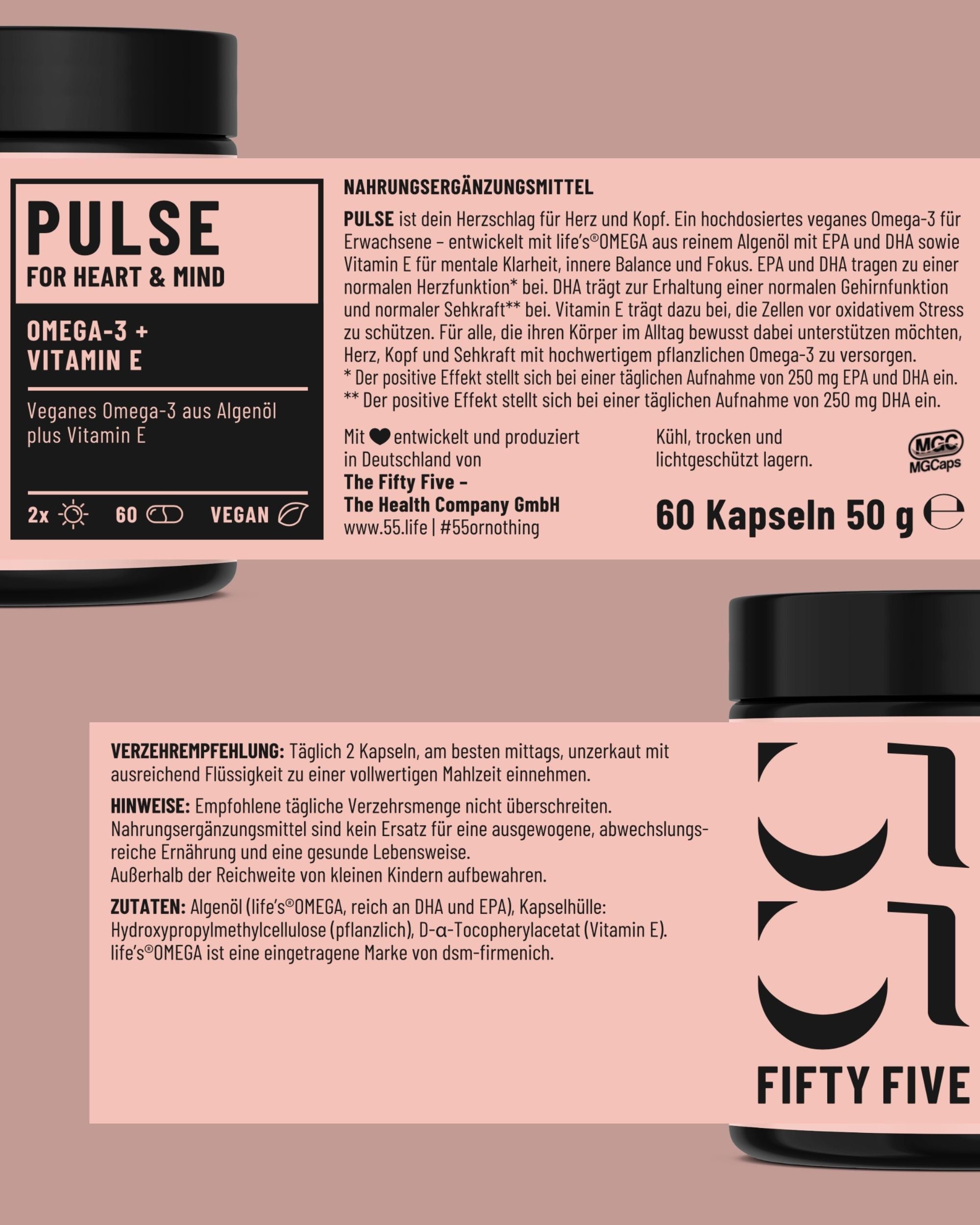
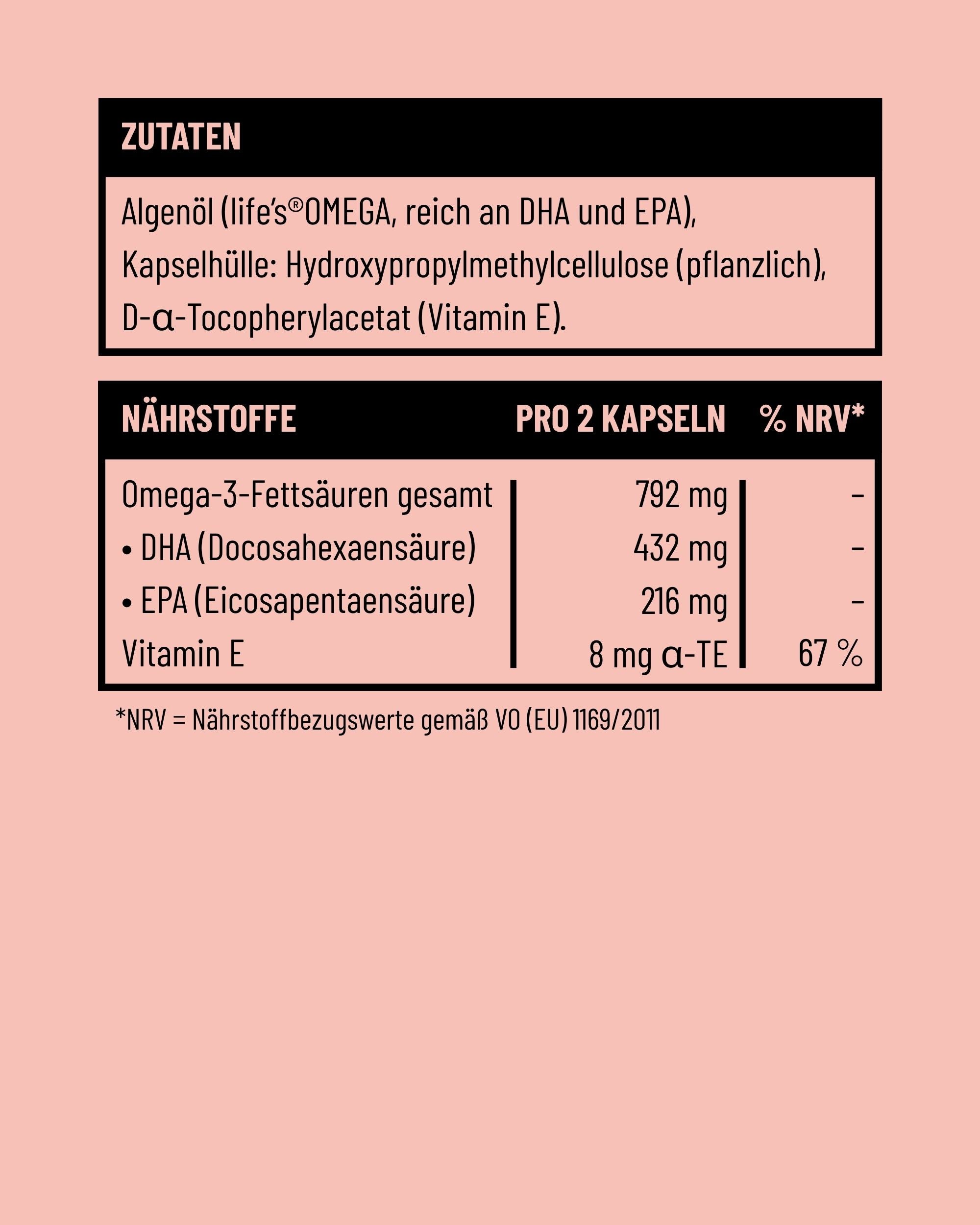
PULSE by Fifty Five declares the daily dose transparently: 792 mg of total omega-3 per daily dose (2 capsules), including 432 mg of DHA and 216 mg of EPA. No mixed calculation over the total weight of the algae oil.
Additionally, PULSE contains 8 mg of vitamin E (67% NRV) as natural antioxidant protection for the sensitive algae oil. Vitamin E contributes to the protection of cells from oxidative stress. This combination makes PULSE one of the few omega-3 products on the market that actively protects the valuable fatty acids from oxidation.
FAQ
Can I take omega-3 together with other supplements?
For most common combinations (multivitamin, magnesium, vitamin D), there are no known negative interactions. Combining omega-3 with fat-soluble vitamins like vitamin D or vitamin E is physiologically obvious, since both are lipophilic and are absorbed together.
Does it make a difference whether I take EPA+DHA in one or two capsules?
No. What counts is the total daily amount. Whether it is taken in one or two capsules has no measurable influence on availability.
When will I see an effect?
The omega-3 index improves measurably after 8 to 12 weeks. Subjective changes are hard to attribute and vary individually. Omega-3 is a supply topic with a long-term effect, not an acute remedy.
What is the difference between the triglyceride and ethyl ester form?
Fish oil is frequently concentrated from the ethyl ester form, which makes production cheaper. Ethyl esters tend to have lower bioavailability than the triglyceride form. Algae oil is naturally in triglyceride form and therefore has a structurally more favorable starting position for absorption.
Can I take omega-3 with lactose intolerance or histamine intolerance?
Pure algae oil in HPMC capsules contains neither lactose nor is it a known histamine source. PULSE is vegan and contains no animal ingredients that could trigger intolerances. For specific questions about your own tolerability, a medical assessment is recommended.
Disclaimer
This article is for informational purposes only and does not replace medical advice, diagnosis, or treatment by a physician or pharmacist. The information provided here should not be used for self-diagnosis or self-treatment. Food supplements are no substitute for a balanced, varied diet and a healthy lifestyle. For any health questions or complaints, please always consult a doctor you trust. Fifty Five accepts no liability for any inconvenience or harm resulting from the use of the information presented here.
Sources
- EFSA. Scientific Opinion on Dietary Reference Values for fats, incl. EPA and DHA. EFSA Journal 2010;8(3):1461.
- EFSA. Scientific Opinion on the Tolerable Upper Intake Level of EPA, DHA and DPA. EFSA Journal 2012;10(7):2815.
- German Nutrition Society (DGE). D-A-CH reference values – fat and fatty acids.
- European Commission. EU Register of nutrition and health claims.









Vitamin D3 and K2: Why the Combination Achieves More Than D3 Alone
Exam Stress: How Student Leo Keeps His Focus
Share: