

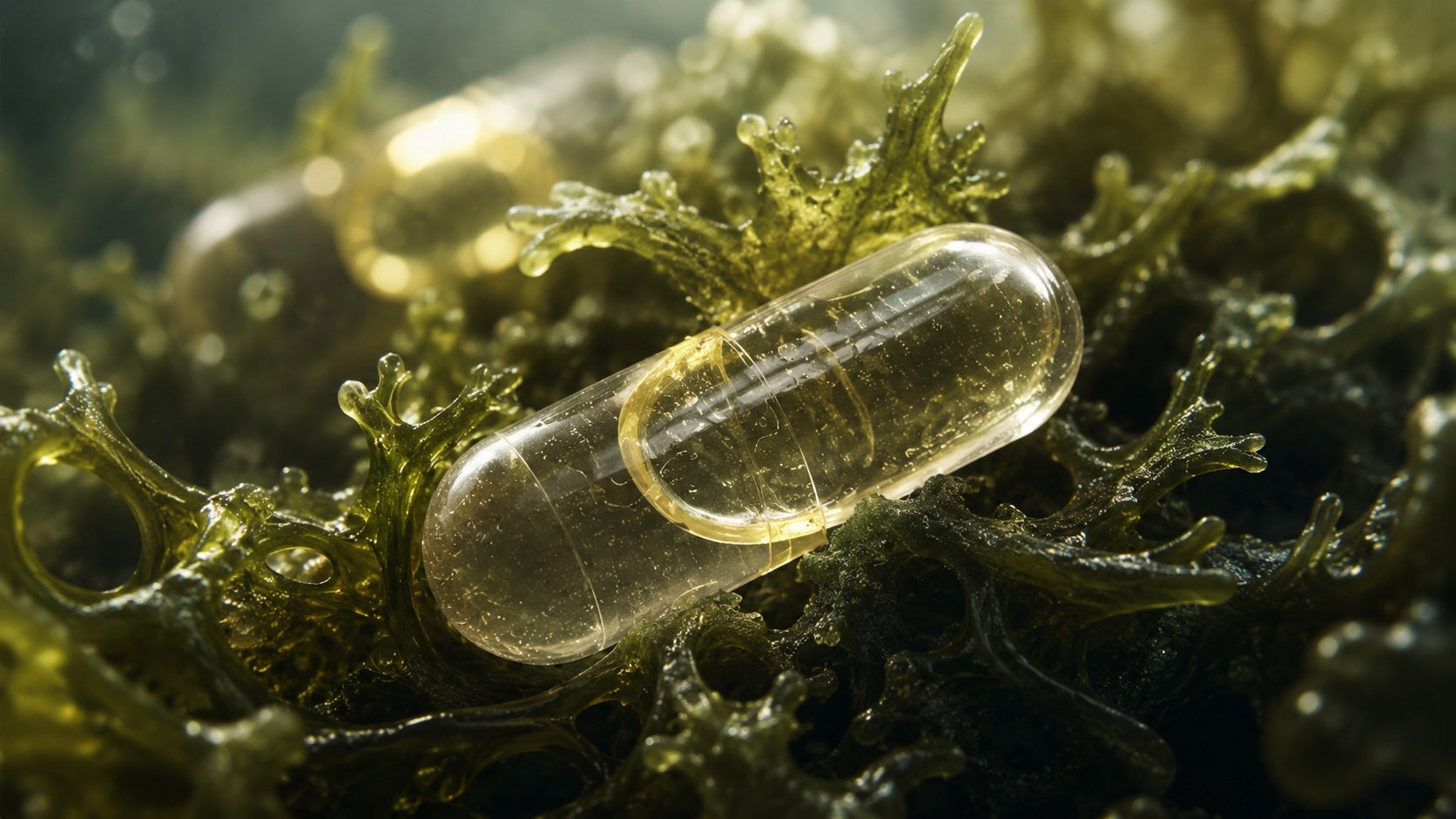
When it comes to omega-3, most people think of fish first. Biologically, though, that is a misconception. Fish do not produce DHA and EPA, they eat it. The original sits at the beginning of the food chain: in microalgae. Anyone who understands this also understands why the comparison between fish oil and algae oil turns many basic assumptions on their head.
Why the fish is not the source
Salmon, herring, mackerel, sardines. Fish is considered the source par excellence, and fish oil the standard product for anyone wanting to supplement omega-3.
Yet there is a biological fact that fundamentally shifts this picture: fish do not produce omega-3. No DHA, no EPA. They take in these fatty acids through their food.
At the beginning of the food chain are microalgae. They are the ones that produce DHA and EPA. Zooplankton, small crustaceans, and small fish eat these algae. Larger fish eat small fish. At the end of the chain, a salmon fillet rich in omega-3 sits on the plate because somewhere at the beginning a microalga synthesized DHA and EPA.
Anyone who gets omega-3 from algae oil goes directly to the original source and skips the animal intermediate step entirely. Algae oil is therefore not a vegan alternative to fish oil. It is the original from which fish oil arises in the first place.
What fish oil offers and where it reaches its limits
Fish oil has been the dominant omega-3 supplement for decades. That has practical reasons: it is cheap to produce, well researched, and delivers EPA and DHA in a form the body can use directly.
The bioavailability of fish oil is well documented. Taken in combination with dietary fat, it is well absorbed, especially when it is in triglyceride form (as opposed to the ethyl ester form frequently used in cheaper products).
But fish oil has structural weaknesses that are relevant when choosing a supplement:
Oxidation: Omega-3 fatty acids, especially DHA with six double bonds, are chemically highly reactive. They oxidize in contact with oxygen, light, and heat. Rancid fish oil smells intense, tastes unpleasant, and may have lost part of its biological efficacy. Studies have shown that a considerable share of commercially available fish oil products has oxidation values above the recommended limits (TOTOX value). That is a quality problem consumers can hardly assess without a laboratory analysis.
Fishy smell and tolerability: The typical "fishy burp" after taking fish oil is no myth. It arises when the oil comes into contact with stomach acid. For many people, that is a reason not to take fish oil regularly despite a fundamental willingness to supplement.
Heavy metals and environmental pollution: Through their food chain, fish take in not only omega-3 but also pollutants found in marine waters: mercury, cadmium, PCBs, and other persistent organic compounds. High-quality fish oil products are elaborately purified (molecular distillation), but the contamination is an inherent feature of marine food chains that does not occur with algae oil from controlled cultivation.
Sustainability: The marine fish stocks from which fish oil is obtained (above all anchovies, sand eel, herring) are under considerable pressure from overfishing. Around 20 percent of global fish catches are processed into fishmeal and fish oil. The ecological footprint of fish oil depends strongly on certification and origin.
What algae oil does differently
Algae oil from controlled cultivation consistently avoids the structural weaknesses of fish oil:
Direct source: Algae produce DHA and EPA without an animal intermediate step. The profile of the obtained oil can be deliberately controlled through the choice of algae species and cultivation conditions. Schizochytrium algae, used for most algae oil supplements, naturally produce a high DHA share.
Controlled conditions: Algae for supplement production are cultivated in closed bioreactors or tanks, not in the open ocean. That eliminates the heavy metal risk from the marine food chain entirely and allows precise quality control.
No fishy smell: Algae oil has no fishy taste and causes no fishy-tasting burping. That makes regular intake considerably more pleasant, which is relevant for long-term supplementation.
Fully vegan: Algae oil is vegan by definition. That is obviously relevant for people living plant-based, but also for people who want to reduce animal products in general without giving up EPA and DHA.
Bioavailability compared: what studies show
A common question: is algae oil just as usable as fish oil? The answer is a clear yes, well documented by studies.
Comparative studies measuring the rise of the omega-3 index after supplementation with algae oil versus fish oil show comparable or even slightly better results for algae oil, especially for the DHA share. That is biologically plausible: algae oil delivers DHA in a natural triglyceride form with high bioavailability.
A relevant comparison comes from studies with DHA from algae oil and DHA from tuna oil: both sources showed similar increases in the plasma DHA level at equivalent dosing. Algae oil is no compromise in bioavailability but an equivalent alternative with structural advantages.
What makes a good algae oil raw material
Not every algae oil is the same. Quality differences arise through algae species, cultivation method, extraction method, and stabilization.
High-quality algae oil raw materials are produced under standardized conditions, regularly tested for purity and fatty acid profile, and filled into closed capsules with oxidation protection. Branded raw materials with their own scientific documentation are a more reliable quality feature than anonymous raw materials without proof of origin.
A good raw material declares the DHA and EPA content per serving clearly and comprehensibly, has a low oxidation value (TOTOX), and is demonstrably free of heavy metals and other contaminants.
The oxidation problem: why vitamin E plays a role
Omega-3 fatty acids are prone to oxidation because of their polyunsaturation, that applies to fish oil and algae oil equally. DHA, the most reactive form with six double bonds, is particularly sensitive. Oxidation does not begin only after opening a bottle but can already set in during production and storage.
Vitamin E (tocopherol) is the natural, fat-soluble antioxidant of the human body. In the body, it protects polyunsaturated fatty acids in cell membranes from oxidative attack. In an omega-3 product, it fulfills the same function: it protects the sensitive oil in the capsule and extends stability.
This combination, algae oil plus vitamin E as oxidation protection in a shared formulation, is biochemically coherent. That it is barely found on the market is not due to a lack of logic but to costs and formulation effort.
PULSE: a consistent algae oil formulation
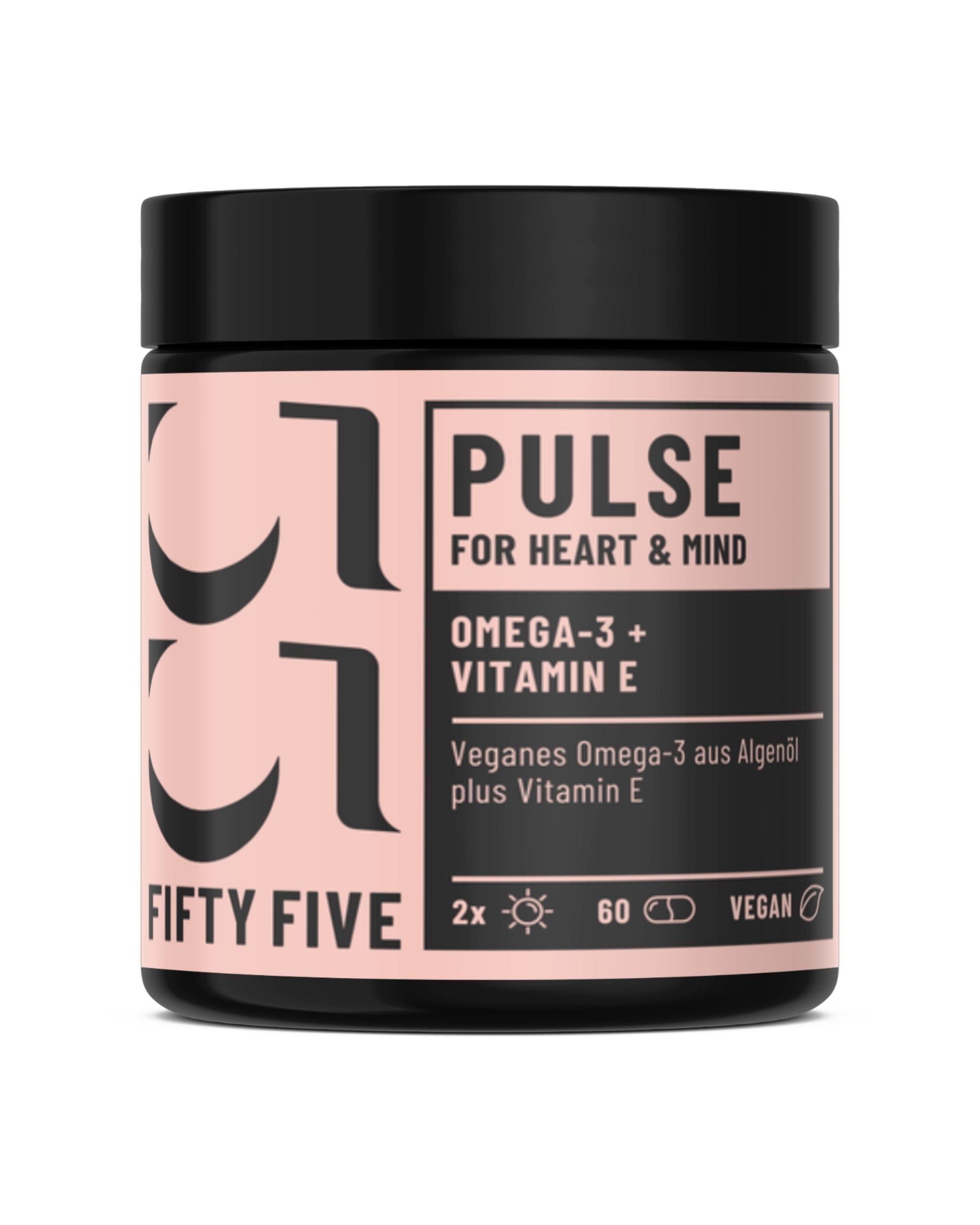
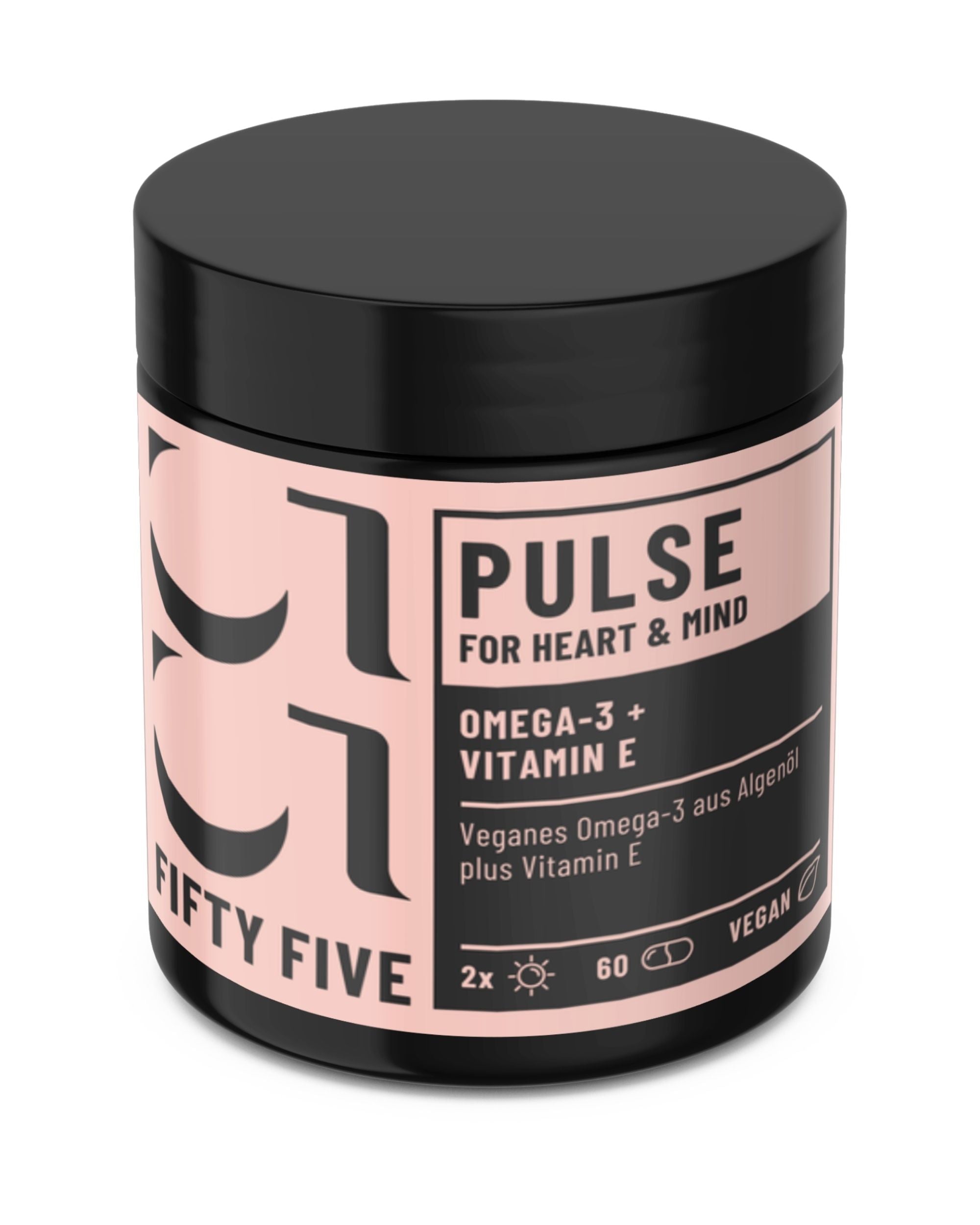
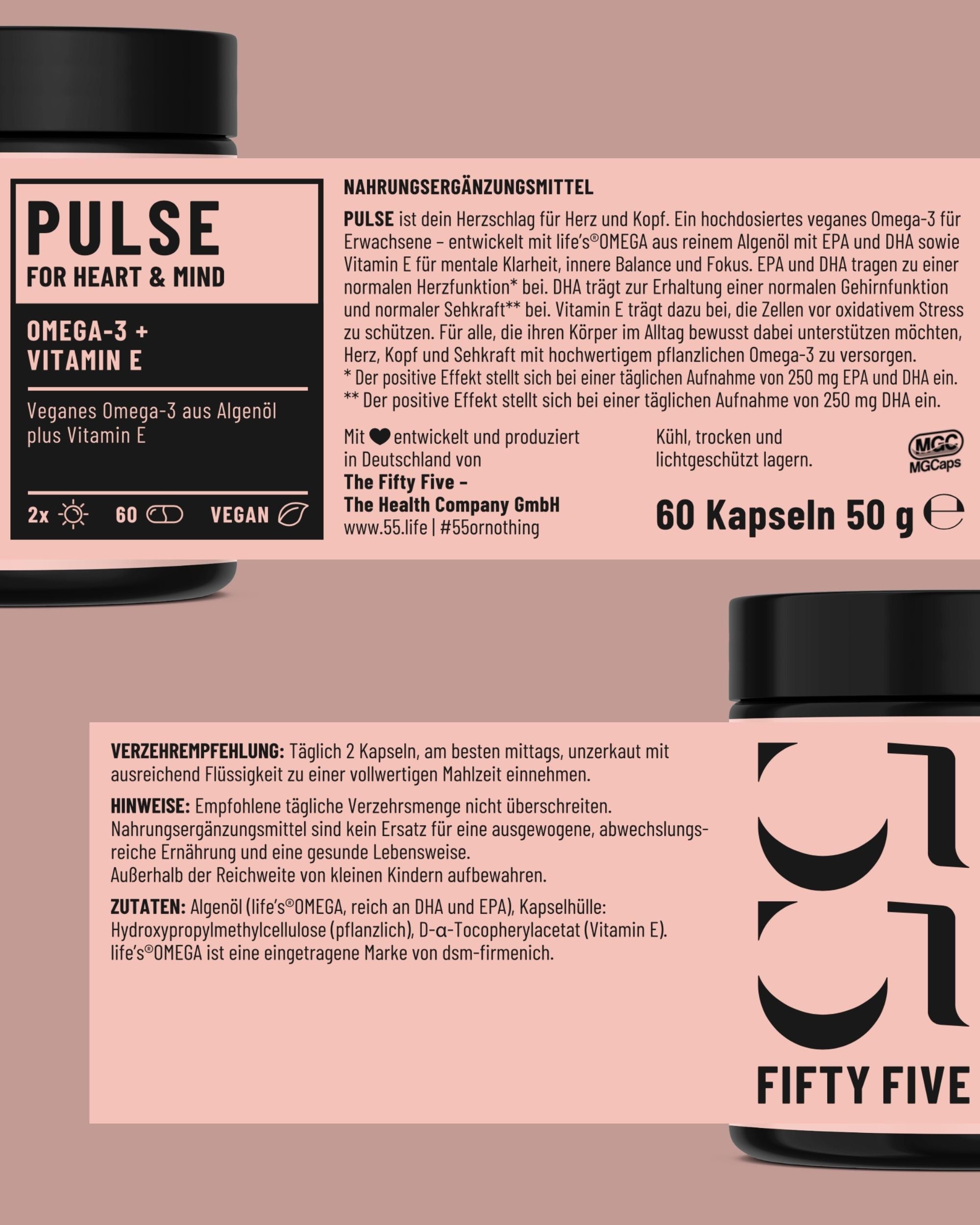
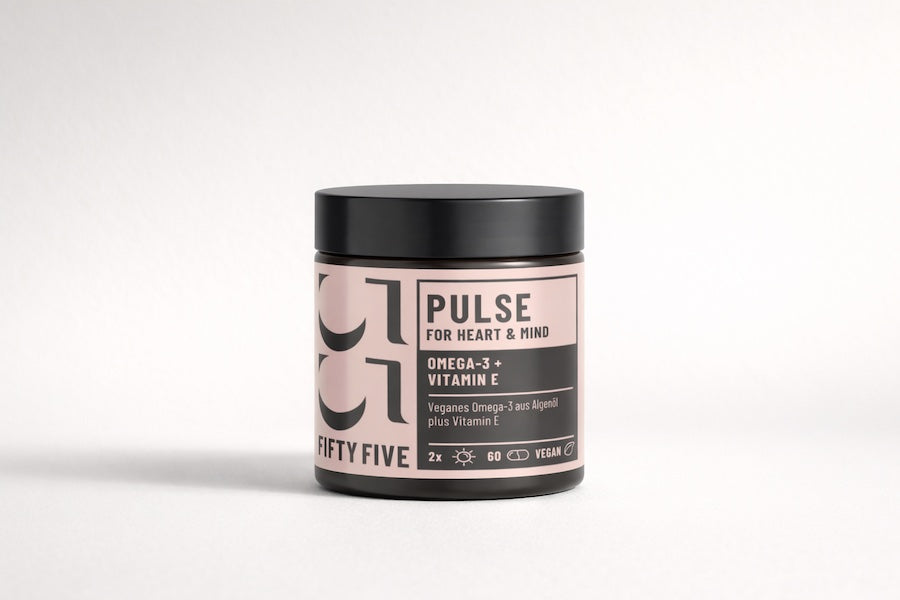
PULSE by Fifty Five uses DSM Lifes60® premium algae oil, one of the scientifically best-documented branded raw materials in the omega-3 segment. The raw material source offers a clearly defined fatty acid profile, is produced under controlled conditions, and delivers DHA and EPA in proven bioavailability.
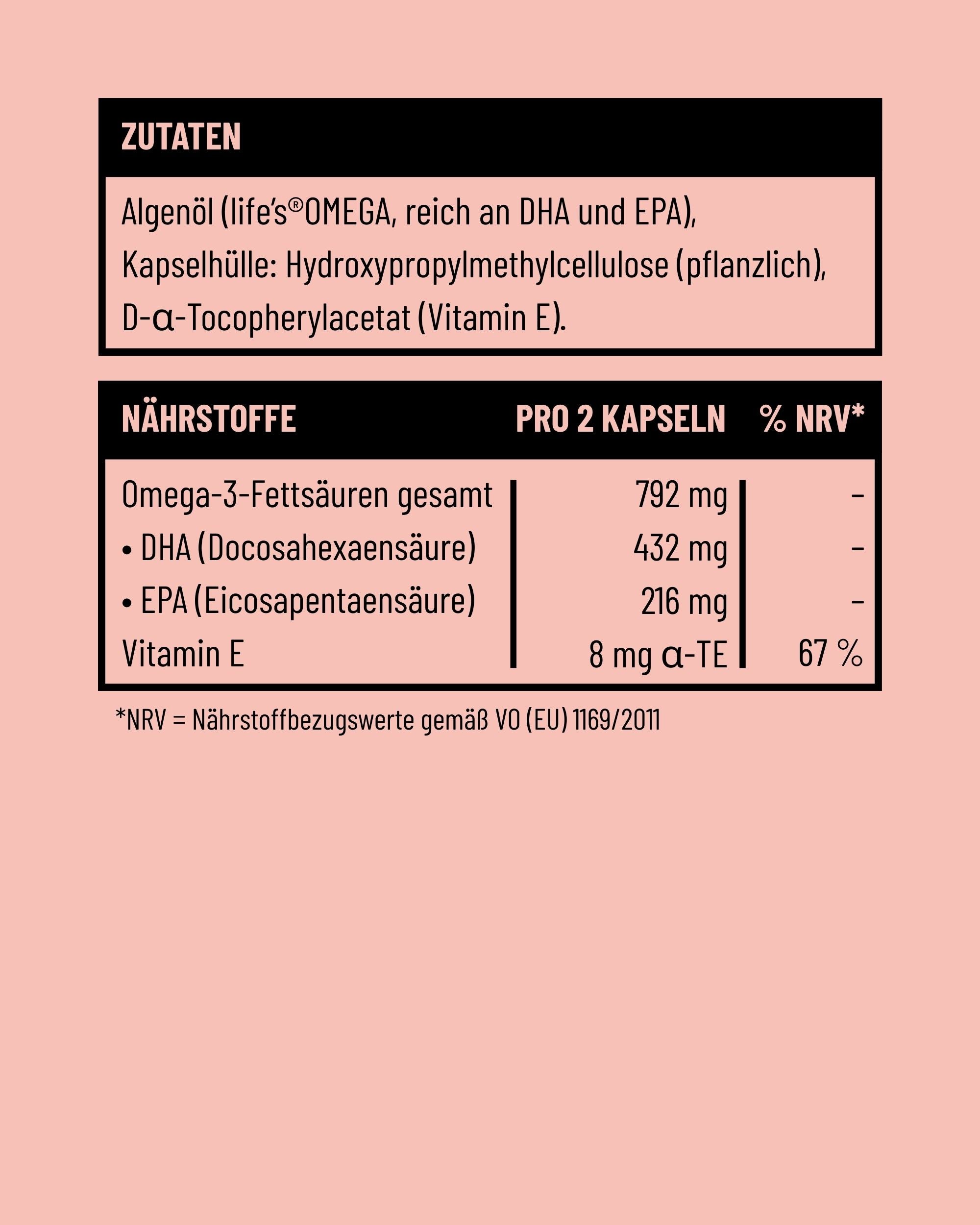
Each daily dose (2 capsules) contains 792 mg of omega-3, including 432 mg of DHA and 216 mg of EPA. No fishy taste, no heavy metal risk, no dependence on the fishmeal industry and marine fishing.
What additionally distinguishes PULSE from most algae oil products on the market: the combination with 8 mg of vitamin E (D-alpha-tocopheryl, 67% NRV) per daily dose. That protects the sensitive fatty acids and contributes to the protection of cells from oxidative stress. This combination is found almost nowhere among omega-3 products.
PULSE also forgoes cheap softgel capsules and comes in liquid caps, specially sealed HPMC capsules, making it considerably more pleasant to take and fully vegan.
FAQ
Is algae oil more expensive than fish oil?
Generally yes, due to the more elaborate production process. The price difference has decreased considerably in recent years. For the calculation, the EPA+DHA content per euro is more relevant than the price per capsule.
Can algae oil also go rancid?
Yes, algae oil, like fish oil, is prone to oxidation. Closed capsules with antioxidants (like vitamin E) and cool, light-protected storage slow oxidation considerably.
Does algae oil contain only DHA or also EPA?
That depends on the algae species. Schizochytrium produces primarily DHA with smaller amounts of EPA. Other algae species like Nannochloropsis produce more EPA. High-quality supplements declare both separately.
Does algae oil taste like algae?
Good algae oil in liquid caps is largely flavor-neutral. It has no fishy taste and causes no fishy-tasting burping. A slightly algae-like flavor of its own is possible but considerably less pronounced than the fishy taste of many fish oil products.
Is fish oil worse than algae oil?
Not fundamentally. A high-quality, certified fish oil with a low oxidation value and proven freedom from pollutants is a valid omega-3 source. Algae oil has structural advantages regarding sustainability, freedom from heavy metals, and tolerability. For a vegan or vegetarian diet, algae oil is the only option.
→ To the complete omega-3 guide
Disclaimer
This article is for informational purposes only and does not replace medical advice, diagnosis, or treatment by a physician or pharmacist. The information provided here should not be used for self-diagnosis or self-treatment. Food supplements are no substitute for a balanced, varied diet and a healthy lifestyle. For any health questions or complaints, please always consult a doctor you trust. Fifty Five accepts no liability for any inconvenience or harm resulting from the use of the information presented here.
Sources
- EFSA. Scientific Opinion on Dietary Reference Values for fats, incl. EPA and DHA. EFSA Journal 2010;8(3):1461.
- EFSA. Scientific Opinion on the Tolerable Upper Intake Level of EPA, DHA and DPA. EFSA Journal 2012;10(7):2815.
- German Nutrition Society (DGE). D-A-CH reference values – fat and fatty acids.
- European Commission. EU Register of nutrition and health claims.




Vitamin D Dosage: How Much D3 per Day Is Sensible and Safe?
When to Take Magnesium? The Best Time for Your Routine
Share: