


Magnesium accompanies you through practically every day: screen work, sports, tension, restless nights. Many people eventually reach for a supplement and quickly notice that "magnesium" is not simply "magnesium." The package lists terms like citrate, bisglycinate, or oxide, often without any real explanation.
That is exactly why we are giving you the overview. You will get a clear picture of why different magnesium forms exist, how they differ in tolerability, solubility, and use, and what to watch out for with a sensitive stomach. From that, you can tell which form fits your body, your stress level, and your routine, instead of relying on vague promises.
The form plays a practical role here: it influences how well your body can use the magnesium, how your digestive system reacts, and whether intake works better during the day, after sports, or as part of your evening routine. If you want to dive deeper into function and daily needs, you will find more on how magnesium works and daily requirements in a separate overview article.
Quick definition: which magnesium form fits you?
The right magnesium form depends primarily on your digestion, your goal (everyday life, sports, sleep), and your preferred intake routine.
- Magnesium citrate: highly soluble, everyday-friendly, dose carefully with a sensitive gut.
- Magnesium bisglycinate: chelated, often well tolerated, popular for the evening routine.
- Magnesium oxide: high content, lower solubility, common in inexpensive products.
- There is no universally best magnesium form for everyone.
Mini decision rule: If your digestion reacts sensitively, lean toward chelated forms like magnesium bisglycinate; with a robust digestion, magnesium citrate can be a versatile starting point.
Why different magnesium forms exist (elemental content vs. compound)
When you buy a magnesium supplement, you never take "pure" magnesium, but always magnesium coupled to a so-called binding partner. This compound is often referred to as the "magnesium form." For example, magnesium citrate or magnesium bisglycinate.
Chemically, there is a difference between elemental magnesium and the compound it comes in. Elemental magnesium is the actual mineral your body uses for the nervous system, muscle function, energy metabolism, and electrolyte balance. In the capsule or powder, however, it is bound to other substances to make it stable, dosable, and easy to manufacture.
Organic vs. inorganic magnesium compounds
A rough distinction is made between organic and inorganic magnesium compounds. Organic compounds are bound to organic acids or amino acids, for example citrate (citric acid) or glycine. Inorganic forms include oxide or chloride compounds such as magnesium oxide or magnesium chloride. Organic here does not mean "organically grown," but describes the chemical structure.
A central term is bioavailability, meaning how well your body can actually absorb and use a particular form after intake. Among other things, it depends on the solubility of the compound in the digestive tract: highly soluble forms are more quickly present in a state the body can absorb.
The concept of a chelate also matters: here, magnesium is bound to an amino acid like glycine, creating a ring-shaped structure. These chelated compounds, such as magnesium bisglycinate, are often associated with good tolerability, especially with sensitive digestion.
Manufacturers use different magnesium forms to balance bioavailability, tolerability, stability, and price. Inexpensive products often rely on forms with high magnesium content per gram but lower solubility. Higher-quality formulations sometimes combine several compounds to cover different needs.
Important for your decision: more milligrams on the label does not automatically mean "better." A moderate amount in a highly available form can be far more practical than a very high amount in a poorly soluble compound that your body can only absorb to a limited extent, or that even irritates your digestion. We have covered the topic of intake & dosage separately and in detail in a dedicated guide.
The most important forms in review
Before diving into details, a quick overview of the most important forms you will encounter helps you make sense of package labels.
-
Magnesium citrate
An organic compound with citrate as the binding partner. Highly water-soluble, often used in drink powders and capsules for daily supply and around sports and demanding phases. -
Magnesium bisglycinate (chelate)
Magnesium is bound to two glycine molecules. This chelated form is often associated with good tolerability and a "calmer" intake feel, particularly in the evening. -
Magnesium oxide
An inorganic compound with high magnesium content per gram but lower solubility in the digestive tract. Often used in standard or cheaper products. -
Magnesium malate
An organic compound with malic acid (malate) as the partner. Often mentioned in the context of energy and muscle metabolism, for example with active daily routines and athletic load. -
Magnesium lactate
An organic compound with lactic acid (lactate). Considered a rather mild form, used in products aimed at differently sensitive target groups. -
Magnesium chloride
An inorganic, highly water-soluble form, often used in liquid products or for external applications (e.g. baths). The taste can be quite intense. -
Magnesium taurate (niche)
A compound with taurine as the partner. Used mainly in specialized niche products, often with a focus on cardiovascular contexts, without specific healing claims.
You do not need to memorize any of this yet. What matters: there is a manageable number of relevant forms that come up again and again. In the next sections, you will look more closely at magnesium citrate and magnesium bisglycinate in particular, since these cover the most important needs in many everyday situations, while the other forms tend to play specialist roles.
Magnesium citrate: the classic for sports and everyday life
Magnesium citrate is an organic compound of magnesium and citric acid. This binding partner makes it highly water-soluble: powder usually dissolves quickly, and capsules also release their contents promptly in the digestive tract. That makes magnesium citrate a widely used form for everyday life.
Quick definition: magnesium citrate is a highly soluble magnesium salt of citric acid, often used for everyday-friendly supplements and around sports and demanding phases.
The good solubility is often associated with favorable bioavailability. That means: in many cases, your body can absorb the supplied magnesium well and use it for processes such as normal muscle function, normal energy-yielding metabolism, and normal functioning of the nervous system.
Typical use logic in everyday life:
- You want to support your basic supply because you feel heavily taxed professionally or mentally.
- You move regularly or play sports and want to supply your body with magnesium, especially around demanding phases.
- You prefer drinking solutions or powders that dissolve quickly in water.
An important point is digestion. Due to its osmotic effect in the gut, magnesium citrate at higher doses is often associated with rather soft stools. For many people that is unproblematic; others find it unpleasant. If your gut reacts very sensitively or you already tend toward soft stools, a more cautious dose can make sense, or you might consider other forms.
In everyday life, that could look like this: you work at a desk all day, train in the evening, and want a magnesium you can integrate well into your routine. A glass of water with dissolved magnesium citrate after a meal or after sports is easy to fit in. If you notice digestive reactions more often, however, it makes sense to think about alternative forms rather than simply increasing the amount.
Magnesium citrate is not fundamentally unsuitable for the night, but many people prefer forms in the evening that they associate with particularly calm tolerability.
Magnesium bisglycinate: the stomach-friendly chelate
Magnesium bisglycinate is a magnesium chelate: here, the mineral is bound to two molecules of the amino acid glycine. This structure is often associated with good tolerability, particularly in people with a sensitive stomach or gut.
Quick definition: magnesium bisglycinate is a chelated magnesium in which magnesium is bound to two glycine molecules, often used for continuous, well-tolerated intake.
Glycine itself is a simple amino acid that occurs widely in the body and is often associated with a rather "calm" feel, without deriving any healing claim from that. In this compound, magnesium contributes as usual to normal functioning of the nervous system, normal muscle function, and the reduction of tiredness and fatigue.
In practice, magnesium bisglycinate is often chosen when:
- your digestion reacts sensitively and you have had problems with other forms,
- you would rather use magnesium in your evening routine, for example after an intense day,
- you are looking for a form suited to longer, continuous intake.
Many experience bisglycinate as "unobtrusive": it does not announce itself in the form of bloating or very soft stools, but integrates into your routine in the background, perhaps a capsule with dinner or just before brushing your teeth. Of course, every body reacts individually, but especially for people who have experienced magnesium citrate as too "active" in the gut, magnesium bisglycinate can be an option.
If you are unsure whether a magnesium deficiency is behind your complaints, you will find a clear assessment of causes and signs in our guide to magnesium deficiency symptoms.
Bisglycinate is also popular in the context of sleep routines and stress: magnesium contributes to normal functioning of the nervous system, and many people build it into their evening habits, perhaps together with a quiet screen break, breathing exercises, or a short stretch.
Bisglycinate can also be used for intense training phases, especially if you additionally value a supply that remains well tolerated over the long term. A detailed performance discussion is not necessary for that. What matters is finding a form that fits both your activity level and your digestive system.
Magnesium oxide: high content, low bioavailability
Magnesium oxide contains a lot of elemental magnesium per gram but dissolves comparatively poorly in the digestive tract. It is therefore often used in standard and cheaper products. For you, that means: a high Mg number on the package, but not automatically high usability. With sensitive digestion, larger amounts can also be challenging.
Magnesium malate & other special forms
Beyond citrate and bisglycinate, there are a few other forms you may encounter in products. They are helpful for covering special needs or enabling certain dosage forms.
-
Magnesium malate
Here, magnesium is bound to malic acid (malate). This compound is often mentioned in the context of energy and muscle metabolism, for example in active everyday situations or regular training. Magnesium malate can play a role if you want to use magnesium around demanding phases and also prefer an organic compound. -
Magnesium lactate
Magnesium lactate uses lactic acid (lactate) as the binding partner. It is often used in products aimed at different age groups and sensitivities. The form is considered rather mild and can be an alternative if you do not get along well with other compounds. -
Magnesium chloride
Magnesium chloride is highly water-soluble and therefore suitable for liquid products or concentrates. It is also used for external applications (e.g. baths). For oral intake, taste matters: it is often distinctly salty-bitter, which some find unpleasant. -
Magnesium taurate
This form combines magnesium with taurine. It is used in niche products, often with a focus on heart and circulation contexts. For your everyday life, it tends to be interesting only if you are specifically looking for this combination and have already engaged more deeply with the background.
Bottom line: magnesium citrate and magnesium bisglycinate cover a large share of typical everyday needs, from work stress to sports to the evening routine. Other forms can make sense if you have special requirements or prefer a particular dosage form (e.g. liquid). But the actual decision is best made along your digestion, your goal, and your daily structure.
How to find the right magnesium form for your situation
Which magnesium form is the best?
There is no universally best magnesium form for everyone. What matters is your digestion, your goal, and your routine: magnesium citrate is often chosen for everyday supply and sports, magnesium bisglycinate for sensitive digestion and the evening routine, magnesium oxide mainly in inexpensive standard products.
In short:
- Magnesium citrate: everyday-friendly, sports-adjacent, highly soluble.
- Magnesium bisglycinate: often well tolerated, suited to evenings and long-term use.
- Magnesium oxide: high content, standard products, lower solubility.
Three questions help with your decision:
-
How sensitively does your digestion react?
If you tend toward soft stools or react quickly to changes, it is worth considering gentler forms like chelated magnesium bisglycinate. With robust digestion, magnesium citrate can be a good starting point. -
What is your main use case?
- everyday life & work stress
- sports & physical exertion
- evening routine, sleep, and winding down
-
When do you want to take magnesium?
Some prefer taking it in the morning or during the day; others build it into their evening routine. That influences which form feels right for you.
Practical decision checklist
- Sensitive digestion: then try magnesium bisglycinate first.
- Robust digestion, sports focus: then consider magnesium citrate.
- Price matters more than form: then examine magnesium oxide products, knowing the pros and cons.
- Evening routine & nervous system in focus: then lean toward chelated forms like bisglycinate.
- Often on the go: then plan for capsules with a well-tolerated form.
Comparison table: magnesium forms at a glance
| Form | Typical use | Digestive tolerability | Intake timing | Product impression |
|---|---|---|---|---|
| Magnesium citrate | everyday life, sports, flexible routine | often good, can soften stools | during the day, after meals | often high quality |
| Magnesium bisglycinate | evening routine, sensitive digestion, long-term | often considered well tolerated | rather in the evening, with a meal | often high quality |
| Magnesium oxide | standard, inexpensive products | individual, can be taxing at high doses | flexible, with meals | rather standard |
| Magnesium malate | active everyday and sports phases | usually good, test individually | before/after exertion | depends on product |
| Magnesium lactate | milder options, sensitive groups | tends to be mild, individual | spread across the day | depends on product |
| Magnesium chloride | liquid solutions, possibly external use | orally well soluble, mind the taste | rather in the evening or spread out | specialized |
An example:
- If you have a hard time "coming down" in the evening after long office and screen days and have already reacted to higher citrate doses with digestive complaints, magnesium bisglycinate could be worth a try for your evening routine.
- If you are mainly looking for an uncomplicated magnesium around training and everyday life and your digestion is robust, magnesium citrate can be a good fit.
- If you mainly go by price, you will encounter many products with magnesium oxide. Here it is worth factoring in the lower solubility and individual tolerability instead of looking only at the milligram number.
Some products, like CALM by Fifty Five, deliberately combine different forms to bring together tolerability and everyday-friendly solubility. You will look at the exact logic behind that in the next section.
Why CALM by Fifty Five combines citrate and bisglycinate
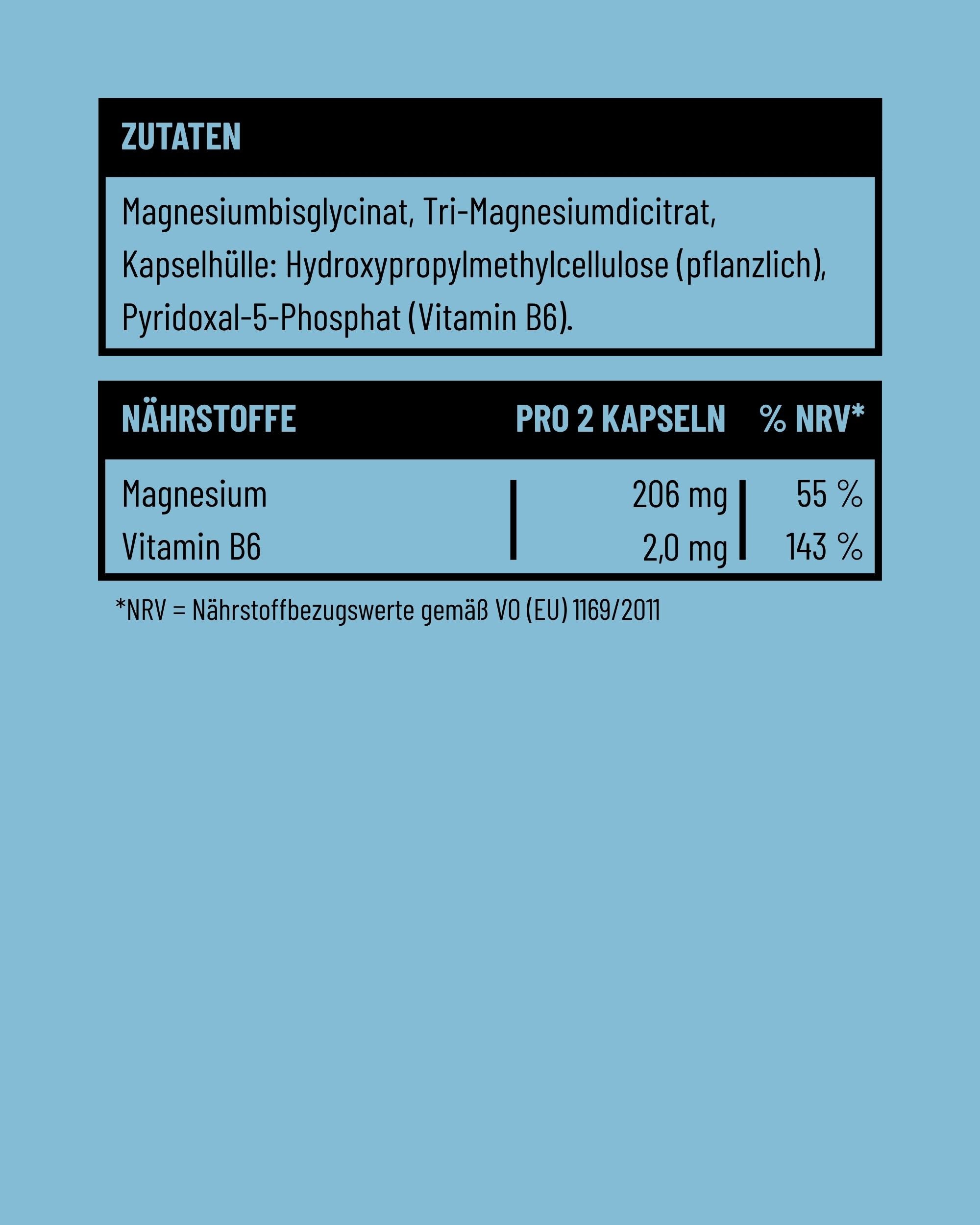
CALM by Fifty Five is an example of a deliberately constructed magnesium formula: instead of mixing as many different magnesium forms as possible, the product focuses on two clearly defined compounds plus vitamin B6.
At its core is a combination of about 65% magnesium bisglycinate and 35% magnesium citrate (ratio based on the compounds used):
- The high share of magnesium bisglycinate aims at good tolerability and use in your daily or evening routine. Chelated magnesium is often chosen when digestion is sensitive or magnesium is to be used long term.
- The magnesium citrate share brings a highly soluble component into the product that has proven itself particularly in demanding phases, for example after a stressful day or after sports.
Added to that is vitamin B6, which contributes to normal energy-yielding metabolism, normal functioning of the nervous system, and normal psychological function. Combined with magnesium, which itself contributes to normal functioning of the nervous system and to the reduction of tiredness and fatigue, this creates a coherent context for your demanding everyday life.
Instead of betting on "10 magnesium forms in one product," Fifty Five pursues a different logic with CALM:
- Clarity: you know exactly which forms are included and why.
- Tolerability: focus on a chelated form with a good tolerability profile, complemented by a highly soluble variant.
- Synergy: magnesium and vitamin B6 interlock sensibly at the metabolic level without creating unnecessary complexity.
CALM thus becomes the logical consequence of the form analysis: a combination of bisglycinate and citrate that accounts for both calm evening routines and phases of exertion, embedded in a deliberately lean product architecture. If you want to see the exact composition, dosage, and further details, you can view CALM in detail.
Intake, dosage & combining with other nutrients
With magnesium, your individual situation decides. As orientation, it makes sense to follow the recommended intake on the package and, in case of uncertainty or existing conditions, consult a doctor or another professional.
There is no hard rule on time of day:
- Many people like taking magnesium in the evening because they connect it with their routine around relaxation and sleep.
- Others integrate it well by planning magnesium in the morning or around demanding phases (e.g. intense sports).
More important is that you build the intake consistently into your day and that it feels right for your stomach and gut. Whether you take magnesium with or after a meal also depends on your tolerance. Many find intake with food more pleasant.
In combination with other nutrients and products from Fifty Five, you can think of your system as a modular setup:
- BASE as the daily basic supply: this is about covering your foundation of central micronutrients. Magnesium can then be added in the form of CALM.
- RISE (vitamin D3 + K2 + E): vitamin D plays a role in mineral balance and is often considered together with magnesium. RISE sensibly complements CALM with fat-soluble vitamins without directly interacting with the magnesium form.
- PULSE (omega-3): omega-3 fatty acids are associated with heart, brain, and inflammatory processes. They complement the role of magnesium, which contributes to normal muscle function and normal functioning of the nervous system, into a more holistic picture.
Important: in special life situations such as pregnancy, breastfeeding, certain pre-existing conditions, or when taking medications, always discuss dosage and combination with a professional. Supplements do not replace medical diagnosis or treatment, but they can help support your supply in a targeted way.
If you want to plan magnesium deliberately around sports, you will find more depth at magnesium and recovery in sports. For its role in your evening routine, see the overview magnesium in your evening routine.
Your decision in brief
- If you have a robust digestion and want a flexible everyday and sports magnesium: then lean toward magnesium citrate.
- If your digestion reacts sensitively or you want a magnesium for the evening routine: then try magnesium bisglycinate.
- If price is what counts most and you are willing to compromise on comfort: then critically examine standard products with magnesium oxide.
- If you want as little complexity on the label as possible: then prefer clear formulations with few, well-explained forms.
FAQ: common questions about magnesium forms
Which magnesium form is tolerated best?
Many people find chelated forms like magnesium bisglycinate well tolerated. They are particularly suitable if your stomach or gut reacts sensitively. Ultimately, tolerability is individual, so a deliberate test with one form over a few weeks is worthwhile.
Which magnesium form is good for the evening?
For the evening routine, people often choose forms associated with calm tolerability, such as magnesium bisglycinate. In this compound, magnesium contributes to normal functioning of the nervous system. What matters is that the timing and amount feel comfortable for you.
Which magnesium form is most likely to cause diarrhea?
Higher doses of highly soluble forms like magnesium citrate are more often associated with softer stools. Magnesium oxide can also tax digestion in larger amounts. If you react quickly, start with smaller amounts or gentler forms like bisglycinate.
How long should I test a magnesium form?
A test over several weeks usually makes sense to assess tolerability and how it feels for you personally. Watch your digestion, energy level, and routine. If you are unsure or take medications, discuss the duration with a professional.
Can I combine magnesium forms?
Yes, you can combine different magnesium forms as long as you keep the total dose in view. Well-tolerated forms like bisglycinate are often complemented with another form. Products like CALM already use this logic in a coordinated combination.
Summary & decision aid
The right magnesium form depends primarily on your digestion, your goal (everyday life, sports, sleep), and your preferred intake routine.
- Magnesium citrate: highly soluble, everyday-friendly, dose carefully with a sensitive gut.
- Magnesium bisglycinate: chelated, often well tolerated, popular for the evening routine.
- Magnesium oxide: high content, lower solubility, common in inexpensive products.
- There is no universally best magnesium form for everyone.
Mini decision rule: If your digestion reacts sensitively, lean toward chelated forms like magnesium bisglycinate; with a robust digestion, magnesium citrate can be a versatile starting point.
Compact comparison table
| Form | Typical use | Digestion | Note |
|---|---|---|---|
| Magnesium citrate | everyday life, sports, flexible routine | can soften stools | highly soluble, choose dose sensitively |
| Magnesium bisglycinate | evenings, sensitive digestion | usually well tolerated | chelated, for long-term use |
| Magnesium oxide | price-driven standard products | individual, sometimes taxing | high content, lower solubility |
Disclaimer:
This article is for informational purposes only and does not replace medical advice, diagnosis, or treatment by a physician or pharmacist. The information provided here should not be used for self-diagnosis or self-treatment. Food supplements are no substitute for a balanced, varied diet and a healthy lifestyle. For any health questions or complaints, please always consult a doctor you trust. Fifty Five accepts no liability for any inconvenience or harm resulting from the use of the information presented here.
Sources
- EFSA. Scientific Opinion on Dietary Reference Values for magnesium. EFSA Journal 2015;13(7):4186.
- German Nutrition Society (DGE). D-A-CH reference values – magnesium.
- German Federal Institute for Risk Assessment (BfR). Maximum levels for vitamins and minerals in food supplements.
- European Commission. EU Register of nutrition and health claims.










Exam Stress: How Student Leo Keeps His Focus
Multivitamin for Vegans: Which Nutrients Are Really Missing, and What a Supplement Can Do
Share: