


You may know the feeling: a full workday, lots of decisions, emails or social media late into the evening. And when you finally lie in bed, your mind keeps running. Falling asleep takes a while, staying asleep is unreliable, and you feel "wired" inside even though you are tired.
This is exactly where your nervous system takes center stage. Stress, alertness, and sleep are not separate topics, but expressions of how well your "inner control center" can switch between tension and relaxation. Nutrients like magnesium and vitamin B6 can support this process, but they do not replace healthy routines or medical evaluation.
In this article, you will learn how magnesium supports your nervous system at the biochemical level, how realistic its effect on sleep and inner calm is, which magnesium forms can make sense in this context, and how to build them into your daily life practically.
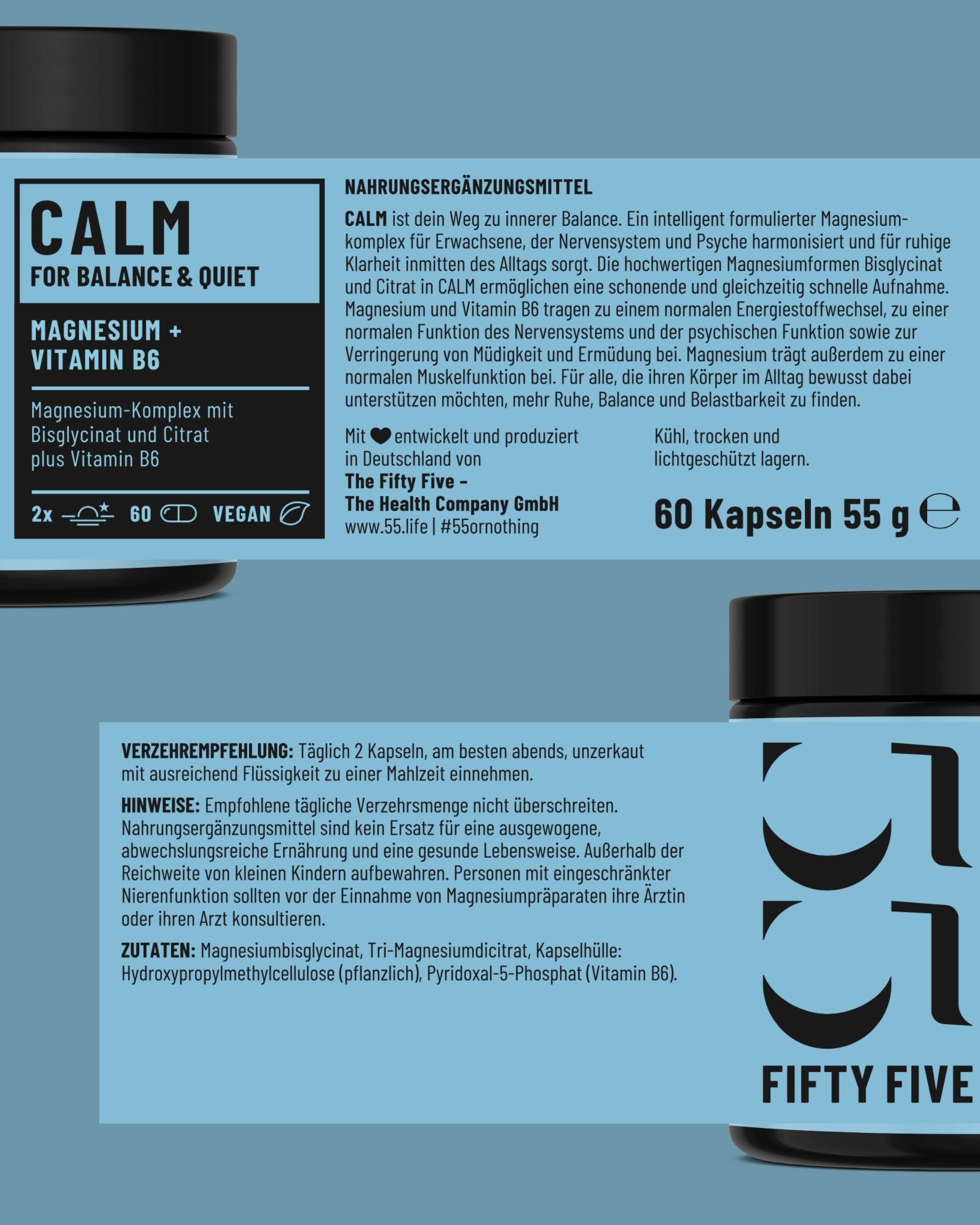
By the end, you will be better able to judge whether a product concept like CALM by Fifty Five, with magnesium bisglycinate, magnesium citrate, and vitamin B6, fits your situation.
Quick overview: does magnesium help with stress and sleep?
Magnesium supports your nervous system and can improve the conditions under which your body finds relaxation and sleep more easily under stress.
- Contributes to the normal function of nerves and mind.
- Supports muscle relaxation and energy metabolism in everyday life.
- Works only in interplay with lifestyle and sleep hygiene.
- Not a medication for sleep disorders or mental illness.
If everyday stress and tension are your main burden, a magnesium supply with nervous-system-oriented forms can make sense.
Stress, sleep, and your nervous system: what this is really about
At its core, your everyday stress is a nervous system issue. Put simply, two systems constantly work together: the sympathetic nervous system (activation, "fight or flight") and the parasympathetic nervous system (regeneration, "rest and digest"). As long as they alternate, your body can perform and later power down again.
With ongoing stress, many appointments, and light until late in the evening, however, the sympathetic side often stays active too long. Mentally you are still in the meeting while you are already lying in bed. Your nervous system can usually cushion a one-off stress spike, like a presentation, quite well. It becomes problematic when such phases become routine and the central and peripheral nervous systems hardly experience any real breaks.
Typical signs in everyday life:
- You lie awake and keep mentally replaying the day.
- You fall asleep but wake up at night and are immediately "wide awake."
- Your body feels tense: shoulders, neck, jaw.
In the background, neurotransmitters such as GABA, serotonin, and melatonin play a role. They are involved in relaxation, mood, and the sleep-wake rhythm. For them to be produced and regulated, your body needs a solid nutrient base: minerals like magnesium and vitamins like vitamin B6 are involved in many of these processes.
Important: nutrients are only one lever. Sleep hygiene, light management, handling screen time, breaks during the day, and a structured evening routine remain the foundation. Magnesium can be one building block to support your nervous system; different magnesium forms differ in tolerability and speed. We will go into these differences in detail later.
How magnesium supports your nervous system
Magnesium is involved in hundreds of enzymatic reactions and supports numerous processes in nerve and muscle metabolism. It contributes to normal functioning of the nervous system and to normal psychological function, and helps reduce tiredness and fatigue. Magnesium thus supports nerve signal transmission and the balance between muscle tension and relaxation, without being a sedative itself.
Practically, this means for you:
- Nerve impulses can be transmitted in an orderly way.
- Muscles can relax again after activation.
- Energy metabolism processes run more steadily in the background.
Put simply, magnesium acts like an "electrical buffer." It is involved in regulating calcium in the cells, which is important for signal transmission from nerve to muscle. When these processes are well supplied, physical tension and inner restlessness often ease more readily. Provided your daily life leaves room for regeneration.
Vitamin B6 complements this role. It also contributes to normal functioning of the nervous system and is involved in producing various neurotransmitters, including those connected with mood and relaxation. Combined with magnesium, vitamin B6 can help these metabolic pathways work well.
For products meant to support your nervous system in everyday life, a magnesium form is therefore often chosen that is well tolerated and, as an amino acid chelate, considered nervous-system-friendly, combined with vitamin B6. We will look at the exact question of forms, and why Fifty Five relies on a combination of two magnesium forms plus B6 in CALM, in more detail later. Of course, we have also compiled an in-depth comparison of the different magnesium forms in a guide.
Magnesium, inner calm, and sleep quality: what is realistic
Magnesium can bring your body into a state in which relaxation and sleep come more easily, but it does not replace sleep hygiene and is no "switch" that automatically makes you tired. It supports nerve and muscle function and contributes to tension releasing more readily.
Many people know situations like:
- After an intense day, the mind will not switch off.
- After a workout, the body feels "revved up."
- After long sitting, the body is tense even though you are tired.
Muscle tension plays a big role here. When muscles are permanently tense, the body signals "readiness," which makes inner calm harder. Magnesium supports normal muscle function and makes it easier for the muscles to return to a relaxed state. In parallel, a well-supplied nervous system can soften rumination loops by making the physiological basis for relaxation more readily available.
"Inner calm" is a subjective sensation, not a diagnosis. Magnesium can support you in phases of elevated everyday stress in finding rest more easily, especially if you also pay attention to a structured evening routine, less harsh light, and digital breaks.
Products developed specifically for evening routines and stress retreat often choose a combination of:
- a well-tolerated, rather "gentle" form like magnesium bisglycinate,
- a somewhat faster-available form like magnesium citrate,
- plus vitamin B6 for nerve metabolism.
The idea behind this is to support your nervous system and muscles without a sedating effect. It is about balance rather than "knockout": you should be able to find rest, but still think clearly in the evening and wake up refreshed in the morning.
Which magnesium forms particularly support your nervous system
Not every magnesium form behaves the same in the body. For the nervous system and sleep context, the most interesting forms are those that are well tolerated and fit sensibly into your routines. Magnesium bisglycinate and magnesium citrate are commonly used, while other forms tend to play a basic role.
Which magnesium for stress and sleep?
- Often choose magnesium bisglycinate when tolerability and a nervous system focus come first.
- Add moderate magnesium citrate if you also want to benefit from quicker availability.
- A combination of both can cover everyday stress and recovery.
- Vitamin B6 additionally supports nerve metabolism.
- Look for transparent labeling, sensible dosing, and a few well-considered co-nutrients.
Magnesium forms compared
| Form | Tolerability | Nervous system focus | Typical use |
|---|---|---|---|
| Magnesium bisglycinate | often very gentle on the stomach | common in "calm" products | nervous system, evening routine, sensitive people |
| Magnesium citrate | highly soluble, sometimes sensitive for the gut | suitable with mindful dosing | sports, daytime stress, flexible intake |
| Magnesium oxide | less soluble | rather low | basic supply, if tolerability fits |
| Combination bisglycinate + citrate | usually balanced | targeted nervous system focus | everyday stress, sports, evening support |
What is magnesium bisglycinate?
Magnesium bisglycinate is a chelated magnesium form in which magnesium is bound to the amino acid glycine. This form is often considered well tolerated and is commonly used when the nervous system, inner calm, and the evening routine come first, especially with sensitive digestion.
Magnesium citrate is an organic magnesium compound with good solubility and quick availability. It suits situations with physical exertion or daytime stress well, but at high single doses it can have a laxative effect in sensitive people.
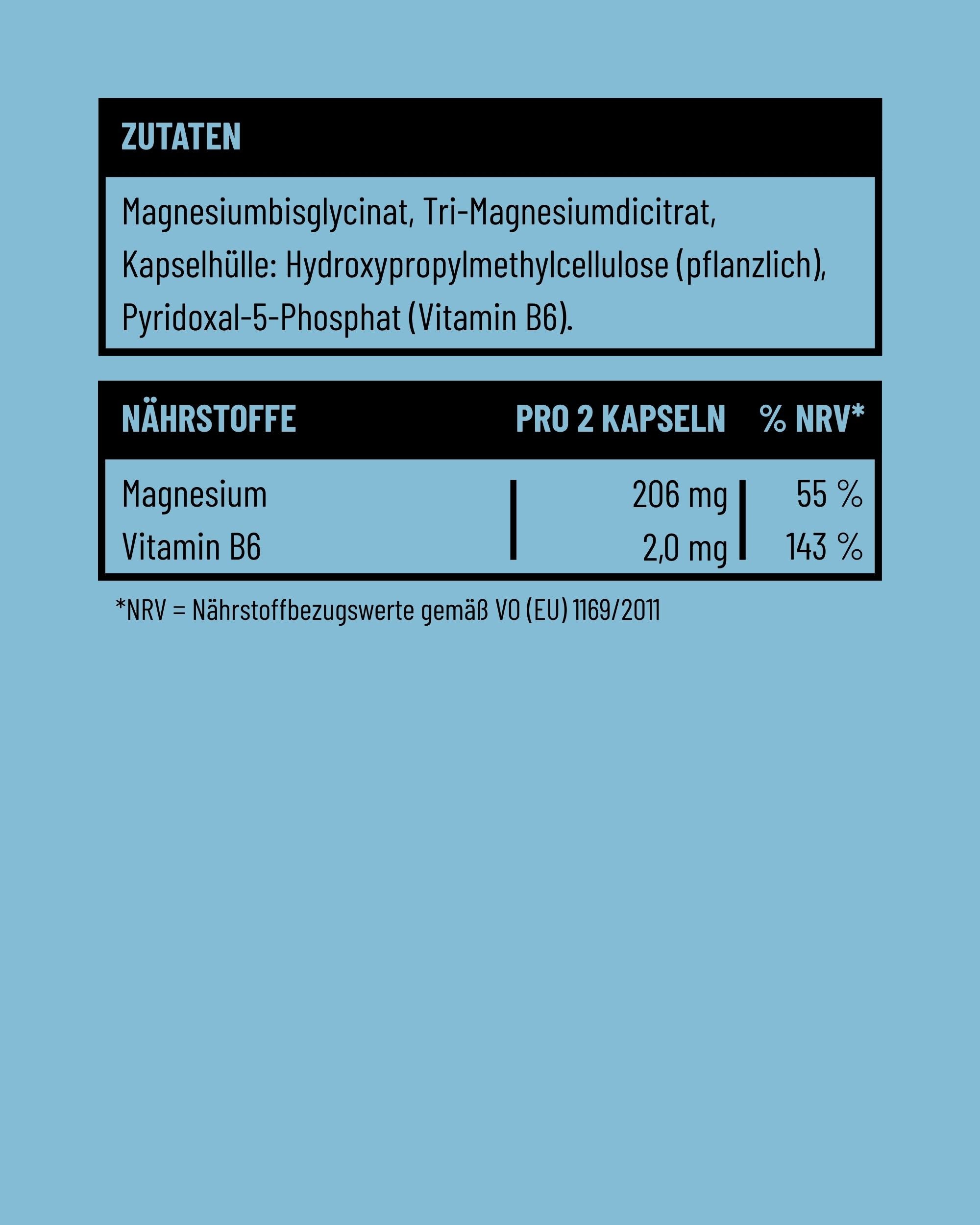
With CALM, Fifty Five deliberately relies on a composition of about 65% magnesium bisglycinate and 35% magnesium citrate. Narratively speaking, bisglycinate is often perceived as rather "calm" and well tolerated, citrate as somewhat "faster." This description is a simplification, not an exact speed profile. The whole is complemented by vitamin B6, which contributes to normal psychological function.
The logic behind it: deliberate reduction to two core forms with a clear role instead of as many forms as possible without a recognizable function. This makes it possible to develop a product that can support both your evening routine and recovery after sports or intense days.
Nutrient synergies: magnesium, B vitamins, vitamin D & co.
Magnesium does not work in isolation. Your nervous system benefits from an interplay of various micronutrients that jointly support energy supply, signaling, and regeneration. Magnesium is a central building block, but not the only key.
Vitamin B6 plays a special role here. It contributes to normal functioning of the nervous system and to normal psychological function and is involved in producing neurotransmitters. It therefore complements magnesium ideally when it comes to inner calm and sleep quality.
Other B vitamins like B1, B2, B12, and folate support energy and nerve metabolism. They help your body make energy available from food and supply nerve cells. Vitamin D, in turn, is important for muscles and the immune system; in the context of mood, it should be framed cautiously and without promises of healing.
Omega-3 fatty acids are components of cell membranes in the brain and can influence inflammatory processes. A good basic supply of minerals like zinc and selenium forms the foundation for many regulatory processes in the body.
In Fifty Five's product architecture, this is reflected as follows:
- CALM focuses on magnesium plus vitamin B6 in the context of the nervous system and sleep.
- BASE serves as the broad foundation of your micronutrient supply, including nerve-relevant vitamins, without a high-dose strategy.
- In addition, products like RISE (vitamin D3/K2/E) and PULSE (omega-3) can support holistic nervous system care when there is a need.
The principle of reduction remains key: not everything at once and at maximum doses, but prioritized and combinable. For the bigger picture, it is also worth taking another look at our magnesium master guide.
Magnesium in everyday life: intake, timing, and routines
The best magnesium form is of little use if it does not fit your daily life. What matters is integrating magnesium so that it remains practical and well tolerated for you.
Typical intake windows are:
- In the evening as part of your evening routine, to tune your nervous system toward relaxation.
- Around athletic exertion, either before or after training, depending on how your gastrointestinal tract reacts.
Many people like to take magnesium with a meal because that can improve tolerability. Others do fine on an empty stomach. Especially with forms like magnesium citrate, it pays to listen to your body: if your gut reacts sensitively, smaller individual portions or combining with food can be more comfortable.
Very high single doses are often unnecessary and can worsen tolerability. Typical dosing ranges and maximum daily intake recommendations depend on various factors and are best explained in their own context. You will find detailed orientation in our separate guide on "magnesium dosage & intake".
Thanks to the mix of magnesium bisglycinate and magnesium citrate, a product like CALM by Fifty Five can be used flexibly:
- In the evening to support "powering down" after an intense day.
- Around training days, so recovery and the nervous system do not have to be considered separately.
The design aims at everyday practicality and tolerability, not at the maximum amount of magnesium. This way, magnesium can be integrated sensibly into your routines without your day starting to revolve around supplements.
Who should pay particular attention to magnesium for stress and sleep
Fundamentally, magnesium is an important nutrient for everyone. In certain life situations, however, it is worth taking a closer look at whether your supply matches your load profile.
Magnesium can be particularly relevant for people with:
- high mental load, many deadlines, and constant performance pressure,
- shift work or irregular working hours that shift the sleep rhythm,
- lots of screen time, which often keeps the evening bright and "active" for longer.
Ambitious recreational athletes who train frequently also tax their muscles and nervous system intensively. Here, a combination of a magnesium-rich diet (e.g. whole grains, nuts, legumes) and targeted supplementation can make sense, especially when sports and a demanding job come together.
Another group is people with a very one-sided diet, where magnesium-rich foods rarely appear on the plate. Here, a basic supply plus targeted magnesium for nervous system and sleep topics can be particularly interesting.
If you have existing conditions, take medications regularly, or are unsure whether symptoms point to a possible magnesium deficiency, a medical evaluation or nutritional consultation makes sense. Including the option of checking lab values.
Products like CALM or BASE are aimed primarily at people who combine mental and physical load: a demanding office routine plus sports, or long days with few breaks. The focus is therefore deliberately on the nervous system and recovery, without making therapeutic promises.
For women whose stress and sleep quality additionally interact with their cycle, we have created a dedicated guide on magnesium, PMS, and hormones.
Quality, purity, and product design: what to look for in magnesium
If you are specifically looking for a magnesium product for stress and sleep, a clear set of criteria helps. It is not just about "how much magnesium," but above all about "which form, with which accompanying substances, and at what dose."
Important quality markers:
- Choice of form: for the nervous system and evening routine, magnesium bisglycinate and moderately used magnesium citrate are often more sensible than poorly soluble or poorly tolerated forms.
- Transparent labeling: the amount of elemental magnesium should be clearly stated.
- Few additives: no unnecessary colorings or superfluous fillers.
- Sensible dosing: supportive but not extreme. Practical for the long term.
- Targeted co-nutrients: a few well-matched partners like vitamin B6 instead of "mega complexes" without recognizable logic.
Checklist: how to recognize a good magnesium product
- The magnesium forms used are clearly named (e.g. bisglycinate, citrate).
- The elemental magnesium amount is transparently declared.
- There are no superfluous colorings or flavorings.
- The dose is everyday-friendly and not extreme.
- Co-nutrients like vitamin B6 are targeted, not randomly combined.
With CALM by Fifty Five, this way of thinking shows in the architecture: a focus on magnesium bisglycinate and magnesium citrate plus vitamin B6, reduced to the essentials for the nervous system, stress, and the evening routine. No all-in-one magnesium for everything. BASE complements this logic as a broad foundation of daily micronutrient supply that can, but does not have to, stand alongside the dedicated magnesium product.
Decision aid at a glance
- If everyday stress and inner tension in the evening concern you most: focus on a nervous-system-oriented magnesium with forms like bisglycinate, ideally combined with vitamin B6.
- If sports and muscular load also play a big role: a combination of bisglycinate and citrate can make sense, covering both recovery and the evening routine.
- If your diet is uncertain overall: first consider a base product like BASE as a foundation and add magnesium in a targeted way.
- If you react very sensitively to supplements: start with well-tolerated forms like magnesium bisglycinate in moderate amounts and observe how you feel.
In summary: which magnesium form makes sense for stress and inner restlessness?
For stress and inner calm, well-tolerated forms like magnesium bisglycinate and a balanced use of magnesium citrate are commonly chosen.
- Bisglycinate: nervous-system-oriented, usually gentle on the stomach.
- Citrate: highly soluble, faster available, watch the gut at high doses.
- The combination plus vitamin B6 supports nerve metabolism in a targeted way.
- Not every form is automatically ideal for a nervous system focus.
If you react sensitively, start with well-tolerated forms and moderate doses, and test slowly.
FAQ on magnesium, stress, and sleep
Does magnesium help with falling asleep?
Magnesium can support falling asleep by contributing to the normal function of the nervous system and muscles, improving the conditions for relaxation. It does not replace sleep hygiene and is not a sleep aid, but it can help you find rest more easily in phases of elevated everyday stress.
When should I take magnesium for better sleep?
Many people benefit from taking magnesium in the second half of the day or in the evening as part of their evening routine. What matters is that the timing fits your daily life and your tolerance. Magnesium can also make sense around athletic exertion. Whether before or after depends on the individual.
Which magnesium form makes sense for stress?
For stress and inner restlessness, well-tolerated forms like magnesium bisglycinate are commonly used, ideally combined with moderate amounts of magnesium citrate. A well-considered combination can support the nervous system and muscles without overwhelming the body. Look for transparent labeling and sensible dosing instead of as many forms as possible.
How long does it take for magnesium to work?
When you notice an effect depends on your starting situation, the dose, the form, and your routines. Some people notice changes in muscle relaxation or inner calm within days; for others it takes longer. Magnesium works best when you take it regularly rather than only occasionally.
Can I combine magnesium with other sleep nutrients?
Magnesium often combines well with other nutrients for the nervous system, such as vitamin B6, certain B vitamins, or omega-3 fatty acids. What matters is that the total amount remains sensible and products do not overlap unnecessarily. A purpose-built magnesium product like CALM can be used alongside a basic supply like BASE if it fits your needs.
Which nutrients are good for the nervous system?
Besides magnesium, B vitamins (especially B6, B1, B2, B12, and folate), vitamin D, omega-3 fatty acids, and minerals like zinc and selenium play a role in nerve and energy metabolism. They support different building blocks such as neurotransmitter production, cell membranes, and energy provision. A balanced diet remains the foundation; supplements can complement it in a targeted way.
Disclaimer:
This article is for informational purposes only and does not replace medical advice, diagnosis, or treatment by a physician or pharmacist. The information provided here should not be used for self-diagnosis or self-treatment. Food supplements are no substitute for a balanced, varied diet and a healthy lifestyle. For any health questions or complaints, please always consult a doctor you trust. Fifty Five accepts no liability for any inconvenience or harm resulting from the use of the information presented here.
Sources
- EFSA. Scientific Opinion on Dietary Reference Values for magnesium. EFSA Journal 2015;13(7):4186.
- German Nutrition Society (DGE). D-A-CH reference values – magnesium.
- German Federal Institute for Risk Assessment (BfR). Maximum levels for vitamins and minerals in food supplements.
- European Commission. EU Register of nutrition and health claims.









How Ben Finds His Rhythm When the Shift Schedule Sets the Beat
When to Take a Multivitamin: Morning, Evening, or with Meals?
Share: