


Poor sleep, tense muscles after training, a head that will not settle down in the evening: many people connect these topics with magnesium and then get stuck on the decisive question: when is the best time to take it? In the morning, in the evening, or even both?
That is exactly what this article is about. You do not get a rigid clock time but a simple structure for setting your personal magnesium timing. Whether evening, morning, or spread out, which one fits depends on your routine and your body, and how the magnesium form (e.g. bisglycinate, citrate) plays into it practically.
This is not about theoretical biochemistry but about your daily life: work, stress levels, sports, stomach tolerability, and your existing supplement routine.
Quick orientation: when does magnesium make sense for you?
The best time for magnesium depends on your goal, your tolerability, and your daily life. More important than the clock time are regular intake and the right form. For sleep and inner restlessness, the evening tends to work better; for muscles and sports, spreading it across the day or around training.
The golden rule: consistency over timing
When it comes to when you take magnesium, one principle matters more than anything else: consistency and total amount are more decisive than the exact clock time. Your body builds magnesium stores over days and weeks, not in single minutes.
For practice, you can orient yourself around three simple rules:
- Focus on sleep & inner restlessness: Take magnesium rather in the evening, embedded in your evening ritual and ideally with or after a meal.
- Focus on muscles & training: Plan magnesium rather across the day or near your training, and at higher amounts split between morning and evening.
- Sensitive stomach / sensitive gut: Take magnesium always with a meal and split the amount across two times if needed.
Organic magnesium compounds like magnesium bisglycinate and magnesium citrate are usually well bioavailable and better tolerated by many people. That makes timing more flexible: you can decide more by goal (sleep, sports, baseline supply) without being slowed down by stomach problems.
How magnesium works in the body: timing basics
Magnesium is involved in hundreds of reactions in the body. For your timing, three areas matter most: the nervous system, muscles, and energy metabolism. Be sure to also check out our magnesium master guide for even deeper information.
- In the nervous system, magnesium contributes to normal function and supports processes connected with inner calm and "winding down."
- In the muscles, it supports normal muscle function, meaning the interplay of tension and relaxation, including after physical exertion.
- In energy metabolism, magnesium contributes to your efficient use of energy from carbohydrates, fats, and proteins.
Magnesium is absorbed in the gut and stored in body tissues. So-called bioavailability describes how much of the ingested magnesium actually arrives in the blood and cells. This process runs over many hours, the effects over days and weeks, not like an "instant switch" within minutes.
Authorized health claims put it this way: magnesium contributes to normal functioning of the nervous system and normal muscle function and to the reduction of tiredness and fatigue. "Normal function" means: magnesium supports regular, healthy processes; it does not replace any therapy and is not a sleep aid or sedative.
For your timing, that means: there is no single "magic window" you must hit. What counts is regular intake within your daily routine, adapted to sleep, stress and training load, and your digestion.
Factors for your personal intake time
Before you settle on "morning or evening," it helps to look at the factors that influence your personal magnesium intake time. That means the point in your day when you plan your magnesium supplement, matched to goal, tolerability, and daily rhythm.
Goal setting: sleep, sports, or baseline supply?
Important levers:
-
Goals:
- sleep quality and winding down internally
- muscle relaxation and recovery after sports
- general baseline supply in everyday life
-
Daily life:
- shift work or classic office hours
- late training or early morning runs
- irregular or rather fixed meals
If you know when stress peaks occur or when you train, you can place magnesium so it fits well into that flow.
Gastrointestinal tolerability & meals
Then there is stomach and gut tolerability: "stomach sensitivity" means you react to certain foods or supplements with a feeling of pressure, nausea, bloating, or diarrhea. In that case, it is often sensible to take magnesium with a meal and in two smaller portions instead of one high single dose.
Another point is interactions: some medications and minerals can influence each other's absorption. It is best to discuss specific spacing with your doctor or pharmacy, especially with ongoing medication.
Finally, your routine plays a role: a routine is a fixed, recurring sequence in your day, e.g. "in the morning after brushing teeth" or "in the evening after brushing teeth and before reading." Tying magnesium to such a routine point makes intake noticeably more reliable.
Magnesium in the morning: focus on daytime stress & energy
For many, magnesium fits well into the morning routine. You get up, have breakfast calmly or quickly between emails and appointments, and want to handle your supplements right away.
Advantages of morning intake:
- It is easy to combine with breakfast, which improves tolerability, especially with forms like magnesium citrate.
- If your day is shaped by stress, deadline pressure, or many meetings, a morning intake supports normal functioning of the nervous system and muscles throughout the day.
- If you do early morning sports (e.g. running or the gym before work), magnesium fits well around that exertion. Either before or after the session, preferably not on an empty stomach if your stomach reacts sensitively.
An example: you start the day early at your laptop, your shoulders tighten up quickly over the morning, plus lots of coffee and few breaks. A magnesium supplement with breakfast can help secure your baseline supply and establish a clear routine moment.
Possible downsides in the morning:
- If you take magnesium on an empty stomach and have a sensitive stomach or gut, that can lead to discomfort or softer stools, especially with citrate.
- Some people subjectively notice that magnesium makes them feel more relaxed or sleepy. If you know that feeling, you may prefer to use this effect in the evening.
For you, morning intake fits especially well if you:
- have a lot of stress during the day,
- do sports mostly in the morning,
- tolerate magnesium well, ideally together with breakfast.
Magnesium in the evening: focus on relaxation & sleep routine
For many, the evening is the natural time to close out the day: laptop shut, lights dimmed, maybe a book or a show. Here, magnesium can be embedded nicely into a relaxation routine.
Magnesium contributes to normal functioning of the nervous system and muscles. When your body switches from activity mode to rest mode, an evening intake can support processes connected with relaxation and muscle rest, without being a sleep aid itself.
Typical advantages of evening intake:
- You connect magnesium with your evening ritual, e.g. after dinner or just before brushing your teeth.
- After an intense day with lots of mental strain, screen time, or late training, magnesium fits this "wind-down phase" better emotionally for many.
- If you take magnesium after dinner, your stomach is not empty. That can improve tolerability, especially with a sensitive gut.
Many people report perceiving a "calmer" effect in the evening. That is less about a short-term effect of the magnesium and more about the fact that evenings bring less distraction and stimulation, so you perceive your body more strongly.
For you, evening intake fits especially well if you:
- have trouble settling down in the evening,
- experience a lot of evening stress from work or family,
- tolerate magnesium better when you take it with your largest meal.
Important: magnesium is not a sleep aid or sedative. It supports normal body functions that many people associate with a feeling of relaxation and better switching off. If you want to go deeper, you will find detailed information on magnesium for stress and sleep in our guide.
Special case sports: timing around training
If you do sports regularly or take a product with a higher daily amount, the timing question becomes even more practical. Two things matter most here: steady supply and tolerability.
With athletic exertion, a solid baseline supply across the day is more important than an exact intake minute before or after the session. We have worked out the details in a dedicated guide on sports and recovery. Magnesium supports normal muscle function and energy metabolism, processes that run continuously.
Sensible strategies:
- Take part of your magnesium near your training, e.g. with the snack before or the meal after, if your stomach tolerates that well.
- With high daily amounts (e.g. in the range of about 300-400 mg per day, around the usual reference intake), it is often better to split the amount into two portions: morning and evening, or daytime and evening.
Practical examples:
-
Office + after-work sports:
- half the daily amount with lunch,
- second half with dinner after training.
-
Early morning sports + quiet evening:
- intake with breakfast after training,
- second portion in the early evening with the main meal.
With a sensitive gut, avoid taking a high single dose (especially of citrate) on an empty stomach right before intense sessions; otherwise you risk gastrointestinal unrest during training.
Principle: respect upper limits and individual tolerability. If you are unsure, stick to the recommended serving of your supplement and seek medical advice when in doubt.
The role of the magnesium form (bisglycinate vs. citrate)
Not just the clock time, the form of your magnesium also influences how flexible your timing can be. This is mainly about bioavailability and tolerability.
- Organic magnesium compounds (e.g. magnesium bisglycinate, magnesium citrate) are bound to organic acids or amino acids. They are usually absorbed better and are gentler on the stomach for many people.
- Inorganic forms (e.g. magnesium oxide, magnesium carbonate) have a chemically simpler structure, are often cheaper, but can have lower bioavailability and lead to digestive problems more quickly.
Short profile of the key forms with timing in mind:
- Magnesium bisglycinate: Chelated form, usually well tolerated, perceived as "calm" by many. Popular in the evening, especially with a focus on inner calm and good stomach tolerability.
- Magnesium citrate: Well bioavailable and absorbed relatively quickly. With a sensitive gut, it can have a loosening effect, so better with meals and a very good fit in the context of sports and daytime demands.
- Magnesium oxide / carbonate: Rather lower bioavailability, but often a stronger effect on bowel movements. For everyday use, these forms are often only of limited suitability if you are prone to diarrhea.
You will find a complete comparison of the different magnesium forms in our guide.
Table: magnesium form and timing notes
| Form | Tolerability | Typical timing |
|---|---|---|
| Magnesium bisglycinate | usually gentle on the stomach, rather "soft" | especially in the evening, good for calm routines |
| Magnesium citrate | well available, can loosen stools | with meals, often around sports/daytime |
| Magnesium oxide | digestive problems more likely | rather not on an empty stomach, at low doses |
| Magnesium carbonate | variable tolerability, lower absorption | only if you personally tolerate it well |
CALM by Fifty Five: optimized for everyday demands
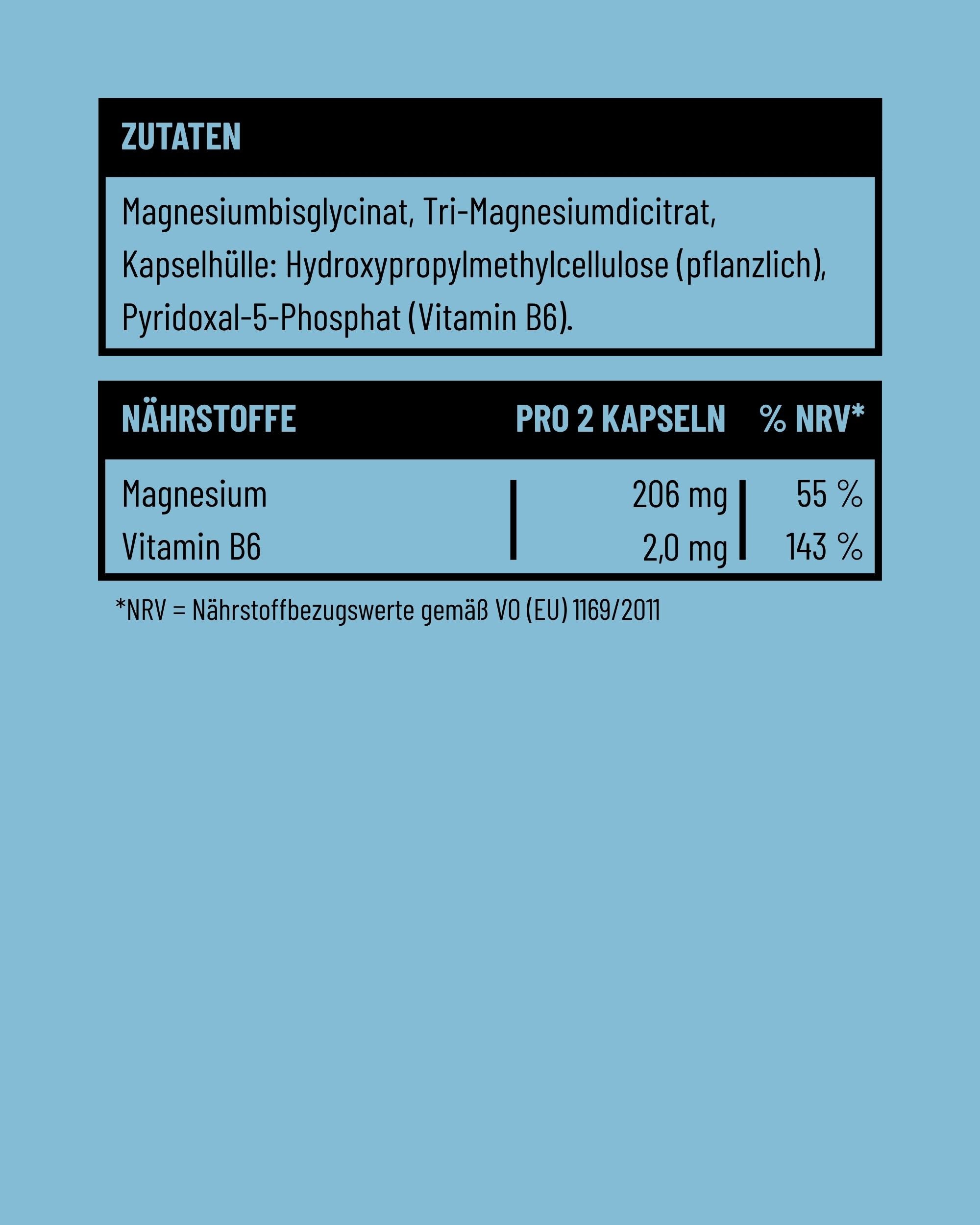
With our product CALM by Fifty Five, we deliberately rely on a combination of magnesium bisglycinate (approx. 65%) and magnesium citrate (approx. 35%) plus vitamin B6:
- The bisglycinate share focuses on a well-tolerated supply that fits especially well into an evening routine and supports processes connected with inner calm.
- The citrate share adds a highly available form that has proven itself with everyday demands and athletic recovery.
- Vitamin B6 contributes to normal energy-yielding metabolism and normal functioning of the nervous system, supporting the systems in which magnesium is also active.
The result: a product that can cover different daily demands without you having to combine several individual supplements. Important: the form gives you orientation; it does not prescribe an exact time of day.
Intake routine: how to combine magnesium with BASE, RISE & PULSE
Magnesium does not work in isolation but is part of your overall nutrition and supplement concept. Your timing should therefore also fit your other supplements and your diet.
Through your diet, you take in magnesium mainly via nuts, whole grains, legumes, and green vegetables. If you eat such foods regularly, it makes sense to take magnesium supplements with meals as well.
In the Fifty Five context, three other products play a role:
- BASE (multivitamin/mineral complex): Lays the foundation without relying on high doses. It is usually taken once daily with a meal. CALM, the magnesium supplement, can be added before, after, or deliberately in the evening.
- RISE (D3/K2/E): Fat-soluble vitamins, often sensible in the morning or during the day with a meal containing fat. There is no strict timing relationship to magnesium; you can use RISE as a routine anchor and place magnesium at a different time.
- PULSE (omega-3 algae oil): Also often with a meal. Many use PULSE and RISE during the day and plan magnesium, especially CALM, rather in the evening to keep the overall routine lean.
The goal is a clear, easy-to-remember daily routine, not a "pill orgy" spread across the whole day.
Practical routine: what your day with magnesium can look like
You determine the best time for magnesium based on your goal, your tolerability, and your daily life, not a rigid clock time.
- Morning: e.g. BASE and RISE with breakfast or brunch.
- During the day: PULSE with a main meal, if it fits your flow.
- Evening: magnesium (e.g. CALM) as part of your evening ritual, especially with a focus on switching off and muscle relaxation.
- Magnesium is not a sleep aid; it complements your diet and supports normal body functions.
- If sports and muscle recovery are the priority, you can place part of your magnesium near training and part in the evening.
Common mistakes when taking magnesium
Even though magnesium is widespread in everyday life, there are typical pitfalls, many of them around timing and expectations.
1. "More helps more"
High single doses or several products in parallel quickly lead to gastrointestinal problems without increasing the benefit. Better: choose a sensible daily amount and take it regularly.
2. High citrate dose on an empty stomach
Especially with a sensitive gut, a large amount of magnesium citrate on an empty stomach can trigger diarrhea or abdominal cramps. Take such forms with a meal instead and spread the daily amount.
3. Irregularity
Taking magnesium only "now and then" when you happen to think of it achieves little. Your body benefits from a consistent routine, whether morning, evening, or split.
4. Expecting an instant effect
Magnesium is not a sleeping pill or painkiller. It supports normal functioning of nerves and muscles and works over days and weeks, not seconds. Unrealistic expectations quickly lead to disappointment.
5. Ignoring medications & pre-existing conditions
If you take medications regularly or have pre-existing conditions, discuss possible interactions and dosing with your doctor or pharmacy. In our guide, you will find more detailed information on side effects and interactions of magnesium. This article does not replace individual medical advice.
How to determine your ideal intake time
Here is how we lead you step by step to your personal routine:
1. Define your main goal
- sleep & switching off internally
- sports & muscle recovery
- general baseline supply
2. Assess your gastrointestinal sensitivity
- rather robust → also possible on an empty stomach or between meals
- sensitive → preferably with meals, rather split
3. Analyze your daily rhythm
- When are you most stressed?
- When do you train?
- When do you realistically have a quiet moment for your routine?
4. Mark your routines
- morning ritual (e.g. after brushing teeth, at breakfast)
- lunch break
- evening ritual (e.g. after dinner, before reading)
5. Decision suggestions
| Goal | Recommended window | Note |
|---|---|---|
| Sleep/relaxation | rather in the evening, after eating | integrate well into evening ritual |
| Sports/recovery | across the day & near training | not on an empty stomach if sensitive |
| Baseline supply | once daily with a fixed meal | consistency matters more than clock time |
| Sensitive stomach | with meals, rather split | avoid high single doses |
With a product like CALM, you can, for example:
- take it once in the evening on quiet days,
- on intense work or sports days, once during the day with a meal and once in the evening, always within the recommended daily serving and adapted to your personal tolerability.
Decision aid at a glance
- If you mainly want to support sleep and switching off internally → plan magnesium rather in the evening.
- If sports, muscle recovery, or cramping tendency during training are the priority → take magnesium spread across the day and near training, but not high-dosed on an empty stomach.
- If your stomach is sensitive → take magnesium with meals and split the daily amount into two portions.
- If you mainly want a baseline supply → choose a fixed daily time you can sustain long term.
- If you already use several supplements → place magnesium so your routine stays clear and manageable (e.g. other products during the day, magnesium in the evening).
FAQ: common questions about taking magnesium
Can you take magnesium in the morning and in the evening?
Yes, you can take magnesium in the morning and in the evening, especially with higher daily amounts or when sports play a big role. What matters is that the total amount stays sensible and you tolerate it well. Splitting can ease the load on your stomach and gut and make supply more even.
Should you take magnesium before or after eating?
With a sensitive stomach, it is usually better to take magnesium with or after a meal. If you tolerate your product well, taking it on an empty stomach is also possible. Pay attention to how your body reacts and adapt the timing accordingly.
Is magnesium before sleep sensible?
Magnesium can support processes connected with relaxation and the normal functioning of nerves and muscles. Many people find an evening intake fitting because it integrates well into their wind-down ritual. However, it is not a sleep aid and does not replace treatment for sleep disorders.
How long should I take magnesium?
Magnesium is permanently relevant in your diet, which is why it is often supplemented over longer periods. A regular intake in the range of the usual daily reference is sensible. With pre-existing conditions or ongoing medication, discuss duration and dosage with your doctor or pharmacy.
What do I do if I forget a dose?
No reason to panic: do not simply take a double amount afterward. Continue your usual routine with the next planned intake. What matters is regularity over weeks, not every single capsule.
Disclaimer:
This article is for informational purposes only and does not replace medical advice, diagnosis, or treatment by a physician or pharmacist. The information provided here should not be used for self-diagnosis or self-treatment. Food supplements are no substitute for a balanced, varied diet and a healthy lifestyle. For any health questions or complaints, please always consult a doctor you trust. Fifty Five accepts no liability for any inconvenience or harm resulting from the use of the information presented here.
Sources
- EFSA. Scientific Opinion on Dietary Reference Values for magnesium. EFSA Journal 2015;13(7):4186.
- German Nutrition Society (DGE). D-A-CH reference values – magnesium.
- German Federal Institute for Risk Assessment (BfR). Maximum levels for vitamins and minerals in food supplements.
- European Commission. EU Register of nutrition and health claims.










Fish Oil or Algae Oil: Where Omega-3 Really Comes From
Single Vitamin or Multivitamin: When a Combination Product Is Smarter, and When It Is Not
Share: