


You may know the feeling: you push through your session, feel stable during training, and suddenly muscle cramps appear, your legs feel heavy, or you struggle to fall asleep after late sessions. At the latest then, the question comes up whether magnesium might play a role and whether a supplement would make sense.
In sports, magnesium is less about "quick effects" and more about a reliable base. Magnesium contributes, among other things, to normal muscle function, to the maintenance of normal electrolyte balance, to normal functioning of the nervous system, and to the reduction of tiredness and fatigue. These processes are in particular demand under load.
In this article, we lay out which roles magnesium plays in an athlete's body, which situations can point to a suboptimal supply, and how to combine diet, electrolytes, and supplements in an everyday-friendly way. You will also get a clear assessment of which magnesium forms (e.g. magnesium bisglycinate vs. magnesium citrate) can make sense in which context, and why CALM by Fifty Five is geared precisely toward training and recovery. Whether adjusting your diet, stabilizing your basic supply, or supplementing in a targeted way, the answer lies in your training routine.
Quick definition: does magnesium help with muscle cramps in sports?
Magnesium supports normal muscle function and electrolyte balance, but it does not replace medical evaluation or individual training planning.
-
-
Support normal muscle and nerve function in everyday life and in sports.
-
Sports, sweat, and diet shape your individual situation.
-
Always clarify other causes of complaints with a doctor.
-
Not intended as treatment for diseases or acute emergencies.
-
If you regularly get cramps despite an adjusted diet, basic supply, and sensible training, have the cause and your supplement intake checked by a doctor.
Why sports influence your magnesium needs
As soon as you train, your muscles work harder, your energy metabolism runs at a higher gear, and you lose fluid and electrolytes through sweat. This applies above all to endurance sports, but also to strength training, HIIT, and team sports. Depending on intensity and duration.
Electrolyte loss through sweat and high intensity
During long runs, intense intervals, or tournaments, several factors come together: high muscle work, sustained activation of the nervous system, and sometimes substantial sweat losses. Such phases can lead to a situation in which magnesium in the body is more tightly budgeted. That does not have to be a medical deficiency, but it can become noticeable in everyday life, for example through faster fatigue or restless muscles after exertion.
Training also rarely runs at a constant level. In intense weeks, before competitions, or in training camps, the load rises significantly. It is precisely in these "windows" that paying attention to your recovery, diet, and fluid intake makes sense. Magnesium is one building block here, not the only lever.
Different sports place different demands:
-
Endurance training (running, cycling, triathlon): longer efforts, often heavy sweating, heat, or indoor trainer sessions.
-
Strength and HIIT training: high peak loads, many muscle contractions in a short time, sometimes training late in the evening.
-
Team sports: stop-and-go, tournaments, travel, irregular meals.
In all these scenarios, magnesium is part of your basic "kit" of minerals and electrolytes. It does not replace sensible training planning, stretching, or adjusted load management, but it can help support the normal functions of muscles, nervous system, and energy metabolism on which your sport ultimately builds.
Magnesium's roles in an athlete's body
Magnesium matters for athletes because it contributes to normal muscle function, to the maintenance of normal electrolyte balance, to normal functioning of the nervous system, and to the reduction of tiredness and fatigue. Training, sweat losses, and recovery stress place greater demands on this base in everyday life.
Magnesium is a mineral and also acts in the body as an electrolyte. Electrolytes are electrically charged particles such as sodium, potassium, calcium, and magnesium that are involved in nerve conduction, muscle contraction, and fluid balance, among other things. In sports, the balance of these electrolytes shifts temporarily, for example through sweating or long efforts, and has to be stabilized again through diet and drinking habits.
Muscle function: the interplay of tension and relaxation
Magnesium is particularly relevant for your muscles because it is involved in the normal tensing and relaxing of muscle. While calcium is more linked to contraction, magnesium supports the relaxation phase. In everyday training, it is less about individual contractions and more about the sum of thousands of movements, especially in longer sessions or intense blocks.
Your nervous system also benefits from a good magnesium supply. Magnesium contributes to normal functioning of the nervous system and thus plays a role in processing stimuli, coordinating movements, and powering down again after intense efforts. Especially if you feel "revved up" inside after training, it is worth looking at the overall context of sleep, stress management, and basic supply.
Magnesium as an electrolyte in energy metabolism
In energy metabolism, magnesium participates in numerous enzymatic reactions and contributes to normal energy-yielding metabolism as well as the reduction of tiredness and fatigue. That does not mean magnesium "makes you perform better," but it supports the processes that keep you from feeling exhausted as quickly in everyday life and in training. Provided the other factors like carbohydrate intake and training planning are right.
Recovery in the sports context means restoring your performance capacity after exertion: your muscles, your nervous system, your energy stores, and your sleep all interact here. Magnesium is one of the micronutrients that support these normal functions. If you want to understand the details of effects and recommended intake more broadly, a deeper look into our comprehensive magnesium master guide will help.
Typical problems: signs of a suboptimal supply
Many athletes first notice in everyday life that something is "off," without a deficiency necessarily being involved. A suboptimal magnesium supply can become noticeable in interplay with load, sleep, and diet.
Common situations include:
-
Muscle cramps during or after sports, for example in the calves or feet.
-
Muscle twitching at rest after intense sessions, especially in the evening or at night.
-
Heavy legs or a feeling of unusually fast fatigue, even though the training load does not seem extreme.
-
Inner restlessness after hard sessions, difficulty "coming down."
-
Restless sleep on nights after intense or late sessions.
-
Heavy sweating combined with insufficient fluid and electrolyte intake.
-
Frequent urination when you drink a lot but barely replace electrolytes.
Important: all of these complaints can have many causes. Magnesium plays a role through normal muscle function, electrolyte balance, nervous system function, and energy metabolism, but it is only one part of the overall picture. Stretching, training volume, carbohydrate intake, fluids, sleep, and possible underlying conditions are just as relevant.
If complaints are very severe, persist, worsen, or come with other symptoms, you should have them medically evaluated. Especially when the heart, circulation, or kidneys are involved, or you take medications regularly. In such cases, it can also be checked whether lab values and targeted diagnostics make sense; for orientation, take a deeper look at when a medical evaluation and lab values make sense.
Optimizing recovery: magnesium and sleep after training
After training begins the part that often gets short shrift in everyday life: recovery. This is about your muscles repairing, your glycogen stores rebuilding, your nervous system being relieved, and your sleep not being permanently disturbed. Especially when you combine work, family, and sports, this phase is decisive.
Magnesium contributes to normal muscle function, to the functioning of the nervous system, and to the reduction of tiredness and fatigue. In the recovery context, that means: it supports processes your body has to perform anyway, such as muscle relaxation, stimulus processing, and energy balance. Many athletes report having trouble settling down after very late or intense sessions. That is often due to a combination of stress hormones, high mental activation, and physical exertion.
A sensible evening routine can be a stable anchor here. It can include:
-
an easily digestible meal with carbohydrates and some protein
-
sufficient but not excessive fluid intake
-
a quiet wind-down without harsh light or intense screens
-
a relaxed phase without additional stimuli
-
if needed, a magnesium intake within your daily ration
Your post-training recovery setup
-
Aim for 7-9 hours of sleep, as far as your daily life allows.
-
A carbohydrate- and protein-rich meal within a few hours after the session.
-
Drink enough; with heavy sweating, add electrolytes if needed.
-
Integrate magnesium as part of your basic supply.
-
Plan a deliberate rest window without further heavy demands.
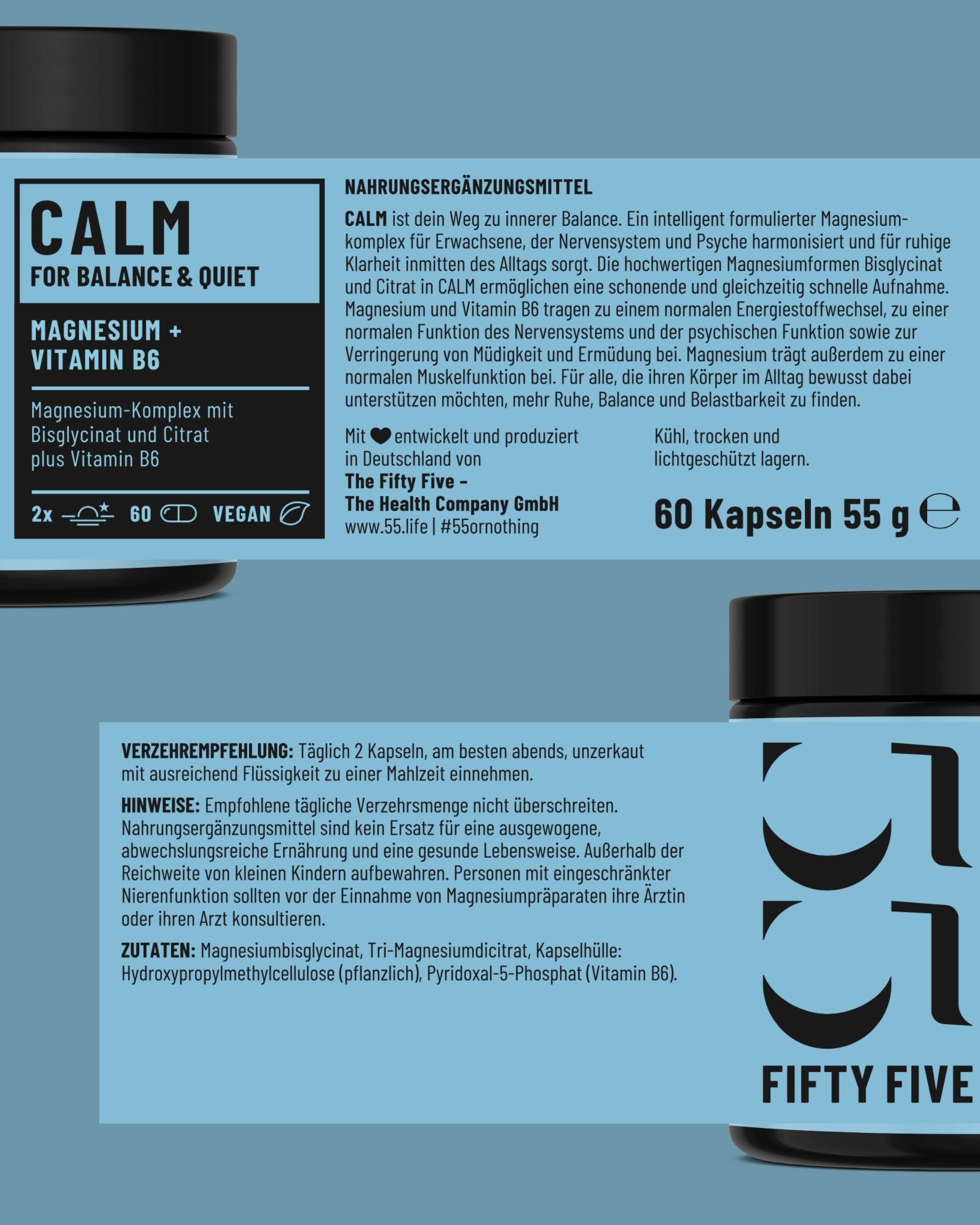
CALM by Fifty Five is designed precisely for this junction: as part of your evening and recovery routine, after the workday and your training session. CALM is not a sleep aid and does not replace sleep hygiene; it delivers a focused combination of magnesium bisglycinate, magnesium citrate, and vitamin B6 geared toward normal nervous system and muscle function and energy metabolism.
Magnesium and electrolytes when sweating
As soon as the sweat flows, you lose not only water but also electrolytes. Sodium dominates in sweat, joined by potassium, chloride, and smaller amounts of magnesium and calcium. How much you lose depends on duration, intensity, temperature, humidity, and your individual sweat rate.
Electrolytes in sports are minerals such as sodium, potassium, calcium, and magnesium that carry electrical charge in dissolved form and are important for normal nerve conduction, muscle work, and fluid balance.
In the short term, for example at a competition or hard interval session, the focus is often on fluids plus sodium and potassium, for example via sports drinks or salty snacks. Magnesium plays its role over longer periods: if you regularly sweat a lot, eat a one-sided diet, or follow restrictive diets, your daily supply can become tighter.
A simple rule of thumb:
-
For sessions up to about 60 minutes and moderate sweating, water is often enough, combined with an overall balanced diet.
-
For longer endurance sessions, heat, or tournaments, an electrolyte drink with sodium and possibly potassium can make sense.
-
Magnesium should be covered mainly across the day through diet and possibly supplements, not in very high single doses shortly before the start.
Needs, reference values, and special considerations for athletes
Reference values for magnesium indicate how much an average adult should take in per day to support basic bodily functions. Depending on country and sex, these recommendations are usually in the range of about 300-400 mg daily. They refer to the general population, not specifically to competitive athletes.
For athletes, the data is complex: on the one hand, sweat and higher metabolic activity can produce greater losses; on the other hand, the body adapts to load. A blanket "athlete dose" is therefore hard to justify scientifically. What makes sense is staying within the reference values, paying attention to a steady supply, and avoiding extreme under- or oversupply.
Magnesium needs for athletes: overview
| Group | Intake orientation | Special considerations |
|---|---|---|
| General adults | Stay within the usual reference values | Balanced diet, no special athletic loads |
| Recreational athletes | Aim for the reference range, steady intake | 2-5 sessions per week, watch sweat and diet |
| Intense training | Reference range, possibly at the upper end | High sweat losses, medical consultation for complaints |
This table is rough orientation only and does not replace medical advice. In the EU, a tolerable upper limit of 250 mg per day is often cited for additional magnesium from supplements, mainly because of possible digestive complaints at higher doses. How much fits you depends on body size, diet, kidney function, medications, and your overall situation.
If you are unsure, have underlying conditions, or take medications regularly, consult a doctor before using high-dose magnesium products. The recommended intake of a product, such as CALM, should not be exceeded without professional consultation.
A magnesium-rich diet for athletes: the best sources
Before thinking about supplements, take a look at your plate. Many athletes rely heavily on quickly available carbohydrates, white bread, light pastries, sweet snacks, sports drinks, and leave magnesium-rich foods at the margins.
Good magnesium sources include whole grains, nuts, seeds, legumes, green leafy vegetables, and certain mineral waters with higher magnesium content. In a sports-friendly diet, you can fit these building blocks in relatively easily without compromising your tolerance during training.
Sports-friendly foods with magnesium
| Food | Typical portion | approx. Mg content* | Practical note |
|---|---|---|---|
| Oatmeal | 50 g (1 serving of muesli) | approx. 60-70 mg | Ideal for breakfast with fruit and yogurt |
| Almonds | 30 g (small handful) | approx. 70-80 mg | Snack or topping for porridge/salad |
| Lentils (cooked) | 150 g | approx. 50-60 mg | Filling meal with protein and carbohydrates |
| Spinach (cooked) | 100 g | approx. 40-50 mg | Side for pasta, rice, or potatoes |
| Mineral water | 0.5 l (Mg-rich) | approx. 40-80 mg | Easy way to combine fluids and magnesium |
*Guide values; actual values vary by variety and product.
An example daily combination could be: oatmeal with nuts in the morning, a lentil dish at lunch, and vegetables with a whole-grain side in the evening. Plus a magnesium-rich mineral water spread across the day. That way, you already cover a large share of your recommended intake through diet.
Diet alone can fall short, however, if you restrict heavily (e.g. a dieting phase), eat many meals on the go, have intolerances, or eat very one-sidedly. In such phases, a structured base supplement like BASE by Fifty Five can help round out your daily micronutrient supply without extremely overemphasizing individual nutrients.
The right supplement: form, timing, and tolerability
Once diet and basic supply are in place, the question often remains: "Do I need additional magnesium, and if so, which form and when?" A sober look at forms, tolerability, and everyday practicality is worthwhile here.
Commonly used magnesium compounds include:
-
Magnesium oxide: high nominal magnesium content but lower bioavailability; can have a laxative effect with a sensitive gut.
-
Magnesium citrate: an organic form with good solubility, usually well absorbed, can also stimulate digestion at higher single doses.
-
Magnesium bisglycinate: a chelate compound of magnesium and the amino acid glycine, often described as well tolerated.
-
Other organic forms such as malate or lactate also occur.
For sports, the most important thing is finding a product you tolerate well, particularly around intense sessions. High single doses shortly before intervals or competitions are usually not a good idea, since gastrointestinal complaints are a risk.
Practical timing approaches:
-
Split the daily dose (e.g. morning and evening) instead of taking everything at once.
-
Keep a gap from intense training, especially if you tend toward a sensitive gut.
-
Evening intake can combine well with your recovery routine and products like CALM.
Vitamin B6 plays a role as a cofactor in normal protein and energy metabolism and for the nervous system and is often combined in magnesium products, as in CALM. The dose should stay in the moderate range; a "mega B-vitamin bomb" is neither necessary nor sensible.
If you want to compare forms in detail, such as magnesium bisglycinate vs. citrate or oxide, in-depth overviews like the detailed comparison of the most important magnesium forms will support you. In everyday life, what counts most is a steady, well-tolerated intake within the recommended amounts, not the hunt for the supposedly "perfect" form.
Why CALM by Fifty Five works well for athletes
CALM by Fifty Five was deliberately developed for the transition between everyday life, training, and recovery. The focus is on a few deliberately selected components instead of an overloaded complex.
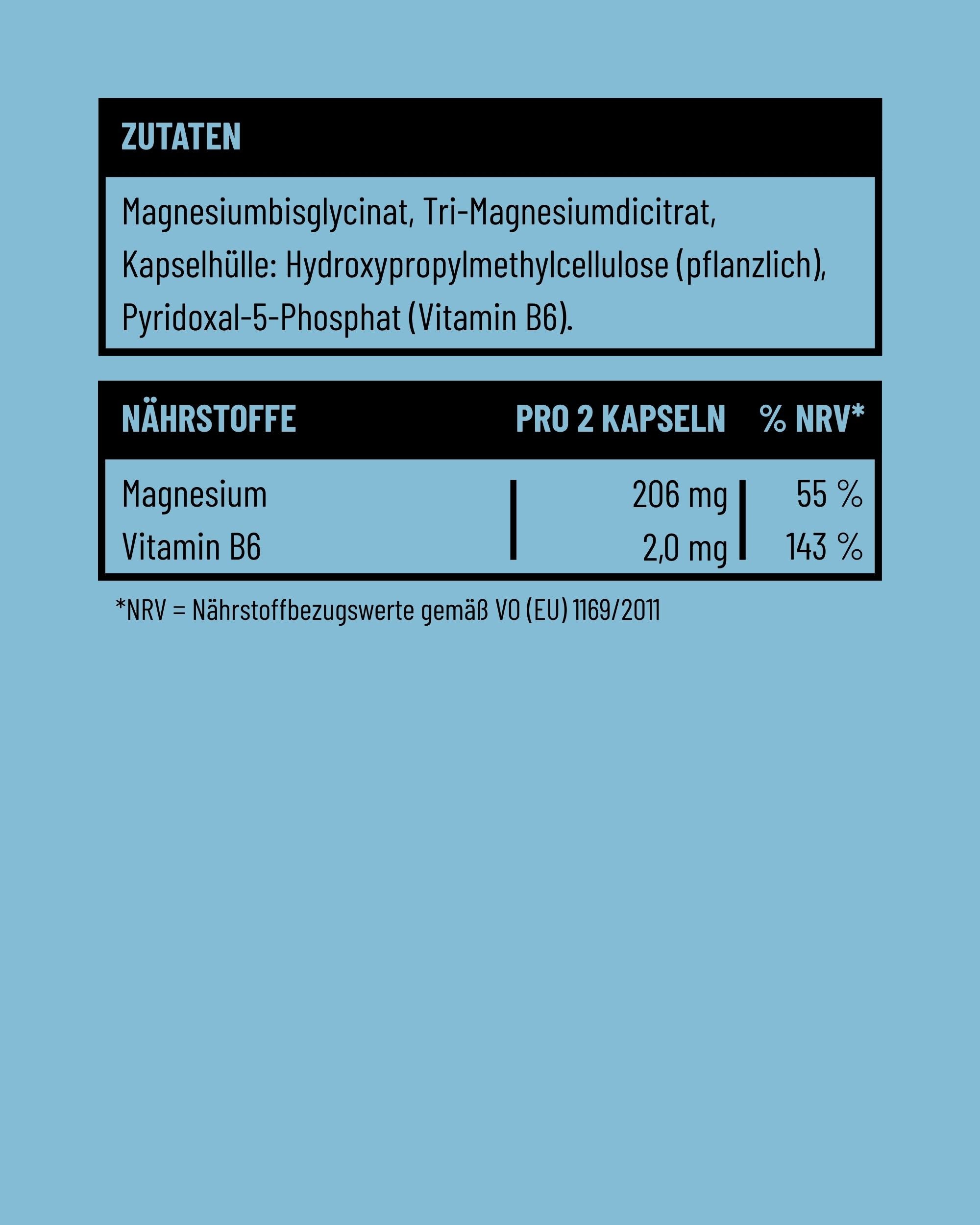
Magnesium bisglycinate (65%)
Magnesium bisglycinate is a chelate compound in which magnesium is bound to the amino acid glycine. This form is usually described as well tolerated and is particularly suited to a steady basic supply. In the context of CALM, it stands for the focus on normal nerve and muscle function. Especially in the evening, when your body should switch from activity to recovery.
Magnesium citrate (35%)
Magnesium citrate is an organic form with good solubility and relatively quick availability. In CALM, it complements the bisglycinate and addresses situations with regular athletic load, in which overall magnesium needs can be higher, without leaving the reference ranges.
Vitamin B6
Vitamin B6 contributes to normal protein and energy metabolism and to normal functioning of the nervous system. In CALM, it is moderately dosed to complement the magnesium combination, not to deliver a "B-vitamin booster."
The underlying principle: reduction instead of overload. Rather than adding twelve more ingredients, CALM concentrates on magnesium bisglycinate, magnesium citrate, and vitamin B6, with a clear use case: in the evening after your day, including your training session, as a building block of your recovery setup.
Within the Fifty Five system, CALM fits into a simple structure:
-
BASE as the daily foundation of vitamins and minerals for general basic supply.
-
RISE (D3/K2/E) and PULSE (omega-3) as complementary building blocks.
-
CALM, magnesium bisglycinate & citrate plus vitamin B6, as targeted support for your evening and recovery routine.
This lets you plan your micronutrient supply without needing a separate specialty product for every situation.
In practice: how to integrate magnesium sensibly into your training routine
The decisive question remains: how do you bring all this into your daily life between job, family, and 2-5 training sessions per week? The key is a simple, repeatable structure instead of complex protocols.
Strength and HIIT training
In strength training and HIIT, intensity and mechanical load are high, often compounded by strong activation of the nervous system. Many sessions take place after work, when you are already "switched on."
A possible daily structure:
-
Morning: breakfast with whole grains (e.g. oatmeal), the first portion of your magnesium base (diet plus supplement if needed).
-
During the day: drink enough, build in magnesium-rich snacks (nuts, mineral water).
-
Before training: easily digestible carbohydrates, no high magnesium single doses right before intense sessions.
-
Evening: the main share of your magnesium supplementation, for example with CALM, in a quiet phase after training and dinner.
That keeps your digestion calm during training, and you tie recovery, diet, and supplements to fixed anchors in your day.
Endurance and team sports
With longer runs, bike rides, or match days, sweat losses and repeated load come into play. Planning across several days helps here.
-
Preparation phase (days/weeks before): keep your diet steady with whole grains, legumes, vegetables, choose magnesium-rich mineral water, establish basic supplementation with products like BASE and possibly CALM.
-
Competition/match days: focus on carbohydrates, fluids, and electrolytes (especially sodium). Use magnesium in proven, well-tolerated amounts; do not experiment.
-
Recovery days afterwards: deliberately refill energy stores, get enough sleep, continue your magnesium routine, possibly use CALM in the evening.
This shifts your magnesium strategy away from "emergency pills" on race day toward a calm, predictable basic supply.
Late training sessions & office routine
If you sit at a desk during the day and train in the evening, stress, mental load, and sports are often bundled together. Many people then know the feeling of still being internally active long after the session.
A sensible structure can look like this:
-
During the day: micronutrient base with BASE, balanced meals, short activity breaks.
-
Before the late session: a light pre-workout snack, no very late caffeine.
-
After training: shower, a light meal, a quiet phase, then take CALM within your daily ration as a signal for "evening mode."
-
Sleep environment: darkness, little screen light, a consistent bedtime.
If you want to combine all this with further routines, deeper content like your complete recovery routine with sleep, light, and micronutrients helps round out the overall picture of environment, nutrients, and behavior.
Decision aid: choosing your next step
-
-
If you train without complaints and eat a balanced diet, a focus on diet and a simple micronutrient base is usually enough.
-
If you are often tired, "empty," or restless after training, a check of sleep, hydration, and magnesium intake is worthwhile.
-
If you regularly have cramps or severe complaints, medical evaluation and possibly lab work are a sensible basis before supplement experiments.
-
If you want a clear evening routine, CALM can be a structured building block in combination with BASE, RISE, and PULSE.
-
FAQ on magnesium, sports, cramps, and electrolytes
Should I take magnesium before or after training?
Magnesium supports normal muscle function and the nervous system, but it does not replace medical evaluation or individual training planning.
-
Stabilize normal muscle function and electrolyte balance across the day.
-
Sports, sweat, and diet determine when supplements make sense for you.
-
Always clarify other causes of complaints with a doctor.
-
Not intended as an acute measure for complaints during training.
If you react sensitively to magnesium, take it spread across the day or as part of your evening routine after training, and have timing and dosage checked medically if you are unsure.
Which magnesium makes sense for muscle cramps in sports?
Muscle cramps can have various causes, from overload and stretching issues to electrolyte shifts to orthopedic or internal matters. Magnesium products with well-tolerated organic compounds like citrate or bisglycinate are often suited to a regular basic supply. What matters is tolerability, steady intake, and the overall context of training, stretching, hydration, and diet.
Do I even need a magnesium supplement as a recreational athlete?
If you mostly eat fresh, varied, magnesium-rich food, sleep enough, and only sweat moderately, you can often cover your needs through food. A supplement can become sensible if you train a lot, sweat heavily, are dieting, or notice that your everyday diet regularly has "gaps." A structured basic supply like BASE plus a targeted product like CALM can then help without resorting to extreme doses.
Can I combine magnesium and electrolyte drinks?
Yes, in principle, because electrolyte drinks usually put sodium and possibly potassium front and center, while magnesium works more across the day. Take care not to use too many high-dose products in parallel and stick to the recommended intakes. With frequent use of electrolyte drinks and supplements, a look at the total intake and possibly a medical consultation is worthwhile.
How quickly will I notice an effect of magnesium on my recovery?
That is very individual and depends on how your supply was beforehand and which other factors you change (sleep, diet, training volume). Many processes magnesium supports, muscle function, the nervous system, energy metabolism, work over days to weeks, not in the sense of an acute "performance boost." Observe how you feel over several weeks and treat magnesium as part of an overall strategy rather than a quick fix.
What happens if I take too much magnesium?
Excessive magnesium intake from supplements can lead above all to digestive complaints such as soft stools or diarrhea. For this reason, the EU cites a recommended upper limit for additional magnesium from supplements. People with impaired kidney function or relevant underlying conditions should take magnesium only in consultation with a doctor. Stick to the product's recommended intake and avoid stacking high doses from multiple products in parallel.
Disclaimer:
This article is for informational purposes only and does not replace medical advice, diagnosis, or treatment by a physician or pharmacist. The information provided here should not be used for self-diagnosis or self-treatment. Food supplements are no substitute for a balanced, varied diet and a healthy lifestyle. For any health questions or complaints, please always consult a doctor you trust. Fifty Five accepts no liability for any inconvenience or harm resulting from the use of the information presented here.









Omega-3 After 50: Why Needs Rise and What That Means for Your Supply
What Belongs in a Good Multivitamin, and Why the Best One Deliberately Leaves Out Three Nutrients
Share: