


Magnesium is involved everywhere in your daily life: in normal muscle function, in the nervous system, in energy metabolism, and in electrolyte balance. That is why many people reach for magnesium. Because of stress, nighttime muscle cramps, restless sleep, or lots of sports. The question almost always behind it: "How much magnesium per day actually makes sense, and what is too much?"
The answer is not a fixed number but a range: your actual needs, what you achieve through your diet, and the official safety upper limit for supplements all have to fit together. On top of that, not every magnesium form behaves the same. Tolerability and speed differ noticeably.
In this article, you get a clear decision logic:
-
which reference values apply for daily needs
-
how much magnesium typically comes from food
-
how to derive a sensible supplement dose from that
-
at what point magnesium from supplements can become critical
By the end, you will be better able to judge whether your current dose fits your daily life, and why products like CALM by Fifty Five deliberately rely on a combination of magnesium bisglycinate and citrate at a moderate dose.
Quick definition: how much magnesium per day?
For healthy adults, about 300 to 400 milligrams of magnesium per day is considered sensible, with part coming from food and part from supplements.
-
Food delivers the main share; supplements fill the gap.
-
Official upper limits refer only to magnesium from supplements.
-
Always factor in tolerability and kidney function, especially at higher doses.
-
No treatment recommendation for diseases; seek medical advice for that.
If you are unsure whether your magnesium dose fits, start low, observe tolerability, and clarify higher doses with a medical professional.
Why the right magnesium dose matters
Magnesium contributes to normal muscle function, normal functioning of the nervous system, and normal energy-yielding metabolism. It also plays a role in electrolyte balance and the reduction of tiredness and fatigue. If you are heavily committed at work or at home, train a lot, or struggle to "come down" in the evening, magnesium is often one of the first topics that comes up.
You probably know the typical everyday situations: you work long hours at a screen, sleep restlessly, and reach for a magnesium product hoping for more relaxation. Or you do regular endurance or strength training, sweat a lot, and take magnesium to support your routine. Maybe you have been taking a product for a while and are now wondering: "Are the 300 mg on the package enough, or is that too little, or even too much?"
Underdosing can mean that despite a supplement, you do not meaningfully close the gap between needs and diet. You pay money without much changing in your supply. Unnecessarily high doses bring other problems: above all digestive complaints like soft stools or diarrhea, and in extreme cases safety questions. Especially if your kidney function is impaired or you take medications.
The difference between magnesium from food and from supplements also matters. Through your diet, you usually take in smaller amounts spread across the day. Supplements deliver higher amounts at once and in specific compounds. That makes dosing easy to control but also requires more awareness of upper limits and tolerability.
On top of that: not every magnesium form behaves the same in everyday use. Some compounds are well tolerated; others can have a laxative effect more quickly at higher doses. Products like CALM therefore deliberately combine different forms to bring together steady supply and quick availability. We will look at the details later.
So if you want to know whether your current magnesium dose makes sense, you need to keep three things in view at once: needs, diet, and supplement, and how the whole fits your daily life.
Daily magnesium needs: guide values for every stage of life
Before thinking about your magnesium dose, you need a reference point. By "daily needs," nutrition societies like the D-A-CH societies (Germany, Austria, Switzerland) mean a recommended intake at which most healthy people are well supplied. It is not about a minimum amount for survival, but a sensible daily orientation.
Needs for women, men, and adolescents
The exact numbers differ slightly between recommendations. In everyday life, knowing the order of magnitude is enough. The following table summarizes typical guide ranges for healthy people:
| Group | Magnesium (mg/day) | Note |
|---|---|---|
| Adult women (19-65 years) | approx. 300-320 | reference value for normal physical activity |
| Adult men (19-65 years) | approx. 350-400 | higher needs due to body mass |
| Adolescents (15-18 years) | approx. 330-400 | growth plus often lots of sports |
| Pregnancy | approx. 310-350 | slightly elevated needs |
| Breastfeeding | approx. 340-390 | supplying mother and child |
| Older adults (65+) | approx. 300-350 | similar needs, absorption can vary |
These values are guide ranges, not individual treatment plans. Your actual needs may be somewhat higher or lower depending on body weight, training volume, or particular life circumstances.
On supplement packaging, you often find an indication as a percentage of daily needs, usually as % NRV (Nutrient Reference Value). That is a blanket reference value for labeling and not always identical to the D-A-CH reference values. If a product contains, say, 150 mg of magnesium labeled as 40% NRV, that only means it covers 40% of a reference figure. The rest is supposed to come from your diet.
Increased needs with sports, stress, and pregnancy
Certain situations can also raise your needs somewhat without you automatically having a "deficiency":
-
intense sports and heavy sweating
-
pregnancy and breastfeeding
-
phases of high stress
Whether and when a magnesium deficiency is present is explained in detail in our guide.
At Fifty Five, we have chosen the dose of CALM so it is meant as a complement to your daily needs, not as your only magnesium source, but as a building block in your overall picture of diet and other products like BASE.
How much magnesium does your diet deliver?
Your most important magnesium source is your diet. Typical magnesium-rich foods include whole grains, nuts, seeds, legumes, some vegetables, and certain mineral waters. If your daily life is hectic and you often reach for quick snacks, this share quickly becomes smaller than you think.
A few examples for orientation (average values per portion):
| Food | Typical portion | Magnesium (mg) approx. |
|---|---|---|
| Oatmeal | 40 g (1 small bowl) | 50-60 |
| Almonds | 30 g (small handful) | 70-80 |
| Pumpkin seeds | 20 g | 70-80 |
| Whole-grain bread | 2 slices (approx. 100 g) | 50-70 |
| Cooked legumes | 150 g | 60-80 |
| Magnesium-rich water | 0.5 liter | 40-60 |
On a rather "average day" with white bread, little whole grain, hardly any nuts, and little vegetables, you often reach only part of the reference needs. A "magnesium-conscious day" with oatmeal for breakfast, whole-grain bread, legumes, some spinach or other vegetables, a handful of nuts, and a mineral-rich water can cover your needs considerably better.
Still, many factors influence actual absorption:
-
food quality and farming methods
-
preparation (e.g. cooking water that gets poured away)
-
individual eating habits and portion sizes
In practice, many people sit below the reference range without noticing. With a one-sided diet, lots of convenience food, or little whole grain, the gap can widen. This is exactly where magnesium supplements become interesting: not as a replacement for a good diet, but as a complement.
CALM is therefore designed as a complement to your diet. Deliberately moderately dosed, so you do not "steamroll" your dietary base but complement it sensibly. That leaves enough room to keep getting most of your magnesium from food.
Magnesium supplementation: closing the gap sensibly
Supplementing magnesium can make sense in many everyday situations without it being about treating diseases. Typical contexts are:
-
a one-sided or heavily restricted diet
-
high stress at work or in studies
-
intense endurance or strength training with heavy sweating
-
certain stages of life such as pregnancy, breastfeeding, growth, or older age
The key principle: you do not want to supplement your entire daily needs 1:1, but to close the gap between needs and diet. If you reach roughly 60-80% of your needs through food, relatively moderate additions are often enough.
A practical orientation frame for many healthy adults is:
-
Maintenance / light supplementation: about 100-200 mg of magnesium per day from supplements, in addition to diet.
-
Substantial supplementation: amounts up to the safe upper limit for supplements (see the section on the upper limit), ideally only in consultation with doctors or nutrition professionals.
How you start also matters. Many people do well beginning with a rather low dose, observing tolerability (especially bowel movements), and increasing slowly if needed. If you jump straight to very high amounts, the risk of digestive problems rises, particularly with certain magnesium forms.
For you as a user of Fifty Five products, this means: CALM is designed to fit within this supplementation corridor, meant as a daily companion that sensibly complements your diet, not as an aggressive high-dose regimen. Especially if you also eat a balanced diet or use other products like BASE, your total magnesium dose stays within a moderate, everyday-friendly frame.
Elemental magnesium vs. compound: what is on the label?
When you look at a magnesium package, you often read names like "magnesium bisglycinate" or "magnesium citrate." Behind these stands a compound of magnesium and a carrier substance. Elemental magnesium is the share of pure magnesium in this compound, meaning what your body actually receives as magnesium ions.
Some important everyday forms:
-
Magnesium bisglycinate
A chelated form in which magnesium is bound to the amino acid glycine. It is considered well tolerated and is often used for the daily routine, including in the evening when you want to settle down. -
Magnesium citrate
A highly soluble compound, often with quicker availability. It is popular around athletic exertion. At higher single doses, however, it can lead to softer stools or diarrhea in sensitive people. -
Magnesium oxide
Contains a lot of elemental magnesium per gram but is comparatively less available. At higher doses, the risk of digestive problems rises considerably.
There are also other compounds like magnesium malate, lactate, or taurate that can appear in everyday products. The basic logic remains: form, solubility, and binding determine how much actually arrives in the body and how well you tolerate the dose.
This explains why the mg figure alone often falls short. 300 mg of magnesium oxide behaves differently in the body than 300 mg of magnesium bisglycinate. If you only look at the number without considering the form, you are comparing values that are not functionally identical.
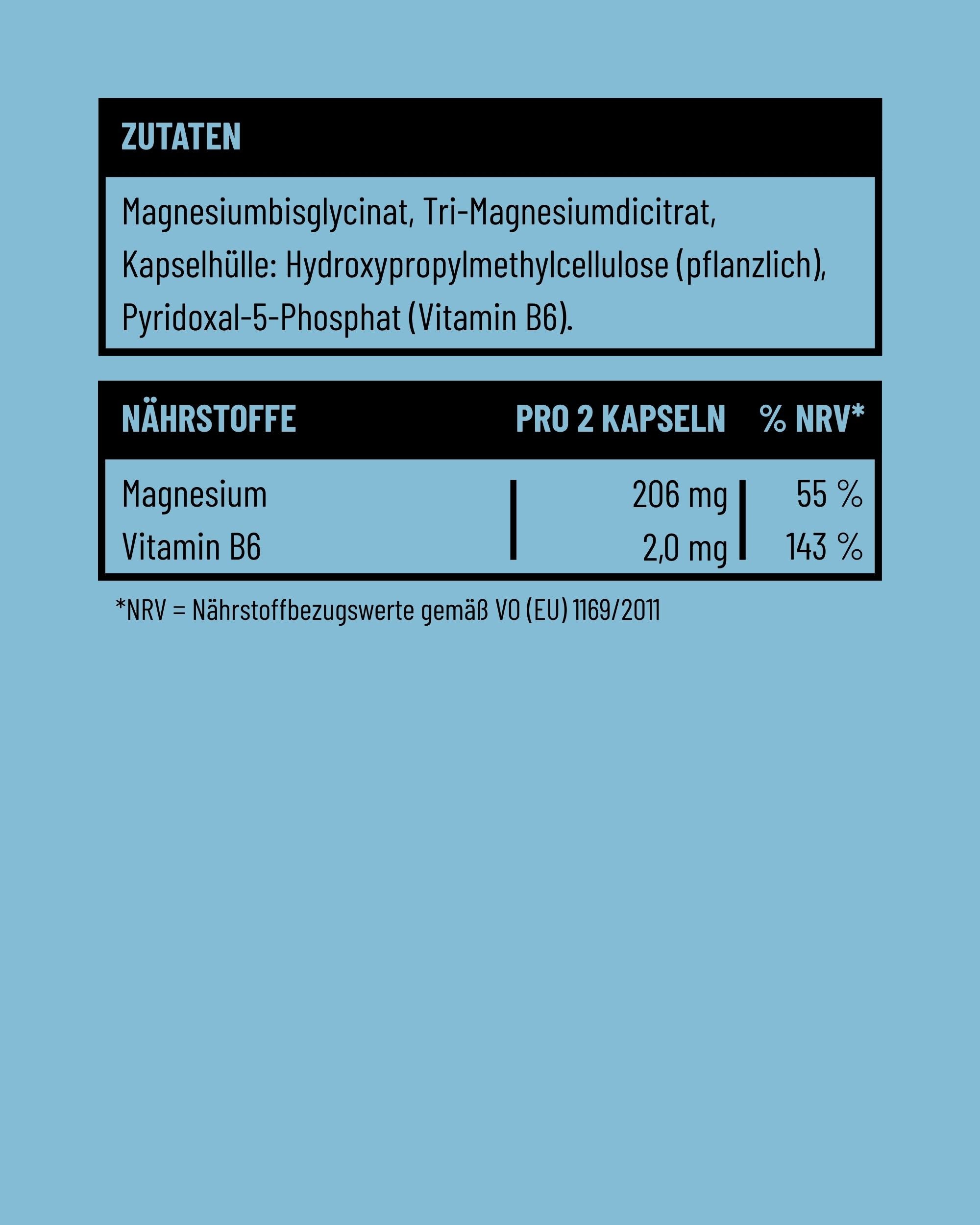
CALM deliberately relies on a combination of magnesium bisglycinate (approx. 65%) and magnesium citrate (approx. 35%) plus vitamin B6:
-
the high bisglycinate share aims at tolerability and a routine-friendly intake, including in the evening
-
the citrate share delivers a highly soluble, quickly available component. Useful, for example, in connection with sports or demanding days
-
vitamin B6 complements the formula in a synergy context without overloading the recipe with many additional forms
The dose stays moderate, so you combine magnesium forms without sliding into problematic ranges with any single compound. Form and dose are designed together here: not "as much as possible," but "matched to everyday life and safety."
Upper limit & safety: when does magnesium become critical?
For safety, the source of the magnesium plays a central role. Magnesium from foods like whole grains, nuts, or vegetables has practically no relevant upper limit in everyday life. Your body normally regulates absorption and excretion well as long as the kidneys are healthy.
The EFSA tolerable upper intake level (UL)
It is different for magnesium from supplements and fortified foods. Here, the European Food Safety Authority (EFSA) works with a so-called tolerable upper intake level (UL), a tolerable daily maximum at which no negative effects are expected in healthy people. For magnesium from supplements, this value for adults is around 250 mg of elemental magnesium per day in addition to diet.
The tolerable upper intake level (UL) describes the permanently tolerable daily maximum of a nutrient from supplements at which no health risks are expected.
Typical signs that your magnesium dose is too high are, with healthy kidneys, primarily digestive reactions:
-
soft or mushy stools
-
diarrhea
-
sometimes abdominal cramps
That is unpleasant but usually reversible in healthy people as soon as you reduce the dose or choose a different form. A true magnesium overdose (hypermagnesemia), meaning excessively high magnesium levels in the blood, is very rare with normal kidney function and usual doses, and is more of a concern with severely impaired kidney function or extremely high medical doses.
Particular caution applies to:
-
people with impaired kidney function or kidney disease
-
people taking medications that affect electrolyte balance or kidney function
-
people using several magnesium-containing products in parallel
Doses significantly above the UL should only be used under medical supervision, for example as part of a medically prescribed treatment. For everyday supplementation: plan your dosing so that, across all your products combined, you stay below this limit, especially if you react sensitively to digestive changes. How side effects like diarrhea can manifest with overdosing is covered in a dedicated guide.
CALM by Fifty Five is therefore designed so that the recommended daily dose stays within common safety considerations. The goal is an everyday-friendly, long-term usable supplement, without deliberately "pushing the limit" or chasing short-term high-dose effects.
Brief summary: at what dose does magnesium from supplements become critical?
For healthy adults, up to about 250 milligrams of magnesium per day from supplements is considered uncritical; higher amounts should only be used in consultation with professionals.
-
-
Magnesium from food has no practical upper limit in everyday life.
-
The UL consideration refers to additional magnesium from supplements.
-
Kidney function and tolerability are decisive, especially with long-term use.
-
No treatment recommendation; always seek medical advice for diseases.
-
If you combine several products or use high doses long term, add up the amounts and have your strategy checked by a medical professional.
How to find your right magnesium dose
Theory helps, but in everyday life you need a simple decision logic. You can derive your magnesium dose in a few steps without immediately determining blood values or memorizing tables.
Step 1: Assess your diet
Ask yourself honestly: do you regularly eat whole grains, legumes, nuts, seeds, and vegetables? Do you occasionally drink magnesium-rich mineral water? If your answers are rather hesitant, it is likely you are not fully covering your reference needs through food.
Step 2: Check reference needs and life stage
Use the guide values from the table and place yourself: adult woman, adult man, adolescent, pregnancy, breastfeeding, or older age. Intense sports or high stress can be a further argument for somewhat higher supplementation. For deeper background, you can later read up on which constellations are particularly relevant in a guide on signs of magnesium deficiency.
Step 3: Choose a starting dose
For many people, a starting dose in the range of about 100-200 mg of magnesium per day from a supplement works well. This amount complements the diet without exhausting the safety upper limit for supplements. In the first days, watch your digestion in particular.
Step 4: Adapt timing to your daily life
You can generally take magnesium in the morning, in the evening, or spread across the day. Many use magnesium in the evening as part of an evening magnesium routine; others prefer taking it after sports. What matters most is regularity. If you tend to forget supplements, plan a fixed time.
Step 5: When to involve professionals?
If persistent everyday symptoms like frequent muscle cramps, strong tiredness, or concentration problems concern you, take a look at dedicated content like "Recognizing magnesium deficiency: causes, signs & what you can do". At the latest with pre-existing conditions, medications, plans to conceive, pregnancy, or the wish for higher doses, discuss your strategy with doctors or nutrition professionals.
Checklist: 5 steps to your right magnesium dose
-
-
Honestly assess your diet: magnesium-poor or magnesium-conscious?
-
Roughly place your reference needs and life stage.
-
Start with a low supplement dose, e.g. in the evening.
-
Observe tolerability and everyday symptoms over a few weeks.
-
Seek medical advice when unsure or at higher doses.
-
CALM fits this scheme well: rather in the evening or after demanding days, at a dose you can combine with other building blocks like BASE as needed, without overloading your overall strategy.
The Fifty Five dosing philosophy: safe & combinable
If you use several Fifty Five products or are considering them, the question "How does this all fit together?" plays an important role. The product architecture follows a clear logic: foundation first, then targeted additions without a dosing competition between products.
BASE forms the daily foundation for minerals and vitamins. The idea behind it: set up your basic supply broadly yet clearly formulated, without ending up with a hopelessly overloaded product. Beyond that, you can add and stack in a targeted way, for example with magnesium via CALM.
CALM is the magnesium-centered product in the range. Its role: to accompany you in switching off after the day, in recovery, and in sports-adjacent routines. Without promises of healing, but with focus on the areas where magnesium plays a role (e.g. muscle function, nervous system, energy metabolism). The combination of magnesium bisglycinate, magnesium citrate, and vitamin B6 is deliberately lean and designed for synergy rather than as many forms as possible.
RISE and PULSE occupy other pillars: RISE concentrates on vitamins D and K, PULSE on omega-3 fatty acids. These products do not compete with magnesium for the same "dosing space" but complement the overall picture of your supply. So you need to worry less about unknowingly high-dosing the same nutrient several times.
In summary:
-
-
BASE: foundation of minerals and vitamins for everyday life
-
CALM: magnesium focus, relaxation, recovery, sports-adjacent
-
RISE: focus on the vitamin D/K pillar
-
PULSE: focus on the omega-3 pillar
-
The dosing philosophy behind it: safe, everyday-friendly, combinable. No overload formulas, no competition for the same nutrient across multiple high-dose products, but a system in which you can combine building blocks deliberately.
Your decision overview
-
-
If you eat a mostly balanced diet and only want light supplementation: orient yourself toward moderate amounts around 100-200 mg from supplements.
-
If your diet is rather magnesium-poor: check how to adjust your foods first, then supplement with a well-tolerated product in a targeted way.
-
If you train intensively or sweat heavily: use supplements as a complement and stay below the upper limit for magnesium from supplements across all products.
-
If you combine several Fifty Five products: see CALM as the magnesium building block and BASE, RISE, PULSE as complementary pillars, not competition.
-
If you have pre-existing conditions, medications, or want higher doses: always make dosing decisions together with a medical professional.
-
FAQ on magnesium dosage
How much magnesium per day is sensible?
For most healthy adults, about 300-400 mg of magnesium per day is a sensible guide range, depending on age and sex. A substantial share should come from magnesium-rich foods. In addition, moderate amounts from supplements can be used as long as the supplement upper limit of about 250 mg per day is not exceeded.
Can you take too much magnesium?
Yes, especially through supplements the dose can become too high. The first signs are usually digestive problems like soft stools or diarrhea, particularly in sensitive people. Anyone permanently above the supplement upper limit or with kidney disease should definitely clarify their intake with doctors.
How long can I take magnesium?
A moderate magnesium supplement can usually be used over longer periods in healthy people, for example as part of a daily routine. What matters is a sensible total amount (including diet), good tolerability, and a clear role for the product in your supply concept. With pre-existing conditions, medications, or high doses, medical supervision makes sense.
When is the best time to take magnesium, morning or evening?
Whether morning or evening is less important than regularity. Many people take magnesium in the evening because they connect it with relaxation and sleep rituals; others prefer taking it after sports. Test which time integrates best into your daily life and watch your individual tolerance.
How much magnesium is really in "X mg of magnesium citrate"? (Elemental Mg)
Magnesium citrate is a compound of magnesium and citric acid; only part of it is elemental magnesium. Depending on the exact compound, magnesium citrate contains roughly 15-16% magnesium. 300 mg of magnesium citrate thus delivers approximately 45-50 mg of elemental magnesium; the exact figure should be on the package.
→ To the complete magnesium guide
Disclaimer:
This article is for informational purposes only and does not replace medical advice, diagnosis, or treatment by a physician or pharmacist. The information provided here should not be used for self-diagnosis or self-treatment. Food supplements are no substitute for a balanced, varied diet and a healthy lifestyle. For any health questions or complaints, please always consult a doctor you trust. Fifty Five accepts no liability for any inconvenience or harm resulting from the use of the information presented here.
Sources
- EFSA. Scientific Opinion on Dietary Reference Values for magnesium. EFSA Journal 2015;13(7):4186.
- German Nutrition Society (DGE). D-A-CH reference values – magnesium.
- German Federal Institute for Risk Assessment (BfR). Maximum levels for vitamins and minerals in food supplements.
- European Commission. EU Register of nutrition and health claims.










Out of the Supplement Jungle: How Clara Found Her Vegan Foundation
Taking a Multivitamin Daily: Sensible or Too Much?
Share: