• Angenehm kleine Kapsel und sehr gut verträglich. Ich habe gefühlt mehr Energie im Alltag. Klare Empfehlung, ich bestelle wieder.

    Markus J. Verified purchase

  • Wirkt hochwertig und ist easy in den Alltag einzubauen. Für mich mittlerweile fester Bestandteil jeden Morgen.

    Anna L. Verified purchase

  • Ich liebe diese kleine Kapsel. Hab sonst leicht Schluckprobleme bei Kapseln, bei dieser überhaupt nicht.

    Lena S. Verified purchase

For Light & Strength

For immune system, bones and muscles, all year round

Vitamin D deficiency is not the exception in Germany, it is the rule, as in most European countries. Between October and March the skin produces hardly any vitamin D of its own, and even in summer most people spend the bright hours indoors.

So for most people, supplementing makes sense. The only question is how: most D3/K2 products solve it with oils, emulsifiers and synthetic carriers. RISE solves it with a micro powder capsule: clean, bioactive, no artificial additives. 2,000 IU vitamin D3, 100 µg vitamin K2 as all-trans MK-7 and natural vitamin E.

Read more in the journal: Vitamin D3 and K2: What You Need Them For and Why They Belong Together →

The difference

How RISE compares

D3 doesn’t work on its own. It takes K2 and a dependable dose to turn intake into actual supply.

Comparison with typical products in each category. Individual products may differ.

Compare with
RISE
D3 oil drops Drops
High-dose D3 High­dose
D3 + K2 + E combined in one formula

Vitamin K contributes to the maintenance of normal bones, vitamin E protects cells from oxidative stress. Single-nutrient products cover only part of that.

K2 as MK-7, 100 % all-trans

MK-7 stays available longer than short-chain K2 forms. The all-trans form is the biologically active one, cis fractions contribute nothing.

No liquid oil or emulsifiers (MCT-based powder)

RISE is a micro powder capsule: the MCT carrier keeps the fat-soluble vitamins in powder form, with no liquid oil and no emulsifiers.

An exact dose per capsule instead of counting drops

With drops, the dose depends on how carefully you count and how full the pipette is. One capsule is one dose.

Dosed to actual need, no weekly or monthly boluses

A steady intake is easier to keep up day to day than occasional high doses.

Vegan micro capsule, easy to swallow

Capsule shell made from plant cellulose, noticeably smaller than a standard capsule.

Around €0,25 per day

One capsule every two days, the pack lasts 120 days.

  • applies
  • partly / depends on the product
  • typically not

The formula

Every ingredient, in its active form

Three fat-soluble vitamins in a micro powder capsule, with no liquid oil and no emulsifiers. Why we formulated RISE exactly this way.

Vitamin D3: Cholecalciferol

Vitamin D is a fat-soluble vitamin the skin produces in sunlight. It contributes to the maintenance of normal bones and to normal muscle function.

D3D2
Bioavailable form
Why it matters

Between October and March the sun sits too low in Germany for the skin to produce enough vitamin D on its own. With D3 we supply it in exactly the same form the body otherwise makes itself.


Vitamin K2: Menaquinone-7, all-trans

Vitamin K is a fat-soluble vitamin that activates proteins which bind calcium. It contributes to the maintenance of normal bones.

MK-7MK-4
Bioavailable form
Why it matters

K2 is in RISE because of the D3: vitamin D contributes to the normal absorption of calcium, and vitamin K activates the proteins that bind it. We use MK-7 in its all-trans form because it stays available in the blood far longer than short-chain K2 forms.

Vitamin E: D-alpha-tocopheryl acetate

Vitamin E is a fat-soluble vitamin that embeds itself in the cell membrane. It contributes to the protection of cells from oxidative stress.

1 natural 7 others
Bioavailable form
Why it matters

For us, vitamin E counts as a nutrient in its own right, and we use only the natural variant, of which the body takes up more than from the synthetic mixture.

Nutrients and ingredients

What is inside

Nutrientsper 1 capsule% NRV*
Vitamin D350 µg = 2,000 IU1,000%
Vitamin K2 (MK-7)100 µg133%
Vitamin E8 mg67%

*NRV = Nutrient Reference Values according to Regulation (EU) No. 1169/2011

Ingredients

MCT-Öl-Pulver (mittelkettige Triglyceride aus Kokos), Kapselhülle: Hydroxypropylmethylcellulose (pflanzlich), D-α-Tocopherylacetat (Vitamin E), Cholecalciferol (Vitamin D3), Menachinon-7 (Vitamin K2, all-trans).

Hand hält eine kleine weiße RISE Micro-Kapsel zwischen Daumen und Zeigefinger

The capsule

A micro capsule with a functional carrier

D3 and K2 are fat soluble and need a carrier. The usual answers are oils with emulsifiers, or large capsules where tiny amounts of active ingredient are padded out with filler. Here MCT powder does that job, and the capsule stays small.

Format
Micro capsule, our smallest. This small because nothing is padded out.
Intake
One micro capsule every two days.
When
In the morning or at lunchtime, with a main meal.
Shell
100 % vegan: capsule shell made from plant based cellulose (HPMC).

Your new daily routine

What changes for you in 90 days

Vitamin D is the vitamin your skin makes from sunlight. Only that sunlight arrives less often than you might think: in winter the sun sits too low, in summer you spend most of the bright hours indoors, and the further north you live, the less you get in general. RISE makes you independent of all that: your supply no longer depends on whether it is July or January outside.

  1. Day 1 The first capsule

    One micro capsule with breakfast or lunch, that is all. D3 comes in the same form your skin produces in sunlight, plus K2 as all-trans MK-7 and natural vitamin E. The easiest start in the whole range: the smallest capsule we have.

  2. Day 21 The level rises

    Three weeks, and the capsule is a fixed part of the meal. Your liver converts vitamin D into 25(OH)D, the value a blood test measures. And that value now rises continuously, whether the sun is shining outside or not. You will not feel it directly, but you can see it: get tested now and watch the value climb.

  3. Day 60 Arrived

    After two months your level has reached its plateau, intake and use are now in balance. This is the state RISE is made for: bones and muscles that are well supplied, defences that run at one level all year round, and a body that gets going in January just as it does in July.

  4. Day 90 Your new normal

    Three months, and the jar is not empty yet: 60 capsules last up to 120 days. Welcome to your new normal: a supply that no longer swings with the seasons. Many only notice how much that is worth when they pause. So: do not pause. Keep your routine running, summer and winter alike.

    Secure your supply1 jar · up to 120 days

Change takes time

60 to 90 days, to be precise.

First the supply: the body stores vitamin D in fat tissue, which is why RISE gets by with few capsules. The level rises over weeks and reaches its plateau after two to three months. Until then your account builds up capsule by capsule.

Then the routine: the bigger part of the change happens in your head. A new regular action takes 66 days* on average before it runs automatically. Until then the capsule is a resolution you make anew each time. Around day 60 it becomes a habit, from day 90 it is simply part of your meal.

90 days, that is your path from the first resolution to the new normal, and one jar lasts beyond that.

* Lally et al., European Journal of Social Psychology 2010: 66 days on average.

What RISE supports you with

  • Immune system Vitamin D contributes to the normal function of the immune system.
  • Bones Vitamin D and vitamin K contribute to the maintenance of normal bones.
  • Muscles Vitamin D contributes to the maintenance of normal muscle function.
  • Calcium Vitamin D contributes to normal absorption and utilisation of calcium.
  • Cell protection Vitamin E contributes to the protection of cells from oxidative stress.

Morning to evening

Complete your day

RISE brings light into the day. BASE, PULSE and CALM carry the rest.

Build your own routine: choose which Essentials belong to your day and how long your supply should last. From three Essentials you save, with a bigger supply even more.

  1. Morning
  2. Midday
  3. Evening
Your advantage: 10 % You save €11,26
Total €112,96€101,70 just €2,72 per day

incl. VAT Free shipping

No code needed, the advantage is already deducted in your cart.

All four in the Essential Bundle: −10 %, 60-day supply −12 %, 90-day supply −15 %.

Georg, the Founder of Fifty Five in a close-up portrait
Quote Icon

90 days are a promise you make to yourself. Here is mine: I believe real quality does not need explaining, it shows in what it does. That is why every jar holds only what your body really needs, and nothing that burdens it. No hidden additives, no gimmicks, no mediocrity. Just a clear formula, day after day. For you and for me, only one thing counts: #55ornothing.

— Georg Roscher, founder of Fifty Five

Answers to the most important questions

FAQ

Is RISE the right product for me?

RISE is ideal for anyone who wants their immune system, bones and muscles well supplied all year round, especially in the months with little sun or when needs are higher.

Can I combine RISE with other products?

Yes, RISE combines perfectly with our other Daily Essentials: PULSE, our omega-3, CALM, our magnesium, and our multivitamin BASE. All Daily Essentials products were developed and coordinated so they can be stacked perfectly.

Can you take vitamin D3 and K2 together?

Yes, and that is exactly why both are combined in RISE. Vitamin D contributes to normal absorption and utilisation of calcium, vitamin K to the maintenance of normal bones and to normal blood clotting. Both vitamins are fat-soluble and can easily be taken together with a meal. One exception: if you take blood thinners of the vitamin K antagonist type (e.g. phenprocoumon or warfarin), discuss vitamin K intake with your doctor first.

Read more in the Journal: Vitamin D3 and K2: What You Need Them For and Why They Belong Together

How much vitamin D3 per day makes sense?

The German Nutrition Society gives an estimated requirement of 20 µg (800 IU) per day when the skin produces no vitamin D. The European Food Safety Authority considers up to 100 µg (4,000 IU) daily safe for adults. RISE contains 50 µg (2,000 IU) per micro capsule. With our recommended intake of one capsule every two days, you average 25 µg (1,000 IU) per day: an amount that meaningfully complements your body's own production and stays at a quarter of the EFSA upper limit. Higher doses only make sense if a blood test (25-OH vitamin D) shows a deficiency, and then in consultation with your doctor.

Read more in the Journal: How Much Vitamin D Per Day? Daily Needs, 1,000 or 2,000 IU and the Upper Limit

Why only one capsule every two days?

Because vitamin D is fat-soluble and your body stores it. That is why the level in your blood changes only slowly, with a half-life of around two weeks. One micro capsule with 2,000 IU every two days averages 1,000 IU a day, a quarter of the EFSA upper limit of 100 µg, and stays far away from the weekly and monthly megadoses that fared worse in studies. The vitamin K2 in RISE is also the long-lasting MK-7 form, which stays available in the blood for days. The side effect: 60 micro capsules last up to four months.

Read more in the Journal: Vitamin D Overdose: Symptoms, How Much Is Too Much and What Helps

What is vitamin K2 MK-7 and why “all-trans”?

Vitamin K2 comes in several variants. MK-4 is short-chain and disappears from the blood within a few hours. MK-7 is long-chain and stays available in the blood for several days. That is exactly why MK-7 suits an intake every two days. “All-trans” describes the natural, biologically active molecular form. Cheap raw materials often contain a share of the cis form, which the body cannot use. RISE contains 100 µg of MK-7 at 100 % all-trans. Vitamin K contributes to the maintenance of normal bones.

Read more in the Journal: Vitamin K2: What You Need It For, Where It's Found, and Why MK-7

Should I take vitamin D in summer too?

Between October and March the sun in Germany is too low for the skin to produce vitamin D on its own. During this period supplementation makes sense for most people. In summer, the body's own production is often sufficient if you regularly spend time in the midday sun with your face and arms uncovered. But if you mainly work indoors, consistently use sunscreen, have a darker skin type or are older, you also produce less in summer. That is why many people take RISE all year round, while others pause from May to September. A blood test (25-OH vitamin D) gives you clarity.

Read more in the Journal: Vitamin D from the Sun: How Long You Need Outside and Why Winter Isn't Enough

From the journal

Vitamin D3 / K2

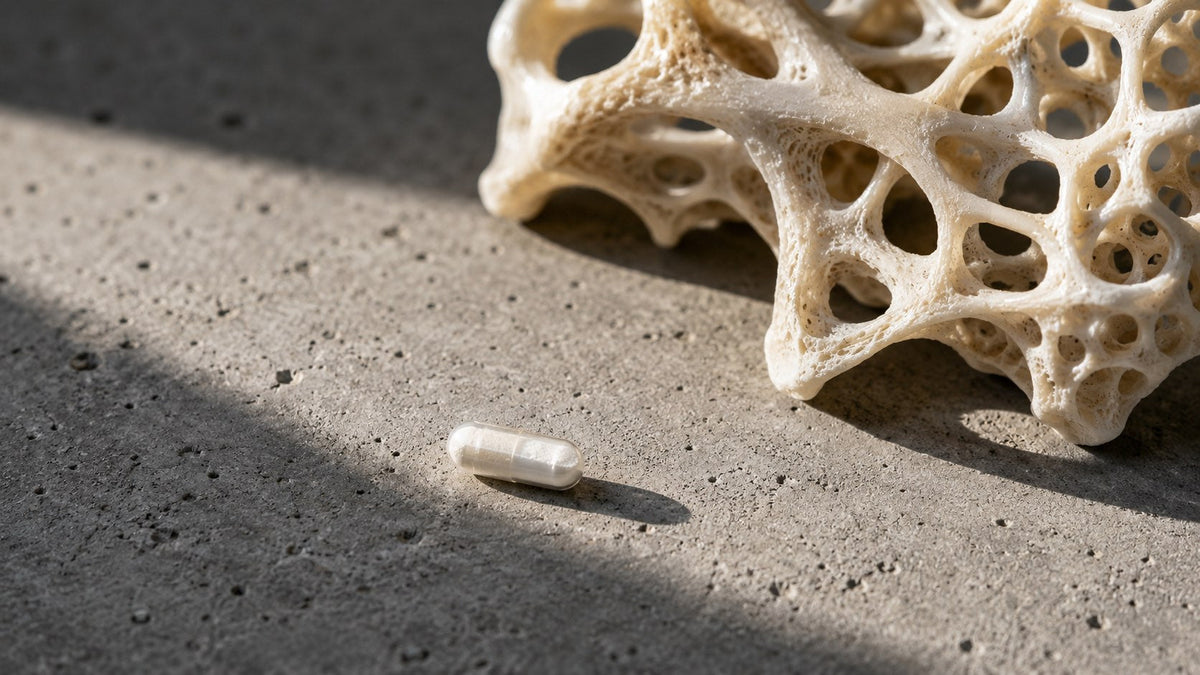
Kleine transparente Micro-Kapsel mit weißem Pulver neben knöcherner Struktur, Symbolbild für den Vitamin-D-Wert im Blut

Vitamin D Levels: Normal Range, Testing and What the Blood Test Costs

Your lab report says 60 nmol/l, with an asterisk next to it. Depending on the lab, the same value is either sufficient or too low, and since 2024 the Endocrine Society no longer names a target level at all. Here is what you can still go by when you look at your vitamin D level.

Read more

Tief stehende Wintersonne am Fenster, Symbolbild für Vitamin D aus Lebensmitteln und Sonne

Foods High in Vitamin D: Table with µg per Serving

Two eggs at breakfast give you just under 3 µg of vitamin D, so to reach the 20 µg set by the German Nutrition Society, you would need 14 to 20 of them. One serving of salmon gets you there almost on its own. Why everyday eating still almost never covers it is shown in our table per serving.

Read more

Kleine transparente HPMC Micro-Kapsel mit weißem Pulver liegt in einer glatten goldgelben Ölfläche mit feinem Lichtspiel.

Vitamin E and the Fat-Soluble Vitamins: What E Is Good For and Why It Fits with D3 and K2

Since 2024, the German Nutrition Society has put vitamin E needs at just 8 mg a day, while many guides still quote the old 11 to 15 mg. A small handful of almonds covers four fifths of that. With supplements, the real question is whether your body can use all of it or only half.

Read more

Skulpturale knöcherne Struktur im warmen Licht als Symbol für den Erhalt der Knochendichte durch Vitamin K2.

Vitamin K2: What You Need It For, Where It's Found, and Why MK-7

An aged Gouda gives you around 65 µg of vitamin K2 per 100 g, a Parmesan next to nothing. The difference between supplements is even bigger, because one form of K2 is still in your blood days later while the other is gone within hours. Which one is in yours, the label will tell you.

Read more

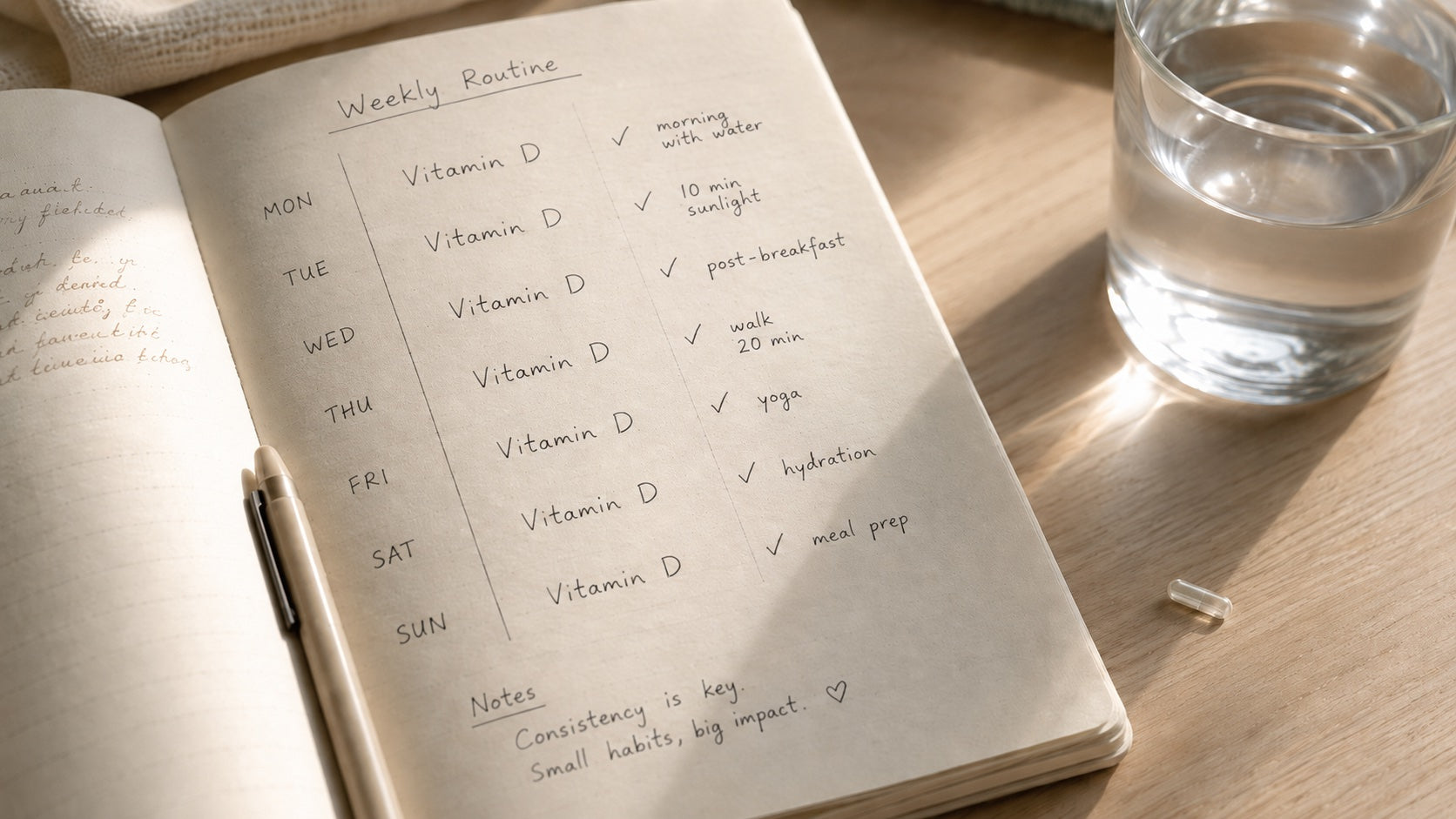
Handgeschriebener Wochenplan mit täglicher Vitamin-D-Routine neben Glas Wasser und kleiner Micro-Kapsel.

How Much Vitamin D Per Day? Daily Needs, 1,000 or 2,000 IU and the Upper Limit

In a large study, almost 26,000 people took 2,000 IU of vitamin D a day for five years, and their calcium didn't run high any more often. For supplements, Germany's BfR still proposes just 800 IU. So how does that fit together, and which number applies to you?

Read more

Winterliche Fensterlandschaft mit tief stehender Sonne als Symbol für Vitamin-D-Bildung im Winter.

Vitamin D from the Sun: How Long You Need Outside and Why Winter Isn't Enough

In December, the midday sun over Hamburg sits just 13 degrees above the horizon, so even a two-hour walk does next to nothing for your vitamin D. In summer, a few minutes on your face and arms are enough, and sunscreen gets in the way less than most people think.

Read more

Frau Ende 40 steht in hellem Tageslicht am Fenster als Symbol für Vitamin D und weibliche Gesundheit.

Vitamin D for Women: Deficiency Symptoms, Pregnancy and Menopause

Women need just as much vitamin D as men, and that holds during pregnancy too. Even so, more than every second woman aged 18 to 45 was short on it in a nationwide German survey. Why that matters before a pregnancy and in menopause comes down to time.

Read more

Frau Anfang 30 nimmt eine Kapsel Vitamin D3/K2 zu einer Mahlzeit mit Glas Wasser ein.

When to Take Vitamin D: Morning or Night, With or Without Food?

"50% more vitamin D than on an empty stomach" is what many guides say as soon as taking it with food comes up. The thing is, nobody in the study behind it measured anything on an empty stomach. So what really matters for your capsule: the time of day, the fat or something else entirely?

Read more

Viele transparente Vitamin-D Micro-Kapseln mit weißem Pulver fallen auf porigen Beton als Symbol für Überdosierung.

Vitamin D Overdose: Symptoms, How Much Is Too Much and What Helps

Yes, you can overdose on vitamin D, just not from sunlight or food, and not overnight either. The cases doctors in Germany have reported involved 10,000 IU a day or more, over months. The first signs are usually tiredness, nausea and strong thirst.

Read more

Mann Ende 40 steht an einem Fenster mit Glas Wasser und blickt in gedämpftes Morgenlicht.

Vitamin D Deficiency: How to Spot the Symptoms, Understand the Causes, and What to Do

Been feeling tired for weeks? In a trial in Zurich, 72% of tired participants who were low in vitamin D felt less exhausted after a single dose, compared with only 50% on placebo. Whether that's your reason too isn't something any symptom will tell you, though. A very specific number will.

Read more

Kleine transparente HPMC Micro-Kapsel mit weißem Pulver zwischen Knochenstruktur, Licht und wissenschaftlichen Elementen.

Vitamin D3 and K2: What You Need Them For and Why They Belong Together

80 to 90% of your vitamin D is made by your own skin, provided the sun actually reaches it. And around here, that happens less often than you might think. What helps then, and why so many jars also list K2, is something we sort out for you here.

Read more