If you have any questions, please feel free to contact us at any time. We will get back to you as soon as possible, usually within 24 hours on business days.
If you have specific questions about our products or how to take them, please contact our support team at any time. We usually respond to inquiries within 24 hours on business days.
We have compiled a list of the most frequently asked questions and answers from all of our customers for you here: FAQ
Contact us
For all other questions and matters, please contact us at support@55.life. We will usually respond to your inquiry within 24 hours on business days.
For Energy & Resilience
Your foundation for energy and resilience
BASE is your daily foundation of micronutrients: precisely dosed to daily needs, no megadoses, well below the EU upper limits, and easily absorbed.
You don’t live in a lab. You live in the real world. With irregular meals, pressure to perform, and little time for perfection. BASE isn’t an “all-in-one miracle” or a high-dose supplement that promises to do it all. It’s a well-thought-out basic supplement containing 16 essential micronutrients that fills in the gaps left by modern diets. Your daily life demands a lot. BASE gives back.
What makes a multivitamin worth taking isn’t the number of nutrients. It’s the form, the dosage and what has been left out.
Comparison with typical products in each category. Individual products may differ.
Compare with
BASE
Standard multivitaminMultivitamin
Greens powderGreens powder
Bioactive forms (methylcobalamin, Quatrefolic®, P-5-P)
Forms your body can use directly, without a conversion step first.
Minerals organically bound (bisglycinate, picolinate) instead of oxides
Organically bound minerals are gentler on the stomach and more available to the body.
Every amount fully declared, no “proprietary blends”
You see every single dose in mg or µg, not just one total for a whole blend.
Dosed to daily requirement, no mega-doses
More isn’t better. BASE covers what you need instead of exceeding it many times over.
No fillers, flavourings or sweeteners
Only active ingredients and what holds the capsule together.
1 mini capsule, no mixing, no shaker
In the morning, with breakfast. No loose powder, no washing up, no taste.
Under €1 per day
30 capsules for 30 days, €0,73 per day.
applies
partly / depends on the product
typically not
The formula
Every ingredient, in its active form
For every nutrient, the compound decides whether your body can use it directly. Why we formulated BASE exactly this way.
Vitamin B12: Methylcobalamin
Vitamin B12 is a water-soluble vitamin involved in blood formation, energy metabolism and the function of the nervous system.
Bioavailable form
Why it matters
Your body cannot make vitamin B12 itself, it has to come from food. A purely plant-based diet supplies no usable B12; the German Nutrition Society (DGE) explicitly recommends a supplement here. Choosing the ready-to-use bioactive form contained in BASE saves your body a conversion step.
Folate: Quatrefolic® (5-methyltetrahydrofolate)
Folate is the natural form of vitamin B9 and is involved in cell division, blood formation and psychological function.
Bioavailable form
Why it matters
For folate, a large share of the population stays below the DGE intake recommendation. Supplementing deliberately with BASE means the already active form skips the detour that synthetic folic acid has to take in the body first.
Vitamin B6: Pyridoxal-5-phosphate
Vitamin B6 is a water-soluble vitamin and a coenzyme in over a hundred enzyme reactions. It contributes to the regulation of hormonal activity.
Bioavailable form
Why it matters
Vitamin B6 only works as a coenzyme, and that requires the phosphate group. That is why BASE uses exactly the form in which B6 works in your body.
Zinc: Zinc bisglycinate
Zinc is a trace element and a component of more than 300 enzymes. It contributes to the normal function of the immune system and to normal cell division.
Bioavailable form
Why it matters
Your body cannot store zinc, it has to be supplied daily. Cheap supplements mostly contain zinc oxide, which has to be dissolved by stomach acid first. Organically bound zinc, as in BASE, does not depend on that and is also gentler.
Selenium: L-selenomethionine
Selenium is a trace element the body needs for its antioxidant enzymes. It contributes to the normal function of the immune system and the thyroid.
Bioavailable form
Why it matters
European soils are low in selenium, and so is the selenium content of local food. We supply it in the organic form your body knows from food.
Chromium: Chromium picolinate
Chromium is a trace element the body needs only in microgram amounts. It contributes to the maintenance of normal blood glucose levels.
Bioavailable form
Why it matters
In food, chromium occurs only in traces, and milling grain or refining sugar removes part of what little is there. We use the organically bound form in BASE rather than an inorganic salt.
Copper: Copper bisglycinate
Copper is a trace element and part of the enzymes that release energy. It contributes to the protection of cells from oxidative stress.
Bioavailable form
Why it matters
Zinc and copper share the same transport routes in the gut. We dose both in balance with each other and in the same organically bound form.
Manganese: Manganese bisglycinate
Manganese is a trace element found in the enzymes of connective and bone tissue. It contributes to the maintenance of normal bones.
Bioavailable form
Why it matters
The body needs manganese only in very small amounts, which is exactly why the form matters. We stay with the organically bound variant rather than raising the dose through a less soluble salt.
Vitamin E: D-alpha-tocopheryl acetate
Vitamin E is a fat-soluble vitamin that embeds itself in the cell membrane. It contributes to the protection of cells from oxidative stress.
Bioavailable form
Why it matters
Synthetic vitamin E is a mixture of eight similar variants, only part of which the body uses. In BASE we use the natural variant alone, the same one found in nuts and plant oils.
Vitamin A: Retinyl palmitate
Vitamin A is a fat-soluble vitamin the body needs for the retina, the skin and the mucous membranes. It contributes to the maintenance of normal vision.
Bioavailable form
Why it matters
Vitamin A is fat-soluble and sensitive to light and oxygen. That is why we use the ester form: it survives storage without any need for preservatives.
Vitamin C: L-ascorbic acid
Vitamin C is a water-soluble vitamin the body cannot store. It contributes to the normal function of the immune system and to the protection of cells.
Bioavailable form
Why it matters
Vitamin C is water-soluble and continuously excreted, there is no way to build a reserve. We cover the daily need with the form that also occurs in food.
Biotin: D-biotin
Biotin is a B vitamin and a coenzyme in fat and protein metabolism. It contributes to the maintenance of normal hair and normal skin.
Bioavailable form
Why it matters
With biotin it is not the amount that decides, but whether the effective variant is in there at all. We use D-biotin exclusively.
Pantothenic acid: Calcium D-pantothenate
Pantothenic acid is a B vitamin and a building block of coenzyme A, the hub of energy metabolism. It contributes to normal mental performance.
Bioavailable form
Why it matters
Pantothenic acid itself is unstable, which is why it is used as a calcium salt. We take the pure D-pantothenate for that rather than the DL mixture.
Niacin: Nicotinamide
Niacin is a B vitamin and a precursor of the coenzymes NAD and NADP, which turn over energy in almost every cell. It contributes to normal energy metabolism.
Bioavailable form
Why it matters
Nicotinic acid can cause skin flushing and a feeling of heat in higher amounts. We use nicotinamide, which does not trigger that reaction.
Riboflavin: Riboflavin
Riboflavin is a B vitamin and a building block of the coenzymes FAD and FMN. It contributes to the reduction of tiredness and fatigue.
Bioavailable form
Why it matters
Not every nutrient has a better variant. For riboflavin the form from food is the right one, and that is exactly the one we use.
Thiamine: Thiamine hydrochloride
Thiamine is a B vitamin the body needs to break down carbohydrates. It contributes to normal energy-yielding metabolism.
Bioavailable form
Why it matters
Thiamine is sensitive to heat and light. That is why we use the salt form: it survives storage without having to cut back on content.
Nutrients and ingredients
What is inside
Nutrients
per 1 capsule
% NRV*
Vitamin A
800 µg
100%
Vitamin C
120 mg
150%
Vitamin E
10 mg
83%
Thiamin (Vitamin B1)
1.2 mg
109%
Riboflavin (Vitamin B2)
1.4 mg
100%
Niacin (Vitamin B3)
16 mg
100%
Pantothenic acid (Vitamin B5)
6 mg
100%
Vitamin B6
2 mg
143%
Folic acid (Quatrefolic®)
200 µg
100%
Vitamin B12
5 µg
200%
Biotin
50 µg
100%
Zinc
5 mg
50%
Selenium
55 µg
50%
Copper
0.5 mg
50%
Manganese
1 mg
100%
Chromium
40 µg
100%
*NRV = Nutrient Reference Values according to Regulation (EU) No. 1169/2011
Quatrefolic® is a registered trademark of Gnosis S.p.A.
That only works because neither fillers nor anti caking agents have to come along. Only actives and the shell that holds them together.
Format
Mini capsule. A compact formula instead of a stack of capsules, practical and easy to live with.
Intake
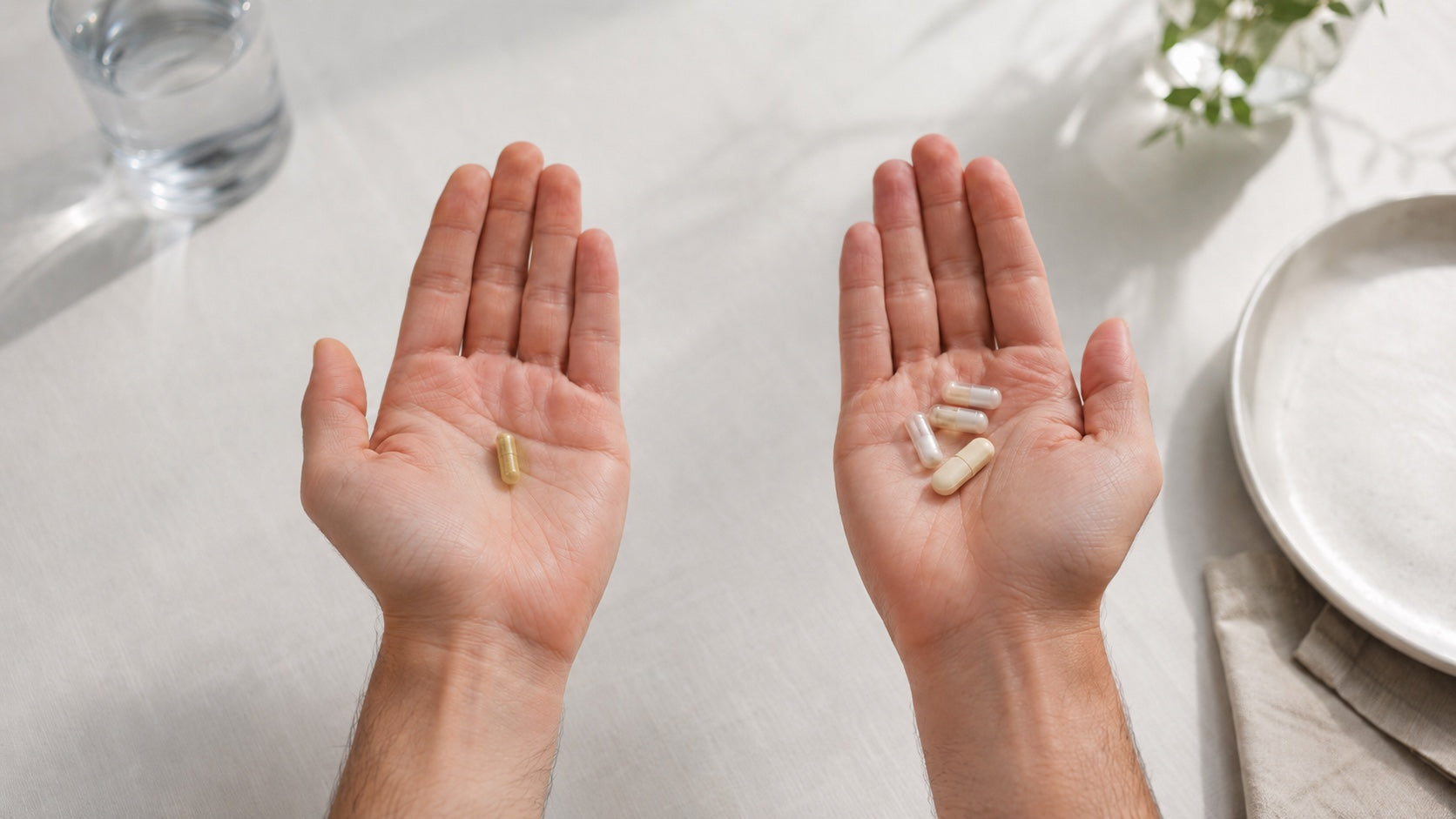
One mini capsule daily.
When
In the morning or at midday with a meal and plenty of water. That covers you all round.
Shell
100 % vegan: capsule shell made from plant based cellulose (HPMC).
Your new daily routine
What changes for you in 90 days
Nutrients do not work like an espresso, they work more slowly and quietly. Your nutrient account behaves exactly like your bank account: what counts is what gets paid in every day. With every capsule the stores fill up, and good supply gradually becomes your new normal.
Day 1The foundation
From today your body gets 16 micronutrients in forms it can use directly. Vitamin C and the B vitamins are in your blood within just a few hours and go straight into energy metabolism. No kick, your coffee keeps taking care of that. But BASE is the base underneath, and you lay it today.
Day 14The routine is set
Two weeks, you start every morning with the same supply and your body is already responding to it. B vitamins, folate and vitamin C contribute to the reduction of tiredness, every single day. Where you notice it first: in the afternoon. The typical dip gets flatter, the day gets longer and more usable.
Day 60The stores are full
Now the slow stores are filled too: folate in the blood, selenium in the tissue. Immune system, nervous system and cell protection now run on a full account. This is the state BASE is made for: steady energy instead of a rollercoaster, a head that keeps going, defences that are supplied.
Day 90Your new normal
Three months, three jars, supplied with 16 vitamins and minerals every day. Welcome to your new normal. You feel energised and consistently good. Many only notice how much that is worth when they pause. So: do not pause, keep at it instead. Keep your new routine going, every single day.
First the supply: nutrients only work if something comes in every day. The fast stores fill within hours, the slow ones take around two months. Until then your account builds up day by day.
Then the routine: the bigger part of the change happens in your head. A new daily action takes 66 days* on average before it runs automatically. Until then the capsule is a resolution you make anew every morning. Around day 60 it becomes a habit, from day 90 it is simply part of your day.
90 days, that is your path from the first resolution to the new normal.
* Lally et al., European Journal of Social Psychology 2010: 66 days on average.
What BASE supports you with
Energy B1, B2, B3, B5, B6, B12, vitamin C and biotin contribute to normal energy-yielding metabolism.
Tiredness B2, B3, B5, B6, B12, folate and vitamin C contribute to the reduction of tiredness and fatigue.
Nerves and mind B1, B6, B12 and biotin contribute to the normal functioning of the nervous system, folate, B6 and B12 to normal psychological function.
Immune system Zinc, selenium, copper, vitamin C, B6, B12 and folate contribute to the normal function of the immune system.
Cell protection Vitamin C, vitamin E, zinc, selenium and manganese contribute to the protection of cells from oxidative stress.
Morning to evening
Complete your day
BASE is the foundation. RISE, PULSE and CALM build on it, each at its own time.
Build your own routine: choose which Essentials belong to your day and how long your supply should last. From three Essentials you save, with a bigger supply even more.
90 days are a promise you make to yourself. Here is mine: I believe real quality does not need explaining, it shows in what it does. That is why every jar holds only what your body really needs, and nothing that burdens it. No hidden additives, no gimmicks, no mediocrity. Just a clear formula, day after day. For you and for me, only one thing counts: #55ornothing.
— Georg Roscher, founder of Fifty Five
Answers to the most important questions
FAQ
Is BASE the right product for me?
Yes, if you want to supply your body daily with 16 key vitamins and minerals, precisely dosed to daily needs and well below the EU upper limits. BASE is ideal for those with an active lifestyle who value health, mental clarity, and resilience - whether in their daily routine, at work, or during challenging phases of life.
Can I combine BASE with other products?
Absolutely. BASE is part of our Daily Essentials line and harmonizes perfectly with RISE – our Vitamin D3/K2, PULSE – our vegan Omega-3, and our magnesium complex CALM. Our Daily Essentials products were intentionally developed to complement each other functionally, making them perfect for stacking. There are no dosage conflicts: where nutrients overlap (B6 with CALM, vitamin E with PULSE and RISE), the total stays well below the EU upper limits.
Does a multivitamin actually make sense?
With a truly balanced diet it is not a must. Reality often looks different: according to the German National Nutrition Survey, around four in five adults in Germany do not reach the recommended folate intake, and for vitamin D, zinc and some B vitamins a relevant share also stays below the reference values. A good multivitamin does not replace a diet. It secures the basics on days when the diet isn't perfect. That is exactly what BASE is made for: 16 micronutrients in moderate amounts and in forms the body can use directly. One mini capsule a day, no megadoses.
Ideally in the morning or at lunchtime with a meal. The fat-soluble vitamins A and E are absorbed better with some fat, and minerals like zinc or copper can be unpleasant for some people on an empty stomach. The start of the day also suits the B vitamins, which contribute to normal energy-yielding metabolism. If you also take CALM, the split is simple: BASE in the morning, CALM in the evening. A gap is not essential, but this way two products become one clear routine.
Folic acid is the synthetic precursor. The body has to convert it in several steps into the active form 5-methyltetrahydrofolate (5-MTHF). In some people this step works only to a limited extent because of a variant of the MTHFR enzyme. Folate is the umbrella term for the natural, directly usable forms. BASE contains Quatrefolic®, a 5-MTHF the body can use without conversion. Folate contributes to normal blood formation, to normal homocysteine metabolism and to the reduction of tiredness and fatigue.
Is BASE vegan and does it cover the critical nutrients?
Yes, BASE is completely vegan, from the capsule shell to every raw material. Of the nutrients considered critical on a plant-based diet, BASE provides vitamin B12, selenium and riboflavin at no less than the full daily reference intake, plus half the daily reference intake of zinc. Three topics we deliberately kept out of BASE: vitamin D is in RISE, omega-3 in PULSE, magnesium in CALM, each in its own effective dose. Iron, calcium and iodine should be supplemented specifically when a need has been confirmed, not by default in a multivitamin for everyone.
The supplement in one stress study contained about twelve times as much vitamin B1 as the German Nutrition Society recommends for men, and the men really did feel less stressed afterwards. So do you need that much, or is an amount close to your daily needs enough?
One serving of spinach and a lamb's lettuce salad together already bring around 300 µg of folate, and yet a large share of adults don't reach that amount. And methylfolate? At least equivalent, and it spares your body a conversion step.
Some B12 packages say 500 µg, others just 5. Of the big dose, though, the gut absorbs only about 1%, and suddenly the math looks pretty different. We worked it through for you, from 1 to 500 µg.
Two easy hours on the bike, and about 8 to 9% of the US recommended daily amount of zinc ends up in your jersey. So do you need your own vitamin program as an athlete? The International Olympic Committee is surprisingly matter-of-fact about it and names exactly three nutrients.
Everyone knows vitamin C, but hardly anyone really knows folate and vitamin B12, even though your body needs both every day for cell division and blood formation. With folate, women average 252 µg instead of the recommended 300 µg. All 13 vitamins and the minerals in two tables.
Germany's big consumer testers never crowned a multivitamin test winner. Their vitamin test from 2017 was more of a warning: many of the 35 products they bought delivered far more than is recommended for food supplements. What actually helps you is right there on the label.
In a study by Germany's Federal Institute for Risk Assessment, vegans had B12 levels just as good as people on a mixed diet, because almost all of them took a supplement. With iodine, though, a third were below the threshold for severe deficiency. So which gaps remain once B12 is taken care of?
Where the German Nutrition Society specifically recommends a supplement, it's about single nutrients, and a multivitamin isn't on its list at all. That doesn't make it unnecessary, not by a long way. What usually tips the balance is how much you know about your own supply.
According to the US Food and Drug Administration, some hair, skin and nail products contain up to 650 times the recommended daily intake of biotin. So too much mostly comes from the sum, not from the one capsule in the morning. Things get tight with vitamin A, B6, selenium and zinc.
The German Nutrition Society puts your magnesium needs at no less than 75,000 times what you need of vitamin B12. That alone shows why a good multivitamin is also defined by what it leaves out. So here's what really belongs in it, and what you're better off taking on its own.
In one trial, vitamin E levels rose almost three times as much with dinner as without food. Whether a multivitamin is absorbed better in the morning or at night, nobody has ever compared. We still put our capsule in the morning, and the reason is pretty mundane.
Lots of jars say "For Women", yet according to the German Nutrition Society, women need just as much folate, B12, iodine and calcium as men. The one big difference lies with a nutrient, of all things, that you're better off not taking on a hunch.