

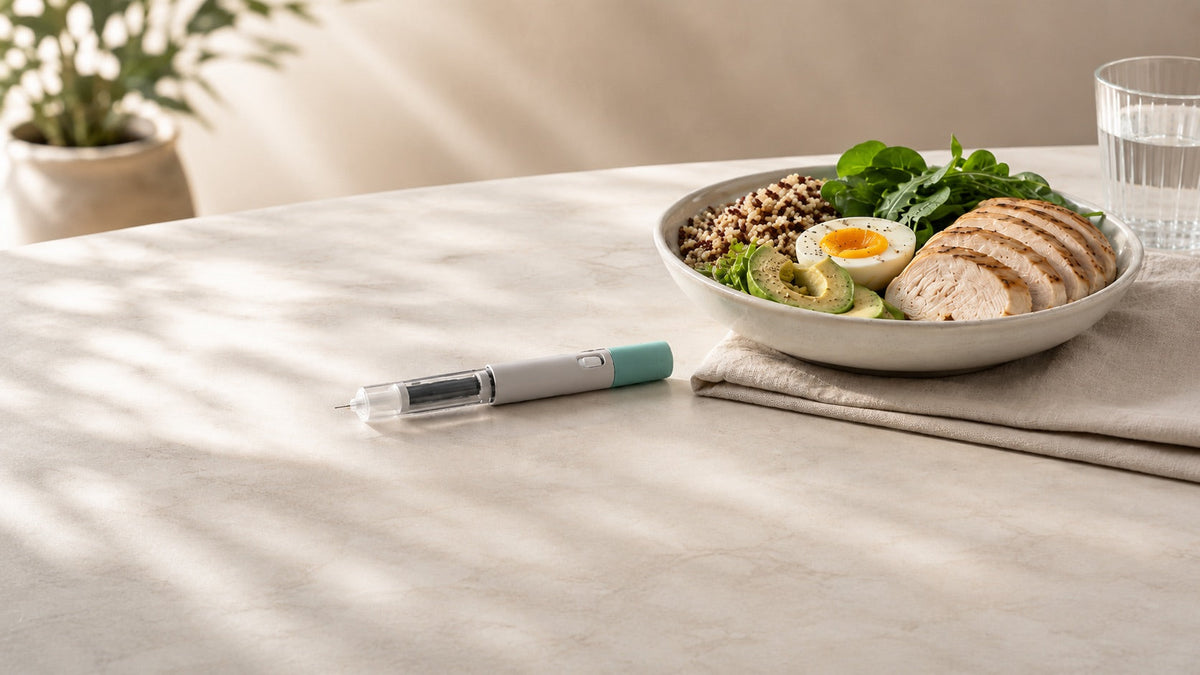
If you use the weight-loss injection to lose weight in Germany, you pay for it yourself. Statutory health insurance (GKV) covers nothing, not even with a high BMI, because Section 34 of the German Social Code Book V (SGB V) explicitly excludes medicines for regulating body weight. The only exception is type 2 diabetes. For self-payers with a doctor's prescription, costs for semaglutide (Wegovy) start at around €172 per four-week pack, and at the 2.4 mg maintenance dose it is around €278. Tirzepatide (Mounjaro) starts at around €207 and is around €490 at the highest strength of 15 mg, all as of October 2026. Both are prescription-only and approved in the EU for weight management, Wegovy since 2022 and Mounjaro since 2023.
Before you start, you should be able to plan with real numbers and not with a gut feeling. That's why we converted every strength to a month and to a whole year, because over a year in particular it usually gets more expensive than you'd think.
How much does the weight-loss injection cost per month in Germany?
Converted to 30 days, the weight-loss injection costs self-payers in Germany between around €185 and around €525 a month, depending on the medicine and strength, as of October 2026. The German consumer advice centre (Verbraucherzentrale) gives a range of around €130 to just under €500 a month as of March 2026, depending on medicine and dose.
The fact that the range is so wide comes down almost entirely to the strength. And that is deliberately increased over the first few months. How this works is set out in the summary of product characteristics (SmPC), the product information for doctors and pharmacists approved by the European Medicines Agency (EMA). According to it, Wegovy is increased from 0.25 mg to 2.4 mg per week over 16 weeks. Mounjaro starts at 2.5 mg and is increased in 2.5 mg steps after at least four weeks each, up to a maintenance dose of 5, 10 or 15 mg. Which step you need in the end is decided by your doctor. That medical decision also determines what you pay.
One pack lasts four weeks, so 28 days, and not a calendar month. That's why we converted every step to 30 days and to a whole year:
| Medicine and strength | Role according to the SmPC | Four-week pack | Per month (30 days) | One year at this step (13 packs) |
|---|---|---|---|---|
| Wegovy 0.25 mg, 0.5 mg and 1 mg | dose escalation, weeks 1 to 12 | around €172 | around €185 | escalation phase only |
| Wegovy 1.7 mg | dose escalation, weeks 13 to 16 | around €237 | around €254 | escalation phase only |
| Wegovy 2.4 mg | maintenance dose | around €278 | around €297 | around €3,600 |
| Mounjaro 2.5 mg | starting dose, at least 4 weeks | around €207 | around €222 | starting phase only |
| Mounjaro 5 mg | first possible maintenance dose | around €278 | around €297 | around €3,600 |
| Mounjaro 10 mg | possible maintenance dose | around €384 | around €411 | around €5,000 |
| Mounjaro 15 mg | maximum dose | around €490 | around €525 | around €6,400 |
These are rounded pharmacy retail prices in Germany for self-payers with a doctor's prescription, for Wegovy according to the pharmacy trade publication apotheke adhoc of August 28, 2026, for Mounjaro of February 12, 2025, both still valid in October 2026. According to the SmPC, the Mounjaro steps of 7.5 and 12.5 mg are only intermediate steps, and we don't have a documented price for them.
How much does Mounjaro cost, and how much does Wegovy cost?
Mounjaro 5 mg, whose price people search for particularly often, costs self-payers around €278 per four-week pack, practically the same as Wegovy at the 2.4 mg maintenance dose, as of October 2026. You need a doctor's prescription for both.
The two prescription-only medicines are approved for adults with a BMI of 30 or more, or 27 or more with a weight-related health condition. The injection is always intended as an adjunct to a reduced-calorie diet and increased physical activity. When it comes to price, what's special about Mounjaro is that there are three possible maintenance doses. Between the lowest and the highest there is a good €210 per pack. Whether it stays at 5 mg or goes up to 15 mg therefore often decides your costs more than the choice of medicine, and that decision is made by your doctor.
Since July 2026, Wegovy has also been available in the EU as an approved tablet, and it is just as prescription-only as the pen. According to apotheke adhoc, the low strengths of 1.5 and 4 mg cost around €172 for 30 tablets, the 9 mg strength around €233. For the 25 mg maintenance dose and the 7.2 mg pen there is no documented price yet. More on the tablet is in our article on the Wegovy tablet and other new medicines.
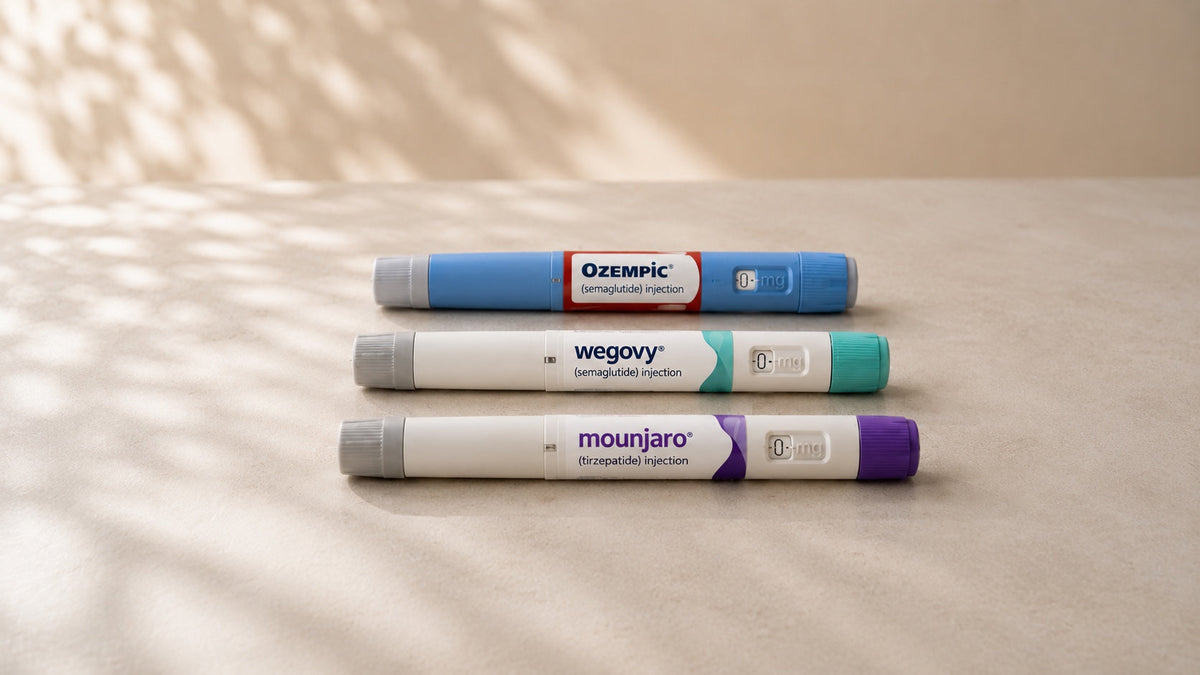
Ozempic is missing from the table on purpose. It does contain the same active ingredient as Wegovy, but in the EU it has been approved exclusively for the treatment of type 2 diabetes since 2018, is prescribed by doctors for that purpose and is paid for by health insurance.
How the medicines differ in studies and in side effects is something you can read in our comparison of Ozempic, Wegovy and Mounjaro and in our article on side effects and warning signs. Which medicine suits you is a medical decision, not a question of price.
How much does the weight-loss injection cost per year?
A year of Wegovy at the 2.4 mg maintenance dose costs self-payers with a doctor's prescription around €3,600, a year of Mounjaro 15 mg around €6,400, as of October 2026. The reason: with its 52 weeks, a year needs no fewer than 13 four-week packs. That thirteenth pack is very easy to forget when you calculate in months, and yet with Wegovy 2.4 mg it alone accounts for around €278.
In the first year the math looks a bit friendlier, because nobody starts on the maintenance dose. For two courses following the schedule in the SmPC it looks like this, with the pace and maintenance dose always decided by your doctor:
| Course | Escalation phase | Cost of the escalation phase | First year in total (13 packs) |
|---|---|---|---|
| Wegovy up to 2.4 mg | 16 weeks, 4 packs | around €755 | around €3,250 |
| Mounjaro up to 5 mg | 4 weeks, 1 pack | around €207 | around €3,540 |
Getting up to 15 mg takes at least 20 weeks with Mounjaro, and after that every pack costs around €490. The Verbraucherzentrale offers a piece of advice here that we would sign exactly as it stands: actively ask about the total costs over at least twelve months. How long your treatment runs is something you discuss with your doctor. What comes afterward is in our article on stopping and maintaining your weight.
Does health insurance in Germany pay for the weight-loss injection?
Statutory health insurance does not pay for the weight-loss injection for weight loss, unfortunately not even for obesity with related health conditions, as of October 2026. The reason is in the law: Section 34 SGB V excludes medicines intended for slimming or suppressing the appetite, or for regulating body weight.
Exactly which prescribed medicines fall under this is determined by the Federal Joint Committee (G-BA). That is the body that decides what statutory health insurance pays for. Its list of excluded medicines includes Wegovy in all strengths, so the tablet as well, Mounjaro and liraglutide (Saxenda, approved in the EU since 2015 and injected daily). Each one carries the note that the exclusion applies only when it is used for weight reduction. An exception from a BMI of 30 was reviewed by the G-BA in March 2024 and rejected because of the statutory exclusion.
In official German the list is called "lifestyle medicines", which, for a treatment supervised by a doctor, unfortunately sounds a bit like luxury. For health insurance, though, all that counts is what a medicine is prescribed for, and that is also what the one exception hinges on.
For type 2 diabetes, the active ingredients are available on a statutory insurance prescription, provided the prescribed product is approved for it. That means Ozempic, Rybelsus, semaglutide as a tablet, approved since 2020 for type 2 diabetes only, and Mounjaro under its diabetes approval, but not Wegovy or Saxenda. Whether diabetes is present and which medicine fits is established by your doctor alone, and a prescription for weight loss remains self-pay, even with Mounjaro.
What about Switzerland and Austria?
In Switzerland, basic insurance pays under strict, time-limited conditions, in Austria only in exceptional cases according to the trade press, as of October 2026.
According to the Swiss Federal Office of Public Health (BAG), basic insurance has covered Wegovy since March 2024 and Mounjaro since January 2026. Both are available there only when prescribed by a specialist practice for endocrinology and diabetology or an obesity center. Fixed conditions apply on top: a BMI of 35 or more, or 28 or more with a weight-related health condition, nutrition counseling, documented physical activity and a written cost approval from the insurer in advance. Anyone who misses the agreed weight-loss target after ten months gets nothing more reimbursed. Payment runs for three years at most, and the rule is only temporary, for Wegovy until February 2027 and for Mounjaro until the end of 2027.
In Austria, according to the Deutsche Apotheker Zeitung of February 13, 2026, health insurers cover prescribed Wegovy only for selected groups outside the regular reimbursement list. These are adolescents between 12 and 20 with a BMI over 30, related health conditions and unsuccessful previous treatment. Plus adults before planned obesity surgery.
What is changing right now in prices and reimbursement?
Nothing is currently changing about reimbursement in Germany, the list of excluded medicines is actually getting longer. With the G-BA resolution of September 17, 2026, all generic versions of liraglutide that have existed since the Saxenda patent expired are being added. That applies insofar as they are prescribed for weight reduction. This resolution has not yet come into force, though.
In 2026 the Lower Saxony-Bremen State Social Court confirmed that an insurer does not have to pay for Mounjaro prescribed for weight loss. According to the Pharmazeutische Zeitung, the Federal Ministry of Health has also confirmed that weight-loss medicines will not be reimbursed by health insurers in the future either. There has been more movement on prices, which is why every number here comes with a date.
What about offers without a prescription?
Nothing good, because without a prescription these prescription-only medicines are not legally available in Germany. The Verbraucherzentrale puts it unmistakably: offers without a prescription requirement are illegal in Germany.
At several thousand euros a year, looking for a cheaper route is completely understandable. But that is exactly where the counterfeits lurk. The EMA reported that falsified Ozempic had turned up in the supply chain in October 2023, a medicine approved exclusively for the treatment of type 2 diabetes. And the Drug Commission of the German Medical Association (AkdÄ) warned that counterfeits of the diabetes medicine Ozempic (semaglutide) are in circulation and probably pose health risks. A prescription at the click of a mouse doesn't replace medical supervision either. In the test purchase by the Verbraucherzentrale of North Rhine-Westphalia, five out of six online platforms allowed an order with a made-up body weight.
In August 2026, the Federal Union of German Associations of Pharmacists (ABDA) warned about dubious online offers for the new tablet, with a sentence that applies to all of these medicines: medicines for obesity are not lifestyle products but highly effective medicines with risks and side effects. The only safe route is therefore through your doctor's office and a licensed pharmacy.
What the injection doesn't cost, but does need
Treatment always includes what you eat and how you move, too. That doesn't appear on any pharmacy bill. The German S3 guideline on obesity is clear here: drug treatment should only be carried out in combination with a multimodal basic therapy for weight reduction. That means nutrition, exercise and behavior, with the aim of losing as much fat and as little muscle as possible.
What the injection leaves open costs attention more than money: what ends up on the smaller plate, enough protein and regular strength training. How much of each, the European expert consensus from 2026 spells out pretty precisely: while you are losing weight, 1.0 to 1.5 g of protein per kilo of adjusted body weight a day, and at least 60 g. Adjusted body weight is a reference value below your starting weight, so the amount doesn't come out unnecessarily high. For training, the consensus recommends strength training on at least two days a week, a goal you are welcome to build up step by step. We have written separate articles on all of this: what belongs on the smaller plate, how you get enough protein, how strength training protects your muscles and which vitamins and minerals can now run short. You'll find the big picture in our weight-loss injection overview.
FAQ
Why does a higher dose cost more?
Every strength is a separate pack with its own price. With Mounjaro, the pack at the maximum dose costs more than twice as much as the starting dose. With Wegovy, the maintenance dose is a good 60% above the starting strengths. Which dose you need is a medical decision, so it's best to factor in the possible maintenance dose from the start.
Are there other costs on top of the medicine?
That may well be. The Verbraucherzentrale points out that there can be further costs on top of the medicine, for medical supervision or lab tests, for example. So it's best to ask your doctor right away which appointments and blood tests are planned for the first year.
Does private health insurance pay for the weight-loss injection?
That depends on the individual contract, there is no common rule like Section 34 SGB V for statutory insurance that applies to private insurers. The only reliable answer is therefore the one from your own insurer about your own plan.
Has the weight-loss injection become cheaper recently?
Partly, yes: Mounjaro 2.5 mg has cost around 20% less since February 2025, and Wegovy 2.4 mg has become around 8% cheaper since April 2025. At the same time, though, the higher strengths of Mounjaro became more expensive, the 15 mg pack for example from around €345 to around €490. The first few weeks are therefore a little cheaper today than at the start of 2025. If your doctor later raises the Mounjaro dose, you pay more for it.
Disclaimer:
This article is for informational purposes only and does not replace medical advice, diagnosis, or treatment by a physician or pharmacist. The information provided here should not be used for self-diagnosis or self-treatment. Food supplements are no substitute for a balanced, varied diet and a healthy lifestyle. For any health questions or complaints, please always consult a doctor you trust. Fifty Five accepts no liability for any inconvenience or harm resulting from the use of the information presented here.
And since this is about prescription medicines, one more word from us: Fifty Five does not sell medicines, and any questions about your treatment, your dose or stopping it are best taken to your doctor.
Sources
- Sozialgesetzbuch (SGB) Fünftes Buch, § 34 Ausgeschlossene Arznei-, Heil- und Hilfsmittel (German Social Code Book V, Section 34, excluded medicines, remedies and aids). gesetze-im-internet.de
- apotheke adhoc: Das kostet die Abnehmpille (what the weight-loss pill costs). August 28, 2026. apotheke-adhoc.de
- apotheke adhoc: Mounjaro wird teurer (Mounjaro is getting more expensive). February 12, 2025. apotheke-adhoc.de
- Verbraucherzentrale [German consumer advice centre]: Abnehmspritzen: Häufige Fragen und Antworten zum Trend (weight-loss injections: frequently asked questions about the trend). As of April 2, 2026. verbraucherzentrale.de
- European Medicines Agency (EMA): Wegovy, EPAR, Produktinformation (Anhang I bis III), deutsche Fassung (product information, annexes I to III, German version). Last updated September 21, 2026. ema.europa.eu
- European Medicines Agency (EMA): Mounjaro, EPAR, Produktinformation (Anhang I bis III), deutsche Fassung (product information, annexes I to III, German version). ema.europa.eu
- European Medicines Agency (EMA): Ozempic, EPAR, Produktinformation (Anhang I bis III), deutsche Fassung (product information, annexes I to III, German version). ema.europa.eu
- Gemeinsamer Bundesausschuss (G-BA) [Federal Joint Committee]: Arzneimittel-Richtlinie, Anlage II (Lifestyle Arzneimittel) (Pharmaceuticals Directive, Annex II, lifestyle medicines). As of August 20, 2025. g-ba.de
- European Medicines Agency (EMA): Saxenda, EPAR, Produktinformation (Anhang I bis III), deutsche Fassung (product information, annexes I to III, German version). ema.europa.eu
- Gemeinsamer Bundesausschuss (G-BA) [Federal Joint Committee]: Tragende Gründe zum Beschluss des Gemeinsamen Bundesausschusses über eine Änderung der Arzneimittel-Richtlinie: Anlage II (Lifestyle Arzneimittel), Ergänzung Semaglutid (rationale for the resolution amending Annex II, addition of semaglutide). Dated March 21, 2024. g-ba.de
- European Medicines Agency (EMA): Rybelsus, EPAR, Produktinformation (Anhang I bis III), deutsche Fassung (product information, annexes I to III, German version). ema.europa.eu
- Bundesamt für Gesundheit (BAG) [Swiss Federal Office of Public Health]: WEGOVY, Neuaufnahme in die Spezialitätenliste (SL) per 1. März 2024 (new listing on the list of reimbursed medicines as of March 1, 2024). bag.admin.ch
- Bundesamt für Gesundheit (BAG) [Swiss Federal Office of Public Health]: Erweiterung der Limitierung von MOUNJARO (Gewichtsregulierung) per 1. Januar 2026 (extended reimbursement conditions for Mounjaro, weight management, as of January 1, 2026). bag.admin.ch
- Deutsche Apotheker Zeitung: Novo Nordisk senkt Wegovy-Preis (Novo Nordisk lowers the Wegovy price). February 13, 2026. deutsche-apotheker-zeitung.de
- Gemeinsamer Bundesausschuss (G-BA) [Federal Joint Committee]: Tragende Gründe zum Beschluss des Gemeinsamen Bundesausschusses über eine Änderung der Arzneimittel-Richtlinie: Anlage II (Lifestyle Arzneimittel), Ergänzung und Aktualisierung (rationale for the resolution amending Annex II, addition and update). Dated September 17, 2026. g-ba.de
- Pharmazeutische Zeitung: Gericht sieht Abnehmspritze als Lifestyle-Medikament (court classifies the weight-loss injection as a lifestyle medicine). May 11, 2026. pharmazeutische-zeitung.de
- European Medicines Agency (EMA): Recommendations of the Executive Steering Group on Shortages and Safety of Medicinal Products on shortage of Glucagon-Like Peptide-1 (GLP-1) receptor agonists. EMA/143883/2024, June 12, 2024. ema.europa.eu
- Arzneimittelkommission der deutschen Ärzteschaft (AkdÄ) [Drug Commission of the German Medical Association]: Drug Safety Mail 2023-46, Information zu Ozempic® (Semaglutid): Warnung vor Fälschung (warning about counterfeits). October 2023. akdae.de
- Verbraucherzentrale NRW [consumer advice centre of North Rhine-Westphalia]: Abnehmspritzen aus dem Internet. Testkäufe bei telemedizinischen Plattformen (weight-loss injections from the internet, test purchases on telemedicine platforms). March 25, 2026. verbraucherzentrale.nrw
- ABDA, Bundesvereinigung Deutscher Apothekerverbände [Federal Union of German Associations of Pharmacists]: ABDA warnt vor dubiosen Online-Angeboten zur neuen „Abnehmpille“ (ABDA warns about dubious online offers for the new weight-loss pill). Press release, August 2026. presseportal.de
- Deutsche Adipositas-Gesellschaft (DAG) e. V. [German Obesity Society] et al.: Interdisziplinäre S3-Leitlinie „Prävention und Therapie der Adipositas“ (interdisciplinary S3 guideline on the prevention and treatment of obesity), AWMF register 050-001, version 5.0, as of October 7, 2024. register.awmf.org
- Dobbie LJ, Tolvanen L, Alves D et al.: Nutritional, functional, and psychological considerations for incretin-based therapies in adults-an EASO, EFAD, and ECPO Consensus Statement. The Lancet Diabetes & Endocrinology, 2026. pubmed.ncbi.nlm.nih.gov/42419343
- apotheke adhoc: Wegovy-Erhaltungsdosis wird günstiger (Wegovy maintenance dose is getting cheaper). March 27, 2025. apotheke-adhoc.de


Ozempic Face and Hair Loss: Why Your Face and Hair Change on the Weight-Loss Injection and What Helps
New Weight-Loss Injections and Pills: Retatrutide, Orforglipron, the Wegovy Tablet and Where They Stand
Share: