


"Ozempic face" isn't a medical term, it's a catchphrase for a face that looks hollow and older after fast, substantial weight loss. What's behind it is mainly fat that is missing from the face, not a medicine that attacks the skin, even if the name sounds like the prescription-only diabetes medicine Ozempic.
Hair loss is a slightly different story. It really is listed in the Wegovy summary of product characteristics (SmPC), the prescription-only semaglutide product approved in the EU for weight management. That is the product information for healthcare professionals approved by the European Medicines Agency (EMA). There it counts as a common side effect (may affect up to 1 in 10 people). In the pivotal trials of semaglutide it affected 2.5 in 100 people treated, compared with 1 in 100 on placebo, a dummy medicine with no active ingredient. It was mostly mild. For your face and your hair alike, what counts is how fast and how much you lose during the treatment your doctor supervises. And that is exactly where you can shape quite a lot yourself.
If you notice a slimmer face or a few more hairs in your brush while on the injection, there is usually a good explanation.
What is "Ozempic face"?
It describes a face that looks thinner, more wrinkled and older after substantial weight loss with GLP-1 medicines, because fat, and with it volume, is missing there. GLP-1 is a gut hormone your body releases after eating, and one of the things it does is make you feel full. The medicines mimic it. A systematic review from plastic surgery analyzed no fewer than 23 papers. It describes the phenomenon as excessive volume loss that makes the face look prematurely aged, and itself rates the evidence as limited. A German review in the ENT journal HNO adds looser skin and more pronounced wrinkles. The term doesn't appear in the SmPCs. Nobody has reliably counted how often it happens so far.
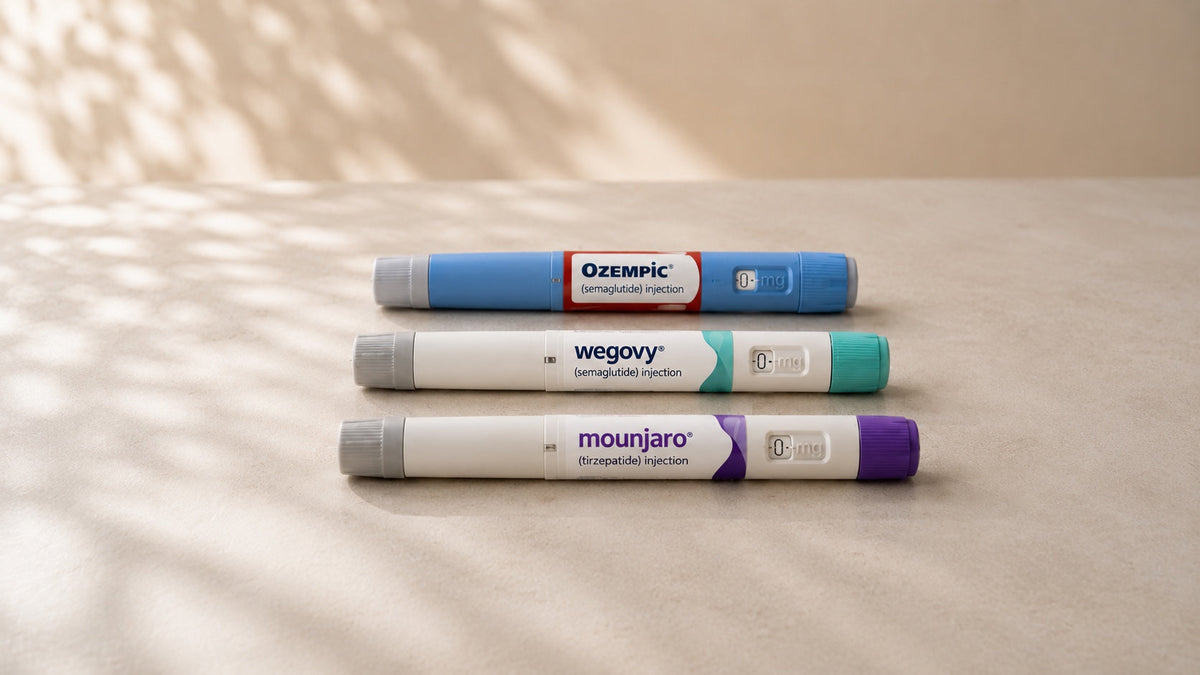
The name is catchy more than accurate. Ozempic does contain semaglutide, but in the EU it has been approved since 2018 exclusively for the treatment of type 2 diabetes and is prescribed by doctors for that purpose. For weight management, the same active ingredient is approved as Wegovy, alongside tirzepatide as Mounjaro, both prescription-only. So the catchphrase covers all of these medicines and, strictly speaking, any fast, substantial weight loss.
Why does your face look hollow when losing weight on the injection?
When you lose weight, your face loses fat just like the rest of your body. And it is exactly this fat that gives the face its fullness from within. If a lot of it disappears in a short time, the skin over it looks looser and wrinkles stand out more. Think of a sofa cushion that loses some of its filling: the cover stays as big as it was for the time being and falls into folds.
The expert reviews therefore put the change down to fast fat and volume loss. A review of 40 studies on skin with GLP-1 medicines also names what raises the risk of more visible changes: older age, long-standing severe overweight, fast weight loss, too little fluid and too little protein. That is a first pointer to where you can step in yourself. Whether more protein or water really prevents anything hasn't been tested in these mostly small studies and case reports, though.
On top of that, weight loss never means losing fat alone. According to an independent analysis of 35 studies, on average a good quarter of the weight lost on GLP-1 medicines isn't fat but lean mass (fat-free mass), which includes water, organs and connective tissue as well as muscle. This analysis says nothing about the face, but for your body as a whole it is actually the bigger topic.
Why does the weight-loss injection cause hair loss?
According to the SmPC, hair loss is one of the common side effects of semaglutide and of tirzepatide, both prescription-only. The Wegovy SmPC states explicitly that it was reported more often in people who lost 20% of their weight or more. How this probably fits together is described in a systematic review from dermatology that analyzed 24 studies on GLP-1 medicines and hair loss. Where the type of hair loss was determined at all, it was mostly so-called telogen effluvium. Or hereditary hair loss that can become visible earlier as a result.
Telogen effluvium simply means that a trigger sends far more hairs than usual into their resting phase at the same time. That trigger can be fast, substantial weight loss or eating very little. The hairs then fall out together weeks to a few months later. This has long been known after weight-loss surgery on the stomach. The authors therefore assume that it is above all the pace and extent of weight loss that tip the balance, not the active ingredient alone. That hasn't been proven for the injection yet, though. Another analysis of nine studies with a good 4,100 people who received GLP-1 medicines arrives at roughly three times the risk seen on placebo. In absolute terms, though, that is 3.9%, so just under 4 in 100 people treated.
How many people in the approval data were actually affected in addition, that is beyond the background level on placebo, is what we worked out in the table. All the medicines listed are prescription-only. Wegovy 7.2 mg has been approved in the EU since early 2026, the Wegovy tablet since July 2026 and Mounjaro for weight management since December 2023 (as of October 2026). Which form and dose suit you is decided by your doctor. The figures come from the SmPCs of Wegovy and Mounjaro.
| Medicine and form | Hair loss with the medicine | Hair loss with placebo | Additionally affected, calculated |
|---|---|---|---|
| Semaglutide (Wegovy), injection, 2.4 mg per week | 2.5% | 1.0% | about 1 in 67 |
| Semaglutide (Wegovy), injection, 7.2 mg per week | 5.3% | 1.0% | about 1 in 23 |
| Semaglutide (Wegovy), tablet | 6.4% | 2.0% | about 1 in 23 |
| Tirzepatide (Mounjaro), injection | "common", no percentage given, mainly in people with overweight or obesity | not stated | cannot be calculated |
The numbers come from different studies and were never tested directly against each other. That is why they're no good for ranking the medicines. But they do show that hair loss remains the exception, because even in the group with the highest rate, a good 93 in 100 people treated had none.
Do Ozempic face and hair loss go away again?
With hair loss, the odds are really good. The SmPC of the prescription-only semaglutide product Wegovy describes the course in the trials like this: the events were mostly mild in severity and resolved in most patients while treatment continued. The dermatology review sees it the same way. Telogen effluvium typically passes on its own, and there is no solid evidence of lasting damage to the hair roots. Because hair just grows slowly, a little patience is unfortunately part of it.
For the face, the answer is less clear, because nobody has systematically studied the course after a large weight loss yet. According to the reviews, how clearly you see the lost volume depends mainly on three things: how much someone loses in total, how fast that happens and how old they are. That's why it pays to look at this not at the end of your weight loss, but right from the start.
What helps against Ozempic face and hair loss?
There is no remedy so far that has been shown to prevent Ozempic face or hair loss on the injection. But experts from dermatology and plastic surgery name similar levers: no extreme weight loss in a very short time, no strict starving, enough protein and enough to drink. Luckily, that's good for your whole body and not just for your reflection in the mirror. Your doctor has a say in the pace, the rest is very much in your own hands.
Bring up the pace with your doctor
The pace is the first lever, and with a prescription-only treatment it isn't yours alone, because how fast the dose is increased and which dose you need in the end is decided by your doctor. If your face or your hair is on your mind, feel free to bring it up openly at your appointment. That's what the medical supervision is there for, and it will certainly not be the first time the question comes up.
Enough protein, even when your appetite is small
On the injection you eat much less. And the protein your body needs to keep as much muscle as possible while losing weight is quickly left behind as well. The European expert consensus on nutrition with weight-loss injections therefore recommends 1.0 to 1.5 g of protein per kilo of adjusted body weight a day while you are losing weight, and at least 60 g. For the Polish Society of Dietetics, adjusted body weight means a reference weight that lies between a normal weight and your starting weight. It helps to start with the protein before the feeling of fullness sets in. That protein also plays a role for the face is at least suggested by the review on skin. How much that is in concrete terms and how you manage it with small portions is what we work through in our article on protein on the weight-loss injection.
Strength training, so the protein actually gets put to work
Protein alone hardly holds on to your muscles, though. The German Society for Nutritional Medicine (DGEM) calls enough protein on weight-loss injections central and strength and endurance training just as important. For the European Association for the Study of Obesity (EASO), strength training comes first if you want to keep your muscles while losing weight, and the European expert consensus sets the goal of strength exercises on at least two days a week, built up step by step. How to get started when your energy is low is covered under strength training while on the injection. How Andreas fitted training and nutrient supply into his everyday life is something he tells in his Fifty Five Story.
Keep an eye on your nutrient supply from the start
If you eat much smaller portions, you usually take in fewer vitamins and minerals too, while your body's needs stay the same. That applies to everyone on the injection, quite apart from face and hair. Which nutrients can run short and how to have your status checked by a doctor is in our article on nutrient status on the weight-loss injection. Whether a supplement makes sense for you and what in this area is more marketing than substance is collected in a separate article on supplements.
When should you see your doctor or a dermatologist?
If your hair is falling out very heavily, if other complaints come on top, or if the hair loss is simply weighing on you a lot, bring it up with the practice that supervises your treatment. The European expert consensus also counts hair loss among the signs on the injection that should make you think of an insufficient nutrient supply, along with wounds that heal poorly, frequent infections or pronounced tiredness, for example. For persistent hair loss, the dermatology review also names blood tests that narrow down other causes and nutrient gaps. These include a blood count, ferritin as a measure of your iron stores, a thyroid value and vitamin D. Which of these makes sense for you is decided by your doctor.
According to this review, hair loss belongs in a dermatologist's office above all if it hasn't passed after six to nine months or shows a pattern, such as a receding hairline at the temples or thinning on top of the head. The same applies if your scalp itches or is inflamed or if it remains unclear where it comes from. Round bald patches, in our view, don't fit with weight loss and should always be looked at. Which other side effects of the prescription-only injection are common and how to recognize warning signs is covered under side effects of the weight-loss injection at a glance.
What can cosmetic treatments do?
Cosmetic practices offer treatments intended to restore lost volume or tighten the skin. The ENT review names fillers, fat grafting, ultrasound and radiofrequency procedures and even facelifts, for example. How well and how safely this works after weight loss with GLP-1 medicines hasn't been studied systematically yet, according to the authors. If you're considering it, it's best to discuss it with a specialist, keeping in mind that your face will keep changing for as long as you continue to lose weight.
FAQ
Does everyone on the weight-loss injection get "Ozempic face"?
Not everyone, and nobody knows exactly how many people it affects yet. It is described mainly after large weight losses in a short time and more often in older people. So it isn't a fixed consequence of the injection, it depends heavily on your own course.
Do "Ozempic face" and hair loss also happen with Wegovy and Mounjaro?
Yes, the term covers all GLP-1 medicines. Hair loss is listed as a common side effect in the SmPC of tirzepatide (Mounjaro) just as it is in the one for semaglutide (Wegovy). Both are prescription-only, and which medicine suits you is something you clarify with your doctor.
When does the hair loss start, and when does it stop?
If it is telogen effluvium, according to the dermatology review the hair loss typically starts about six weeks to three months after starting treatment or after a dose increase. It usually eases off three to six months after your weight has stabilized. The SmPC gives no time course, and the exact course on the injection hasn't been measured so far.
Do I have to stop the injection if my hair falls out?
In the trials, the hair loss went away in most people while treatment simply continued. Still, never stop the injection on your own. According to the package leaflet, you should not stop using it without talking to your doctor. Your doctor can then also clarify whether the hair loss fits with the weight loss or has another cause.
Is it worth paying attention to protein, training and nutrient supply right from the start?
Yes, and quite apart from face and hair. On the injection your body gets less food, but it doesn't need fewer nutrients. If you eat enough protein and do strength training regularly, you make sure that more of what disappears is fat and less of it is muscle. The injection doesn't take care of that part for you. How it all fits together is in our overview of how the weight-loss injection works and what it doesn't do for you.
Disclaimer:
This article is for informational purposes only and does not replace medical advice, diagnosis, or treatment by a physician or pharmacist. The information provided here should not be used for self-diagnosis or self-treatment. Food supplements are no substitute for a balanced, varied diet and a healthy lifestyle. For any health questions or complaints, please always consult a doctor you trust. Fifty Five accepts no liability for any inconvenience or harm resulting from the use of the information presented here.
And since this is about prescription medicines, one more word from us: Fifty Five does not sell medicines, and any questions about your treatment, your dose or stopping it are best taken to your doctor.
Sources
- European Medicines Agency (EMA): Wegovy, EPAR, Produktinformation (Anhang I bis III), deutsche Fassung (product information, annexes I to III, German version). Last updated September 21, 2026. ema.europa.eu
- Daneshgaran G, Shauly O, Gould DJ: "Ozempic Face" in Plastic Surgery: A Systematic Review of the Literature on GLP-1 Receptor Agonist Mediated Weight Loss and Analysis of Public Perceptions. Aesthetic Surgery Journal Open Forum, 2025. pubmed.ncbi.nlm.nih.gov/40626110
- Seidel DU, Bode S: Rapider Gewichtsverlust durch GLP-1-Rezeptor-Agonisten als Lifestylephänomen und Implikationen für die plastisch-ästhetische Medizin (rapid weight loss from GLP-1 receptor agonists as a lifestyle phenomenon and implications for aesthetic plastic medicine). HNO, 2025. pubmed.ncbi.nlm.nih.gov/40767957
- Barone M, Brunetti B, D'Emilio R et al.: Effects of GLP-1 Receptor Agonists on Skin Quality: A Comprehensive Literature Review. Aesthetic Plastic Surgery, 2026. pubmed.ncbi.nlm.nih.gov/42162206
- Batsis JA, Gavras A, Gross DC et al.: Effect of Incretin-Based and Nonpharmacologic Weight Loss on Body Composition: A Systematic Review. Annals of Internal Medicine, 2026. pubmed.ncbi.nlm.nih.gov/41996180
- Gupta AK, Teasell EM, Economopoulos V et al.: GLP-1 therapies and hair loss: A systematic review of current evidence and implications for counseling. Science Progress, 2026. pubmed.ncbi.nlm.nih.gov/41998799
- Cheng PL, Chang HC: Glucagon-like peptide-1 receptor agonists and hair loss: A systematic review and meta-analysis. Diabetes Research and Clinical Practice, 2026. pubmed.ncbi.nlm.nih.gov/42155605
- European Medicines Agency (EMA): Mounjaro, EPAR, Produktinformation (Anhang I bis III), deutsche Fassung (product information, annexes I to III, German version). ema.europa.eu
- Dobbie LJ, Tolvanen L, Alves D et al.: Nutritional, functional, and psychological considerations for incretin-based therapies in adults-an EASO, EFAD, and ECPO Consensus Statement. The Lancet Diabetes & Endocrinology, 2026. pubmed.ncbi.nlm.nih.gov/42419343
- Kwaśny A, Słoma-Krześlak M, Kostelecki G et al.: Diet and nutrition in obesity treated with incretin-based therapies: A scientific statement of the Polish Society of Dietetics. Advances in Clinical and Experimental Medicine, 2026. doi.org/10.17219/acem/235937
- Deutsche Gesellschaft für Ernährungsmedizin e. V. (DGEM) [German Society for Nutritional Medicine]: Pressemitteilung zum Welt-Adipositas-Tag „Gewicht reduziert, und dann? DGEM fordert strukturierte Ernährungsbegleitung nach Abnehmspritzen“ (press release for World Obesity Day: weight reduced, what next? DGEM calls for structured nutritional support after weight-loss injections). Berlin, March 2, 2026. dgem.de
- Oppert JM, Bellicha A, van Baak MA et al.: Exercise training in the management of overweight and obesity in adults: Synthesis of the evidence and recommendations from the European Association for the Study of Obesity Physical Activity Working Group. Obesity Reviews, 2021. pmc.ncbi.nlm.nih.gov/articles/PMC8365734


Vitamin B Complex: Benefits, How to Take It and When You Really Need It
How Much Does the Weight-Loss Injection Cost? Prices per Medicine, Health Insurance and Ongoing Costs
Share: