

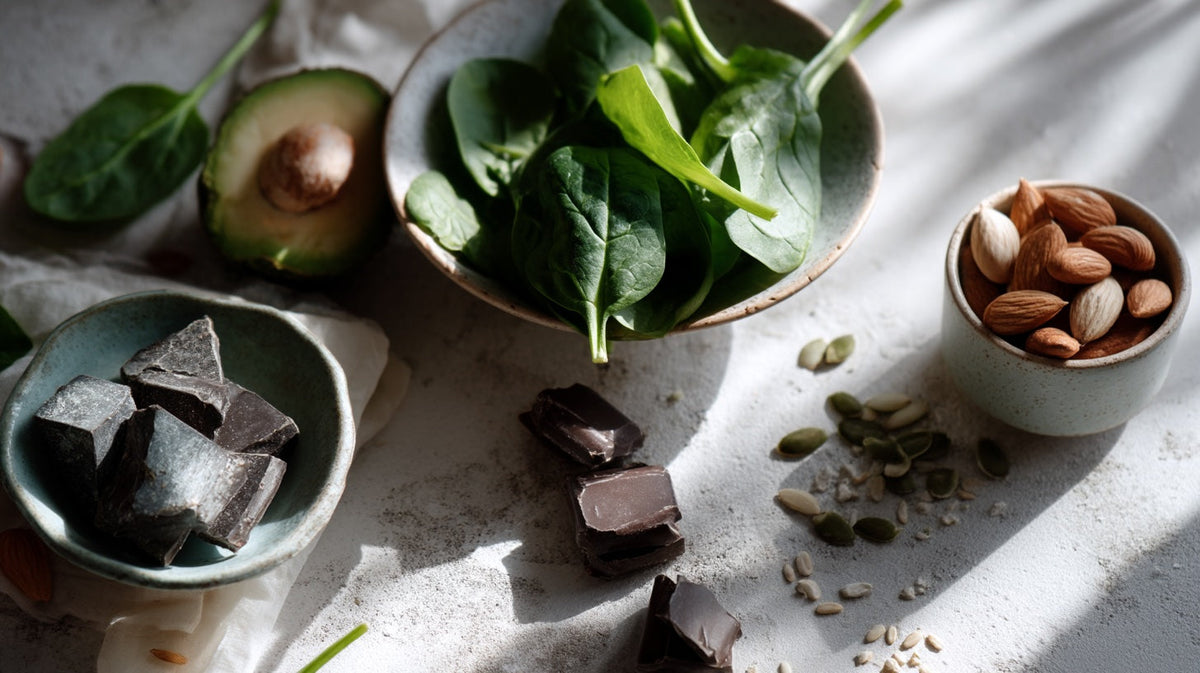
The foods with the most magnesium are seeds above all, followed by nuts, cocoa, whole grains, legumes and leafy greens. Three tablespoons of hulled hemp seeds deliver a whole 210 mg, which is already more than half of what the German Nutrition Society (DGE) sets for an entire day: it works with 300 mg for adult women and 350 mg for men.
What matters more than the amount per 100 g, though, is what a normal serving delivers. Nobody eats 100 g of cocoa powder, but a bowl of oatmeal, sure. That's why our table shows both. What magnesium actually does in your body is explained in our magnesium guide. Here we're sticking to what's on your plate.
Which foods are high in magnesium?
Per 100 g, the most magnesium is found in hulled hemp seeds (700 mg), wheat bran (611 mg) and unsweetened cocoa powder (499 mg), followed by flaxseed, Brazil nuts, sesame and chia seeds at 335 to 392 mg. Depending on the database, pumpkin seeds either go right to the top with 592 mg or into the upper middle with 284.8 mg.
| Food | mg per 100 g | Typical serving | mg per serving | Source |
|---|---|---|---|---|
| Seeds | ||||
| Hemp seeds, hulled | 700 | 30 g (3 tbsp) | 210 | USDA |
| Pumpkin seeds | 592 or 284.8 | 30 g (handful) | 178 or 85 | USDA or BLS |
| Flaxseed | 392 | 10 g (1 tbsp) | 39 | USDA |
| Sesame seeds | 351 | 10 g (1 tbsp) | 35 | USDA |
| Chia seeds | 335 | 15 g (1 tbsp) | 50 | USDA |
| Sunflower seeds | 325 | 30 g (handful) | 98 | USDA |
| Nuts | ||||
| Brazil nuts | 376 | 10 g (2 nuts) | 38 | USDA |
| Cashews | 292 | 30 g (handful) | 88 | USDA |
| Almonds | 270 | 30 g (handful) | 81 | USDA |
| Peanuts | 168 | 30 g (handful) | 50 | USDA |
| Hazelnuts | 163 | 30 g (handful) | 49 | USDA |
| Walnuts | 158 | 30 g (handful) | 47 | USDA |
| Grains and bread | ||||
| Wheat bran | 611 | 15 g (2 tbsp) | 92 | USDA |
| Amaranth, raw | 248 | 60 g | 149 | USDA |
| Buckwheat, raw | 231 | 60 g | 139 | USDA |
| Quinoa, raw | 197 | 60 g | 118 | USDA |
| Rolled oats | 121.3 | 50 g (bowl of cereal) | 61 | BLS |
| Brown rice, raw | 116 | 60 g | 70 | USDA |
| Millet, raw | 114 | 60 g | 68 | USDA |
| Whole wheat bread | 75 | 50 g (1 slice) | 38 | USDA |
| Whole grain rye bread | 55.7 | 50 g (1 slice) | 28 | BLS |
| Legumes | ||||
| Black beans, cooked | 70 | 150 g (side dish) | 105 | USDA |
| Edamame, prepared | 64 | 100 g (small bowl) | 64 | USDA |
| Tofu, firm | 58 | 100 g | 58 | USDA |
| Chickpeas, cooked | 48 | 150 g (side dish) | 72 | USDA |
| Lentils, cooked | 36 | 150 g (side dish) | 54 | USDA |
| Vegetables and potatoes | ||||
| Spinach, cooked | 87 | 150 g (side dish) | 131 | USDA |
| Swiss chard, cooked | 86 | 150 g (side dish) | 129 | USDA |
| Kale, cooked | 25 | 150 g (side dish) | 38 | USDA |
| Potatoes, boiled in skin | 22 | 200 g (side dish) | 44 | USDA |
| Broccoli, cooked | 21 | 150 g (side dish) | 32 | USDA |
| Fruit | ||||
| Figs, dried | 68 | 30 g (2 figs) | 20 | USDA |
| Dates (Medjool) | 54 | 30 g (1 to 2 dates) | 16 | USDA |
| Avocado | 29 | 70 g (half an avocado) | 20 | USDA |
| Banana | 27 | 120 g (1 medium) | 32 | USDA |
| Cocoa and chocolate | ||||
| Cocoa powder, unsweetened | 499 | 10 g (1 heaping tbsp) | 50 | USDA |
| Dark chocolate, 70 to 85% cocoa | 228 | 20 g (2 squares) | 46 | USDA |
| Fish and meat | ||||
| Chicken breast, raw | 28 | 125 g (fillet) | 35 | USDA |
| Salmon, raw | 27 | 125 g (fillet) | 34 | USDA |
| Beef, lean, raw | 23 | 125 g (steak) | 29 | USDA |
| Dairy | ||||
| Emmental cheese | 41.1 | 30 g (1 to 2 slices) | 12 | BLS |
| Yogurt, whole milk | 12 | 150 g (1 cup) | 18 | USDA |
| Whole milk | 10 | 200 g (1 glass) | 20 | USDA |
The values come from the nutrient database of the US Department of Agriculture (USDA in the table) and, for typically German products like rolled oats, whole grain rye bread and Emmental, from the German Nutrient Database (Bundeslebensmittelschlüssel) of the Max Rubner Institute (BLS). The servings are normal household amounts we set ourselves, since there's no official standard for them. Grains are weighed raw, legumes and vegetables cooked, fish and meat raw.
Where is the most magnesium: per 100 g or per serving?
For your everyday life, the serving is what counts, because that's what ends up on your plate. And per serving, the foods at the top are quite different from the per 100 g ranking. Next to hemp seeds, it's amaranth, buckwheat, cooked spinach and Swiss chard.
You know this from the supermarket shelf. Under the price there's the small unit price per kilo. Spices cost a fortune per kilo, and on your receipt they're still just a small item. Magnesium works exactly the same way. The value per 100 g is the unit price, the serving is what shows up on the receipt.
Cocoa powder is the best example. It sits near the top of every ranking, but what goes into your mug is just one heaping tablespoon, and that's 50 mg. Per 100 g, rolled oats reach barely a quarter of the cocoa value, and yet a bowl of oatmeal still delivers 61 mg, more than the spoonful of cocoa.
Spinach is the other way around. Per 100 g it looks pretty modest next to seeds and nuts, but nobody eats 30 g of spinach, and a cooked side of 150 g brings 131 mg, a lot more than a handful of almonds with their 81 mg.
Oats, nuts, pumpkin seeds: the everyday sources
Oats, nuts and seeds are the easiest way to get magnesium in your everyday life, because you can add them to your cereal, sprinkle them over a salad or toss them in your bag, no cooking needed. A handful of cashews brings 88 mg, almonds come in just below that, and a tablespoon of chia seeds adds another 50 mg to your bowl of oatmeal.
Among nuts, Brazil nuts have the highest content at 376 mg per 100 g, but you usually only eat two of them, and that's 38 mg. Peanuts, hazelnuts and walnuts, at 158 to 168 mg per 100 g, sit well below cashews and almonds, so a handful brings around 50 mg.
For pumpkin seeds, our two databases are a factor of two apart. The US database measures 592 mg for hulled, dried seeds, while the BLS lists 284.8 mg under "pumpkin seed" without saying whether the shell was weighed too. We honestly can't tell from here which value applies to the bag in your cupboard, so both are in the table. But even with the lower one, a handful still brings 85 mg, and that's more than most other servings.
How much magnesium is in a banana?
A banana has 27 mg of magnesium per 100 g, so a medium fruit with 120 g of flesh comes to 32 mg. That's about a tenth of the DGE estimate, and honestly pretty thin for its reputation as a magnesium source.
To reach 300 mg from bananas alone, you'd have to eat more than nine a day, and a handful of cashews has almost three times as much. That doesn't make the banana bad, it just does its part. In a bowl of oatmeal with milk, a breakfast like that comes to 113 mg, which is already more than a third of the daily amount set for women.
Which fruits and vegetables are high in magnesium?
Among vegetables, cooked spinach and Swiss chard are clearly ahead. Among fruits, it's dried figs at 68 mg and Medjool dates at 54 mg per 100 g. Fresh fruit delivers little magnesium, half an avocado comes to 20 mg.
Supposedly, cooking robs vegetables of their magnesium. In the US Department of Agriculture data, though, the picture is mixed. Cooked spinach and Swiss chard actually have a bit more magnesium per 100 g than raw (for spinach, 87 versus 79 mg), probably because the vegetables lose water and wilt down as they cook. Kale, on the other hand, drops from 33 to 25 mg, and broccoli stays at 21 mg. So once again, the amount matters more than the preparation, because you can easily eat 150 g of cooked spinach, but more like 50 g as a salad.
Sample day: how to get 300 to 350 mg of magnesium
A completely normal day with oatmeal, lentils with rice and a cheese sandwich delivers 305 mg of magnesium, just above the estimate for women. With two squares of dark chocolate in the afternoon, you're at 351 mg, which covers the value for men too.
- Breakfast: 50 g rolled oats (61 mg) with 200 g whole milk (20 mg) and a banana (32 mg), 113 mg in total.
- Lunch: 150 g cooked lentils (54 mg) with 60 g brown rice, weighed raw (70 mg), 124 mg in total.
- Dinner: two slices of whole grain rye bread (56 mg) with 30 g Emmental (12 mg), 68 mg in total.
- Total: 113 + 124 + 68 = 305 mg. With 20 g of dark chocolate (46 mg), it's 351 mg.
We calculated with the servings from the table, no specialty shelf and no capsule. If you skip breakfast, though, more than a third is gone in one go. On the other hand, there isn't a single seed or nut in the whole calculation, so the strongest sources aren't even included yet. A handful of sunflower seeds on your salad adds 98 mg on top, a tablespoon of flaxseed in your cereal another 39 mg.
Mineral water: how much magnesium is in water?
Depending on the source, mineral water contains anywhere from under 50 to over 100 mg of magnesium per liter, while tap water averages 9 mg according to the BLS. In Germany, a mineral water may only be labeled "magnesium-containing" from more than 50 mg per liter.
The range on the shelf is wide. According to the manufacturers, Ensinger Sport has 121 mg per liter, Gerolsteiner Sprudel 108 mg and Staatl. Fachingen 59.2 mg, while Gerolsteiner Naturell sits just below the threshold at 44 mg.
Over a day, it adds up. One and a half liters of a water with 108 mg per liter brings 162 mg, a good half of the estimate for women, while the same amount of tap water brings around 14 mg. What's in your tap water varies a lot by region, and your water supplier can tell you the value.
Your body absorbs magnesium from water well. In a study with ten healthy women and a water with 110 mg per liter, absorption was 45.7%, and 52.3% when the water was drunk with a meal. In a follow-up study with twelve men, what mattered most was how the water was drunk. From two large portions of 750 ml each, 32.4% was absorbed, from seven small ones spread over the day, 50.7%. That really speaks for the water next to your keyboard, even though both studies were small and came from research institutes of water manufacturers. So the bottle on your desk that you sip empty over the day is one of the most convenient magnesium sources there is.
How much magnesium from food does your body absorb?
Your gut only absorbs part of the magnesium in a food. In measurements, it was between 13 and just over 50%, depending on the meal and drink. Absorption is slowed mainly by two plant compounds that bind magnesium in the gut: phytic acid from whole grains, bran, legumes and seeds, and oxalic acid from spinach and Swiss chard.
Researchers at ETH Zurich measured this with labeled magnesium that can be traced in the body. In their study with white bread that had phytic acid added, absorption dropped from 32.5 to 13.0% when the bread contained as much phytic acid as whole grain bread does, and at half the amount the drop was a lot smaller. That was a small trial, though, with fewer than ten adults and a single meal of white bread with an additive. It doesn't show how real whole grain bread behaves over weeks.
For oxalic acid, the same research group put 300 g of spinach up against 300 g of kale, which contains hardly any oxalic acid. The nine adults absorbed 26.7% of the magnesium from the spinach meal and 36.5% from the kale meal. Spinach still doesn't come off that badly, because according to the authors its higher content at least partly makes up for it. Roughly estimated with our table values, about 35 mg gets through from 150 g of cooked spinach, compared with about 14 mg from the same amount of kale.
Please don't let this drive you crazy, because you really don't need to calculate any of it. The DGE estimate applies to intake anyway, meaning what you eat, and if water, nuts, leafy greens and whole grains come together over the day, nothing hinges on a single food.
Is diet enough, or do you need a magnesium supplement?
For most people, food is enough. According to the DGE, magnesium deficiency is relatively rare with a balanced diet and healthy metabolism. But far from everyone reaches the estimate on their own. In Germany's National Nutrition Survey II from 2008, a large government survey of what people in Germany eat, 29% of women and 26% of men fell short of the amount recommended at the time, which isn't yet a diagnosis of deficiency.
In our view, things get tight when the strong sources are regularly missing, meaning white bread instead of whole grain, hardly any legumes, no seeds and tap water that doesn't bring much. The tricky part is that a day like that doesn't feel wrong at all while you're eating. How to tell if you have a gap is covered in our article on recognizing magnesium deficiency.
If you train a lot, you do lose some extra magnesium through sweat, but less than is often claimed. The DGE calls these losses relatively small, and depending on the method, measurements found around 1.3 mg to just under 10 mg per liter of sweat. For comparison, a handful of almonds contains 81 mg. Why magnesium still matters for training is covered in our article on magnesium for sports, and what it looks like when someone consistently tracks what they eat is told in Markus's story.
Your body needs magnesium every day, for muscles and nerves just as much as for turning food into energy, and because it keeps excreting it, some has to come in every day too. In the EU, ten claims have been reviewed and authorized for this, worded, for example, as "Magnesium contributes to normal muscle function", "Magnesium contributes to normal energy-yielding metabolism" and "Magnesium contributes to a reduction of tiredness and fatigue". The absorption percentages above, on the other hand, are results of individual small studies and not an official claim.
When your plate isn't enough
We made our own magnesium for exactly these days. CALM by Fifty Five complements your diet, it's not meant to replace it. Two capsules a day deliver a combined 206 mg of elemental magnesium from magnesium bisglycinate and magnesium citrate, with no magnesium oxide, of which the body absorbs only a small share. They cost you €0.93 a day and stay below the 250 mg per day that applies in the EU as the upper limit for magnesium from food supplements.
How much from a supplement fits into your day is covered in our article on magnesium dosage, why the form makes a difference in our comparison of magnesium forms, and how much oxide is in supplements on the market we worked out in our magnesium complex comparison. How magnesium works together with vitamin D, zinc or potassium is covered in our article on combining magnesium. Your plate stays the foundation, and the capsule fills in on the days when not much comes together between the office cafeteria and a late dinner.
FAQ
Which food has the most magnesium?
In our table, hulled hemp seeds have the most magnesium. With 700 mg per 100 g and 210 mg in three tablespoons, they lead both columns. Per 100 g, they're followed by wheat bran at 611 mg and, depending on the database, pumpkin seeds at up to 592 mg.
Is dark chocolate high in magnesium?
Yes, dark chocolate with 70 to 85% cocoa contains 228 mg of magnesium per 100 g, which puts it among the magnesium-rich foods. Two squares (20 g) deliver 46 mg, about as much as a handful of walnuts.
What to eat for magnesium deficiency?
If you're not getting enough magnesium from food, seeds, nuts, whole grains, legumes and magnesium-rich mineral water bring the most per serving. A serving of amaranth or buckwheat comes to around 140 to 150 mg, a handful of sunflower seeds to just under 100 mg. A deficiency with symptoms, however, is something different from a day that falls a bit short and should be checked by a doctor.
When does a magnesium supplement make sense?
Whenever the strong sources are regularly missing from your plate, meaning whole grains, legumes, seeds and nuts. And that happens more often than a full plate would suggest. According to Germany's National Nutrition Survey II, 29% of women and 26% of men didn't reach the amount recommended at the time. A supplement with 206 mg like CALM fills that kind of gap and still stays below the 250 mg upper limit for supplements. And because magnesium from food doesn't count toward it, you can keep eating nuts and whole grains completely relaxed.
Can you get too much magnesium from food?
In Europe, there's no upper limit for magnesium that occurs naturally in foods and drinks. The upper limit of 250 mg per day applies only to magnesium from food supplements and to magnesium added to foods or water. So nuts, whole grains and mineral water don't count, and if you also take a supplement, you only count its magnesium against the upper limit.
Disclaimer:
This article is for informational purposes only and does not replace medical advice, diagnosis, or treatment by a physician or pharmacist. The information provided here should not be used for self-diagnosis or self-treatment. Food supplements are no substitute for a balanced, varied diet and a healthy lifestyle. For any health questions or complaints, please always consult a doctor you trust. Fifty Five accepts no liability for any inconvenience or harm resulting from the use of the information presented here.
Sources
- Deutsche Gesellschaft für Ernährung (DGE) [German Nutrition Society]: Referenzwerte für die Nährstoffzufuhr, Magnesium (reference values for nutrient intake, magnesium). Derivation as of 2021. dge.de
- U.S. Department of Agriculture: FoodData Central, SR Legacy. fdc.nal.usda.gov
- Max Rubner-Institut: Bundeslebensmittelschlüssel (BLS) [German Nutrient Database], Version 4.0. doi.org/10.25826/Data20251217-134202-0
- Mineral- und Tafelwasser-Verordnung, Anlage 6 (German Mineral and Table Water Ordinance, Annex 6). gesetze-im-internet.de
- Manufacturer information, mineral water: Ensinger Sport, Gerolsteiner Sprudel, Staatl. Fachingen, Gerolsteiner Naturell (accessed September 30, 2026)
- Sabatier M, Arnaud MJ, Kastenmayer P et al.: Meal effect on magnesium bioavailability from mineral water in healthy women. Am J Clin Nutr, 2002. PubMed 11756061
- Sabatier M, Grandvuillemin A, Kastenmayer P et al.: Influence of the consumption pattern of magnesium from magnesium-rich mineral water on magnesium bioavailability. Br J Nutr, 2011. PubMed 21473800
- Bohn T, Davidsson L, Walczyk T et al.: Phytic acid added to white-wheat bread inhibits fractional apparent magnesium absorption in humans. Am J Clin Nutr, 2004. PubMed 14985216
- Bohn T, Davidsson L, Walczyk T et al.: Fractional magnesium absorption is significantly lower in human subjects from a meal served with an oxalate-rich vegetable, spinach, as compared with a meal served with kale, a vegetable with a low oxalate content. Br J Nutr, 2004. PubMed 15035687
- Deutsche Gesellschaft für Ernährung (DGE) [German Nutrition Society]: Ausgewählte Fragen und Antworten zu Magnesium (selected questions and answers on magnesium). Last updated September 10, 2025. dge.de
- Max Rubner-Institut (ed.): Nationale Verzehrsstudie II, Ergebnisbericht Teil 2 (Germany's National Nutrition Survey II, results report part 2). Karlsruhe, 2008. mri.bund.de
- Montain SJ, Cheuvront SN, Lukaski HC: Sweat mineral-element responses during 7 h of exercise-heat stress. Int J Sport Nutr Exerc Metab, 2007. PubMed 18156662
- Baker LB, Stofan JR, Lukaski HC, Horswill CA: Exercise-induced trace mineral element concentration in regional versus whole-body wash-down sweat. Int J Sport Nutr Exerc Metab, 2011. PubMed 21719904
- Commission Regulation (EU) No 432/2012 of 16 May 2012 establishing a list of permitted health claims made on foods, other than those referring to the reduction of disease risk and to children's development and health. eur-lex.europa.eu
- European Food Safety Authority (EFSA): Overview on Tolerable Upper Intake Levels as derived by the Scientific Committee on Food (SCF) and the EFSA Panel on Dietetic Products, Nutrition and Allergies (NDA). Version 11, August 2025. efsa.europa.eu


Lighter, but weaker: How Birgit got her strength back on the weight-loss injection
Magnesium Complex: 13 Supplements Compared
Share: